The Texas sun beat down like a hammer, but Martin Hernandez never flinched. For years, he and his son Daniel had been the quiet heroes of Channelview, turning neglected jungles into manicured lawns for free. Their YouTube channel, M&D Lawn Care, captured millions of hearts—and then, suddenly, silence. The videos stopped. The familiar hum of mowers vanished. And the internet exploded with rumors: bone fragments unearthed, police sirens, a life-or-death secret buried in the weeds. What really happened to Martin?
In 2020, Martin was just another immigrant worker chasing the American dream, one lawn at a time. His son Daniel, barely an adult, rode shotgun in their beat-up truck, scouring Houston’s suburbs for clients. One day, they stumbled upon a house swallowed by weeds taller than a man—an elderly veteran’s last stand against city fines and foreclosure. “Let’s do it for free, Dad. He really needs help right now,” Daniel said. Martin didn’t hesitate. That single act of kindness sparked a movement.
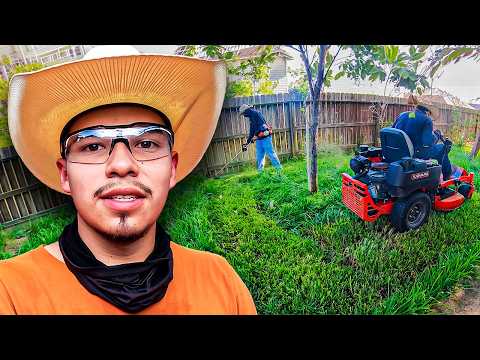
Word spread. Their channel, launched in 2021, exploded. No scripts, no clickbait—just raw, sweaty transformation. By 2022, they’d racked up 600,000 subscribers and 140 million views. News crews showed up. The Hernandez family expanded, adding Martin Jr. and a pressure-washing spin-off. But behind the heartwarming thumbnails lurked real danger.
In 2023, a cleanup unearthed bone fragments. Police tape replaced lawn mowers. “When discovering anything unusual, the first rule is to turn off the camera and contact the police immediately,” Martin later said. Then came the threats: furious neighbors, venomous snakes, hypodermic needles in the brush. Through it all, Martin kept pushing—until his body began to break.
By 2024, the videos slowed. Fans panicked. Was Martin dead? In hiding? The truth was far less sinister—and far more human. Decades of backbreaking labor had wrecked his spine. Texas heat and storms made work impossible. And the family was burning out, juggling paid gigs with free cleanups. “Continuous rainstorms prevent us from bringing machinery onto the property,” the family explained. “Workplace safety must come first.”
Martin didn’t disappear. He stepped back. Today, he’s still in Channelview, alive and optimistic, but he’s traded mower handles for a clipboard. As a technical advisor, he supervises Daniel and Martin Jr., who now shoulder the heavy work. “Seeing my children grow up and continue the mission of helping the community is the most priceless reward,” he says.
The family’s new project, Three for Change, goes beyond lawns—repairing roofs, clearing dangerous structures, rebuilding lives. The bone fragments? Just one of many hidden hazards in abandoned yards. The police calls? Routine. The real story isn’t a tragedy—it’s a quiet, stubborn legacy of kindness. But the question remains: how long can a father’s heart keep beating for a community that still needs him?
But the story doesn’t end with a clipboard and a smile. There was a day—one the family rarely discusses—when the silence almost became permanent. It happened in the summer of 2023, deep in a property the crew had nicknamed “the forgotten acre.” The yard hadn’t seen a mower in fifteen years. Daniel was operating the brush cutter, Martin guiding from the edge, when the machine struck something that didn’t sound like rock.
“Dad, shut it down. Now,” Daniel said, his voice flat. What they uncovered wasn’t bone—it was a rusted lockbox, half-buried under years of rot. Inside: old photographs, a military medal, and a handwritten will. The homeowner, a widower who’d passed away alone months earlier, had hidden his last wishes where no one would ever look. The family tracked down his estranged daughter in Louisiana. She wept on the phone.
That night, Martin sat on his tailgate and stared at the Texas stars. “We’re not just cutting grass, mijo. We’re finding people’s lives buried under the mess.” Daniel didn’t answer. He didn’t have to.
The discovery changed how the family approached every job. They started cataloging valuables, contacting relatives, turning cleanup sites into something closer to archaeological digs. It slowed them down—but it also saved them. Two months later, in a different yard, Daniel spotted a buried gas line the city had forgotten about. One wrong swing of the mower would have leveled the block. “That lockbox taught us to look before we cut,” Martin Jr. later admitted. “It probably saved our lives.”
Meanwhile, the online rumors kept churning. A conspiracy thread claimed Martin had been “silenced” by a homeowner with something to hide. Another insisted he’d fled the country. The family laughed it off—until a reporter showed up at their doorstep demanding answers about the bone fragments. Martin invited him in, poured him sweet tea, and showed him the police report. Case closed: animal remains, likely a deer. The reporter left looking almost disappointed.
But the pressure of fame had a darker side. Daniel confessed to his father one evening that he hadn’t slept properly in weeks. The comments, the requests, the endless inbox of desperate pleas—it was crushing him. “I feel like if I stop, people will think I don’t care,” he said. Martin put a hand on his son’s shoulder. “We didn’t start this to be heroes. We started it to help one old man. Remember that.”
So they made a pact. No more than three free projects a month. The rest of the time belonged to family, to paid work, to rest. The internet grumbled, but the Hernandez men held firm. And slowly, something unexpected happened—the smaller schedule brought back the joy. Daniel started filming again, not for views, but for the sheer satisfaction of watching a jungle become a garden.
The joy returned in small, unscripted moments. Daniel began filming again—not with the frantic energy of a man chasing algorithms, but with the calm eye of someone rediscovering why he’d picked up a camera in the first place. The videos grew shorter, quieter. A timelapse of a lawn being reclaimed. A close-up of Martin’s weathered hands pointing out a sprinkler head hidden under decades of neglect. No voiceover, no music. Just the work.
And the audience? They didn’t leave. They leaned in closer. “This is the real M&D,” one comment read. “Not the viral version. The human one.” The channel’s growth slowed, but its community deepened. People weren’t just watching anymore—they were showing up. Volunteers began arriving on weekends, strangers with rakes and gloves, drawn by the simple promise of helping a neighbor.
Martin watched it all from his folding chair, a cold bottle of water in one hand, a walking stick in the other. He’d become something he never expected: a teacher. Young men and women from across Houston came to learn the craft—how to read a yard, how to spot danger, how to knock on a stranger’s door with a smile instead of a bill. “You don’t fix a lawn,” he told them one Saturday morning, his voice raspy but firm. “You fix the person who lives behind it.”
But the past has a way of catching up. In early 2025, a developer approached the Hernandez family with an offer. A production company wanted to turn their story into a streaming series—big budget, national release, the works. The money would have been life-changing. Martin listened politely, then shook his head. “Our story isn’t for sale,” he said. “It belongs to the people whose lawns we cut.”
Daniel was furious at first. He’d spent years filming, editing, building an audience—and his father had just turned down the biggest opportunity of their lives. They didn’t speak for two days. Then Daniel found his father in the backyard, staring at the old truck that had carried them through a thousand jobs. “You angry at me, mijo?” Martin asked without turning around.
“Yeah,” Daniel admitted. “A little.”
Martin nodded slowly. “Good. Stay angry. But ask yourself—do you want to be famous, or do you want to be useful?” Daniel didn’t answer. He didn’t have to. The next morning, he was back on the mower, and the production company never called again.
The silence that followed wasn’t the eerie silence of disappearance. It was the comfortable silence of a family that had finally found its rhythm. Martin still supervised. Daniel still filmed. Martin Jr. still handled the pressure washing. And the lawns of Channelview—wild, forgotten, and hopeless—still got cut, one by one, by men who asked for nothing in return.
But the world outside kept spinning. New requests piled up. Old dangers lurked in every overgrown yard. And somewhere in the thickets of Houston, another desperate homeowner was waiting for a knock on the door. The Hernandez family had found their balance—but balance, as Martin knew all too well, is a fragile thing.
The balance held through the spring of 2025, but it was tested in a way no one had prepared for. A letter arrived at the Hernandez home, handwritten and trembling, from an eighty-three-year-old woman named Alma. She lived alone in a house she’d shared with her late husband for fifty years. The yard had swallowed itself whole after his death, and the city had given her thirty days to clear it or face foreclosure. She had no money, no family, and no strength. “I don’t know who else to ask,” she wrote. “I saw your videos. I prayed you were still real.”
Martin read the letter twice, then handed it to Daniel. “This is why we didn’t sell the story,” he said quietly. “Because she still needs us.” Daniel nodded, and by sunrise the next morning, the old truck was loaded—mowers, trimmers, and a cooler packed by Martin’s wife. Martin Jr. drove. Martin rode shotgun, his walking stick across his knees, watching the sun climb over the freeway.
The job took three days. On the second afternoon, Daniel’s camera caught something unexpected: Alma standing on her porch, tears streaming down her face, watching her husband’s rose bushes emerge from the weeds—still alive, still blooming after years of neglect. “He planted those the week we moved in,” she whispered. “I thought they were gone.” Martin, seated in his folding chair, simply tipped his hat.
That video—no music, no narration, just a woman weeping over roses—became the most-watched clip the channel had posted in two years. But the family didn’t chase the numbers. They finished the job, accepted a plate of cornbread as payment, and drove home in silence.
These days, Martin Hernandez wakes before dawn out of habit, not necessity. He drinks his coffee on the porch, watches the Texas sky turn from gray to gold, and listens for the distant hum of his sons’ mowers. The rumors are dead. The bone fragments were a deer. The police calls were routine. The silence was never a mystery—it was a man learning to let go.
But the lawns keep growing. The letters keep coming. And somewhere in Channelview, a father and his sons are still loading the truck, still knocking on doors, still cutting through the mess to find the lives buried underneath. The story of M&D Lawn Care was never about virality or danger or disappearance. It was about a promise made under the scorching sun: that no lawn is too wild, no life too forgotten, no kindness too small.
Now we turn it over to you. If a stranger knocked on your door tomorrow with a mower and a smile, would you let them in—or would you wonder what they were really hiding? Tell us in the comments below.
Report this article
Select a reason for reporting:






