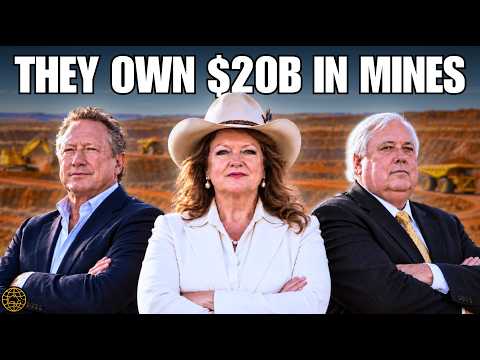
What if the greatest fortunes aren’t dug up, but inherited? These are the eight families who own Australia’s biggest mines, and their stories are as dramatic as the riches they’ve unearthed. From a geologist who turned knowledge into a coal empire to a woman who inherited a struggling business and built a mining giant, each tale reveals ambition, risk, and the relentless pursuit of wealth beneath the earth.
In the Hunter Valley, the Kemp family transformed a single mining lease into a coal enterprise spanning generations. Roy Kemp took over Bloomfield South in 1937, and today his great-granddaughters are shareholders in a business that exports coal to Asia and employs hundreds. But the Kemp’s are just the beginning.
Christopher Wallin, a former government geologist, knew exactly where to look. In 1989, he founded Q Coal, and after years of exploration, his company now exports 15 million tons of coal annually from Queensland’s Bowen Basin. “He recognized what lay beneath the ground and worked for years to bring it into production,” a testament to patience and vision.
Then there’s Sam Chong, a mining engineer from Malaysia who arrived in Australia in the early 1970s. His family’s company, Gelambar Group, now holds a 60% stake in two major coal mines, producing 14 million tons a year. In 2025, the family bought out Anglo American’s stake for $1.6 billion, cementing their control.
In Western Australia, Chris Ellison built Mineral Resources from a contracting business into a diversified mining powerhouse. “A contractor that once worked around other people’s mines had become a diversified company running major mines of its own,” with a 57% stake in the Onslow iron project and revenue of $6.5 billion.
But perhaps the most intriguing is the Wright and Bennett families, who made billions from royalties without ever operating a mine. Their stake in Rhodes Ridge, estimated to hold 6.8 billion tons of iron ore, was sold for $5.3 billion in 2025. “The extraordinary asset was not simply iron ore. It was the rights attached to it,” negotiated generations ago.
Clive Palmer’s Mineralogy secured magnetite tenements near Cape Preston and struck a deal with CITIC, retaining royalties while CITIC built and operated the $12 billion Sino Iron project. “Money could flow from the ore without Mineralogy operating the crushers or running the port,” a legal battle over pricing ensued, but Palmer’s fortune was secured.
Andrew Forrest’s Fortescue challenged the iron ore giants, building mines, railways, and ports from scratch. In 2026, Fortescue shipped 201.3 million tons of iron ore, a thousand times its first shipment. “The Forrest family’s wealth is closely tied to that machine,” with a 37% stake in the listed company.
Finally, Gina Rinehart inherited a troubled Hancock Prospecting and turned it into a private empire. “She secured major partnerships and led the development of Roy Hill,” owning 70% of the mine that shipped 61.6 million tons in 2025. Hancock Prospecting reported a net profit of $3.1 billion.
These families didn’t just find wealth—they built it through strategy, risk, and relentless determination. But their stories are far from over. The mines continue to yield, the deals continue to be made, and the fortunes continue to grow. Stay tuned as we delve deeper into each family’s journey, uncovering the challenges, controversies, and triumphs that shaped Australia’s mining dynasties.
Behind each of these fortunes lies a decision that could have gone the other way. For Roy Kemp, it was the choice to sell coal to post-war Japan in 1955, a move that tied a regional New South Wales mine to an industrial economy across the Pacific. For Christopher Wallin, it was the patience to keep funding exploration through the 1990s, when coal prices fluctuated and the company’s search seemed endless. “What had started as geological information was now a working export mine,” but only after years of quiet persistence.
Sam Chong’s story carries a different weight. When his family’s investment company, Zafin, bought out Anglo American’s stake for $1.6 billion, it wasn’t just a transaction. It was the moment a family of engineers became the controlling force in a Queensland coal producer. “Sam Chong had arrived as an engineer. Decades later, his family held the controlling stake,” a transformation that few outside the Bowen Basin saw coming.
Chris Ellison’s path was never quiet. The 2024 board penalty over governance issues and the accelerated succession plan revealed a company wrestling with its own founder’s influence. “Substantial influence, but not outright ownership,” a phrase that captures the tension between Ellison’s personal stamp and the listed company’s need to stand on its own. MinRes had become a major miner, but the question of who would lead it next remained open.
The Wright and Bennett families faced a different kind of reckoning. The 2025 sale of a 40% interest in Rhodes Ridge to Mitsui for $5.3 billion was a landmark, but the April 2026 court ruling on Hope Downs royalties mattered just as much. “A Western Australian court upheld Wright Prospecting’s claim to half of certain past and future royalty payments,” while rejecting a separate claim to ownership of specific mining areas. The victory was partial, and the legal battles were far from settled.
Clive Palmer’s disputes with CITIC over royalty formulas showed how quickly a lucrative arrangement could turn adversarial. The 2017 Supreme Court ruling in Mineralogy’s favor resolved one dispute worth almost $150 million, but further disagreements over approvals kept the relationship tense. “The Palmer story reveals an unusual kind of mining empire,” one built on tenements and contracts rather than crushers and ports.
Andrew Forrest’s Fortescue faced its own test in 2026, when negotiations with a major Chinese buyer left a gap between ore shipped and ore sold. “Showing how much Australian miners depend on customers overseas,” the episode was a reminder that even a company shipping 201.3 million tons a year wasn’t immune to the pressures of global trade.
And then there was Gina Rinehart. Roy Hill’s 61.6 million tons in the 2025 financial year came despite disruption from Tropical Cyclone Zelie. “That’s actually sent to customers, not an estimate of underground reserves,” a distinction that underlined the operational discipline behind the numbers. By then, Roy Hill had shipped more than 500 million tons since its first vessel in 2015.
The acquisition of Atlas Iron and the 2026 launch of McPhee Creek showed Hancock Prospecting wasn’t standing still. “Adding feed without building a separate export chain,” McPhee Creek fed directly into Roy Hill’s existing processing system, a strategy that squeezed more value from infrastructure already in place.
With 91 million tons shipped across the group and a net profit of $3.1 billion, Hancock Prospecting remained privately owned, a rarity among Australia’s mining giants. “From a business fighting to survive, the family had built one of Australia’s largest private mining enterprises,” and the next generation was already being positioned to carry it forward.
But the eight families profiled here are only part of the story. Australia’s mining landscape is shifting, with new deposits being explored, old agreements being renegotiated, and a new generation of heirs stepping into roles their parents once held. The fortunes built on iron ore, coal, and mineral rights are now facing questions about succession, sustainability, and the global energy transition.
For the Hancock family, the next chapter is already being written. Gina Rinehart’s children have taken on increasingly visible roles within the private empire, and the question of how Hancock Prospecting will be governed after its matriarch is no longer hypothetical. “Succession inside a privately held giant is a different beast,” one analyst noted, pointing to the absence of public shareholders who might force transparency. The family’s stake in Roy Hill, Hope Downs, and Atlas Iron gives the next generation enormous leverage, but also enormous responsibility.
Meanwhile, the Wright and Bennett families are still navigating the fallout from their courtroom victories. The April 2026 ruling on Hope Downs royalties opened a new front in a decades-long legal campaign, and further challenges are expected. “The paperwork deciding who gets paid when the ore moves is never truly settled,” a legal observer remarked. Angela Bennett’s AMB remains a quiet but formidable presence in the Pilbara, and the family’s willingness to litigate suggests they are not done pressing their claims.
Clive Palmer’s Mineralogy faces a different kind of pressure. The Sino Iron operation has become a flashpoint in Australia-China commercial relations, and any shift in the royalty formula could ripple through both CITIC’s balance sheet and Palmer’s private fortune. “The arrangement works until it doesn’t,” one mining analyst said, noting that the original benchmark pricing system has been obsolete for over a decade. Palmer’s ability to adapt his legal strategy may determine whether his royalties keep flowing at their current scale.
At Fortescue, the 2026 gap between ore shipped and ore sold was a warning shot. Andrew Forrest’s company has bet heavily on green hydrogen and decarbonization, investments that could either future-proof the business or divert capital from its core iron ore operations. “The machine that shipped 201.3 million tons still runs on Chinese demand,” a market watcher observed, and any slowdown in that demand would test Fortescue’s diversification strategy.
Chris Ellison’s MinRes, too, is entering a new phase. The board’s 2024 governance penalty and accelerated succession plan signaled that the company’s founder-centric era may be winding down. “Ellison built it, but the next leader has to run it differently,” a Perth-based fund manager said. With a 57% stake in Onslow iron and a growing lithium portfolio, MinRes has the assets to thrive, but the transition from founder to institution is rarely smooth.
In Queensland, the Chong family’s Zafin is still digesting its $1.6 billion acquisition of Anglo American’s stake in Gelambar. The family’s 60% holding gives it control, but the mines’ 14 million ton annual capacity must be sold into Asian markets that are increasingly price-sensitive. “Control is one thing. Delivering consistent returns is another,” a Brisbane analyst noted, pointing to the volatility of coking coal prices.
The Kemp family’s Hunter Valley operations face their own pressures. Coal exports from New South Wales are under scrutiny as global markets shift toward cleaner energy, and the family’s Bloomfield and Rix’s Creek mines must navigate an uncertain regulatory environment. “The Kemp’s have survived every downturn since 1937,” a local industry veteran said, but the next decade may test that resilience more than any before it.
And Christopher Wallin’s Q Coal, now exporting 15 million tons a year from the Bowen Basin, is watching the same market signals. The Byerwen mine’s 10 million ton capacity was built for a world that still needs metallurgical coal, and the question is how long that world will last. “Wallin found the coal. Now his company has to decide what to do as the market changes,” one observer said.
The eight families profiled here have built fortunes that span generations, but the ground beneath them is shifting. New deposits, new technologies, and new global priorities are reshaping the industry. The next chapter of Australia’s mining dynasties will not be written in iron ore alone.
Yet the stories of these eight families share a quiet common thread: none of them simply found wealth. They recognised it, fought for it, and often waited decades before the ground gave anything back. “The fortune was never in the ore alone—it was in the decision to keep going,” one historian of Australian mining observed.
From Roy Kemp’s first lease to Gina Rinehart’s 70% of Roy Hill, the pattern repeats: patience, leverage, and a willingness to endure the long years between discovery and shipment. The next generation now inherits not just assets, but unfinished arguments over royalties, succession, and markets that no longer look the way they did in 1955.
Which of these eight families do you think will still be standing tallest in twenty years—and which one might quietly disappear? Tell us in the comments below.
Report this article
Select a reason for reporting:






