August 7th, 1942. Noon, Gavutu Island, Solomon Islands. 395 Marines from the 1st Parachute Battalion hit the beach under withering fire from Japanese positions carved into solid rock. In their hands, a weapon that cost $50 to manufacture—lightweight, accurate, innovative—the perfect budget alternative to the $225 Thompson they couldn’t afford to wait for. Within 48 hours, 212 of those Marines would be eliminated or severely wounded, nearly two out of every three men, and the weapon malfunctions would turn close quarters combat into a nightmare.
A Paramarine crouches behind coral rock, Japanese voices echoing from a cave entrance 10 yards ahead. He raises his M55 Reising, squeezes the trigger—click. He pulls the charging handle. Tries again—nothing. The bolt is locked halfway back. Sand in the action, or maybe moisture, or maybe the magazine has jammed again. Doesn’t matter. The cave is spitting fire and his submachine gun is a 7-lb paperweight. He drops it, grabs his knife, and rushes forward because that’s all he has left.
This scene repeats itself dozens of times across Gavutu that day. Different Marines, different positions, same result. The weapon designed to save America money is costing Marines everything.
Rewind three years, 1938. Europe is arming for war, and Eugene Reising sees an opportunity. He’s not some amateur tinkerer—he’s legitimate. In the early 1900s, he worked directly under John Moses Browning himself, contributing to the final design of the .45-caliber M1911 Colt pistol. Throughout the ’20s and ’30s, he designed commercial rifles and pistols that actually sold. But now, Reising is focused on a bigger problem: the Thompson submachine gun.
It’s magnificent. Gangsters love it. Soldiers love it. But here’s the issue—$225 per unit, over 150 hours of skilled machining. Every single Thompson required hand-fitting by master craftsman. Beautiful? Absolutely. Practical for mass wartime production? Not even close. America is watching Europe burn and doing the math. If war comes, they’ll need thousands of submachine guns immediately. Tens of thousands. And waiting months for enough Thompsons to roll off production lines could cost them battles, maybe even the war.
Reising designs a solution that’s genuinely innovative. The secret ingredient: a delayed blowback system that keeps the bolt from flying backward the instant the gun fires. This allows the weapon to fire from a closed bolt, making it more accurate than the Thompson. The first shot actually goes where you aim. Plus, it’s lighter—6.75 lbs empty versus the Thompson’s 10.75. Easier to carry. Easier to handle. And the manufacturing breakthrough? It can be produced for $50 per unit, 1/4 the Thompson’s cost.
In 1941, Reising pitches his design to Harrington and Richardson, a respected Massachusetts firearms manufacturer. They’re impressed. Production begins. On paper, the Reising is perfect—light, accurate, affordable, fast to produce. American ingenuity at its finest. But there’s something Reising doesn’t test. Something nobody tests. How does this precision instrument perform when it’s caked in coral dust? When it’s been carried through seawater? When humidity approaches 100% and there’s no time for meticulous cleaning because Japanese soldiers are charging your position in the darkness? They’re about to find out.
Pearl Harbor changes everything. America isn’t preparing for war anymore. It’s in war right now, and the military needs weapons yesterday. The Marine Corps examines their inventory and sees a crisis unfolding. Every Thompson submachine gun rolling off production lines is earmarked for the Army or British contracts under lend-lease. Marine tankers need compact weapons, junior officers need close quarters firepower. And the newly formed Marine Parachute Battalions—the elite Paramarines—need something they can actually jump with. The Thompson is too long, too heavy, too bulky for airborne operations. And most importantly, there aren’t enough of them.
In November 1941, Marine Corps brass examine the Reising at Quantico, Virginia. They run hurried tests in controlled conditions. Clean environment, careful maintenance, range conditions. The gun performs well. The evaluators note the Reising is acceptable when maintained to standards. That phrase—when maintained to standards—seems reasonable in Virginia. But the jungles of Guadalcanal aren’t a rifle range, and Marines don’t get 8 hours between battles to meticulously disassemble and clean complex delayed blowback mechanisms.
The Corps faces an impossible choice. Wait indefinitely for enough Thompsons, or adopt an affordable alternative that’s available now. In early 1942, desperate for any submachine gun, they choose the Reising. The order: 65,000 units, needed yesterday. The Model 50 with a full wooden stock for general issue. The Model 55 with a folding wire stock and shortened barrel for the Paramarines. It’s not that they’re ignoring warning signs—it’s that they don’t have options. Every day without adequate weapons is another day their Marines train with bolt-action rifles while the Japanese fortify Pacific islands. The Reising is available, it’s affordable, it works in testing, so they gamble.
The entire 1st Parachute Battalion will carry M55s into combat—lighter than a Thompson, more compact, 1/4 the cost. On paper, it’s the perfect solution for America’s budget-conscious military. But nobody tests it in a jungle. Nobody tests it in 100% humidity. Nobody tests it caked in coral dust and sand. Nobody tests it when a Marine’s hands are slick with sweat and his weapon has been carried through mud and seawater for 3 days straight while being shot at.
Operation Watchtower—the first major American offensive of the Pacific War. Some call it Operation Shoestring because Marines go in with barely enough supplies, barely enough support, and definitely not enough reliable weapons. When the 1st Marine Division hits the beaches of Guadalcanal that morning, over 4,200 Marines are carrying Reisings—not by choice, by necessity.
20 miles across Sealark Channel, the situation is about to get infinitely worse. The small islands of Tulagi, Gavutu, and Tanambogo are defended by elite Japanese Special Naval Landing Forces—Japan’s equivalent of Marines. They’ve turned these islands into fortresses with positions carved into solid rock, positions that naval bombardment can’t touch.
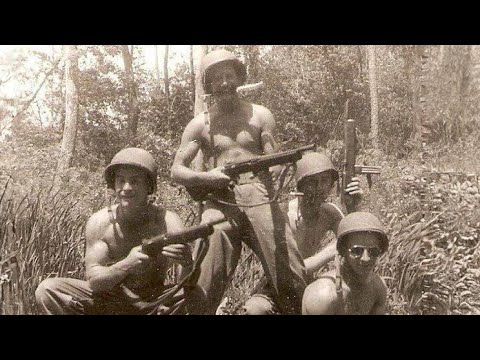
At noon on August 7th, the 1st Parachute Battalion—395 men—hits the beach at Gavutu. The fire is immediate and devastating. The Paramarines push forward anyway, their M55 Reisings ready. The fighting is exactly what submachine guns are designed for: close quarters, cave clearing, rock-to-rock combat where the difference between life and death is measured in seconds.
And that’s when the fatal flaw reveals itself.
The magazines jam. Not occasionally—constantly. The 20-round magazines use a double-stack single-feed configuration, 20 rounds stacked in two columns that have to feed through a single opening. In a clean environment, it works. In coral dust and sand and humidity? Any debris that gets inside causes the rounds to bind. And on Gavutu, there’s dirt everywhere, sand everywhere, moisture everywhere.
When a Paramarine’s Reising jams, clearing it isn’t simple. The delayed blowback mechanism—so innovative on the drawing board—creates complex stoppages. The bolt locks up in unpredictable ways. Under fire, with Japanese soldiers meters away, there’s no time to diagnose and fix a complicated mechanical failure.
Some of the folding wire stocks, designed lightweight to save weight and cost, snap during combat. Not every burst, but often enough that Marines start losing trust. When your stock breaks, you’re left holding an unwieldy chunk of metal with no way to shoulder it properly.
A Paramarine later describes the nightmare: “The guns jammed in the mud and sand. The jams were so complicated you couldn’t clear them in a fight. You were left with nothing but knives.”
The battle for Gavutu lasts two days. By the time it’s over, 212 Paramarines out of 395 are eliminated or severely wounded. 56% casualties. Some losses are due to poor naval gunfire support, some from friendly fire when bombers drop ordnance short. But weapon malfunctions at critical moments turn close-quarters fights that should be survivable into death sentences.
How many times does a Marine squeeze the trigger and get nothing? How many times does a jam force a man to charge a Japanese position with just a knife? How many close-quarters fights are lost because the $50 solution fails when it matters most?
On Guadalcanal itself, something is happening in the Marine camps. The stories are spreading. Not official reports, not formal complaints through the chain of command—word-of-mouth campfire conversations. One unit tells another about the Reising failures. A corporal who survived Gavutu describes watching his buddy’s gun jam three times in 30 seconds. A sergeant from the Raiders talks about magazines falling out during movement because the magazine release is too loose.
The fear grows. New replacements arriving from the states hear the stories before they even land. Whatever you do, get rid of the Reising. Trade it for anything else. A rifle. A pistol. Hell, a captured Japanese weapon. Just don’t take that thing into combat.
Lieutenant Colonel Merritt “Red Mike” Edson commands the First Marine Raider Battalion. He’s a legend—two Navy Crosses, combat experience in Nicaragua, brilliant tactician. If anyone can make the Reising work, it’s Edson. But even he can’t overcome fundamental design flaws in jungle conditions. One Marine Raider earns a Navy Cross when he successfully eliminates the occupants of a fortified Japanese cave with his Reising on August 8th. It’s one of the few success stories. Marines will repeat this story for years—but they’ll repeat the failure stories far more often.
As the campaign wears on, the same problems appear in report after report. Magazines jam after nearly every shot. The bolt won’t close because sand or grit works into the action. Firing pins made from questionable steel break easily. The receiver, barrel, and magazine rust almost immediately in Guadalcanal’s brutal humidity.
The design trap: to speed production and reduce costs, Harrington and Richardson hand-fitted many components. Each gun is essentially custom-built. If you break a part, you can’t just grab a replacement from another Reising—you need the exact part from your exact gun. This might work for police departments back in the states. In the Pacific, where spare parts are scarce and supply lines are stretched, it’s catastrophic.
Marines being Marines, they try to improvise. During one operation, an entire company disassembles all their Reisings for cleaning at the same time and mixes up the parts. When they reassemble them, nothing works properly. Bolts from one gun don’t fit another receiver. Trigger mechanisms won’t function in different frames. Weapons that were marginally functional become completely useless.
The frustration turns to anger. The anger turns to hatred. Some Marines reportedly throw their Reisings into the Lunga River so they can draw better weapons from supply. Whether Edson officially ordered this remains debated, but multiple veterans report doing exactly that on their own initiative. “My last recollection of that weapon was that I flung it into the mouth of the Lunga River,” one anonymous Marine states years later, “and to this day it’s probably still there.”
By late 1942, photographs from Guadalcanal tell the story. Only a few Marines still carry Reisings as M1 carbines and simplified M1 Thompsons finally reach the combat zone. Surviving M50s and M55s disappear rapidly, traded for Springfields, captured Nambu pistols—anything that will actually fire when you pull the trigger.
In early 1943, the Marine Corps officially cancels all Reising production contracts. The weapon that was supposed to solve their submachine gun shortage is restricted to stateside commands only. The First Parachute Battalion, shattered at Gavutu, is withdrawn and re-equipped with M1941 Johnson rifles. The Paramarines never carry Reisings into combat again.
But here’s what makes the story stranger: the Reising wasn’t fundamentally flawed. The 20,500 Model 50s built for the Coast Guard performed well—they had improved single-stack magazines, time to clean, and facilities to maintain them. After the war, police departments loved the closed-bolt accuracy and light weight. Eugene Reising designed a good gun for the wrong war.
The Army had already warned them. At Aberdeen Proving Ground in 1942, testers noted the weapon failed to meet expectations in sand, mud, and dust—the exact conditions Marines would face. Their conclusion: not acceptable for field use. They waited for the M3 Grease Gun instead, that ugly $18.50 stamped-metal weapon that served from D-Day to Desert Storm.
The Reising cost $50. The Thompson cost $225. But what’s the cost of a Marine’s life? The Corps learned an expensive lesson in the Solomons: the cheapest option isn’t always the most affordable. By 1953, the Reising was gone from military service—sold as surplus, cut for scrap, or rusting at the bottom of Pacific rivers. The Thompson kept fighting for forty years. When you pulled its trigger in a jungle at midnight, it worked. Every single time.
Eugene Reising died in 1967, remembered for one weapon: the $50 submachine gun that cost the Marine Corps blood on a coral island. From Gavutu to the Lunga River, the M50 proved you can’t save your way to victory. Sometimes the expensive gun is the one that brings Marines home alive.
So here’s the question: if you were a Marine on Gavutu in 1942, would you have trusted the $50 Reising—or thrown it in the river and bet your life on something heavier, slower, and four times the price?
Report this article
Select a reason for reporting:






