The freezing fog clung to the Ardennes like a burial shroud, and inside a ruined Belgian farmhouse, Hauptmann Erich von Falkenrath warmed his numb hands over a fire that gave more smoke than heat. His uniform—once immaculate—hung in tatters, patched with scraps of captured cloth. For three days, he and his men had survived on frozen black bread and ersatz coffee brewed from acorns. Their faces were gaunt, their boots wrapped in rags, their bellies hollow with a hunger that gnawed at their sanity.
Then the heavy wooden door groaned open. Two soldiers shoved a young American infantryman into the cellar—a boy, really, no older than nineteen, shivering violently, his eyes wide with terror. The captain needed intelligence. He ordered his men to search the prisoner. They stripped him of his M1 Garand, his helmet, and finally unbuckled the heavy canvas haversack from his shoulders.
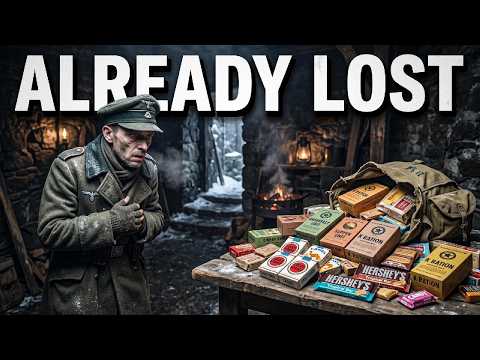
Von Falkenrath stepped forward, drawing his trench knife. He cut the straps and dumped the contents onto a crude wooden table, hoping for a map, a codebook, perhaps a few extra rounds. Instead, a cascade of impossible abundance spilled across the wood. Waxed waterproof boxes stamped K-ration. A tin of processed meat, perfectly sealed. Bouillon powder. A cellophane wrapper of chewing gum. His hands began to tremble.
He found a pristine package of Lucky Strike cigarettes. A block of Hershey’s tropical chocolate. A disposable razor, a tube of toothpaste, thick dry woolen socks, and a small packet of real granulated instant coffee. Finally, a roll of soft, tightly wound toilet paper. The German soldiers stared in absolute silence, as if gazing upon alien artifacts.
Von Falkenrath looked up from the table at the terrified private. He did not see a fierce warrior or a tactical genius. He saw the untouched luxury spilling from a simple infantryman’s backpack in the middle of a frozen combat zone—and felt a cold spike of dread pierce his chest. He was not looking at a few pieces of food. He was looking at the terrifying, unstoppable GDP of the United States.
He picked up the packet of instant coffee, held it to the firelight. “How often are you issued this?” he asked in perfect English, learned at a Berlin university long before the war. The boy blinked, confused. “The K-ration, sir? Every day. Sometimes C-rations if the kitchens are set up, but we always get the coffee and the smokes. Every day.”
Every day. The captain set the packet down. He knew that back home, a civilian family would trade on the black market for a month just to acquire a single cup of real coffee. His elite soldiers—men who had bled for the Fatherland for four years—wore boots with holes. He did not need to ask about troop movements or radio frequencies. The intelligence he had just gathered was worse than any map.
He ordered the prisoner taken away, but commanded his men to leave the backpack and its contents on the table. When the door closed, he stood alone in the dark with the American rations. He understood then that he was a dead man walking—that his beloved army had been fighting a romantic nineteenth-century war of grand tactics and warrior spirit, while the Americans fought a twentieth-century war of industrial extermination. You cannot out-tactic a factory. You cannot outflank a society that can afford to mass-produce morale.
But the full weight of that realization—the cold mathematics of calories and cigarettes, the vast machinery that had delivered a roll of toilet paper to a teenager in a blizzard—was still unfolding in his mind. And outside, in the freezing fog, the war was far from over.
The cellar door creaked open again, and Von Falkenrath’s adjutant, a lean sergeant named Weber, slipped inside, his breath misting. He saw the table and stopped dead. “Mein Gott,” he whispered, staring at the chocolate and cigarettes as if they were holy relics.
Von Falkenrath said nothing. He picked up the Hershey’s bar, turned it over in his fingers. The wrapper was bright, cheerful, stamped with English words and a picture of a tropical beach. He imagined the factory that made it—some sprawling complex in Pennsylvania or Illinois, untouched by bombs, humming with electricity, workers laughing as they packed sweetness into cardboard. He imagined the ships, the trucks, the supply depots stretching back across France like a steel river.
Weber stepped closer. “What do we do with it, Herr Hauptmann?” His voice was hoarse, and Von Falkenrath understood the question beneath the question. The men were starving. The chocolate alone could give them a few hours of warmth, a few moments of comfort.
The captain looked at the roll of toilet paper. Such a small thing. Such an absurd thing to find in a war zone. But that was the point, wasn’t it? The Americans didn’t think it was absurd. They thought it was essential. They had built an army that treated comfort not as a luxury but as a necessity—a weapon as surely as any rifle.
He unwrapped the chocolate. The smell hit him first—rich, sweet, almost obscene in that freezing cellar. He broke off a piece and handed it to Weber. “Eat,” he said. “We all eat. Then we get drunk on their coffee and we smoke their cigarettes like kings.”
Weber hesitated. “But the men—”
“The men will do the same,” Von Falkenrath cut him off. “We are not savages, Weber. We are soldiers. And tonight, we will dine on the enemy’s generosity.” He smiled, but it was a bitter, hollow thing. “Perhaps it will give us the strength to die properly.”
They divided the rations with the precision of a military operation. The meat was shared among the dozen men in the cellar, each receiving a sliver. The bouillon powder was dissolved in boiling water, and for the first time in weeks, the air smelled of something other than rot and smoke. The instant coffee was brewed in a battered tin cup, passed from hand to hand, each man taking a sip as if it were a sacrament.
The young private, still trembling in the corner, watched them with wide eyes. Von Falkenrath caught his gaze and held it. “Your name?” he asked.
“P-Private First Class Miller, sir. James Miller. From Ohio.”
Ohio. Von Falkenrath nodded slowly. “I have never been to Ohio, Private Miller. But I believe I have just received a very detailed report on its industrial capacity.” He lit a Lucky Strike, inhaled deeply, and let the smoke curl toward the ceiling. “Tell me—in Ohio, do they teach you that suffering is a virtue?”
Miller blinked. “No, sir. They teach us that suffering is something to fix. You know—with hard work. And maybe a cup of coffee.”
Von Falkenrath laughed—a genuine laugh, surprising even himself. “Then you are a very dangerous people, Private Miller. And I am beginning to understand why.”
He took another drag of the cigarette, savoring the smooth, machine-rolled burn. It tasted of nothing he could name—no acorn bitterness, no chicory aftertaste. Just clean, bright tobacco, as if the war had never touched it. “You know,” he said, almost to himself, “my men have been smoking dried leaves and newspaper for a month. They will weep when they taste this.”
Weber reappeared at his elbow, a fresh worry creasing his face. “Herr Hauptmann, the radios are dead again. The batteries froze. And there is still no word from battalion.” The words hung in the cold air. No fuel. No orders. No relief. The offensive, which had begun with such roaring promise, was bleeding out in the snow.
Von Falkenrath nodded slowly. “Then we wait,” he said. “And we listen.” He gestured toward the American private. “Because our young friend here has just told me more about the enemy’s strength than a dozen reconnaissance patrols.”
He turned back to Miller, his voice dropping to a quiet, almost gentle register. “Tell me, Private. When your trucks brought this up to the line—how many trucks? How many men did you see?” The boy hesitated, and Von Falkenrath raised a hand. “Not troop movements. I am not asking for your secrets. I am asking what you saw with your own eyes.”
Miller swallowed. “I don’t know, sir. A lot. The road was backed up for miles. Trucks, jeeps, trailers. There was a whole line of them just idling, waiting to unload. Guys were complaining because the coffee was getting cold.” He paused, as if realizing how it sounded. “They were complaining about cold coffee, sir. In the middle of all this.”
Von Falkenrath closed his eyes. There it was—the detail that cut deeper than any artillery barrage. Not the chocolate, not the cigarettes, not even the toilet paper. The complaints. An army that could afford to let its soldiers complain about lukewarm coffee was an army that had never truly known hunger. It was an army so drowning in abundance that it had lost the ability to be grateful.
He opened his eyes and looked at his own men—huddled in their threadbare coats, their faces gray with frost and exhaustion, sharing a single cup of American coffee as if it were the last warmth they would ever know. They were grateful. Grateful for a sip, a bite, a drag of a cigarette. And that gratitude, he realized with a cold, sinking certainty, was the truest measure of their defeat.
He stubbed out the Lucky Strike against the stone wall and straightened his uniform, a gesture of habit rather than pride. “Weber,” he said quietly, “have the men fall in. We move at first light.”
Weber frowned. “Move where, Herr Hauptmann? We have no orders. No fuel for the vehicles. The roads are—”
“We move toward the sound of the American supply trucks,” Von Falkenrath said, and his voice was flat, almost amused. “If we cannot beat them, Weber, we can at least surrender to them with full stomachs.” He picked up the remaining chocolate bar and slipped it into his pocket. “And perhaps a cup of coffee for the road.”
Outside, the fog pressed against the cellar door like a living thing, and somewhere in the distance, the low rumble of engines rolled through the frozen trees—steady, endless, unstoppable.
Von Falkenrath pulled on his threadbare gloves and stepped out into the gray dawn. The fog had thinned, and for the first time in days, he could see the road below—a ribbon of white cutting through the pines. It was choked with American trucks, bumper to bumper, engines idling, exhaust curling into the cold air. Men in clean overcoats stood in clusters, laughing, passing steaming cups between them.
Weber emerged behind him, his rifle slung low. “Herr Hauptmann, we cannot simply walk down there. They will shoot us.”
“Then we will walk with our hands up,” Von Falkenrath replied, “and hope they are as generous with their mercy as they are with their chocolate.” He turned to the dozen gaunt soldiers behind him, their faces hollow, their eyes fixed on the impossible spectacle below. “No weapons. No sudden movements. We are not soldiers anymore—we are men who want to live.”
They descended the slope in a ragged line, hands raised, boots crunching through the crust of snow. A young American sergeant spotted them first, his rifle snapping up—then hesitating. He saw their rags, their hollow cheeks, the white flag Von Falkenrath had fashioned from a captured pillowcase.
The sergeant lowered his weapon and shouted something over his shoulder. A crowd gathered, not hostile but curious. One soldier—a lanky kid from Georgia—stepped forward and pressed a warm tin cup into Von Falkenrath’s hands. “Coffee, sir? Fresh made. Got some eggs too, if you’re hungry.”
Von Falkenrath stared at the cup, then at the endless line of trucks stretching back toward the coast. He thought of Berlin in ruins, of his men eating sawdust bread, of the entire Reich crumbling under the weight of its own arrogance. He took a sip—hot, bitter, real—and felt something inside him finally, quietly break.
“Thank you,” he said, and the words felt like a surrender more complete than any signed document. “You have no idea what this means.”
The Georgia kid just shrugged. “It’s only coffee, sir. We got plenty.”
And that, Von Falkenrath realized as he drank, was the whole war in a single sentence. What do you think—was it the chocolate, the coffee, or the complaints about cold coffee that truly broke the German spirit?
Report this article
Select a reason for reporting:






