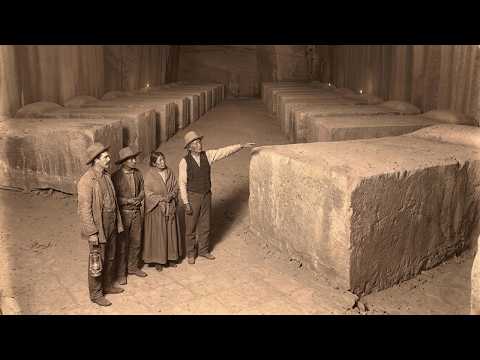
On October 15, 1901, a drill steel broke through the face of a tunnel 300 feet under the Sierra Madre of Southern Wyoming. On the other side, miners found a room full of beds made of stone. Ira DeLong, a 42-year-old rancher working the winters underground, was the first to crawl through. He lifted his lantern as high as he could reach and still could not see over the edge of the first bed—a block of pale gray stone nearly as long as a freight wagon, rising seamlessly from the floor. Beyond it, another, then another. The beds ran into the dark in two rows, 20 along each wall, their pillows to the walls and their feet to an open aisle. At the far end, a 41st lay crosswise in front of a doorway choked with fallen rock. On all 41, a fine gray dust lay at the same depth, and nothing had walked in it.
The company that owned the mine was in the middle of selling it. Within three days, the room was walled off with timber, a door was hung, and the door was locked. The papers that went to the buyers described a natural opening in the rock, barren of ore. They said nothing about beds. But 15 months before the drill went through, more than 150 miles to the north, a young anthropologist from New York had sat in a canvas tent on the Wind River reservation, sketching the painted designs on a raw hide case. The case belonged to an Arapaho woman of about 70. The design on it was two long lines side by side, each lined with 20 short marks and one mark lying across the end. She told him what the design was called: Where They Sleep by Turns. As far as anyone knows, she had never been inside that mountain. No one at the mine had ever heard of her.
The dust on those forty-one beds was counted three times in fifty-three years, twice by a timekeeper who had spent fourteen years in sleeping cars and once by a government engineer looking for uranium who had never heard of him. Each time the count came out different. The place where all of it happened can still be walked, and the walk begins at the bottom of the mountain.
Encampment, Wyoming, sits at more than seven thousand feet where the Encampment River comes down out of the mountains into the broad sagebrush basin of the North Platte. To the east rise the Medicine Bow Mountains. To the west, closer and darker, rise the Sierra Madre, a long timbered range with the Continental Divide running along its crest. In winter, the snow up there can lie twenty feet deep and it lies into June. From the town, the highway climbs west up the River Valley, then out of it in long switchbacks through lodgepole pine and aspen, past the fallen walls of cabins toward the crest.
The copper that brought the town into being was found just over that crest in the summer of 1897. The man who found it was Ed Haggerty, an Englishman. In the spring of that year, three men in the valley—Ramsey, Deal, and Ferris—agreed to pay his costs for a season in exchange for shares in whatever he found. That summer, high on the west slope of the range, just over the line of the divide, Haggerty found an outcrop stained green and blue with copper. He named the claim for his three backers and himself, taking the first two letters of each name: Ru-Day-Fay-Ha. The partnership did not last as long as the name. One by one the other shares were bought out, and by 1899 a Rollins businessman named George Ferris had bought out Haggerty as well. In 1900 Ferris was killed in an accident on the road near the mine. His estate kept the property running, and by then it had a new name, the Ferris Haggerty, and a reputation that was spreading east by telegraph.
The ore near the surface ran rich. A small camp of log cabins and bunkhouses grew up beside the shaft, so high and so exposed that the snow drifted over the roofs in winter, and the men went from building to building through tunnels dug in the drifts. Today that slope is national forest, where the highway tops out on the divide among wind-bent spruce. There are snow fences, and in the meadows beside the road there are still the tall timber towers of a tramway, leaning a little now, their cables long gone. The towers run in a line straight over the crest and down the other side. If a walker follows them west and down, the line ends at a scatter of gray waste rock, rusted iron, and the collapsed timbers of a headframe. That is the Ferris Haggerty. The shaft that the miners of 1901 rode down is under that rubble.
Everything the camp ate, burned, or drilled with came up by wagon or sled, and the men who worked there were Finns and Swedes and Norwegians, Slovenes, Cornishmen and Irishmen, and Americans from everywhere. Every one of those men had his hours written down by the same hand. Before we meet the man who kept those hours, a short word from us. The real records behind our videos are now a book, The Old History. 15 entries are free as a PDF. On theoldhistory.com click download the free sample. Gumroad opens, and the price is zero. Type your email, click get, and the PDF is yours. The full edition adds the audiobook. Link in the description.
The timekeeper and clerk of the Ferris Haggerty in 1901 was Morgan Lyle. He was 44. He had been born in 1857 in Ottumwa, Iowa, on the Des Moines River, the son of a harness maker. At 26, he took a job with the Pullman Palace Car Company as a sleeping car conductor, and for 14 years he rode the overland trains back and forth across the plains between Omaha and Ogden through Rawlins and through the night in charge of the sleeping cars. That work explains nearly everything about the record he left. The conductor’s tool was a printed chart called a diagram. It showed every berth in the car as a numbered box. Every night of those 14 years, Morgan Lyle marked on a diagram which berths were sold and to whom, which were made up, which were empty, and who had boarded at which station. A Pullman conductor who could not account for every berth on his diagram at every hour of the night did not stay a Pullman conductor.
In 1897 he left the railroad. The surviving records do not say why. He settled in Rawlins, went to work as a clerk in one of George Ferris’s offices, and in 1900 was sent up to the mine to keep the time book and the payroll. He took with him a habit and a stack of paper. The habit was that he wrote nothing down as a fact until he had counted it twice. The paper was a pad of unused Pullman diagram forms, the printed outline of a sleeping car on the front, blank on the back. He kept his notes on the backs of them in pencil, and he kept the pad in his coat.
On the 15th of October 1901, five men were working the North Crosscut on the 300-ft level. The shift boss was Matti Rautio, 46, from a parish near Oulu in Finland, who had mined iron in Michigan before he came west. Nils Åberg, 31, a Norwegian, held the drill steel. Anton Kovac, 38 from Kranj in what is now Slovenia, swung the hammer. Jim Pollard, 27 from the lead country of Southern Missouri, loaded and timbered. The trammer was Ira DeLong, 42 who had come out from Ohio in the 1880s, kept a few cattle on a homestead near Saratoga and went underground in winter when the ranch could spare him. He shoveled the broken rock into the car and pushed it back to the shaft. This was his third winter in the mine.
The crosscut had been driven north from the shaft for nearly 400 feet through the dark, greenish banded rock that the miners called schist. Copper showed in it in streaks and stains. For a week though, Rautio had been watching something else. When a man drills hard rock by hand, the drill steel grinds the rock into a wet paste that runs out of the hole, and the color of that paste is the color of the rock. For 380 feet, the sludge from the north crosscut had run out green-black. In the second week of October, it began to run out gray, not the gray of the waste rock, but a pale, even, ashy gray, like flour mixed with water. Rautio showed it to Lyle on the 14th. Lyle wrote it down because Rautio asked him to on the back of a diagram form with the date, sludge gray. Rautio says the rock ahead is not the same rock.
The next afternoon, a little after 3:00, Åberg’s drill steel went through. It did not stick and it did not strike water. On one blow, it was in rock and on the next, it slid forward the length of a man’s forearm and stopped against nothing. Kovac held his hammer up and did not swing. Åberg drew the steel back out. The hole it left was no wider than a coin and a thread of air was coming out of it, cool and steady and dry, strong enough to lean the flame of a candle back toward the men. Mines breathe. Every miner knows that air moves in a mine, pulled up one shaft and down another by the difference between the air inside the mountain and the air outside. What Rautio noticed was that this air did not smell of anything. Mine air smells of wet rock and powder smoke and the men themselves. This smelled of nothing at all.
They did not blast. Rautio would not have it. They opened the hole with picks and bars over the next two hours, and the rock that came away was the same pale gray as the sludge. By a little after five, they had an opening a man could crawl through. Ira DeLong went first because he had the lantern, then Rautio, then Lyle with the time book still in his pocket, then the others.
The first thing Lyle wrote inside was a measurement of the floor. It was dead level. Over the following two days, he checked it with a carpenter’s level from the mine shop every 25 feet down the full length of the room and found no rise or fall that the bubble could show. The walls rose straight up from the floor, plain and smooth, made of the same pale stone as the beds, with no tool marks on them anywhere. Nobody could see the roof. Åberg threw a lighted candle stub straight up as hard as he could throw. It climbed into the dark, went out, and fell back to the floor without striking anything. Lyle wrote, roof not seen, over 35 feet. He chained the room with the survey chain from the shaft house. It was 296 feet long and 68 feet wide, and it ran nearly north and south. Their own hole was in the south wall, about halfway along it. The choked doorway faced it from the north wall at the far end.
There was no water in the room. There was no frost, though the crosscut behind them was cold enough that men worked in coats. Lyle hung a thermometer in the middle of the aisle and left it for half an hour. It read 44 degrees. He moved it to the north end, then back to the hole. 44, 44. There were no bones on the floor, no ashes, no droppings of animals, no nests, nothing that had ever been alive. There was the dust and the stone. The dust was fine and gray, finer than flour, and it lay on the floor and on every surface of every bed to the same depth. Lyle had no instrument for measuring something so thin, so he took a silver dime out of his pocket, pressed it flat into the dust on the floor beside the hole until it touched stone and looked at it from the side. The top of the dust was level with the face of the coin. He did the same on the first bed and on the 10th and on the 30th, level with the face of the coin each time. He wrote, dust, one dime, same everywhere.
Then he counted the way he had counted every night for 14 years. He numbered the beds on the east side 1 to 20, starting at the hole and going north. He numbered the west side 21 to 40. Then he walked to the north end and stood looking at the bed across the door for a long time and gave it no number at all. On the back of a diagram form he wrote only and one across the end.
Measuring the beds filled that night and the following day. Ira DeLong held the dumb end of the tape, moving from bed to bed with the lantern hooked to his belt. Every one was 26 feet long and 9 feet wide. Every one stood 5 feet 10 inches high at its foot, then rose another 14 inches at the wall end in the same smooth curve, the shape of a bolster. The gap between each bed was 5 feet. The aisle between the two rows of feet was 14 feet wide. Over 40 beds Lyle could find no difference larger than the width of his pencil line.
The 41st was larger. It lay across the north end of the aisle on a foot-high step of the same stone. It was 30 feet long and 12 feet wide, its raised end at the east, its long side to the aisle—so whoever lay on it would have faced straight down the room between the two rows of feet toward the hole in the south wall. The beds were not built. Lyle went around the base of bed number one on his knees with a candle, looking for the line where it had been set down. There was none. Floor became bed the way a hillside becomes a valley without a break.
Åberg tried a drill steel on the corner of bed number three. He was the best driller on the shift. Kovach struck it a dozen times. When they pulled it away, the bit was blunted round, and on the floor lay a sliver of gray stone no bigger than a fingernail paring. Lyle folded the sliver into a paper. Åberg did not try again.
Ira DeLong was 5 foot 6. Lyle had him stand at the foot of bed number one and hold the lantern against it. The crown of DeLong’s hat did not reach the edge. Lyle put his folding rule between them—4 inches short. He measured that too, wrote it down, and under it did the conductor’s arithmetic. A lower berth on the overland was a little over 6 feet long. Four lower berths laid end to end would not fill one of these.
In his head he was measuring it against a sleeping car. A Pullman of those years was laid out by number: 12 sections, six down each side, each made up at night into a lower and an upper berth, heads and feet toward the ends of the car, the long aisle running down the middle. At one end, often, a private compartment called a drawing room. At the end of the car, beside the door, sat the porter, who did not go to bed. In those years the porter was almost always a black man. He made up the berths, blacked the passengers’ shoes, and stayed awake through the night at the end of the aisle in case anyone needed him or anything came through the door.
Then, on the back of a fresh diagram form, Lyle drew the room. He drew it the way he had drawn sleeping cars all his working life: an outline, an aisle down the middle, a row of numbered boxes down each side, and a box at the end. When it was done, he turned the form over and compared it with the printed sleeping car on the front. Then he wrote in the margin, laid the wrong way, heads to the wall, feet to the aisle, an army barracks, not a car. Under that, a little lower: no porter. The end box is a bed.
On the second day, something happened that Lyle recorded in a single line and never mentioned again. The men had carried their dinner pails into the room at noon because it was the only place on the level where a man was not cold. They ate sitting on the floor of the aisle with their backs against the feet of the beds. Jim Pollard, who had worked a double shift the night before, finished first, climbed onto the foot of bed number 12 on the east side, lay down on his back in the dust, and was asleep within a minute. Rautio pulled him off it by his boot. Lyle wrote that Rautio was angry, which was unusual enough for him to note, and that Pollard laughed about it. The line reads, Pollard slept on 12. Rautio would not have it. Pollard’s back was gray with the dust when he stood up, and there was the print of a man’s body in the dust on the foot of the bed. Nobody smoothed it over. It was the only mark in the room that the miners had not made with a tool.
That afternoon the mine manager came down. His name was Walter Hune, and he had come up from Rawlins that week for a reason that had nothing to do with the crosscut. The Ferris estate was negotiating to sell the mine. Engineers working for the buyers were expected within the month to examine the workings, sample the ore, and report on everything they found. A great deal of money was waiting on what those engineers wrote. Hune walked the room with Lyle’s diagram in his hand. He did not stay long. When he came out he gave three orders, and Lyle wrote down all of them. Close the crosscut behind the hole, say nothing in camp, show it on no map.
Before the carpenters started, the men went in once more for their tools. Ira DeLong was the last one out. Lyle noted that at the hole he turned, held his lantern up toward the dark end of the room, and said good night the way a man says it to a bunkhouse when he is the last one out.
Lyle’s own time book shows what the order cost, because he had to charge it to something. On the 18th of October two carpenters were paid 10 hours each against an account he headed North Crosscut Bulkhead. Against the same account he charged the store for squared timber, plank, spikes, a pair of iron strap hinges, an iron hasp, and a padlock. By evening a wall of timber stood across the crosscut 20 feet back from the hole with a narrow door in it, and the door was locked. Hune kept one key. Lyle kept the other, because the timekeeper kept the keys to every locked door on the property.
When the buyers’ engineers came through in November, the bulkhead was there in the North Crosscut on the 300-foot level, and they asked about it. The answer they were given appears in their report in a single line: a natural opening in the schist, barren, closed for safety. That line could well be true, and the case for it is a good one. Schist is a rock that splits. It forms when older rock is squeezed and heated deep underground until its minerals line up in thin parallel layers, and it breaks along those layers into flat slabs and benches. Where water has moved through it for a long time, it can open into chambers, and a chamber in layered rock can have a flat floor and flat shelves along its walls. Miners in every district of the West broke into natural openings sometimes. A barren opening closed off so no one would fall into it is exactly what a careful company would report. Nothing about that line required anyone to lie.
What the line does not do is account for the room the miners walked through. It does not mention a floor that held level for nearly 300 feet. It does not mention 40 beds of one size, each raised at the same end by the same 14 inches, 5 feet apart. It does not mention stone that was not the stone of the mountain, that dulled a drill steel in a dozen blows, or dust that lay to the same depth on every surface in the room. It does not mention a bed laid crosswise in front of a door, and it does not explain the padlock. A company does not lock a door on an empty crack in the rock.
Nobody had to conspire for any of that. The Ferris estate was a family selling a mine. The man who had found the mine’s money was dead. The miners—Finns and Slovenes and Cornishmen alike—were men who came from places where people still left bread for the spirits of the rock, and Rautio’s crew had already begun to talk in low voices on the cage. A rumor in the bunkhouses that the North Crosscut had broken into a room full of beds would empty the camp before the snow closed the road. A rumor in Denver or New York would end the sale. So the company wrote the plainest true sentence it could find, and it locked the door.
What the company did not know was that a description of that room was already sitting in a museum notebook in New York, and eight days after the door was locked, someone who had spoken that description aloud, line by line, walked into the Ferris office in Rawlins.
The Arapaho call themselves Hinono’e. In the first half of the 1800s, their bands ranged across a vast country on the high plains and in the mountains, from the Platte River south into Colorado and Kansas, and the valleys of the Sierra Madre and the Medicine Bow were part of it. The great camp at the mouth of the Encampment River was one of their places. The French-speaking trappers who came after the beaver called it Camp La Grande, and in August of 1841, a large war party of Lakota, Cheyenne, and Arapaho killed the trapper Henry Fraeb on a creek a day’s ride to the west, which has been called Battle Creek ever since. When the treaties of the 1860s took that country, the nation was divided. The southern bands were sent to Indian Territory in what is now Oklahoma. The northern bands held out on the plains of Wyoming for another decade, and in March of 1878, under their leaders Black Coal and Sharp Nose, they were brought onto the Wind River Reservation in the shadow of the Wind River Mountains on land that had been set aside for the Eastern Shoshone. The arrangement was called temporary. The northern Arapaho are still there.
In the summer of 1900, a young man came to Wind River to ask them about their designs. His name was Alfred Kroeber. He was 24, the son of a New York importer, a graduate student at Columbia studying under Franz Boas, and he had been hired by the American Museum of Natural History for an expedition paid for by Mrs. Morris K. Jesup. His task was to collect Arapaho objects for the museum and to record what they meant. The summer before, he had worked among the Arapaho in Oklahoma. Now he had come to the northern bands. Over the next several years, his notes would become a study published under the plain title The Arapaho.
His method was simple and patient. He would sit with the person who had made a thing—a beaded pouch, a painted robe, a quilled cradle, a rawhide case—and ask what each part of the design stood for. Then he wrote the answers down figure by figure and sketched the design beside them. A triangle could be a tent. A row of small squares could be the tracks of a bear. A line could be a river or a road or the path of a life. He filled notebook after notebook that way.
Among the people he sat with that July was an elderly woman whom his notes call Weasel Bear Woman. She was about 70. She was a quill worker, one of the women who decorated robes and cradles and tipi linings with dyed porcupine quills, a craft the Arapaho held sacred and passed down only through vows and proper instruction. She had brought with her a parfleche, a large folded case of painted rawhide of the kind used to carry dried meat and belongings. It was old. The paint had faded to brown and dull blue. Her interpreter was a young man of 19 named Robert Little Owl, who had learned his English at the mission school at St. Stephen’s. He sat between them in the tent and translated every line.
Kroeber went over the parfleche the way he went over everything, figure by figure. Most of the design was familiar to him by then—borders, tents, a stream. In the center of one panel was a figure he had not seen anywhere else. It was two long straight lines running side by side. Along the inner side of each line was a row of short marks, and when Kroeber counted them there were 20 on each. At one end a single mark lay across the space between the two lines, closing it like a bar across a gate. He asked what it was, and Little Owl gave him her answer in English. Kroeber wrote it down. That is the place in the mountains west of the Great Camp. It is called where they sleep by turns.
Kroeber asked who sleeps there. She answered at some length, and the notebook gives her answer as a list, the way he usually set them down. They lie in two rows with their feet toward the path. The one at the end does not lie with the others. He lies across so he can see down the path. They sleep by turns. One keeps the door. When he has kept it long enough, he lies down and another one gets up. People do not make their beds on that mountain. People do not carry away its pale stone.
Kroeber then asked the question anyone would ask: what they were keeping the door against. She did not answer that one for some time. When she did, Little Owl translated it carefully. She says that part is not hers. It belongs to the old men who keep such things. She will not say it to a stranger. At the foot of the page, Kroeber added a note to himself in brackets: not for print while she lives. At her request, he kept to it. When his study of Arapaho decorative art appeared in the Museum’s Bulletin in 1902, it included hundreds of designs and their meanings. It did not include that one. The notebook page stayed in his field papers, and the field papers went into the Museum’s archives, where the page lay unprinted for more than a century.
The Arapaho, like most nations of the plains, kept many accounts of beings who lived in the land before the people did, and of places that were to be approached with care. Whatever lies behind those accounts is held by the Arapaho themselves. The notebook page preserves one woman’s words spoken to a stranger through a 19-year-old interpreter, and nothing more than that is claimed for it here.
Kroeber went back east in the autumn. Robert Little Owl stayed at Wind River, and the next year, like a good many young Arapaho men, he went to work on the freight road. Everything the Wind River Reservation needed from the outside world—flour, coffee, nails, windows, school desks—came in over the railroad to Rawlins and then went north by wagon, nearly 150 miles across the sagebrush to the agency at Fort Washakie. The government paid Arapaho and Shoshone men to haul it, and by 1901 many of the freight teams on that road were driven by young men from the reservation.
Robert Little Owl was one of them. On the 26th of October 1901 he was in Rawlins with an empty wagon waiting for a load. Rawlins was a small town, and a mining camp’s secrets did not keep long in it. The men who came down from the Ferris Haggerty to drink and buy boots had been told to say nothing, and some of them had said nothing loudly. Little Owl heard in the freight yard that the miners at the copper camp had broken into a room under the mountain full of stone beds. He went to the Ferris office and asked to speak to whoever had measured it.
That was Lyle, who had come down that week with the October payroll. Lyle wrote up the meeting the same evening on the backs of two diagram forms, and it is the longest entry he ever made. He wrote that the young man was polite, spoke good English, and said that he had once helped a man from a museum write down what an old woman knew about a place in the mountains west of the great camp. He asked whether he could see the drawing. Lyle hesitated. Then he took out his diagram of the room and laid it on the table.
Little Owl did not touch it. He counted with his eyes, Lyle wrote, his lips moving. Then he put one finger on the box at the north end—the 41st, the one Lyle had not numbered. He asked one question. Which one was bare? Lyle told him the truth. None of them. There was dust on all of them, the same on every one. Little Owl thought about that, and then he said something Lyle wrote down word for word with a line under it. Then none of them is up yet.
Lyle asked him what he meant by up and by yet. Little Owl repeated what Weasel Bear Woman had said in the tent the year before: that they sleep by turns, that one keeps the door, and that when he has kept it long enough, he lies down and another gets up. Lyle wrote it out as a list, as Kroeber had. He also wrote down three things Little Owl asked him to tell the company. Nobody should lie down in that room even for a minute. Nothing of its gray stone should leave the mountain, and it should not be closed with iron.
Lyle wrote that he did not tell the young man about Jim Pollard, and he did not tell him that the carpenters had hung the door on iron hinges, fastened it with an iron hasp, and locked it with an iron padlock eight days before. He wrote only too late for the third. Then he folded the two forms into the pad, thanked Little Owl, and went back up the mountain with the payroll.
There are two things to notice in that entry. The first is that Little Owl had never been near the mine and had never seen the room, and yet the first thing he did with Lyle’s drawing was to put his finger on the bed across the end, which was exactly where the figure on the parfleche had its single crossing mark. The second is that he asked about dust. Lyle had said nothing to him about dust. No one at the mine had said anything to anyone about dust. It was the one detail that every man who had been in the room remembered, and none of them had thought worth repeating.
The sale went through in 1902. The new owners were promoters gathered around a lawyer, newspaperman, and novelist named Willis George Emerson, who had been selling the Grand Encampment district to Eastern investors for years with a flood of pamphlets, banquets, and newspaper copy. The money that followed the sale changed the valley. A smelter went up beside the river at Encampment, and to carry the ore down to it from the mine, the company built an aerial tramway—16 miles of steel cable slung from timber towers, straight up the west slope over the Continental Divide at more than 10,000 feet and down the other side to the smelter. It was said at the time to be the longest in the world. Ore buckets swung along it day and night in summer and in snow. The towers that a walker passes on the crest today are the towers of that line.
Encampment boomed. It had newspapers, an opera house, banks, and a population that boosters put in the thousands. Then it fell apart almost as fast as it had risen. The smelter caught fire and was rebuilt and caught fire again. Copper prices collapsed in the panic of 1907. By 1908 the company was in the courts over the way its stock had been sold. The smelter was cold and the tramway buckets hung still on the cables over the divide.
Morgan Lyle stayed with the mine through all of it, keeping the time book under one owner after another and keeping his key to the door on the 300-foot level the whole time. Nobody asked him for it. In the first week of October 1908, with the mine shutting down and the camp emptying, he went down the shaft one last time on his own, walked out the north crosscut, unlocked the door, and went in with a lantern.
He made a single entry about that visit, and it is short. He had come to count, and he counted. The dust lay on the floor of the aisle as it had in 1901, unbroken except for the boot prints of the men who had walked there seven years before, and those were softened, filled in, gray on gray. The dust lay on the 41st bed across the door. It lay on 39 of the 40. It did not lie on bed number 12. Bed number 12 was bare. The pale stone showed from the bolster to the foot, rough and clean, the way the stone had shown under his dime in 1901. Below it, the dust on the floor was undisturbed. Nothing had been brushed off onto it. In front of it, the aisle held no fresh mark. The print of Jim Pollard’s body, which had lain in the dust on its foot when the door was locked, was gone with the rest. Lyle wrote, All dust but 12. 12 bare. Then, on a line by itself, three words: One is up.
He locked the door behind him. Within the month he had moved down to Saratoga in the valley. He never went back up the mountain. His daughter said years later that he would not even take the road over the divide in summer.
Robert Little Owl spoke about that room one more time, 36 years later, to a woman with a typewriter. In the 1930s the Works Progress Administration put unemployed writers to work across the country, and in Wyoming its Federal Writers’ Project sent them out to interview the old settlers, the ranchers, the freighters, and the people of the reservations before their memories were gone. In the summer of 1937 a writer named Edna Marsh Colby drove out to Ethete on the Wind River Reservation and spent an afternoon with a man of 56 who had driven freight for 20 years and now kept a few horses.
Her typescript runs to four pages. Most of it is about the freight road, the winters, the price of oats. On the third page she asked him whether he had ever been to the mining country in the Sierra Madre. He said no. He said he had only seen a drawing of one place in it, in Rawlins, a long time ago, and he told her about Weasel Bear Woman and the man from the museum and the parfleche. He told her that Weasel Bear Woman had died a few winters after that summer and that the parfleche had gone with her. He told her that the company had shut the door with iron anyway. He said that was their business.
Then Colby asked what it meant, sleeping by turns, and his answer is the only place in any of these records where the word is explained at all. He said that a turn was not a night. He said Weasel Bear Woman had told him there was no telling how long a turn would be. Sometimes the one at the door kept it for a few winters and sometimes for longer than a man lives. One of them was always up, keeping the door, and when they changed there was nothing in it to be glad about or afraid of. It was only how the door was kept.
Colby typed it up, and her supervisor filed it with several hundred other interviews in the project’s papers under a heading that read folklore, miscellaneous. The papers went to the state archives in Cheyenne when the project ended. Nobody connected those four pages with a copper mine, because nothing on them said Ferris Haggerty.
Seventeen years later, someone went back into the mountain looking for something else entirely. In the early 1950s, the United States needed uranium. The Atomic Energy Commission was paying bonuses for new deposits, and in 1953 a rancher’s discovery in the Gas Hills of central Wyoming set off a rush. Prospectors with Geiger counters swarmed over every hill in the state, and the commission sent its own field engineers out from its office in Grand Junction, Colorado, to check old mines and prospects that might have been overlooked.
One of them was Hollis Ware. He was 31, a navy veteran from Pueblo, Colorado, who had studied mining engineering on the GI Bill, and in August of 1954 he was working his way through the old copper workings of the Sierra Madre with a scintillation counter, a hand lamp, and a notebook. He needed someone who knew the ground. The man he hired was a rancher from Encampment named Frank DeLong. He was 59, and he was Ira DeLong’s son.
Ira DeLong had stayed in the valley the rest of his life. After the crosscut was locked, he worked on the tramway as a lineman, climbing the towers in all weather to grease the sheaves until the buckets stopped in 1908. Then he went back to his cattle. He never went into the North Crosscut again, and outside his own family he never talked about it. Inside the family he talked about it more than once, and before he died in 1931 he had made sure his son knew the way in. And the one rule he held to about that room: nobody lies down in it.
After the sale, the company had driven a drainage tunnel into the hillside below the shaft to carry water out of the workings, and that tunnel met the old levels. In 1954 it was still open. Its caved mouth can still be found below the waste dump. Frank took Ware in through it.
The bulkhead was where the carpenters had built it. The timbers were sound; the iron was not. The strap hinges had rusted through, and the door hung only from the hasp, still held by its padlock. Ware lifted the door aside, and the two of them walked down the last 20 feet of crosscut to the hole that Åberg’s drill had opened 53 years before.
Ware’s official record of that day is a printed field card in the commission’s files, filled out in the shortest possible way. Old workings, north crosscut, 300 ft level. Count, at or below background. No radioactivity of interest. Not recommended for further work. His unofficial record is a letter to his wife, written that night in a motel in Saratoga, which their son kept. It is four pages long, and most of it is about the room.
He wrote that Frank had told him on the way in what his father said they would find, and he had not believed it, and the old man had been right about every part of it. He wrote that the dust in the aisle was about an eighth of an inch deep, and that under it he could just make out boot prints, old ones, filled almost level. The hobnailed soles of 1901. Frank said one set of those prints would be his father’s. Ware wrote that there were no other tracks in the room of any kind, except the ones the two of them had just made.
He wrote that the dust lay at about the same eighth of an inch on the bed across the door, and on 38 of the 40. Then he wrote about the other two. On the east side, Frank stopped at bed number 12 and said that his father had told him a miner named Pollard had once lain down to sleep on it, and that the shift boss had pulled him off it by the boot. Ware looked at the bed. There was dust on it, but not much. He scraped a little aside with the edge of his notebook and judged it at a 30th of an inch, a quarter of what lay on the bed to either side. And on the west side, bed number 29 was bare stone. Ware ran his hand along it, and his palm came away clean. He looked for dust on the floor beside it and in the aisle in front of it and found the same eighth of an inch as everywhere else, unbroken. Ware held his counter over it out of habit, and it read what it had read everywhere else in the room, which was almost nothing.
Neither of them knew that Morgan Lyle had found bed number 12 bare in 1908. Lyle was 35 years dead, and his notebook was in a box in Saratoga. Neither Ira DeLong nor his son had ever seen the entry. Hollis Ware had never heard of Lyle at all.
Near the end of the letter, Ware wrote, Frank says that in his father’s day there was dust on all of them. I asked him which one he thought had been swept. He said his father never believed any of them had been swept. His father believed somebody had gotten up.
Ira DeLong was not the first man to picture a closed room of sleepers who stir and settle while no one is watching. The best known such room is half a world away. In the sixth century, Bishop Gregory of Tours wrote down in Latin an account already old in his day of seven young men of Ephesus in what is now western Turkey who took refuge from a persecution in a cave, fell asleep, and woke generations later. The same account appears in the 18th chapter of the Quran, which adds two details. It says that anyone who looked in on the sleepers would have thought them awake, though they slept, and that they were turned from side to side as they lay. And it says that their dog lay stretched across the entrance with its four legs on the threshold. Christians and Muslims have honored the cave of the sleepers for well over a thousand years. Neither tradition has anything to do with the Arapaho or with a copper mine, but both describe a room of sleepers who are turned while they sleep and one more who lies across the door.
The plainest reading of all this is also a strong one, and it goes like this. Begin with the rock. Schist splits into flat benches, and a chamber opened by water in layered rock can look, by lantern light, astonishingly regular. Dust settles evenly in still air. A bare shelf in a room of dusty ones can be explained by a draft, by a drip that later dried, by a slab that shifted and shed what lay on it. Then the witness. Nearly everything about the room in 1901 and 1908 rests on one man’s pencil notes on the backs of printed forms. Morgan Lyle spent 14 years filling in diagrams of sleeping cars. A man like that, faced with rows of ledges in the dark, might well see berths because berths were what his eyes had been trained to see.
Then the anthropologist. Kroeber himself, in the study he did publish, pointed out something important about Arapaho designs. The same figure could mean entirely different things to different makers. A tent to one woman was a mountain to another. Two lines with marks along them could be a trail, a river, a row of lodges. One woman’s reading of one figure on one parfleche is a slender thread on which to hang a room underground. Then the setting. The Grand Encampment boom was built on promotion. The man at the center of it, Willis George Emerson, sold mines with pamphlets and banquets. And in 1908, the same year the company collapsed, he published a novel called The Smoky God, about a sailor who finds a hidden world inside the earth. A district that ran on promises about what lay under the ground was a district where a tale about a room full of stone beds could grow in the telling.
Then the translations. Weasel Bear Woman’s words reached Kroeber through a 19-year-old interpreter. They reached Lyle a year later from memory. They reached Edna Colby 37 years after they were spoken. Every crossing between languages and years is a chance for a meaning to shift. A word for those who rest could become those who sleep. A word for a long time could become a turn.
Each of these is a fair objection, and none of them accuses anyone. What none of them can do is reach across from one record to the next. The layered rock accounts for benches, but not for 40 of them one size to the width of a pencil line, all raised at the same end, in a stone that is not the mountains. The trained eye of a sleeping car man accounts for how Lyle saw the room, not for how Hollis Ware found it 53 years later without ever having heard his name. Kroeber’s warning about designs accounts for a figure that might mean anything, not for a young man who had never seen the room putting his finger on the bed across the end and asking, unprompted, about dust. Promotion accounts for exaggeration, but this room was never promoted. It was locked, left off every map, and described to the buyers as barren. And a draft accounts for one bare bed. It does not account for a bare bed in 1908 and a different bare bed in 1954, in a room where nothing had walked down the aisle in between.
The records themselves came to rest where nobody would read them side by side. When Morgan Lyle died in Saratoga in 1919, his papers went to his daughter, and when she died, to the Grand Encampment Museum, which opened in the town in the 1960s to keep what was left of the boom. There his pad of forms was cataloged exactly as it looked: Pullman diagrams, railroad. It sat in a drawer with timetables and tickets until 1998, when a volunteer named Carol Westover turned one of the forms over to see whether the back was blank.
Kroeber’s notebook page is in the archives of the American Museum of Natural History among his field papers. Kroeber never went back to it, and it has never been printed. Edna Colby’s four pages are in Cheyenne under folklore, miscellaneous. Hollis Ware’s field card is in the Federal Records Center outside Denver, and his letter to his wife is with his family. The four have never been in the same room.
The mountain itself is quiet. The Ferris Haggerty mine site was placed on the National Register of Historic Places in 1973. The headframe has fallen, the shaft is buried, and the drainage tunnel that Frank DeLong once led Ware into has caved at its mouth. The tramway towers still march over the crest of the divide, and in summer people walk the line of them up from the road, and in winter the snow climbs their legs and buries the meadows to the depth of a man and more.
Down in the valley, the town that boomed and emptied is still there. The museum keeps a few of the old tram towers and a few of the buckets that hung from them. The Encampment River still comes down out of the mountains into the open country where the great camps used to stand in summer. And the northern Arapaho are still at Wind River. They govern themselves, they teach their language to their children, and they keep what belongs to them in the way they choose and for the people they choose. Whatever is known about the place called Where They Sleep by Turns and what its door is kept against is theirs. Weasel Bear Woman said so in 1900, and nobody since has been given a better right to say otherwise.
When Hollis Ware had finished his count that afternoon in 1954, he went back toward the hole in the south wall, and Frank DeLong followed him. At the hole, Frank stopped and turned around. Ware wrote that he held up his lamp and looked down the length of the aisle past 40 pairs of stone feet to the bed lying across the far door, and stood there long enough that Ware asked him if he was all right. Frank said he was. Then he said good night, as his father had said it at that same hole 53 years before, and climbed out. Ware’s letter does not say whom he thought he was saying it to.
Weasel Bear Woman said there was no telling how long a turn would last. The last count in that room was taken on that August afternoon, when bed 12 had begun to gather dust again, and bed 29 lay bare. Somewhere there may be a time book, a lineman’s photograph from the tramway, or a freight receipt from the Wind River Road that belongs with these pages. If one of them is in your family, and it is yours to share, the comments below are open. Lyle’s diagram came back to light only because a volunteer turned one form over.
And if the next turn has already begun—if somewhere in that dark, one of them is standing at the foot of a bed that was bare the last time anyone counted—how would we ever know, unless someone walked the aisle again and found the dust disturbed?
Report this article
Select a reason for reporting:






