In the early hours of September 3, 1916, Londoners slept uneasily, unaware that the largest fleet of German airships ever assembled was bearing down on them. Sixteen zeppelins, laden with thirty tons of bombs, droned through the darkness toward the capital. At 2:00 a.m., the sky erupted. Anti-aircraft shells burst in fiery blooms, searchlights carved frantic arcs across the clouds, and the city awoke to a storm of shot and shell. Hundreds of thousands spilled from their beds, craning their necks at the terrifying spectacle above.
For two years, these silver monsters had seemed invincible, untouchable. But on this night, one raider was in trouble. High above the English countryside, a young pilot named William Leefe Robinson was about to change the course of aerial warfare—and become a legend.
To understand how a fragile wooden biplane could bring down a giant airship, we must rewind to the dawn of the 20th century. In 1900, Count Ferdinand von Zeppelin launched his first rigid airship, overcoming crushing failures to win the hearts of the German people. His zeppelins became symbols of national pride and technical superiority. Meanwhile, in 1903, the Wright brothers achieved the first powered flight—a mere twelve seconds that would eventually challenge the zeppelin’s dominance.
By 1914, airplanes were still flimsy constructions of wood, wire, and linen, while zeppelins seemed the future of aviation. Before the war, Count Zeppelin’s airships had carried thousands on pleasure flights, and the military took notice, acquiring them for reconnaissance. But there was a darker purpose: bombing. For centuries, the Royal Navy had shielded Britain from invasion. Now, German airships could strike directly at civilian morale, hoping to force the government to sue for peace.
But the story is not about a Zeppelin—it’s about a rival airship, SL11, built by Schütte-Lanz. Outwardly similar, its frame was plywood, not duralumin. To the British, all German airships were simply “zeppelins,” hated and cursed as “baby killers.” SL11 was brand new, commissioned just the previous month, but it had its flaws. Its crew of sixteen endured freezing temperatures, unreliable engines, and primitive navigation. Missions could last up to twenty-four hours, with gunners perched atop the hull, exposed to the elements.
SL11’s commander, Wilhelm Schramm, was an early airship pioneer with a remarkable past. Born in England in 1885, he had returned to Germany as a child. In 1915, on his first raid over England, he nearly bombed his own birthplace, shattering windows in the street where he was born. By 1916, he had led two more raids with little success. Now, he was determined to strike a decisive blow.
Zeppelin raids had begun in January 1915. Earlier in the war, army zeppelins flew low over France, riddled with rifle fire, but over Britain they soared to 10,000 feet or more. An airship was a massive target—nearly 200 yards long—yet destroying one was far harder than it seemed. In 1915, thirty-five sorties resulted in only one zeppelin damaged by anti-aircraft fire. Britain’s defending aircraft, mainly the BE2C, fired solid lead bullets that pierced hydrogen bags but couldn’t ignite the gas. Pilots needed to climb above the airship to drop bombs or explosive darts, but zeppelins could easily outclimb the slow, cumbersome planes. Without radios, pilots were blind, relying on searchlights to find their prey.
The science was daunting: an airship like SL11 held 1.3 million cubic feet of highly flammable hydrogen, but it was contained in up to nineteen separate gas bags. Hydrogen only ignites when mixed with oxygen. Standard bullets were useless. But three men—Pomroy, Buckingham, and Brock—had developed new bullets: explosive, incendiary, and a combination. Fired in sequence, an explosive bullet could rupture a gas bag, releasing hydrogen into the air, and a following incendiary would ignite it. By 1916, these bullets were in service, and pilots of the Royal Flying Corps were eager to test them.
One of those pilots was William Leefe Robinson. Born in India in 1895, educated in England, he attended Sandhurst and was posted to the Worcestershire Regiment. Bored by training recruits, he transferred to the Royal Flying Corps in March 1915, flying as an observer in France. Wounded in May, he applied for pilot training and earned his wings, showing a knack for night flying. By February 1916, he was based at Sutton’s Farm with 39 Home Defence Squadron. By the end of August, he had two unsuccessful encounters with zeppelins. Now, with his machine gun loaded with the new bullets, he shared a growing confidence with his fellow pilots.
By September 1916, the Zeppelin menace was at its height. London had been bombed six times, and many suffered stress and fear. One woman described a raid: “I crept cautiously upstairs and peeped with frightened eyes out of the open front door and up at the sky. I did not see the zeppelin, but I saw the shrapnel bursting into flame in the sky as if a star had suddenly exploded. It was very beautiful, but awful, too. The sounds were so ghastly, and the knowledge that each thud of a bomb falling to earth carried death and destruction with it added to the horror of it all.”
This was exactly the effect the German high command hoped for. On the night of September 2–3, 1916, they launched their largest raid of the war: sixteen airships targeting England, specifically South London. SL11, under Wilhelm Schramm, took off from Spich, near Cologne, and crossed Belgium before heading out over the North Sea. She was spotted off Foulness Island at 10:40 p.m. and pushed inland across Essex. Twenty minutes later, the warning reached 39 Home Defence Squadron. Standing orders required pilots to spiral up to 10,000 feet and patrol for two hours, relying on searchlights to find the enemy.
At 11:10 p.m., Lieutenant William Leefe Robinson’s BE2C rumbled across the grass at Sutton’s Farm and disappeared into the night, patrolling toward Joyce Green. A minute later, two other pilots took off. It would be forty minutes before they reached patrol height. By then, SL11 was near Saffron Walden, thirty miles north. Schramm flew a great arc north of London, dropping his first bombs over Hertfordshire at 1:20 a.m. London was in sight. He dropped ten bombs to lighten the ship and gain height, then more near Potter’s Bar and Enfield, causing a fire at Stud Farm that killed three racehorses. Twisting west, two bombs landed at Hadleywood, dangerously close to a railway tunnel. Then he turned southeast toward the heart of London. The time was 1:50 a.m.
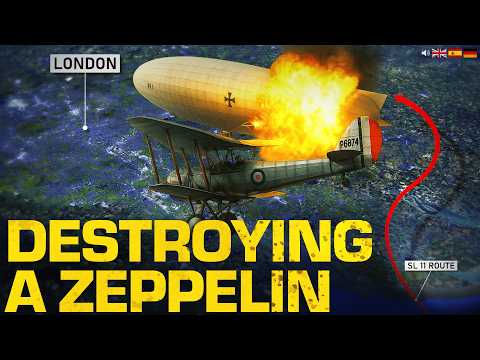
Robinson, meanwhile, was twenty miles away and already overdue back at Sutton’s Farm. He had glimpsed the zeppelin near Gravesend but lost it in clouds. Now, scanning the dark Essex countryside for landing flares, he spotted a red glow north of London—the fire from SL11’s bombs. Though tired and frozen, he turned his BE2C away from home and headed toward the light. SL11 was closing on London. Lieutenant Moffett, commanding an anti-aircraft gun in Finsbury Park, heard the engines and caught a glimpse as the airship passed a gap in the clouds. Searchlights locked on. At 2:00 a.m., Moffett’s gun roared. Robinson headed toward the converging lights as guns all over London burst into action. The exploding shells awoke the city, bringing people into the streets.
For Schramm, the situation deteriorated. He shied away from central London as the guns blasted, climbing desperately for the clouds. For countless Londoners, it was a mesmerizing show. They stood spellbound, recognizing that this response was different—that they were witnessing a momentous event. Many dragged sleepy children from their beds, willing the guns to find the target. Schramm headed north toward Edmonton, breaking free from the searchlights. The guns ceased at 2:13 a.m., but two minutes later, others engaged as SL11 drifted in and out of view. Schramm dropped more bombs over Edmonton, Ponder’s End, and Turkey Street. The commander of the Temple House Gun observed SL11 for eight minutes before firing. His crew thought one round hit the rear, but the officer heard machine gun fire—unseen in the darkness, 21-year-old William Leefe Robinson was closing in at almost 13,000 feet.
Robinson later recalled the moments before his attack: “Remembering my last failure, I sacrificed height for speed and made nose down in the direction of the zeppelin. I saw shells bursting and night tracer shells flying around it. When I drew closer, I noticed that the anti-aircraft aim was too high or too low. Also, a good many some 800 ft behind. A few tracers went right over.”
Having overtaken SL11, Robinson turned back and flew directly toward the airship. His tiny BE2C was dwarfed by the overpowering bulk of the great aerial monster. With his machine gun mounted to fire upward through a cutout in the upper wing, his best position for attack was from underneath—or, if attacking from the side, he needed to tilt his aircraft alarmingly onto its side. The young pilot steadied his nerves and began his run.
“I flew about 800 ft below it from bow to stern and distributed one drum along it. Alternate broken Pomroy. It seemed to have no effect. I therefore moved to one side and gave her another drum distributed along its side without apparent effect. I then got behind it. By this time, I was very close, 500 ft or less below, and concentrated one drum on one part on the underneath rear.”
Robinson was now at 11,500 feet, his breath misting in the freezing air, his hands numb on the controls. He had hardly finished the drum before he saw the part he had fired at begin to glow. In a few seconds, the whole rear of the airship was blazing.
Above him, the now uncontrollable burning airship began to fall. Robinson threw his BE2C into a desperate dive, squirming out of its path as the flaming monster descended. He later described the moment in a letter to his parents: “I hardly know how I felt as I watched the huge mass gradually turn on end and as it seemed to me slowly sink—one glowing blazing mass. I gradually realized what I’d done and grew wild with excitement.”
Far below, a journalist watched the final moments of SL11: “We watched fascinated the terrible death of the zeppelin. The blazing airship swung around for an instant, broadside on, as though unmanageable. Then the burning end dipped. The flames ran up the whole structure as her petrol tanks, one after the other, caught fire. In another second or two, the zeppelin, now perpendicular, was falling headlong to Earth from heights not much short of a couple of miles. A massive roaring flame. With ever-increasing momentum, she sped down until at last she struck the earth with a crash that could be heard for miles.”
A dull red glow brightened the heavens for a few seconds, and a distant mass of still-burning wreckage was all that was left. SL11 crashed on farmland at the village of Cuffley, Hertfordshire. Wilhelm Schramm and his crew all died. Their final moments were horrendous. Some went down with the burning airship, risking being burnt alive. Others chose to jump, hoping for a swifter end. One who did so was discovered in an upright position with his femurs thrust through his body toward his collarbone. Another who stayed on board was discovered with his arms and legs burnt away from his body.
The effect on the other zeppelin commanders was instant. Those approaching London abandoned their missions and turned for home. The effect on the British population was enormous, too. Those countless onlookers across London and surrounding counties had initially watched in silence, but when SL11 fell from the sky, the cheers grew, reaching a crescendo as she smashed into the ground. A brief pause, and then realization set in: after twenty-five months of war, one of the feared and hated baby killers had been destroyed before their eyes.
This was a moment in history witnessed by the masses. At a stroke, the British public no longer felt defenseless in the face of the zeppelin menace. Cuffley instantly became a place of pilgrimage, and thousands made their way there within hours of the crash by all modes of transport. Robinson and a group of fellow officers went too, but when identified as the hero, he was mobbed and had to retreat. He returned later in the day wearing civilian clothes. Even so, he was spotted by a friend, but he begged her not to give him away, telling her, “I’ve already had one dose of popularity this morning, and it very nearly killed me.”
But where exactly was the crash site? Photographs from that time show little—a wooden-framed Schütte-Lanz had burned to ash, leaving only engines and tangled bracing wire. Yet one image held a crucial clue: a corrugated iron building in the background, St. Andrew’s Church, confirmed the wreck fell where modern housing now stands between the Ridgeway and Cranfield Crescent.
For the crew of SL11, there was little to remember them by, and the airship was wiped from the history books for years. Fearing the truth would lessen the impact on morale, the authorities announced the destroyed ship was another raider—Zeppelin L21. As such, the men were laid to rest in a cemetery in Potter’s Bar.
Robinson’s victory marked the beginning of the end for the zeppelin threat. The new bullets brought down two more within a month and another two in November. Where 42 zeppelin nights occurred across 1915 and 1916, only nine more followed in the war’s final two years. Yet the aerial threat endured—in May 1917, the long-range Gotha bomber arrived.
For Robinson, life changed forever. He became an instant media celebrity, a good-news story amid endless casualty lists. Days later he was summoned to Windsor Castle to receive the Victoria Cross from the King—the only VC awarded for an action in Britain. Withdrawn from active service for morale duties, he yearned to return and eventually joined 48 Squadron. On 5 April 1917, leading six Bristol fighters, he was attacked by Manfred von Richthofen’s Jagdstaffel 11. Four aircraft were lost, and Robinson force-landed behind enemy lines, remaining a prisoner for the rest of the war.
He returned to England in December 1918, a weakened man. Just seventeen days later, on 31 December, he succumbed to the influenza pandemic. Thousands attended his funeral. In 1967, the crew of SL11 were reinterred at Cannock Chase, lying side by side with those of Zeppelins L31, L32, and L48. Robinson’s memorial, funded by Daily Express readers, was unveiled in June 1921—but sadly, he never saw it.
The protagonists of this desperate battle were all gone. Yet their story endures. What do you think—was Robinson’s VC a turning point in the war in the air, or merely a fleeting triumph? Share your thoughts below.
Report this article
Select a reason for reporting:






