Camp Forest, Tennessee, July 1943. The processing line moved slowly through the humid afternoon, and the air smelled of red clay and distant rain. Forty-seven German women stood waiting for medical clearance, their eyes fixed carefully forward as military protocol demanded. Then the door opened and Staff Sergeant James Williams entered carrying a clipboard and wearing the same olive uniform as every other American soldier—except he was black.
The women’s carefully maintained composure shattered instantly. They stared with expressions mixing shock, confusion, and something close to terror. The regime had taught them many lies about America, but the most comprehensive propaganda had concerned race. What happened over the following months would force these women to confront the gap between what they had been taught and what they could see, and that confrontation would dismantle more than racial prejudice.
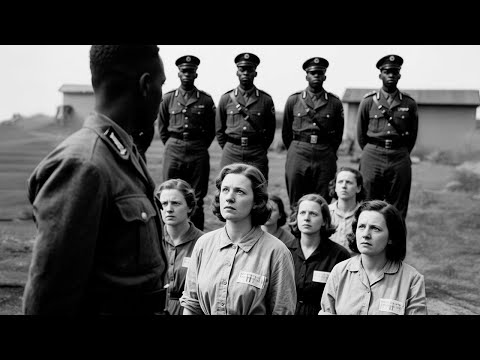
Williams noticed the staring immediately. He had been a soldier for two years, assigned to POW camp administration because the army believed his education—two years of college before the war—made him suitable for clerical work that white officers preferred not to do themselves. He had seen this reaction before, though never quite so intense. German prisoners often stared when they first encountered black soldiers, their expressions suggesting they were processing information that contradicted fundamental assumptions about the world. He kept his face neutral and his voice professional.
“Medical processing,” he announced, reading from his clipboard. “Everyone will be examined by doctors, given basic health screenings, and issued clean clothing. Line forms to the left. Follow the nurse’s instructions.”
Corporal Helen Martinez, a Mexican-American nurse from Texas, translated into German, but the women barely seemed to hear. Their attention remained fixed on Williams with an intensity that suggested they were trying to reconcile his existence with propaganda that had insisted black Americans occupied a category barely above animals—certainly not people who wore uniforms, held authority, or spoke with educated diction.
Ingrid Bauer stood near the front of the line. She was thirty-four, a former secretary from Munich who had been detained in South America when war began. The regime’s racial education had been comprehensive during her years in institutional schooling. America’s racial composition was presented as evidence of national weakness—a mongrel society of inferior populations, contaminated by superior European stock. Black Americans specifically were depicted as primitive, dangerous, intellectually limited, and certainly not capable of military service or positions requiring competence.
Yet here was a black man in a sergeant’s uniform, carrying a clipboard, speaking English with perfect grammar and professional bearing. The contradiction was so complete that Ingrid felt her understanding of reality shift slightly, like ground moving beneath her feet during an earthquake. Either the propaganda had been accurate and this man was somehow an anomaly, or the propaganda had been false and everything she believed about racial hierarchies required reassessment.
The medical processing continued through the afternoon. Williams moved through administrative tasks with efficient competence—checking names against rosters, verifying documentation, ensuring the process moved smoothly. Occasionally he spoke with other staff members. His interactions demonstrated an easy professionalism that suggested authority based on competence rather than merely following orders. Ingrid watched him covertly during her medical examination. The nurse conducting the screening was white, but she deferred to Williams on procedural questions without hesitation or visible discomfort. The dynamic contradicted everything Ingrid had been taught about American racial relations—that white Americans despised and feared black Americans, that integration was impossible, that the society was constantly on the verge of racial violence.
After processing, the women were escorted to their barracks in the camp’s civilian section. The walk provided more opportunities for observation. Camp Forest housed over twelve thousand prisoners, mostly German and Italian military personnel captured in North Africa, plus several hundred civilian detainees like Ingrid’s group. The facility sprawled across Tennessee countryside, and everywhere Ingrid looked, she saw evidence contradicting her expectations.
Black soldiers worked alongside white soldiers in various capacities—not in subservient roles exclusively, but as equals in many contexts. Both races performed guard duty, both operated vehicles, both engaged in administrative work. The interactions seemed casual, unremarkable, as if this mixing of races was normal rather than the dangerous social experiment propaganda had described.
That evening during dinner in the mess hall, Ingrid sat with three other women from her processing group. They spoke in hushed German, aware that camp personnel monitored conversations but unable to contain their confusion.
“Did you see the black sergeant?” asked Frieda Koch, a younger woman who had been a teacher before detention. “How is that possible? We were taught they were intellectually incapable of such positions.”
“Perhaps he is exceptional,” suggested Margarete Stein, older and more cautious. “One example does not disprove general patterns.”
“But there are others,” Ingrid said quietly. “I saw at least six black soldiers during the walk from processing. They were not all doing menial labor. Some were clearly in positions of responsibility.”
“The regime’s teachings must have been incomplete,” Frieda said carefully.
And the other women recognized this for what it was—tentative questioning that stopped short of outright rejection of propaganda. To question racial teachings meant questioning everything, and such comprehensive reassessment felt dangerous even in captivity, where the regime’s direct authority no longer reached.
The following days provided continued exposure to a reality that challenged indoctrination. Williams appeared regularly in the civilian section, conducting administrative tasks and occasionally addressing assembled prisoners through translators. Ingrid found herself studying him with anthropological intensity, trying to understand how his existence could be reconciled with what she had been taught.
He spoke educated English—not dialect or broken grammar, but sophisticated vocabulary and complex sentence structures. He carried himself with quiet confidence rather than the subservience propaganda had suggested was natural to his race. Other soldiers, both white and black, treated him with respect that seemed based on his rank and competence rather than on racial considerations.
The cognitive dissonance was painful. Ingrid had built her worldview on foundations that included racial hierarchies as fundamental truth. The regime had not presented racial ideology as opinion or preference, but as scientific fact. Some races were superior, others inferior, and these differences were biological reality rather than social construction. To question this meant questioning the entire edifice of belief the regime had constructed.
By the second week, Ingrid noticed something else. The black soldiers showed no hostility toward German prisoners. Williams, in particular, treated everyone with the same professional courtesy—firm but fair, following regulations without cruelty, occasionally showing small kindnesses that exceeded official requirements. When an elderly German woman struggled with English language forms, he had patiently arranged for translation rather than simply processing her incorrectly. When children among the civilian prisoners asked curious questions, he answered with the same patience he would show to American children.
The contrast with propaganda depictions was total. The regime had taught that black Americans harbored violent resentment toward white populations—that integration led inevitably to violence, that racial mixing produced social chaos. Yet here were black and white soldiers working together peacefully, and black soldiers treating white German prisoners with consideration rather than the revenge propaganda had predicted.
Ingrid began writing observations in a small notebook she had managed to keep through multiple detentions. The entries were private, honest in ways public speech could not be.
July 19th, 1943. I have now been at Camp Forest for twelve days. Every day I see things that contradict what we were taught. The black soldiers are not what the regime described. They are competent, educated, professional. They treat us fairly—sometimes more fairly than white soldiers who seem to resent prisoner duty. I do not understand how the propaganda could have been so completely wrong about something so fundamental. If they lied about this, what else was false?
The questioning, once begun, spread like cracks through ice. If racial propaganda was false, what about economic propaganda that insisted capitalism created poverty? What about political propaganda that claimed democracy was weak and chaotic? What about military propaganda that promised inevitable victory? Each lie exposed invited scrutiny of adjacent claims, and gradually the entire structure of belief became unstable.
Other women in Ingrid’s section were undergoing similar reassessments. Conversations in the barracks, conducted quietly in evening hours when they felt safest from oversight, revealed widespread confusion about reconciling observation with teaching.
Frieda confessed one evening that she had been taught black Americans were intellectually limited. Yet she had watched Sergeant Williams help resolve a complex administrative problem that had stymied white officers. His solution had been elegant, efficient, and immediately adopted. “How could someone intellectually inferior produce superior results?” she asked, the question hanging in the air like a challenge to everything they had known.
Margarete, more resistant to changing her views, argued that perhaps American black populations were different from African populations—that environmental factors created exceptions. But even she acknowledged that this explanation required abandoning the biological determinism the regime had insisted was scientific fact.
The discussions occurred within the context of a broader realization about propaganda’s comprehensive falsification. The regime had not merely emphasized certain truths while downplaying others. It had created a complete alternative reality where nearly everything was distorted or inverted. The women were discovering this through accumulated small observations that could not be explained away.
September brought a change in camp routine. The civilian prisoners were offered opportunities to work outside the camp under supervision—agricultural labor mostly, helping local farms with the harvest as civilian labor had been depleted by military service. The program was voluntary, compensated with small wages, and carefully regulated to prevent escapes or incidents.
Ingrid volunteered. The work would be demanding, but remaining in camp felt increasingly claustrophobic. She wanted exposure to American society beyond the military facility—wanted to test whether her observations about race relations extended beyond the artificial camp environment.
The work detail consisted of twelve German women and four guards—two white, two black. One of the black guards was Sergeant Williams. They were transported to a farm twenty miles from camp where the owner and his wife had contracted for labor assistance.
The farm was modest—three hundred acres of tobacco and vegetables, operated by a family that had farmed this land for generations. The farmer, a man named Robert Henderson, was in his fifties, weathered by decades of outdoor work. He greeted the prisoners with careful courtesy, speaking slowly so they could understand his Tennessee accent. His wife brought water and explained the work—harvesting tobacco leaves, sorting by quality, preparing for curing. The labor was hot, repetitive, demanding, but not cruel.
What struck Ingrid was Henderson’s interaction with the guards. He spoke to Williams with the same respect he showed the white guards—asking questions about scheduling, coordinating break times, discussing logistics. There was no hint of the racial tension propaganda had described as defining American society. If anything, Henderson seemed slightly more comfortable with Williams, whose education and articulation matched the farmer’s expectations of military authority better than the younger white guards, whose rural backgrounds made them less formally spoken.
During lunch break, Mrs. Henderson brought food for everyone—prisoners and guards alike. She served black and white guards identically, sat down to eat with the group, made conversation that included everyone without apparent consciousness of racial boundaries. Ingrid watched with a fascination that bordered on disbelief. This was supposed to be the segregated South, where propaganda claimed racial separation was absolute and violent. Yet here was a white farm family treating black soldiers as normal members of a military unit—sharing meals, showing respect, acting as if integration was unremarkable.
Williams noticed Ingrid watching and approached during the afternoon break. “You seem surprised,” he said in his careful English, speaking slowly enough that she could understand without translation.
Ingrid hesitated, uncertain how to articulate what she was thinking. “In Germany,” she said haltingly in broken English, “we were taught different things about America. About—” She gestured uncertainly, unable to find appropriate words.
Williams understood. “You were taught that black Americans are inferior, that integration is chaos, that racial mixing destroys societies.” He smiled without humor. “The regime had very specific ideas about race. Most of them false.”
“But why?” Ingrid asked, the question emerging before she could suppress it. “Why lie about something so verifiable? Anyone who comes to America can see the propaganda was wrong.”
Williams considered his response carefully. “Because if you believed racial hierarchies were natural and necessary, you would accept the regime’s hierarchies more easily. If you believed some people were inherently inferior, you would not question why the regime treated certain populations as expendable.” He paused, letting the words settle. “Racial propaganda was not mainly about race. It was about conditioning you to accept categorical dehumanization. Once you accept that some humans are less human, you will accept almost any cruelty toward them.”
The analysis was sophisticated, and it landed with force. Ingrid felt it physically. Williams was correct. The racial teachings had been foundational for everything else. Once you accepted that human value was hierarchical rather than universal, every other regime policy became justifiable. The propaganda about black Americans had not been incidental error, but carefully constructed preparation for accepting atrocities against other populations.
The work days continued through September and into October, each one adding another crack to the edifice of belief she had carried from Germany. At the harvest festival, the Hendersons served everyone at one long table, and Ingrid watched a black guard laugh with a white farmer’s wife over a shared joke. No regime could survive such an image, she wrote that night. The lie dies wherever people simply eat together.
When winter ended the work details, Williams found her before the transfer orders came. “You think differently than when you arrived,” he said. “Once you see the categories are false, the whole structure collapses.” Ingrid nodded. “You taught me that by existing, not by arguing.”
She returned to Germany in 1944 with her notebooks, and after the war she taught children to question, using a black sergeant from Tennessee as her proof that propaganda dissolves before human complexity. Years later, a letter arrived from America—Williams had become a teacher too.
Two lives, one tobacco field. But what became of the women who kept staring, who chose certainty over truth?
Report this article
Select a reason for reporting:






