June 1959, Newark, New Jersey. 2:00 a.m. A small jazz club called Frankie’s Room, nearly empty. Frank Sinatra, fresh from a recording session in New York, slips in for a quiet drink. He could have any bar in the world, but tonight he chooses this one. He doesn’t know it yet, but he’s about to hear something that will echo for decades.
On a tiny stage, a 16-year-old kid is singing to nobody. His voice cracks. His timing is off. But the way he interprets the lyrics—raw, honest, aching—makes Frank stop halfway to the bar. He sits down. Listens. The kid is Paul Anka, and he has no idea the most famous voice in America is watching him.
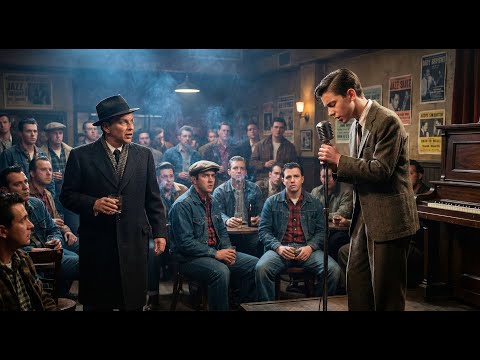
Paul finishes the song, a melancholy tune called It Doesn’t Matter Anymore. Silence. Then slow applause—just one person clapping. Paul squints into the lights, can’t see who it is. The man stands, walks toward the stage. As he gets closer, Paul’s heart stops. Frank Sinatra.
“You wrote that?” Frank asks. Paul just nods. “How old are you?” “16.” Frank is quiet for a moment. “You’re Paul Anka. You wrote ‘Diana.’ That was a hit. Made you a lot of money, I’d guess.” “Yes, sir.” “So what are you doing here? Playing an empty club in Newark at 2 in the morning?”
Paul finds his voice. “Trying to get better. Trying to write songs that matter.” Frank smiles slightly. “Songs that matter. That’s a tall order for 16.” “I know. But that’s what I want. I don’t want to be a teen idol. I want to be a songwriter like the guys who write for you.”
Frank pulls out a chair, sits down facing the stage. “Play me another one. Something nobody’s heard yet.” Paul’s hands are shaking. He thinks for a moment, then starts playing Put Your Head on My Shoulder—romantic, simple, but with a melody that stays with you. Frank listens without interrupting. When Paul finishes, Frank nods slowly. “That’s a hit. You know that, right?” “Publishers don’t think so. They say it’s too old-fashioned.” “Publishers are idiots. That song’s a standard. Ten years from now, people will still be playing it.”
Frank stands, walks onto the small stage, sits on the bench next to Paul. “Let me tell you something about songwriting, kid. Most people write songs to be hits. They chase trends. Those songs disappear in six months. You know what lasts? Songs that tell the truth. Songs that capture a feeling so honestly that people recognize themselves in it.” Paul hardly breathes. “You’ve got that. That song you just played—it’s not trying to be anything except honest. That’s rare, especially from someone your age.”
“How do I get people to take me seriously?” Paul asks. Frank thinks. “You keep writing. You get better. And you don’t let anyone tell you what you should sound like. You find your voice and you trust it.” He pulls out a business card, writes a number on the back. “This is my manager’s number. Hank Sanicola. Call him tomorrow. Tell him I sent you. He’ll help you find the right publishers—people who understand what you’re trying to do.”
Paul takes the card like it’s made of gold. “Mr. Sinatra, I don’t know what to say.” “Don’t say anything. Just keep writing songs that matter.” Frank stands to leave, then turns back. “One more thing. You got any songs about defiance? About doing things your own way, even when everyone says you’re wrong?” Paul thinks. “Not yet, but I could write one.” “When you do, show it to me. I’m always looking for songs like that.”
Then Frank walks out of Frankie’s Room and disappears into the Newark night. Paul stares at the card in his hand, the empty stage, the faint smell of cigarette smoke. He doesn’t know it yet, but the song Frank just asked for won’t exist for nine more years. And when it does, it will change everything.
The next morning, Paul called Hank Sanicola from a payphone in the lobby of his cheap Manhattan hotel. His hand shook so badly he dropped the nickel twice. When Hank answered, Paul blurted out the whole story in one breath—Frankie’s Room, the empty stage, the business card. Hank laughed. “Frank does this sometimes. Picks somebody out of nowhere. Usually it’s a dame. This time it’s a kid with a song.” He told Paul to come by the office that afternoon.
Within a week, Paul was sitting across from real publishers—men who had worked with Cole Porter and the Gershwins. They didn’t treat him like a novelty. They treated him like a writer. Put Your Head on My Shoulder was recorded that fall and released in the summer of 1959. It climbed to number two on the Billboard chart. Frank had been right about everything.
But the song Frank actually asked for didn’t come. Not that year. Not the next. Paul wrote dozens of hits through the early sixties—Lonely Boy, Puppy Love, songs that made him rich and famous and, increasingly, restless. Every time he sat down at a piano, he remembered the question. You got any songs about defiance? And every time, he came up empty.
He tried once, in 1963. Wrote a tune called I Did It My Way—clumsy, obvious, all swagger and no soul. He played it for Hank, who shook his head. “That’s not it, kid. Frank didn’t ask for a slogan. He asked for the truth.” Paul threw the pages in the trash and didn’t try again for five years.
Then came Paris, 1968. Paul was thirty-seven now, living in a rented flat near the Champs-Élysées, burned out on the teen-idol circuit and hungry for something real. A friend played him a record by Claude François—Comme d’habitude, a French ballad about the quiet death of a marriage. Paul listened once. Then again. The melody was strange and powerful, almost operatic, and it grabbed him somewhere behind the ribs.
But the lyrics—the French lyrics—were small. Domestic. A man complaining about his wife’s habits. Paul sat at the piano in his flat that night and heard something else entirely. He heard a man at the end of his life, looking back. Not complaining. Testifying. He thought of Frank, of that Newark night, of the question that had followed him for nine years.
He wrote the English lyrics in one sitting, finishing around four in the morning. When he read them back, his hands were trembling again—the same way they had on that little stage. He called the song My Way.
He sent the demo to Frank through Hank, with a note that said, simply: Frank—remember? 1959, you asked me for a song about defiance. Here it is. Nine years late, but I think it was worth the wait. —Paul.
Then he waited. Days passed. A week. Paul began to convince himself Frank would hate it, that the melody was too French, the lyrics too grand. He was halfway through drafting an apology letter when the phone rang.
It was Hank. “He wants to record it. Tomorrow. He’s already booked the studio.” Paul sat down on the edge of his bed, stunned. “He didn’t say anything else?” Hank chuckled. “He said, and I quote, ‘That kid finally wrote it.’ Then he hung up.”
On December 30th, 1968, Frank Sinatra walked into the studio in Los Angeles with a full orchestra waiting. Paul flew in from Paris, not to produce—Frank never let anyone produce him—but just to be there. To witness it. He stood in the control booth, invisible behind the glass, as Frank stepped up to the microphone.
The first take was good. The second was better. But on the third, something shifted. Frank closed his eyes, and when he sang “And now, the end is near,” the room went silent. The engineers stopped fidgeting. The string players forgot their sheet music. Everyone understood they were hearing something that would outlive them all.
When the final note faded, Frank stood at the microphone for a long moment, eyes still closed. Then he opened them, looked up at the booth, and found Paul through the glass. He gave a small nod. That was all. But Paul understood it perfectly—it was the same nod Frank had given him in Newark, the one that meant that’s it, kid, that’s the truth.
My Way was released in early 1969. It didn’t become a hit overnight. Radio stations were unsure what to do with it—too long, too theatrical, too strange. But Frank started closing his concerts with it. Every night, in every city, the same song. And every night, thousands of people would stand and sing along, many of them crying, because Frank was singing about their lives now, not just his own.
The letters started arriving at Paul’s office a few months later. A man in Ohio who’d walked away from a factory job everyone said he was lucky to have. A woman in London who’d left a marriage that was slowly killing her. A soldier in Vietnam who wrote that the song was the only thing keeping him sane. None of them knew Paul had written it. They thought Frank had. But Paul saved every letter.
He and Frank didn’t talk often after that. They didn’t need to. Occasionally Frank would call, late at night, usually after a few drinks, and say something like, “Sang your song tonight. Cleveland. They wouldn’t let me leave.” Paul would laugh and say, “It’s your song now, Frank.” And Frank would go quiet, then say, “No. It’s ours.” Then he’d hang up.
In 1971, Paul was invited to a party at Frank’s house in Palm Springs. He almost didn’t go—he was in the middle of writing a new album, and the drive from LA was long. But something told him to make the trip. He arrived late, after most of the guests had gone home, and found Frank alone on the patio, staring out at the desert night, a glass of whiskey in his hand.
“Sit down, kid,” Frank said, though Paul was thirty now, no longer a kid by any measure. Paul sat. For a while neither of them spoke. Then Frank said, without looking at him, “You know what I was thinking about? That night in Newark. The empty club. You singing to nobody.” He took a sip of his whiskey. “I almost didn’t stop. I was tired. I’d had a long session. I just wanted a drink and a quiet corner. But something made me sit down.”
“What was it?” Paul asked. Frank turned to look at him. “You were singing like it mattered. Like the room was full. Most people, they can tell when nobody’s listening. They hold back. You didn’t.” He shook his head slowly. “I’ve never been able to explain it. But I knew, sitting there, that you were going to write something important someday. I just didn’t know I’d be the one singing it.”
Paul didn’t know what to say. He’d spent twelve years trying to thank Frank properly, and he’d never managed it. But that night, on the patio, he realized he didn’t have to. Frank already knew.
Frank died in 1998. Paul was fifty-seven, one of the most successful songwriters in history, and when he stood to speak at the funeral, he cried. “In 1959, I was 16 and lost. Frank walked into a club in Newark and heard me singing to an empty room. He could have walked out. Instead, he sat down.”
He paused, his voice breaking. “Frank taught me *My Way* long before I wrote it. He taught me that truth lasts longer than trends. That helping someone find their voice matters more than protecting your own.”
Frankie’s Room closed in 1987, the building torn down in 1992. A plaque now marks the spot, but Paul always said it got the story wrong. Frank didn’t discover him that night. Paul had already discovered himself. Frank just confirmed it.
So here’s what I keep wondering: what song is waiting inside someone you could stop and listen to tonight?
Report this article
Select a reason for reporting:






