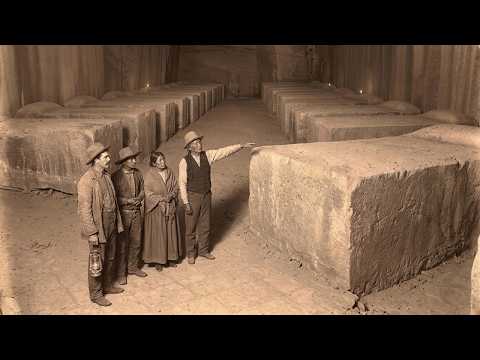
On October 15, 1901, a drill steel broke through the face of a tunnel 300 feet under the Sierra Madre of Southern Wyoming. On the other side, miners found a room full of stone beds—41 of them, each 26 feet long, carved from a single mass of pale gray rock that did not belong to the mountain.
Ira DeLong, a 42-year-old rancher working the winters underground, was the first to crawl through the hole. He held the lantern high, but its light barely reached the top of the first bed. Beyond it, another, and another—two rows of twenty, their pillow-ends swelling into smooth rounded humps against the walls, their feet pointing to a central aisle. At the far end, a 41st bed lay crosswise before a doorway choked with rubble, as if to block the way.
On all 41, a fine gray dust lay at the same depth. Nothing had walked in it.
Within three days, the company walled off the room with timber, hung a door, and locked it. The papers that went to the buyers described a natural opening in the rock, barren of ore. They said nothing about beds.
But 15 months earlier, more than 150 miles to the north, a young anthropologist from New York had sat in a canvas tent on the Wind River Reservation, sketching the painted designs on a raw hide case. The case belonged to an Arapaho woman of about 70. The design on it was two long lines side by side, each lined with 20 short marks and one mark lying across the end. She told him what the design was called in English: Where They Sleep by Turns.
As far as anyone knows, she had never been inside that mountain. No one at the mine had ever heard of her.
The timekeeper and clerk of the Ferris Haggerty mine in 1901 was Morgan Lyle, a former Pullman sleeping car conductor. For 14 years, he had marked every berth on a printed diagram, every night, without fail. Now he stood in a room that looked—to his trained eye—like a sleeping car laid out wrong: heads to the wall, feet to the aisle, and no porter at the end.
Lyle measured everything. The room was 296 feet long, 68 feet wide, the floor dead level for its full length. The walls rose straight up, smooth, without tool marks. The roof was lost in darkness above 35 feet. The temperature held at 44 degrees. The dust lay to the same depth on every surface—exactly one dime’s thickness, level with the face of the coin.
He numbered the beds on the east side 1 to 20, the west side 21 to 40. The 41st, the one across the door, he left unnumbered. On the back of a diagram form he wrote: and one across the end.
Then Jim Pollard, a miner who had worked a double shift, climbed onto bed 12 and fell asleep in the dust. The shift boss pulled him off by his boot. Lyle noted it: Pollard slept on 12. Rautio would not have it. The print of Pollard’s body remained in the dust—the only mark the miners had not made with a tool.
That afternoon, the mine manager gave three orders: close the crosscut, say nothing in camp, show it on no map. By evening, a timber wall with a locked door stood 20 feet back from the hole. The buyers’ engineers were told it was a natural opening, barren, closed for safety.
But eight days after the door was locked, a young Arapaho man named Robert Little Owl walked into the Ferris office in Rawlins. He had heard rumors in the freight yard. He asked to see the drawing. Lyle laid it on the table. Little Owl counted the boxes with his eyes, then put one finger on the 41st—the one across the end—and asked, “Which one was bare?”
Lyle told him the truth: none of them. There was dust on all of them, the same on every one. Little Owl thought about that, then said something Lyle wrote down word for word: “Then none of them is up yet.”
He explained: they sleep by turns. One keeps the door. When he has kept it long enough, he lies down and another gets up. He asked Lyle to tell the company three things: nobody should lie down in that room, nothing of its gray stone should leave the mountain, and it should not be closed with iron. Lyle wrote only: too late for the third.
The sale went through in 1902. The mine boomed, then collapsed. Morgan Lyle stayed through it all, keeping his key to the door on the 300-foot level. In October 1908, with the mine shutting down, he went down alone one last time, unlocked the door, and went in with a lantern.
The dust lay on the floor as it had in 1901, unbroken except for the softened boot prints of the men who had walked there seven years before. The dust lay on the 41st bed across the door. It lay on 39 of the 40. It did not lie on bed number 12. Bed number 12 was bare.
Lyle wrote: All dust but 12. 12 bare. Then, on a line by itself, three words: One is up.
He locked the door behind him and never went back up the mountain.
Robert Little Owl spoke about that room one more time, thirty-six years later, to a woman with a typewriter. In the summer of 1937, a writer named Edna Marsh Colby drove out to Ethete on the Wind River Reservation and spent an afternoon with a man of fifty-six who had driven freight for twenty years and now kept a few horses. Her typescript runs to four pages. Most of it is about the freight road, the winters, the price of oats.
On the third page she asked him whether he had ever been to the mining country in the Sierra Madre. He said no. He said he had only seen a drawing of one place in it, in Rawlins, a long time ago, and he told her about Weasel Bear Woman and the man from the museum and the parfleche. He told her that Weasel Bear Woman had died a few winters after that summer and that the parfleche had gone with her. He told her that the company had shut the door with iron anyway. He said that was their business.
Then Colby asked what it meant, sleeping by turns, and his answer is the only place in any of these records where the word is explained at all. He said that a turn was not a night. He said Weasel Bear Woman had told him there was no telling how long a turn would be. Sometimes the one at the door kept it for a few winters and sometimes for longer than a man lives. One of them was always up, keeping the door, and when they changed there was nothing in it to be glad about or afraid of. It was only how the door was kept.
Colby typed it up, and her supervisor filed it with several hundred other interviews under a heading that read folklore miscellaneous. The papers went to the state archives in Cheyenne when the project ended. Nobody connected those four pages with a copper mine because nothing on them said Ferris Haggerty.
Seventeen years later, someone went back into the mountain looking for something else entirely. In the early 1950s, the United States needed uranium. The Atomic Energy Commission was paying bonuses for new deposits, and in 1953 a rancher’s discovery in the Gas Hills of central Wyoming set off a rush. Prospectors with Geiger counters swarmed over every hill in the state, and the commission sent its own field engineers out from Grand Junction, Colorado, to check old mines and prospects that might have been overlooked.
One of them was Hollis Ware. He was thirty-one, a navy veteran from Pueblo, Colorado, who had studied mining engineering on the GI Bill, and in August of 1954 he was working his way through the old copper workings of the Sierra Madre with a scintillation counter, a hand lamp, and a notebook. He needed someone who knew the ground. The man he hired was a rancher from Encampment named Frank DeLong. He was fifty-nine, and he was Ira DeLong’s son.
Ira DeLong had stayed in the valley the rest of his life. After the crosscut was locked, he worked on the tramway as a lineman, climbing the towers in all weather to grease the sheaves until the buckets stopped in 1908. Then he went back to his cattle. He never went into the North Crosscut again, and outside his own family he never talked about it. Inside the family, he talked about it more than once, and before he died in 1931 he had made sure his son knew the way in. And the one rule he held to about that room: nobody lies down in it.
After the sale, the company had driven a drainage tunnel into the hillside below the shaft to carry water out of the workings, and that tunnel met the old levels. In 1954 it was still open. Frank took Ware in through it. The bulkhead was where the carpenters had built it. The timbers were sound; the iron was not. The strap hinges had rusted through, and the door hung only from the hasp, still held by its padlock. Ware lifted the door aside, and the two of them walked down the last twenty feet of crosscut to the hole that Åberg’s drill had opened fifty-three years before.
Ware’s official record of that day is a printed field card in the commission’s files, filled out in the shortest possible way. Old workings, north crosscut, 300 ft level. Count, at or below background. No radioactivity of interest. Not recommended for further work.
His unofficial record is a letter to his wife, written that night in a motel in Saratoga, which their son kept. It is four pages long, and most of it is about the room. He wrote that Frank had told him on the way in what his father said they would find, and he had not believed it, and the old man had been right about every part of it.
He wrote that the dust in the aisle was about an eighth of an inch deep, and that under it he could just make out boot prints, old ones, filled almost level. The hobnailed soles of 1901—Frank said one set of those prints would be his father’s. Ware wrote that there were no other tracks in the room of any kind, except the ones the two of them had just made. He wrote that the dust lay at about the same eighth of an inch on the bed across the door, and on thirty-eight of the forty.
Then he wrote about the other two. On the east side, Frank stopped at bed number 12 and said that his father had told him a miner named Pollard had once lain down to sleep on it, and that the shift boss had pulled him off it by the boot. Ware looked at the bed. There was dust on it, but not much. He scraped a little aside with the edge of his notebook and judged it at a thirtieth of an inch, a quarter of what lay on the bed to either side.
And on the west side, bed number 29 was bare stone. Ware ran his hand along it, and his palm came away clean. He looked for dust on the floor beside it and in the aisle in front of it and found the same eighth of an inch as everywhere else, unbroken. Ware held his counter over it out of habit, and it read what it had read everywhere else in the room, which was almost nothing.
Neither of them knew that Morgan Lyle had found bed number 12 bare in 1908. Lyle was thirty-five years dead, and his notebook was in a box in Saratoga. Neither Ira DeLong nor his son had ever seen the entry. Hollis Ware had never heard of Lyle at all.
Near the end of the letter, Ware wrote: Frank says that in his father’s day there was dust on all of them. I asked him which one he thought had been swept. He said his father never believed any of them had been swept. His father believed somebody had gotten up.
Ira DeLong was not the first man to picture a closed room of sleepers who stir and settle while no one is watching. In the sixth century, Bishop Gregory of Tours wrote down an account already old in his day of seven young men of Ephesus who took refuge in a cave, fell asleep, and woke generations later. The same account appears in the 18th chapter of the Quran, which adds two details. It says that anyone who looked in on the sleepers would have thought them awake, though they slept, and that they were turned from side to side as they lay. And it says that their dog lay stretched across the entrance with its four legs on the threshold.
Christians and Muslims have honored the cave of the sleepers for well over a thousand years. Neither tradition has anything to do with the Arapaho or with a copper mine, but both describe a room of sleepers who are turned while they sleep and one more who lies across the door.
The plainest reading of all this is also a strong one. Begin with the rock. Schist splits into flat benches, and a chamber opened by water in layered rock can look, by lantern light, astonishingly regular. Dust settles evenly in still air. A bare shelf in a room of dusty ones can be explained by a draft, by a drip that later dried, by a slab that shifted and shed what lay on it.
Then the witness. Nearly everything about the room in 1901 and 1908 rests on one man’s pencil notes on the backs of printed forms. Morgan Lyle spent fourteen years filling in diagrams of sleeping cars. A man like that, faced with rows of ledges in the dark, might well see berths because berths were what his eyes had been trained to see.
Then the anthropologist. Kroeber himself, in the study he did publish, pointed out something important about Arapaho designs. The same figure could mean entirely different things to different makers. A tent to one woman was a mountain to another. Two lines with marks along them could be a trail, a river, a row of lodges. One woman’s reading of one figure on one parfleche is a slender thread on which to hang a room underground.
Then the setting. The Grand Encampment Boom was built on promotion. The man at the center of it, Willis George Emerson, sold mines with pamphlets and banquets. And in 1908, the same year the company collapsed, he published a novel called The Smoky God, about a sailor who finds a hidden world inside the earth. A district that ran on promises about what lay under the ground was a district where a tale about a room full of stone beds could grow in the telling.
Then the translations. Weasel Bear Woman’s words reached Kroeber through a nineteen-year-old interpreter. They reached Lyle a year later from memory. They reached Edna Colby thirty-seven years after they were spoken. Every crossing between languages and years is a chance for a meaning to shift. A word for those who rest could become those who sleep. A word for a long time could become a turn.
Each of these is a fair objection and none of them accuses anyone. What none of them can do is reach across from one record to the next. The layered rock accounts for benches, but not for forty of them one size to the width of a pencil line, all raised at the same end in a stone that is not the mountains. The trained eye of a sleeping car man accounts for how Lyle saw the room, not for how Hollis Ware found it fifty-three years later without ever having heard his name. Kroeber’s warning about designs accounts for a figure that might mean anything, not for a young man who had never seen the room putting his finger on the bed across the end and asking, unprompted, about dust. Promotion accounts for exaggeration, but this room was never promoted. It was locked, left off every map, and described to the buyers as barren. And a draft accounts for one bare bed. It does not account for a bare bed in 1908 and a different bare bed in 1954 in a room where nothing had walked down the aisle in between.
The records themselves came to rest where nobody would read them side by side. When Morgan Lyle died in Saratoga in 1919, his papers went to his daughter, and when she died, to the Grand Encampment Museum, which opened in the town in the 1960s to keep what was left of the boom. There, his pad of forms was cataloged exactly as it looked: Pullman diagrams, railroad. It sat in a drawer with timetables and tickets until 1998, when a volunteer named Carol Westover turned one of the forms over to see whether the back was blank.
Kroeber’s notebook page is in the archives of the American Museum of Natural History among his field papers. Kroeber never went back to it, and it has never been printed. Edna Colby’s four pages are in Cheyenne under folklore, miscellaneous. Hollis Ware’s field card is in the Federal Records Center outside Denver, and his letter to his wife is with his family. The four have never been in the same room.
The mountain itself is quiet. The Ferris Haggerty mine site was placed on the National Register of Historic Places in 1973. The headframe has fallen, the shaft is buried, and the drainage tunnel that Frank DeLong once led Ware into has caved at its mouth. The tramway towers still march over the crest of the divide, and in summer people walk the line of them up from the road, and in winter the snow climbs their legs and buries the meadows to the depth of a man and more.
Down in the valley, the town that boomed and emptied is still there. The museum keeps a few of the old tram towers and a few of the buckets that hung from them. The Encampment River still comes down out of the mountains into the open country where the great camps used to stand in summer. And the northern Arapaho are still at Wind River. They govern themselves, they teach their language to their children, and they keep what belongs to them in the way they choose and for the people they choose. Whatever is known about the place called Where They Sleep by Turns and what its door is kept against is theirs. Weasel Bear Woman said so in 1900, and nobody since has been given a better right to say otherwise.
When Hollis Ware had finished his count that afternoon in 1954, he went back toward the hole in the south wall, and Frank DeLong followed him. At the hole, Frank stopped and turned around. Ware wrote that he held up his lamp and looked down the length of the aisle past forty pairs of stone feet to the bed lying across the far door and stood there long enough that Ware asked him if he was all right. Frank said he was. Then he said good night, as his father had said it at that same hole fifty-three years before, and climbed out. Ware’s letter does not say whom he thought he was saying it to.
Weasel Bear Woman said there was no telling how long a turn would last. The last count in that room was taken on that August afternoon, when bed 12 had begun to gather dust again, and bed 29 lay bare.
Somewhere there may be a time book, a lineman’s photograph from the tramway, or a freight receipt from the Wind River Road that belongs with these pages. If one of them is in your family, and it is yours to share, the comments below are open. Lyle’s diagram came back to light only because a volunteer turned one form over. Whose turn is it now?
Report this article
Select a reason for reporting:






