On April 6, 1945, the largest suicide air attack in history descended upon the American fleet off Okinawa. Over two days, 355 kamikaze aircraft came south from Kyushu and Formosa, their pilots sworn to crash into American ships until the fleet could no longer stay. Waiting for them was a ring of radar picket destroyers, a blanket of carrier fighters, and a fleet of ships firing shells that did not need to hit anything—they only needed to come close.
The fleet took terrible losses. It did not leave. What happened on those two days decided the naval battle for Okinawa, and the naval battle for Okinawa decided whether the invasion could continue at all.
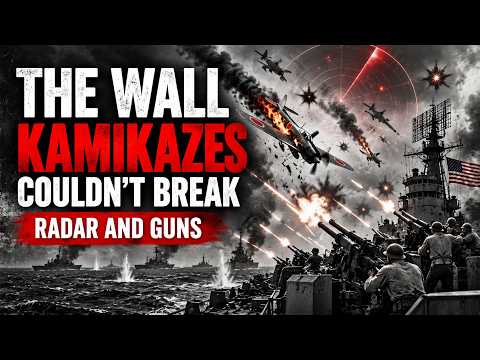
Five days earlier, on April 1st, American soldiers and marines had landed on the island’s western beaches. Behind them lay the largest amphibious fleet ever assembled in the Pacific—more than 1,200 ships. Every rifle, every shell, and every ration on Okinawa had to come across that beach from those ships. If the fleet was driven off, the army ashore would be cut off.
The fleet could not simply retreat out of range and return later. The ships had to stay close to the island day and night for as long as the fighting ashore lasted. The transports had to anchor to unload. The old battleships had to steam slowly along the coast to fire in support of the troops. The escort carriers had to launch aircraft over the beaches from fixed operating areas. All of it made the fleet a stationary target.
Admiral Raymond Spruance’s Fifth Fleet had fought its way across the Pacific by moving. Off Okinawa, it had to stand still and take whatever came. That was exactly what Japan intended.
By the spring of 1945, the Japanese high command no longer believed it could win the war. It believed it could make the war too expensive to finish. The plan was to bleed the American fleet off Okinawa so badly that the United States would accept a negotiated peace rather than invade the Japanese home islands. The instrument of that plan was the kamikaze.
One pilot, one aircraft, one ship.
Japan gave the offensive a name drawn from its own history: Kikusui, meaning floating chrysanthemums. It was planned as a series of mass attacks. The first was the largest.
This is the thesis of those 48 hours. Japan built a weapon that could not be discouraged, could not be frightened off, and did not need to survive. America answered it with a system: radar to see the attack coming, fighters to thin it out, and a shell that turned a near miss into a kill. The system did not stop every aircraft. It was never going to. What it did was make certain that the fleet could stay.
There is a second thing the record shows. On the afternoon of April 6th, two American destroyers at the northernmost radar stations fought one of the most desperate actions in the history of the Navy. That same evening, a third destroyer was burning off Okinawa’s western coast. Less than six months earlier, she had fired torpedoes at the Japanese battle line in Surigao Strait.
But the kamikaze battle off Okinawa did not begin at radar picket station number one. It began five years earlier in a laboratory in Washington, D.C., with a decision nobody recorded as important.
In August 1940, more than a year before Pearl Harbor, a physicist named Merle Tuve was placed in charge of a small group of scientists called Section T. The group worked under the new National Defense Research Committee, the organization America had created to put civilian science to work on military problems before the country was even at war.
Section T was given a narrow and unglamorous problem: anti-aircraft guns were bad at shooting down aircraft. The reason was simple arithmetic. A gunner firing at an aircraft had to guess how far away it would be when his shell arrived and set a timer in the shell’s nose to explode at that moment. If the guess was wrong by a fraction of a second, the shell burst harmlessly behind the target or in front of it. A direct hit on a small, fast-moving aircraft was rare. Most of the time, the gun was firing at empty sky.
Tuve’s group asked a different question: Could the shell decide for itself when to explode?
The idea was to put a tiny radio transmitter and receiver inside the nose of the shell. As it flew, it would send out a signal. When the signal bounced back off an aircraft close enough to be damaged, a circuit would close and the shell would explode. The gunner would no longer have to hit the target—he would only have to miss it by a small enough margin.
In 1940, that was not engineering. It was fantasy. Radios of the day used glass vacuum tubes the size of a thumb, built to sit quietly in a living room. Nobody had ever built electronics meant to be fired out of a gun.
The British had been thinking along similar lines. In the autumn of 1940, a British scientific mission to Washington shared a range of secret research with the Americans, including early ideas for a radio proximity fuse. The British lacked the industrial capacity to develop it. The Americans had the factories.
In late 1941, the Navy’s Bureau of Ordnance approached the Crosley Corporation of Cincinnati, a maker of radios and household appliances, about a top-secret, top-priority project. Crosley’s first contract, signed in December 1941, was for 500 fuses. The first production fuses it accepted came off the line in September 1942. The group moved to Johns Hopkins University in Maryland, where it became the Applied Physics Laboratory.
In early 1942, the first test fuses were fired from 5-inch guns. Just over half of them survived the shot. Half was enough to keep going.
Nobody writing the war’s history in 1942 would have put this project on a list of decisions that mattered. It was one laboratory among hundreds, working on a device that most officers had never heard of, protected by a secrecy so strict that its very existence was classified. It would take three more years to find out what that decision meant.
To understand why it mattered, look at the weapon Japan built.
The kamikaze was not an act of desperation improvised in a single afternoon. It was a decision made by the Imperial Japanese Navy in October 1944, when it had run out of other answers. Its principal author was Vice Admiral Takijiro Onishi, commander of the First Air Fleet in the Philippines.
Onishi’s logic was cold. His young pilots, rushed through shortened training, could no longer survive against American fighters and hit American ships with bombs. A bomb dropped by a novice pilot usually missed. An aircraft flown into a ship by that same pilot usually did not. So Onishi stopped asking his pilots to come back.
Consider what that changed. An ordinary dive bomber had to release its bomb at the right height, the right angle, and the right moment, then pull out and escape through anti-aircraft fire. Every one of those steps could go wrong. A kamikaze had none of them. It had one task: keep flying until impact. It could correct its aim until the last second. It could absorb damage that would drive an ordinary attacker away, because its pilot had no reason to turn back.
It was, in practical terms, a guided missile with a human brain.
Germany had used radio-guided bombs against Allied ships since 1943. Japan built its guided weapon out of men.
The specifications were brutal. A Zero fighter diving on a ship could exceed 350 miles per hour. Many kamikazes carried a bomb of 500 pounds or more, and every aircraft arrived with its fuel tank still partly full. The impact itself sprayed burning gasoline across decks crowded with ammunition, aircraft, and men.
Japan had the aircraft to spend. By the spring of 1945, it was hoarding thousands of planes in the home islands—many of them obsolete fighters, bombers, and even trainers. Aircraft that were useless in a dogfight were perfectly adequate for a one-way flight.
From airfields on Kyushu, Okinawa was about 350 miles away. The kamikazes could reach the American fleet in two hours. The Navy’s principal kamikaze base was at Kanoya, near the southern tip of Kyushu. The Army flew its special attack units from bases such as Chiran, not far away. At these fields, the pilots wrote their last letters home, received a final drink of sake, and took off in the morning or the late afternoon, often in the company of a few escort fighters whose job was to report what they had hit.
Later in the campaign, Japan added a weapon even faster: the Ohka, a small rocket-powered glider packed with explosives, carried under a twin-engine bomber and released near its target. In its final dive, it could exceed 500 miles per hour. American sailors gave it a name of their own. They called it the Baka bomb. Baka is the Japanese word for fool.
The results of the first kamikaze attacks had been enough to convince the Japanese high command that Onishi was right. On October 25th, 1944—the same morning the Japanese battle line was destroyed in Surigao Strait—the first organized kamikaze unit struck the American escort carriers off Samar. The escort carrier St. Lo was hit and sunk within about half an hour.
Over the months that followed, kamikazes hit fleet carriers, battleships, cruisers, and destroyers across the Philippines. The damage was different from anything the fleet had absorbed before. A bomb made one hole. A kamikaze brought its bomb, its engine, its wreckage, and its burning fuel all at once, usually into the most crowded part of the ship.
Each attack confirmed what the Japanese believed. The Americans could shoot down most kamikazes. They could not shoot down all of them, and everyone that got through could kill dozens or hundreds of men in a single instant.
Three hundred fifty-five aircraft, flown by men who did not intend to come home, all converging on one fleet. On paper, it was a weapon designed to overwhelm any defense ever built.
Now look at what the Americans did not have.
For most of the Pacific War, the United States Navy’s defense against aircraft was built on three guns. The heaviest was the 5-inch gun, the main battery of every destroyer and the secondary battery of most larger ships. It could reach high and far, but it fired shells with timed fuses, and against a fast maneuvering aircraft, most of those shells burst in the wrong place. Early in the war, it could take hundreds of 5-inch rounds to bring down a single aircraft.
Closer in were the 40mm Bofors guns, licensed from a Swedish design and built by the thousands. They fired explosive shells rapidly and hit hard. Closest of all were the 20mm Oerlikon cannons, easy to mount almost anywhere on a ship.
Against a conventional dive bomber, the lighter guns worked well enough. A pilot who was hit or frightened would often release early, pull away, and miss. Against a kamikaze, they had a fatal weakness. A 20mm shell could set an aircraft on fire without stopping it. A burning kamikaze on a steady dive would still hit the ship. The record from the Philippines and Okinawa is full of reports of aircraft hit again and again, trailing smoke and flame, that crashed into their targets anyway.
To stop a kamikaze, a gunner could not just damage it. He had to destroy it or knock it off course before it arrived.
The radar was not enough either. Kamikazes learned to fly low under the beam of American search radars, or to approach over land where the returns were cluttered by hills and islands. They mixed into returning American strikes. They came out of the sun and out of cloud. Sometimes the first warning a ship received was a lookout shouting.
And when the warning did come, the gunners faced another problem. The sky over the fleet was full of American aircraft. The electronic identification system meant to tell friend from foe on radar was unreliable, and in the confusion of a raid, gunners sometimes held their fire too long—or fired on their own fighters.
A kamikaze that tucked in behind a returning American formation could reach the fleet before anyone knew it was there.
And the fleet did not have enough fighters. In 1944, a fleet carrier’s air group was balanced among fighters, dive bombers, and torpedo bombers built to strike enemy fleets. By 1945, there was almost no enemy fleet left to strike. What the carriers needed now was a wall of fighters overhead, and they had not been built to carry one.
Put the numbers side by side. Japan: an attacker that could not be discouraged, carrying a bomb and a fuel load straight into the target, arriving by the hundreds. America: timed shells that mostly missed, light guns that could not stop a burning aircraft, radar that could be ducked, and too few fighters to cover a fleet spread across hundreds of square miles of ocean.
The kamikaze had turned every American ship into a target that had to kill its attacker completely or be hit.
That is the version most people know. It is only half the record.
What nobody in the Japanese high command understood yet was this: for two years, the United States Navy had been firing a shell that no longer needed to hit anything. The proximity fuse had moved from the laboratory to the factory. The first test fuses had survived their firing only half the time. Then the engineers redesigned the tubes, strengthening their filaments and supports so they could take the shock. They built a battery that stayed inert in storage and came to life only when fired, when a small glass vial of electrolyte shattered under the force of launch and the shell’s spin flung the liquid into the cells.
By the summer of 1942, the fuse was surviving the gun most of the time.
On August 12th, 1942, the new light cruiser Cleveland, still on her trials in Chesapeake Bay, fired proximity-fused 5-inch shells at radio-controlled target drones. She knocked down three of them with a handful of rounds. The Navy stopped the test because it was running out of drones. Full production began that autumn.
The Navy called the device the VT fuse. VT stood for variable time, a name chosen deliberately to hide what it actually was. The secrecy around it was extraordinary. The VT fuse was one of the most closely guarded technologies of the war. For almost two years, the Navy was forbidden to fire it anywhere a dud might land on enemy territory and be recovered. It could be used only over water. If the Japanese or the Germans ever captured one intact, they might copy it or learn to jam it.
The first shipment went to the Pacific in late 1942 in the care of a naval ordnance officer named William Parsons. On January 5th, 1943, south of Guadalcanal, a Japanese dive bomber attacked a cruiser group. The light cruiser Helena‘s after 5-inch battery opened fire with VT-fused shells. Within three salvos, the dive bomber was falling into the sea. Parsons was on board to watch it happen. Two and a half years later, the same officer would fly aboard the B-29 Enola Gay as its weaponeer and arm the atomic bomb dropped on Hiroshima.
It was the first aircraft ever destroyed by a proximity-fused shell. It received no public attention at all.
The scale of what followed was enormous. By the end of the war, 87 companies in more than 100 factories had produced over 22 million proximity fuses. Each one contained about 130 parts. The program cost more than a billion dollars at the time. The Navy’s own studies found that 5-inch guns firing VT fuses were several times as effective against aircraft as the same guns firing timed shells. The shell no longer had to be aimed at the exact point where the aircraft would be. It only had to pass close enough, and the fuse did the rest.
The unnoticed decision was not to invent the fuse. It was to mass-produce it in the tens of millions and put it into the magazines of ordinary destroyers.
The fuse did not work alone. It was fired from 5-inch guns controlled by the Mark 37 Director, a gunnery system with its own fire-control radar and a mechanical computer below decks that calculated where an aircraft would be by the time the shells arrived. The director aimed the guns. The fuse forgave the small errors the director could not eliminate. Together they turned the destroyer’s main battery into the most dangerous anti-aircraft weapon afloat.
At closer range, the same logic of mass production applied to the 40mm Bofors. American factories built the guns in enormous numbers, and by 1945 ships that had once carried a handful of light guns bristled with twin and quadruple 40mm mounts, each directed by its own gun director. A destroyer on the picket line off Okinawa could put up more anti-aircraft fire than a cruiser of 1942.
By April 1945, every 5-inch gun off Okinawa was firing it.
Before Okinawa, the Navy had already paid for its first lessons in kamikaze defense. The first test came in the Philippines between October 1944 and January 1945, and it was partial, costly, and revealing.
It was costly because nothing the fleet had was built for it. The fast carriers had been designed around the idea that their fighters would keep enemy aircraft away and their own speed would keep them out of trouble. Against aircraft that dove straight at the flight deck, neither was enough. The American carriers’ wooden flight decks, packed with fueled and armed aircraft during launch and recovery, turned a single hit into a firestorm.
After the St. Lo went down off Samar, the attacks kept coming. On November 25th, 1944, kamikazes struck four fleet carriers in a single day: Essex, Intrepid, Cabot, and Hancock. In January 1945, when American forces entered Lingayen Gulf to land on Luzon, the kamikazes came in waves. The escort carrier Ommaney Bay was hit and had to be scuttled. The battleship New Mexico was hit on the bridge, killing her commanding officer and a British lieutenant general who was aboard as an observer. The battleship California—raised from the mud of Pearl Harbor and victorious at Surigao Strait less than three months earlier—was hit as well. Dozens of her men were killed.
The kamikazes at Lingayen were, by many accounts, flown by some of the most experienced pilots Japan still had in the Philippines. They picked their targets. They approached low among the islands where the radar returns were confused by land. They struck the ships that mattered.
The fleet absorbed the blows and landed the army anyway, but the commanders who watched it understood what would happen when Japan brought the same weapon to bear from the home islands with far more aircraft.
It was partial because the defense worked, but not well enough. Most of the kamikazes were shot down. But a defense that stops most attackers is not enough when each one that gets through can gut a ship.
And it was revealing. The lessons were plain to anyone who read the after-action reports. The kamikazes had to be found farther out, before they reached the fleet. They had to be met by more fighters before the guns ever had to fire. And the ships themselves needed more VT-fused 5-inch fire and more 40mm guns, because a burning aircraft that kept coming had to be blown apart, not just set on fire.
The Navy needed a system. It had three months to build one.
And then the rule changed.
The change began with the carriers. In December 1944, Vice Admiral John McCain, commanding the fast carrier task force, and his operations officer, Commander John Thach, rebuilt the fleet’s air defense from the top down. Thach was the fighter tactician who had devised the Thach Weave early in the war to let outclassed American fighters survive against the Zero. Now he turned his attention to the kamikaze.
His answer came to be called the Big Blue Blanket.
The first rule was to stop the kamikazes before they ever left the ground. Instead of striking Japanese airfields once and leaving, the carriers would keep fighters over those airfields from dawn to dusk, shooting down anything that tried to take off. An aircraft destroyed on the runway could never reach the fleet.
The second rule was to put more fighters on the carriers. The balance of the air groups shifted hard. Dive bomber and torpedo squadrons were cut back. Fighter squadrons were doubled and more. By early 1945, a fleet carrier could carry more than 70 fighters, and Marine Corps Corsair squadrons were put aboard the carriers to help fill the decks.
The third rule was to push the warning line outward. Destroyers were stationed far out from the carrier groups, directly on the likely approach routes. Their radars and fighter direction officers would detect incoming raids early and send fighters to meet them. Returning American strike aircraft were required to circle these destroyers before coming home, so the fighters overhead could pick off any Japanese aircraft trying to follow them in. The destroyers were nicknamed Tomcats.
Behind all of it stood the Combat Information Center. In a darkened room on each picket destroyer and each carrier, officers watched the radar returns, plotted the incoming raids, and talked the fighters onto their targets by radio. The fighter direction officer had become one of the most important men in the fleet.
The fleet also changed how it trained. In the weeks before Okinawa, the carrier groups practiced against simulated kamikaze raids, with American aircraft playing the attackers so the fighter directors and gunners could rehearse detecting, tracking, and killing low, fast, determined planes. Low-altitude patrols were added beneath the main combat air patrols to catch the aircraft that came in under the radar, and commanders learned to watch the clock. The Japanese favored dawn and dusk—the hours when the fighters were taking off or landing and the patrols were thinnest.
Okinawa took the whole system and wrapped it around an island.
Around Okinawa, the Navy established a ring of radar picket stations. Eventually, 16 of them, set out from the island on the likely routes from Japan and Formosa. Each was manned by at least one destroyer carrying a fighter direction team. Station number one sat north of the island, squarely on the flight path from Kyushu. Overhead, combat air patrols of carrier fighters were assigned to cover the stations. As the campaign went on, smaller support vessels—landing craft converted into gunboats—were sent out to join the destroyers, adding anti-aircraft fire and picking up survivors. Sailors called them the pallbearers.
Inside the ring sat the transports, the supply ships, the old battleships bombarding the shore, and the escort carriers. Farther to the east, the fast carriers of Task Force 58 under Vice Admiral Marc Mitscher stood ready to launch fighters by the hundreds.
On the ships themselves, 40mm guns had been added wherever they would fit, and every 5-inch magazine was stocked with VT-fused shells.
The design was layered. Radar to see, fighters to thin the attack, 5-inch shells to break it up at long range, 40mm guns to finish what was left. Every kamikaze that reached a ship would have to survive all of it.
The picket destroyers had the worst position in the ring. They were the first ships the Japanese would see on the way south, and many of the kamikaze pilots of 1945 were barely trained. They had orders to attack the first American ship they found. For hundreds of them, the first American ship they would find was a picket destroyer.
On April 6th, American naval intelligence knew a major raid was coming. The ships received the warning. What they did not know was how large it would be. It would be the largest suicide attack ever launched.
The first kamikazes arrived before noon. Shortly after midday, the destroyer Hyman patrolling off Okinawa became the first warship struck. A dive bomber crashed into her forward superstructure and sent a fireball through her combat information center. Seven of her men were killed. She stayed in action.
At about 3:00 in the afternoon, 40 to 50 Japanese aircraft came in from Kyushu toward radar picket station number one. The destroyer Bush was on that station. Another dozen went after the Cassin Young at station number three.
The Bush shot down two dive bombers and drove off two more. Then a single torpedo bomber, flown by a pilot who jinked and weaved through her fire, crashed into her amidships between the two stacks. Its bomb exploded in the forward engine room, killing every man in the space and most of the men in both fire rooms. The Bush went dead in the water. Her crew corrected the list and began fighting the fires. For a time, it looked as though she could be saved.
In her combat information center, the radar scopes showed what was still coming. Returns stacked from the north—more of them than the fighters overhead could possibly stop. The fighter direction officers kept calling targets. The four fighters over the Bush fought until their ammunition ran low. Additional fighters were sent from the carriers.
At radar picket station number two, the destroyer Colhoun heard the call. She turned toward the Bush at 35 knots, bringing four fighters with her.
By now, the sky over the picket stations had become a single sprawling air battle. At 4:35, the Colhoun arrived and placed herself between the burning Bush and an incoming flight of 15 Japanese aircraft. She shot down one, then a second, then a third. A fourth, already in flames, struck her amidships, killing the crews of her 40mm mounts. Its bomb exploded in her after fire room.
At 5:17, three more attacked the Colhoun. Her gunners shot one down. The Bush and a support gunboat shot down another. The third crashed into the Colhoun‘s forward fire room. Its bomb blew both boilers and broke her keel. She lost all power.
At 5:25, three more came in at once from three directions. The Colhoun, firing with her guns in manual control, shot one down and hit the other two. One struck her after stack. The other missed her and went for the Bush, hitting her so hard amidships that her hull was nearly cut in two. A fourth aircraft hit the Bush and set her bow on fire. It killed the wounded men who had been gathered in her wardroom.
Neither crew would abandon ship. The Colhoun‘s men fought their fires with a bucket brigade.
At about 6:00, another kamikaze made a run on the Bush, passed her by, and crashed into the Colhoun despite taking multiple hits. As dusk came on, a heavy swell broke the Bush‘s keel, and both halves of her went down. Ninety-four of her men were killed. The Colhoun was abandoned that night and sunk by gunfire from the Cassin Young. Thirty-five of her men were dead.
Closer to Okinawa at about 6:00, a dozen aircraft came in so low that lookouts saw them before radar did. The destroyer Newcomb was hit by four kamikazes in succession. Less than six months earlier in Surigao Strait, the Newcomb had fired torpedoes at the Japanese battleship Yamashiro. Now she was burning from her bridge to her after guns. The destroyer Leutze came alongside to fight her fires, and a fifth kamikaze aimed at the Newcomb struck the Leutze instead. Both ships survived. Forty-three of the Newcomb‘s men did not.
Off the mine-sweeping area, the destroyer-minesweeper Emmons was hit by five kamikazes in quick succession and had to be sunk. At the Kerama Retto anchorage, a tank landing ship and two ammunition ships were hit and lost.
And yet the ring held. Across the anchorage, the fleet was still there. The transports were still unloading. The beachhead was still supplied. At picket station number three, the Cassin Young had shot down three attackers and was still afloat.
The support gunboats that had come out to the picket stations pulled hundreds of men from the water through the night. Many of the survivors of the Bush had been in the sea for hours, wounded and cold, and some of them did not live until the boats found them.
The destroyer Rooks, screening the transport area, shot down five aircraft that day and was never hit then or at any time through the end of June.
By the Navy’s count, carrier fighters shot down around 200 Japanese aircraft that day, and ships’ guns roughly 200 more. The kamikazes had broken ships. They had not broken the fleet.
The next morning, Japan played the last card of the same operation. On April 7th, the battleship Yamato—the largest battleship ever built—was steaming south toward Okinawa with the light cruiser Yahagi and eight destroyers. She carried fuel for a one-way voyage. Her orders were to beach herself on Okinawa and fire her 18-inch guns at the American fleet until she was destroyed. It was a kamikaze mission for an entire battleship.
She never came within sight of Okinawa. American submarines and patrol planes had tracked her from the moment she left Japan. At about 10 in the morning, the fast carriers of Task Force 58 launched a first wave of about 280 aircraft, followed by more than a hundred others. By the middle of the afternoon, the Yamato had capsized and exploded. The Yahagi and four of the destroyers were sunk with her. More than 4,000 Japanese sailors died. The Americans lost about 10 aircraft and a dozen men.
The kamikazes kept coming that day, too. At midday, a kamikaze struck the carrier Hancock, killing 72 of her men. At dusk, another hit the battleship Maryland on top of her third main turret, killing 16. The Maryland was another survivor of Pearl Harbor and Surigao Strait. She kept firing at the shore for another week before leaving for repairs.
But the arithmetic of those two days was fixed. Three hundred fifty-five kamikaze pilots had flown south, and by the nature of their mission, not one of them was coming back. Hundreds of conventional aircraft and their crews were lost with them. The Yamato, the Yahagi, and four destroyers were at the bottom of the East China Sea. In return, Japan had hit many ships and sunk six: three destroyers and destroyer-minesweepers, a landing ship, and two ammunition ships. It had killed several hundred American sailors. It had not moved the fleet a single mile.
The Japanese command did not see it that way. The escort pilots who survived came home and reported what they believed they had seen: towering columns of smoke, ships ablaze, carriers and battleships struck. In the chaos of a raid, a destroyer hidden by its own guns’ smoke looked like a sinking ship, and a near miss looked like a hit. The claims that reached Tokyo credited the kamikazes with far more ships sunk than were ever even damaged. Those claims fed the decision to keep attacking, and each new attack was planned on the belief that the American fleet was close to breaking.
The record says otherwise, and the aircraft Japan had spent could not be replaced with anything as good. The pilots of April 6th were already the product of shortened training. The pilots who followed them had even less. Many came south with only a few dozen hours in the air. They could take off, fly a compass heading, and dive. They could not evade a Hellcat, and too often they could not pick a target. They attacked the first ship they saw.
Nine more mass Kikusui attacks followed, the last on June 21st and 22nd. None of them matched the first. In the 10 mass attacks together, Japan sent roughly 1,500 kamikazes against the fleet off Okinawa, and hundreds more in smaller raids between them.
On April 12th, the second attack brought the Ohka into use for the first time. One struck the destroyer Mannert L. Abele on the picket line and broke her in two. On April 16th, during the third, the destroyer Laffey was attacked by more than 20 aircraft in about 80 minutes. She was hit by six kamikazes and several bombs. Her rudder jammed, her after section burning. Her captain, Commander Frederick Becton, was asked whether he would abandon ship. He said he would not as long as a gun would fire. The Laffey survived.
The pattern held for the rest of the campaign. The pickets bled. The fleet stayed.
By May, the Navy was sending two and three destroyers to each of the most dangerous stations, with support gunboats alongside and more fighters overhead. The kamikaze still got through, but each raid now had to fight through more guns and more aircraft than the one before it—while each Japanese raid was flown by pilots with less training than the last.
On June 22nd, organized Japanese resistance on Okinawa came to an end. The American fleet was still offshore.
The kamikaze had been built to break American will. It had broken Japanese air power instead. By the end of the campaign, by one careful estimate, well over 3,000 Japanese air crew had been killed in the kamikaze and supporting attacks around Okinawa. The strategy that had promised to make the invasion too expensive to continue had consumed the last trained pilots Japan had.
Vice Admiral Matome Ugaki, who commanded the Fifth Air Fleet and directed the Kikusui attacks, took off on a final kamikaze flight on August 15th, 1945, after the emperor’s surrender broadcast. He did not return. The next day, Vice Admiral Onishi, the man who had created the kamikaze units, took his own life in Tokyo.
Japan would never again launch a suicide air offensive on the scale of April 6th.
Now count the American side of the ledger. The Battle of Okinawa was the costliest campaign in the history of the United States Navy. Just over 4,900 sailors were killed. Nearly as many were wounded. Thirty-six ships were sunk and hundreds more were damaged, most of them by kamikazes. The first 48 hours of Kikusui cost more than 400 of those lives.
Ninety-four on the Bush out of 333 aboard. Thirty-five on the Colhoun. Forty-three on the Newcomb, around 60 on the Emmons, with more dying of their burns later. Seventy-two on the Hancock. Thirty on the Mullany, whose crew abandoned their burning ship and then went back aboard to save her. Dozens more scattered across the destroyer escorts, the minesweepers, the landing ships, and the naval armed guard crews of the ammunition ships.
The picket destroyers paid the highest rate of any ships in the fleet. Their crews stood watch on stations far from any support, knowing that the next raid would come straight at them. Some ships were rotated through the stations again and again. Combat fatigue among the picket crews was widely reported after days at general quarters with almost no sleep. According to a story told across the fleet, one picket crew painted a large sign with an arrow pointing toward the carriers for the benefit of the Japanese pilots.
The carriers paid too. On May 11th, two kamikazes struck the carrier Bunker Hill within seconds of each other. Fire swept through her hangar and her island. Nearly 400 of her men were killed or missing.
The commanders of the Bush and Colhoun—Commander Rollin West and Commander George Wilson—were both awarded the Navy Cross. Commander James Willis, the division commander embarked on the Bush, received it after his death. The Newcomb‘s captain, Commander Ira McMillian, received the Navy Cross to go with the Silver Star he had earned at Surigao Strait. Aboard the Leutze, Lieutenant Leon Grabowski, standing in for a wounded captain, received it for saving two destroyers at once.
The fleet did not stay off Okinawa because it was untouched. It stayed because it was built to absorb what it could not stop. Every ship that was hit was replaced by another coming over the horizon. Every picket destroyer that was knocked out was relieved by another taking her station. New destroyers arrived from the West Coast and from Ulithi. Damaged ships limped into the sheltered anchorage at Kerama Retto, where repair ships patched them enough to cross the ocean home.
That was the ledger. It is written in the names of the men who paid it.
Lay the whole arc out in order, and the shape of it becomes clear. August 1940: Merle Tuve takes charge of Section T. Its task is to build a shell that decides for itself when to explode. December 7th, 1941: Japanese aircraft sink or damage eight American battleships at Pearl Harbor. The Navy’s weakness against air attack is written in the harbor mud. Early 1942: the first test fuses are fired from 5-inch guns. Just over half survive the shot. The section moves to Johns Hopkins and becomes the Applied Physics Laboratory. August 12th, 1942: the cruiser Cleveland fires VT-fused shells at target drones in Chesapeake Bay and knocks down three. Full production follows that autumn. January 5th, 1943: south of Guadalcanal, the light cruiser Helena shoots down a Japanese dive bomber with VT-fused shells. It is the first aircraft ever destroyed by a proximity fuse. October 25th, 1944: the same morning the Japanese battle line is destroyed in Surigao Strait, the first organized kamikaze unit strikes the escort carriers off Samar. The St. Lo is sunk. November 25th, 1944: kamikazes hit four fleet carriers in a single day. December 1944: McCain and Thach build the Big Blue Blanket—more fighters, standing patrols over Japanese airfields, and Tomcat picket destroyers far out from the fleet. January 1945: Lingayen Gulf. The Ommaney Bay is lost. The New Mexico and the California are hit. The lessons are plain. March 1945: the fast carriers strike airfields on Kyushu to break up the air forces massing against Okinawa. On March 19th, a single Japanese aircraft drops two bombs on the carrier Franklin, and more than 700 of her crew are killed. The fleet is reminded that one aircraft that gets through can wreck a carrier. April 1st, 1945: American forces land on Okinawa. The radar picket ring is in place around the island. April 6th, 1945: Kikusui number one. Shortly after midday, the Hyman becomes the first warship struck. At about 3:00 in the afternoon, 40 to 50 aircraft attack picket station number one. The Bush is hit. At 4:35, the Colhoun arrives. By dusk, both are lost. The Newcomb and Leutze are hit off the beaches. The Emmons is sunk, and two ammunition ships burn at Kerama Retto. Carrier fighters and ships’ guns claim some 400 Japanese aircraft. April 7th, 1945: the Yamato is sunk by carrier aircraft. The Hancock and the Maryland are hit. Three hundred fifty-five kamikazes have been spent in 48 hours. April 12th, 1945: the Ohka is used for the first time; the Mannert L. Abele is sunk. April 16th, 1945: the Laffey is hit six times by kamikazes and refuses to sink. May 11th, 1945: the Bunker Hill is hit by two kamikazes. Nearly 400 of her men are killed or missing. June 21st and 22nd, 1945: the 10th and last Kikusui attack. Organized resistance on Okinawa ends. The fleet is still offshore. August 15th and 16th, 1945: Ugaki flies his final mission. Onishi takes his own life.
From a laboratory in Washington to the picket line off Okinawa, it took four years and eight months.
Four factors decided those 48 hours. Remove any one of them, and the outcome changes.
The first factor was the fuse. The VT fuse changed the basic arithmetic of anti-aircraft fire. Before it, a 5-inch gun had to predict precisely where an aircraft would be and set its shell to burst at exactly that moment. After it, the gun only had to put the shell close enough. Against a kamikaze, the difference was everything. A kamikaze did not turn away when it was damaged. It had to be destroyed or blown off course far enough out that its wreckage fell into the sea instead of onto the deck. The VT-fused 5-inch shell did that at ranges the lighter guns could not reach. Every destroyer on the picket line was firing it. Every kamikaze that went down miles from a ship instead of into it was a ship that could stay on station.
The second factor was the picket ring. The radar picket stations pushed the fleet’s eyes outward by dozens of miles. The Japanese raids were detected long before they reached the transports and the carriers, and fighters were sent to meet them while they were still over open water. The picket destroyers paid the price for that warning. That was their purpose. The kamikaze pilots of April 6th were ordered to attack the first American ship they found, and they found the pickets. Every aircraft that dove on the Bush or the Colhoun was an aircraft that never reached the anchorage where the transports carried the army’s supplies. The ring was designed to be hit so that the fleet behind it would not be.
The third factor was the blanket. The fleet that met Kikusui number one was not the fleet that had met the first kamikazes in the Philippines. Its carriers were packed with fighters. Its fighter direction officers had learned their trade. Its patrols were stacked over the picket stations and over the anchorage. On April 6th and 7th, carrier and Marine fighters by themselves claimed around 200 Japanese aircraft. Each one of those was a kamikaze that never had to be stopped by a gun. The fighters thinned the attack before the guns ever saw it. That is what made the ships’ defense possible at all.
The fourth factor was the Japanese pilot. The kamikaze had been designed to turn a poorly trained pilot into an effective weapon. It succeeded only up to a point. By April 1945, many of the pilots flying south had so little training that they could not evade American fighters or choose their targets. They flew into the first ship they saw, which concentrated the attack on the picket destroyers and the smaller ships and spared most of the carriers, battleships, and transports that were the true targets of the operation. Japan had spent its trained pilots over the Solomons, the Marianas, and the Philippines. By Okinawa, it was sending young men with a few dozen hours in the air against a fleet that had spent three years learning how to kill aircraft.
Four factors. Remove the fuse, and the guns fire timed shells that miss. Remove the picket ring, and the raids arrive over the transports without warning. Remove the blanket, and the guns face every aircraft Japan could launch. Remove the collapse of Japanese pilot training, and the kamikazes choose their targets.
Strip away the maps, the tonnage, the flag planting, and what remains is a single reversal. Japan built a weapon that would not turn back and aimed it at the will of the American fleet. America answered with a shell that did not need to hit its target, a ring of radar that saw the attack coming, and a blanket of fighters that met it before it arrived.
Three hundred fifty-five kamikazes in 48 hours broke ships. They did not break the fleet. The weapon Japan had built to make the war too expensive to continue consumed the last of Japanese air power instead.
Unfolded inside that reversal was a second one, quieter, that nobody noticed until it was already finished. The kamikaze was in effect the first guided anti-ship missile used on a large scale, and the Navy understood exactly what it had faced. Before the war ended, the same Applied Physics Laboratory that had built the proximity fuse was put to work on a new project codenamed Bumblebee—a guided missile fired from a ship to destroy attacking aircraft far beyond the reach of any gun. The defense built in desperation against men who would not turn back became the foundation of American naval air defense for the rest of the century.
The destroyer Cassin Young, which held radar picket station number three on April 6th and sank the burning Colhoun that night, survived the war. She was hit by kamikazes twice more off Okinawa and was repaired both times. Today, she is moored at the old Charlestown Navy Yard in Boston. Her 5-inch guns train on an empty harbor.
So here is the question worth arguing over: was the kamikaze a weapon of desperation—or the first glimpse of a future where machines, not men, do the dying? Tell us in the comments.
Report this article
Select a reason for reporting:






