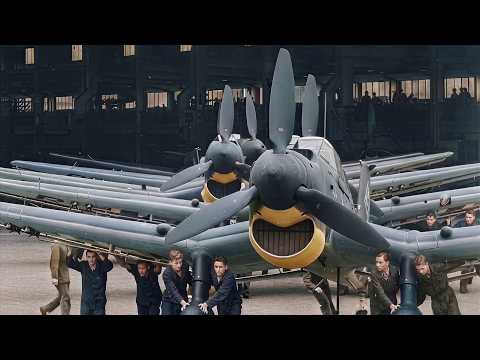
The roar of a Stuka’s engine is a sound that burrows into the bones—a guttural, mechanical scream that promises annihilation. On a windswept airfield in northern France, young pilots gather under an open sky, their eyes fixed on miniature ship models. They are learning to identify enemy vessels, to distinguish a destroyer from a freighter in the split second before a bomb is released. This is the training ground for the Channel raids, where German dive-bombers will soon streak low over the water, their bombs tearing through the hulls of Allied convoys.
But even as these crews prepare for their deadly work, a far greater drama is unfolding—a story of industrial might, desperate logistics, and a secret plan that will stretch across three continents. The war is not just fought with bombs and bullets; it is fought with assembly lines, with oil, with steel, and with the audacity to fly halfway around the world to strike the enemy from an unexpected direction.
In the heart of Germany, massive steel ingots glow white-hot at over 1,100 degrees Celsius. Crane operators guide the blazing metal into a forging press, where it is hammered relentlessly, lengthened and shaped into the barrel of a railway gun—one of the heaviest weapons Germany possesses. The process demands precision to within fractions of a millimeter. Every measurement is checked, every cooling spindle monitored. This is the birth of artillery that will hurl shells across the English Channel.
Meanwhile, in the shipyards and submarine pens, another kind of weapon is being prepared. Young sailors learn the intricate layout of a U-boat’s pressure hull: torpedo room, crew quarters, control room, engine room. They practice emergency dives, the captain’s voice echoing through the loudspeaker: “Both diving stations! Both diving stations!” These crews will soon face the enemy, proving that thorough training is half the victory.
But the war is not only fought by the Axis. Across the Atlantic, a monumental operation is taking shape. In Tehran, in December 1943, the three great Allied leaders agree on a plan of unprecedented scope: shuttle bombing. American bombers will take off from England and Italy, strike targets deep in Eastern Europe, and then land in Soviet Russia to refuel and rearm—before hitting more targets on the way home. It is called Operation Titanic, and it will turn the skies over Europe into a three-sided battlefield.
The challenges are staggering. Over 20,000 tons of equipment must be shipped across submarine-infested waters to Murmansk, then transported 2,000 miles by rail through the Soviet Union. Fuel and bombs must come from Iran and the Middle East, crossing deserts and mountains. A task force of ground crews travels 7,000 miles from England to Egypt, then by rail through Palestine and Iraq, over the snow-capped mountains of Persia, and finally by special train into Russia. “This was a secret journey of over 7,000 miles,” one officer later recalls. “And by the end of four months, the bases were ready.”
On June 2, 1944, the first shuttle mission launches. At 6:00 a.m., bombers roar off English runways, each taking off precisely thirty seconds apart. Their target: the oil fields at Rowland, deep in Germany. After the bombing, they do not turn back—they continue east, toward Russia. As they cross the Soviet border, the navigator’s voice crackles over the intercom: “Navigator to crew. Navigator to crew. It won’t be long now. We are over Russia.” From the sky, all countries look alike. But this is friendly territory. No enemy fighters, no flak—just solid ground ahead and a new ally waiting below.
As the B-17s touch down at their new base, the crews are greeted by General Walsh and General Perminov, the American and Russian commanders. The base looks like any American airfield—rows of tents, P-17s lining the runways, ground crews staring at the sky. But one difference is unmistakable: the ruins that surround the base on all sides, a silent reminder that the enemy once walked here. The first half of the mission is over. The second half has already begun.
Ground crews swarm the parked bombers like ants on a carcass, but there is no death here—only the urgent, practiced rhythm of repair. American mechanics work shoulder to shoulder with Russian armorers, their hands speaking a language that needs no translation. Wrenches turn. Panels open. Engines cough and sputter back to life. A Russian sergeant points at a damaged wing, then at a replacement panel, then grins. The American mechanic grins back. The job gets done.
Inside the mess tent, the men line up for dinner. The queue is long, but no one complains. Katya, Masha, and Olga move behind the serving counters with the efficiency of soldiers on a mission—which, in a sense, they are. “Bozhalyusta,” one of them says, ladling out a thick, dark stew. The Americans repeat the word, mangling it, and the cooks laugh. It is a good sound, laughter in a war zone.
The food is unfamiliar: buckwheat porridge, black bread, canned meat prepared Stroganoff-style. The coffee is hot, and that is the kindest thing anyone can say about it. But the men eat with appetite. “This beats K-rations any day,” mutters a gunner from Texas, and heads nod around the table.
At 9:00 p.m. in Russia, it is noon in Massachusetts. The men of the 15th Air Force think of home—of lunch counters and front porches, of baseball games and Sunday drives. But the war does not pause for nostalgia. In the command post, Colonel Albert A. Kessler and his Russian counterparts lean over maps, their fingers tracing railway lines and factory complexes.
“The target is selected,” Kessler says. “Weather permitting, we go tomorrow.” The numbers are staggering: over 350,000 gallons of gasoline, more than a million rounds of ammunition, 500 tons of bombs, and 50,000 man-hours of maintenance. American and Russian hands will make it happen. They always do.
While the crews work, some men find moments of peace. A group gathers on the grass to watch a makeshift baseball game—but the Russians, it turns out, have seen this game before. “They already knew how to play,” laughs a corporal from Ohio. “One of them hit a line drive that nearly took my head off.” Others write letters home, trying to explain the unexplainable: that their son, their husband, their brother is somewhere in Russia tonight, sleeping under the same sky as a people they cannot yet understand.
Some men walk to a nearby village, drawn by curiosity. The town is a trading center for the surrounding farmland, its main street lined with shops and a museum of Ukrainian treasures. The people are poor but proud. “They have so little,” one lieutenant writes in his journal, “and yet they share what they have.” A young girl teaches him a Russian word for friend. He teaches her one in English. Neither will forget.
The next morning, the base hums with the familiar rhythm of pre-mission chaos. At 6:00 a.m., crews crowd into the briefing tent, the air thick with coffee and cigarette smoke. Maps are unrolled, targets pinpointed. Today, the target is a tank factory in Poland—a facility that has been churning out Panthers for the Wehrmacht. “No target in German-occupied Europe is safe from American bombers,” the briefing officer declares. “Today, we prove it again.”
By 9:00 a.m., the B-17s are airborne, their engines thundering across the Russian sky. The formation assembles at 12,000 feet, then climbs to 22,000—the bombing altitude. Fighter escort joins them over the front lines at 11:43, the P-51s appearing like a swarm of angry hornets. The crews call them “Little Friends.” The fighters wag their wings in reply.
At precisely 1:20 p.m., the bomb bay doors open. Ten 500-pound general-purpose bombs fall away, one after another, their fins whistling through the thin air. The target disappears in a curtain of smoke and fire. Flak rises to meet them—black puffs blooming like deadly flowers—but the formation holds steady. The fighters weave through the barrage, chasing off enemy interceptors. Two B-17s take hits; one limps but stays in formation. The other falls behind, engines smoking, before turning back toward Russia.
As the bombers head home, the men inside are quiet. The adrenaline has faded, replaced by exhaustion and the hollow ache of loss. “Did you see that?” someone asks over the intercom. “They got Miller’s plane. I saw the wing come off.” No one answers. There is nothing to say.
Back at the base, the ground crews wait. They count the planes as they return, their faces tense. When the last B-17 touches down, a cheer goes up—but it is muted, respectful. Eight planes are missing. Eight crews. The cost of the mission is tallied in empty bunks and unclaimed letters.
That evening, the men gather in the mess tent again. The food is the same—borscht, kasha, black bread—but tonight it tastes different. A Russian pilot raises a glass of vodka. “To the fallen,” he says in broken English. “And to the victory they will not see.” The Americans raise their cups. The gesture needs no translation.
Later, a young lieutenant from Brooklyn sits on a crate outside his tent, staring at the stars. A Russian nurse passes by, pauses, and offers him a cigarette. He takes it. They smoke in silence, two strangers from opposite sides of the world, bound together by a war that has touched them both. “You miss home?” she asks. He nods. “Me too,” she says. And for a moment, the vast distance between their countries seems to shrink.
The next morning, the sun rises over the base as if nothing has changed. But the empty cots tell a different story. Mechanics are already out on the tarmac, patching flak holes, swapping out engines, replacing propellers. “We’ll have them flying again by noon,” a crew chief says, wiping grease from his hands. The war does not wait for grief.
In the command post, Kessler and his Russian counterpart pore over reconnaissance photos. The tank factory is confirmed destroyed—a column of smoke still visible from the air. “The Red Army will advance faster now,” the Russian colonel says. “Your bombs have opened a door.” Kessler nods, but his eyes are on the casualty list on his desk.
That afternoon, the crews assemble for a ceremony. The Russian commander pins medals on American airmen—the Order of the Patriotic War, awarded for valor in the shuttle raids. A young gunner from Alabama steps forward, his hands trembling. “Spasibo,” he says, the word awkward but sincere. The Russian general embraces him, and the men cheer.
Before dawn on the third day, the B-17s lift off again, heading west this time—back to England, back to Italy. Their bomb bays are empty, but their mission is complete. As the coast of Russia fades behind them, a navigator writes in his log: “We came as strangers. We leave as allies.”
In the weeks that follow, the shuttle raids continue. Targets fall across Poland, Hungary, Romania, Germany itself. The Luftwaffe scrambles to respond, but the triangular route keeps them guessing. “Where will they come from next?” a German general asks in frustration. No one can answer.
By the end of the summer, 3,800 American aircraft have passed through the secret Russian bases. The cost has been high—dozens of planes lost, hundreds of men missing—but the damage to the Reich is incalculable. Oil refineries burn. Railway yards lie in ruins. Tank factories stand silent.
On the last day of August, a final B-17 touches down in England. The crew climbs out, sunburned and exhausted, and a ground crewman tosses them a baseball. “Welcome home, Big Friend,” he says. The pilot catches it, grins, and throws it back. The war goes on—but for a moment, there is laughter.
Years later, a veteran of the shuttle raids will write: “We were ordinary men in extraordinary times. We flew halfway around the world to prove that no enemy was beyond our reach. And we learned that the people we were sent to help were not so different from us after all.”
The story of Operation Titanic is not just a story of bombs and steel. It is a story of men from Ohio and Alabama, from Brooklyn and Texas, who slept in Russian tents, ate Russian porridge, and learned to say “horosho” with a smile. It is a story of a world at war, and of the unlikely friendships forged in its fires.
And it is a story that asks us, even now: what would you be willing to risk to stand with an ally you barely understood? Share your thoughts in the comments below.
Report this article
Select a reason for reporting:






