In the summer of 1888, 120 feet beneath the hills of Erath County, Texas, a Scottish miner’s pick struck something inside a solid seam of coal. The sound that rang back was not rock, not pyrite, not any bend in the seam. It was long, low, and metallic—like a bell heard from far away.
Six days later, by lamplight, the miners stood before a hammer no human could hold. The handle was sixteen feet long, as thick as a man’s waist. The head stood taller than a grown man, its striking face studded with rows of blunt iron spikes. And beside it, carved not into stone but into iron, was a round mark no one could explain.
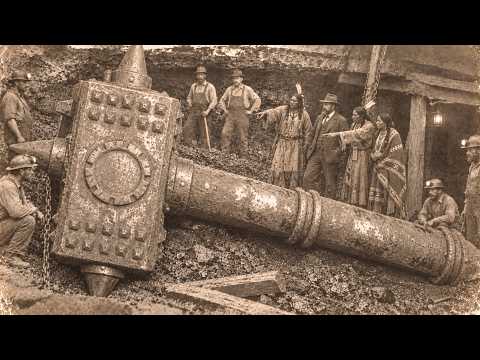
The strongest man on the crew gripped the handle with both hands. He managed to raise it a hand’s width. That was all.
But the strangest part of the story was yet to come. Forty-five years later, in a tent in Oklahoma, an elderly Comanche man who had never seen the hammer, never read a single mining report, and could not speak English would describe it perfectly—its spiked face, its three iron points, its seven notches. And he would say who left it there.
To understand what lay beneath that ground, you must first understand the land itself. Thurber today is little more than a dot on the map, seventy miles west of Fort Worth, marked only by a lone red-brick smokestack rising from flat pasture. But in 1888, these oak-covered hills were the beating heart of a machine that set Texas in motion.
Beneath them lay a thin, hard seam of coal, left behind by an ancient swamp forest that sank roughly 300 million years ago. The miners who came to dig it were Scots, Welsh, Irish, Cornish—men who had worked underground since boyhood. They were paid by the ton. Nothing but coal was worth anything.
That is why, on the morning of August 14, when a miner named Robert Mure struck something that was not coal at the far end of the east entry, the first instinct was to dig it up and throw it away.
But the log book of a shift foreman named Samuel Travale would record what happened next—and that log book still survives.
Travale was a 44-year-old Cornishman who had been underground since the age of twelve. His job was to jot down the day’s entries at the end of each shift: how many cars shipped, which mule was limping, who didn’t show up. Most of the entry for August 14 was routine. Ninety-four cars. Water in the west corridor. One mule replaced.
Then, at the bottom of the page, in a different ink, a single paragraph began. At nine in the morning, at the far end of the east entry, Mure’s pick had struck an iron object in the middle of the coal. There was solid coal above, below, and on both sides of it. No cracks, no fissures, no signs of water. The object was embedded in the seam as if it had grown there.
Mure struck it twice more. The same sound rang out twice more—long, low, metallic. Then he set down his pick and called for the foreman.
Five other men were working with Mure that morning. Travale wrote all their names in the log book: two Irish brothers, Pat and Michael Kio; a shot-firer named Tom Rudd; a loader named Joseph Pew; and a Welsh miner named Owen Maddok. Company policy required the names of everyone present whenever an unusual incident occurred. Travale took this incident as seriously as any accident.
According to his account, the Kio brothers were working in the next room when they heard the sound. A thick column of coal separated them. The sound had traveled through that column and reached them.
Michael Kio said it wasn’t the iron itself that was ringing, but the entire seam.
For the next six days, at the end of each evening’s entry, Travale added one short line in the same ink. Day one: the edge was found. Day two: the surface continues with no end in sight. Day four: the roof rock is being cut. Day six: fully exposed.
And in the entry for the seventh day, Travale wrote for the first time what he saw in a single word: hammer.
The measurements he recorded on August 20 were a foreman’s measurements, taken with a measuring tape, a folding ruler, and a lamp. From the tip of the handle to the back of the head: nineteen feet seven inches. The height of the head: seven feet two inches. Eight rows on the striking face, eight spikes in each row. Next to the head, a round carving approximately three feet in diameter. On three sides of the head, sharp iron points each about twenty inches long.
And the final line: It doesn’t fit in the cage.
To understand what that line meant, you have to picture a coal shaft. Men and coal cars were brought up from underground via a single route—a narrow cage that went up and down on a rope inside the shaft, just large enough to hold a cart. The cage in shaft number one was six feet wide. One hundred twenty feet below ground lay an iron hammer nineteen and a half feet long, and there was no way to bring it to the surface.
The crew tried anyway. According to Travale’s entry for August 21, six men and two mules tried to lift the head of the hammer using chains. One of the chains snapped. In another entry, it is written that the crew’s strongest man, the six-foot-four Welsh miner Owen Maddok, gripped the end of the handle with both hands. Maddok managed to raise it a hand’s width. Then he let go.
Below this line, Travale wrote something not found anywhere else in the notebook. A comment. The hand that swung this was not one of ours.
That same evening, the engineer was summoned.
Charles E. Wearing was a twenty-nine-year-old mining engineer raised in Pennsylvania. The Johnson brothers had hired him to map the veins and determine the locations of new shafts. He carried far more than a foreman’s rope and tape: a steel tape measure, a compass, a pocket scale, a magnifying glass, and a sketchbook.
On August 22 and 23, 1888, Wearing descended into the east entry twice. He spent a total of eleven hours down there. He left behind a seven-page survey report and three pencil drawings.
The notes are those of an engineer—brief, numerical, uncommented. Total length: nineteen feet seven inches. Circumference of the handle at its center: thirty-eight inches. At both ends of the handle and exactly at the center, ring-shaped bands two inches thick. The height of the head: seven feet two inches. The width: four feet. Striking face: sixty-four spikes, eight rows, eight in each. Each spike four inches across at the base, blunt at the tip.
Wearing measured the spacing between the spikes one by one and found no variation greater than one-eighth of an inch in any of them.
On the side of the head was a round medallion, thirty-six inches in diameter, its surface slightly raised like a shield. Along its edge, at equal intervals, were seven notches and three prongs.
In Wearing’s notes, the three points are given their own paragraph: emerging from the top, bottom, and back of the head, each twenty inches long, thick conical iron points. Wearing writes that these were not cast together with the hammer. Each was attached to the head by a heavy riveted band. The rivet heads were irregular, as if hammered by hand.
In other words, someone had once made this hammer—and then added these points to it later.
Wearing does not discuss what this means. He merely writes: The metal of the points is a different color from that of the head.
Next came the weight calculation. Wearing calculated the hammer’s volume piece by piece and multiplied it by the weight of cast iron. The result: if it were solid iron, it would weigh more than six tons. Six tons—heavier than a set of locomotive wheels.
We know from his notes what the three drawings showed. The first was a full side view of the hammer, scaled with a ruler. The second was a front view of the striking face, with each of the sixty-four spikes marked individually. The third was the medallion itself, its seven notches drawn with a compass.
Wearing also conducted an experiment. He tapped the edge of the medallion lightly with a hand hammer and timed the sound with his pocket watch. The ringing lasted fourteen seconds. Cast iron typically produces a short, muffled sound. This sound, as he noted, was long and clear, like the sound of a church bell.
Wearing also noticed that the notches on the medallion were not evenly spaced. Six of the seven notches were close together, while one stood apart from the others. Wearing jotted this down in the margin of a drawing. He did not explain why it was important.
We will return to this small detail.
At this point, we need to clarify something. Thurber’s coal is the remnant of a swamp forest that sank approximately 300 million years ago, during the Pennsylvanian period. Coal forms slowly. Trees fall, sink into the water, are covered by mud. The mud turns to rock and the plants turn to coal. An object cannot enter this vein later on. If it does, it leaves a trace where it passed—a crack, a collapse, a fill.
Travale’s notebook and Wearing’s notes both say the same thing: there was no such mark.
Wearing adds one more detail, perhaps the strangest of all. On the surface of the handle, beneath the rust, there were thin parallel lines resembling tree rings. Wearing had examined them with a magnifying glass. There were even knots. But the handle was not wood. It was iron from end to end.
It was as if someone had transformed a handle that was once made of wood—grains and knots and all—into iron.
Wearing’s final note is a single line: No one made this to be swung. Not anyone like us.
Below Wearing’s note, written in a different hand, is another date—August 24—and three words: Johnson down to be closed off.
This is where the official story begins. And to be fair, the official story has its own logic.
William Whipple Johnson went down to the east entry on August 24. According to Travale’s log, he stayed for less than an hour. He walked around the hammer once, touched the spikes, and gazed at the medallion for a long time. Then he made two decisions.
First, the hammer would not be removed from its place. It wouldn’t fit in the cage, and widening the shaft would take weeks. Johnson didn’t have a week to spare. The railroad was waiting for coal.
Second, the hammer would be dragged out of the working corridor and moved to an old, unused side room at the east entry. According to Travale’s record, this task took four mules, three chains, and two days.
Both decisions were those of an operator. Not excessive, not secret. Reasonable.
Travale’s August 25 entry describes how the move was carried out. The men slid oak planks under the hammer. Four mules were tied with thick chains around the sharp tip at the back of the head. The hammer was dragged along the planks a few feet at a time, all the way to the side room. The distance was only forty feet. It took two days.
Travale concludes this entry with a single line: The mules refused to enter the east entry again.
Johnson wrote to Austin that September, begging the state geologist to come and see. “I do not ask you to believe it. I ask you to come and see it.” But a strike hit the mine that same month, the company was sold by October, and no one ever came. In November, the side room was sealed with stone and brick. On the company map, one line: Old east entry closed.
Forty-five years later, in a tent outside Lawton, an old Comanche man drew the hammer’s shape in the air for an anthropologist named Hobble. He had never seen the reports, never read a word of English. Yet he spoke of seven notches—six together, one alone. “They laid it in the ground so that the earth might remember who first held it.”
Today, Thurber is a smokestack, a church, and a cemetery. The shaft is filled with dirt. The tunnels lie under dark, still water. And if the records are true, the hammer still waits in that sealed room—unlifted, unclaimed, unremembered by anyone but the earth itself.
If the ground truly remembers who first held those hills—should we be the ones to wake it? Tell us what you think in the comments.
Report this article
Select a reason for reporting:






