On July 9, 1873, a blast in the lock pit at Sault Ste. Marie broke into a hidden passage in the red sandstone. At its end stood a stone gate sixty-six feet high, its two leaves meeting in a single seam, its face carved with seven massive lips of stone. The Ojibwe already had a name for that place, and they said the gate was ancient. They said it was shut from the inside.
Anders Strand, a hammer man from Norway, was the first to say something was wrong with the rock. Two days before the blast, he stopped mid-swing and told the powder man, Owen Travail, that the stone answered differently. Like a bell, he said, with a cloth over it. They fired the round anyway at twenty minutes before eleven. The smoke came back cold.
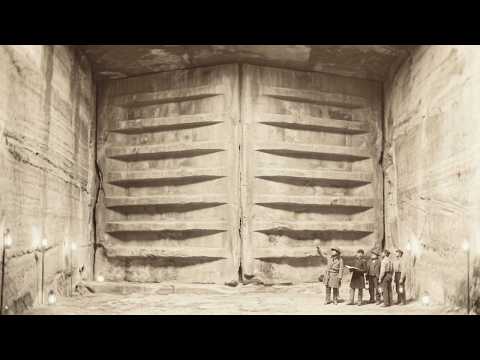
Captain Josiah Abbott, a lock man raised on the Erie Canal, went in with Strand holding the lanterns. Thirty feet from the mouth, the roar of the rapids simply stopped. He stood still for a minute by his watch and listened to nothing at all. Then he wrote one word and gave it a line to itself. Quiet.
The passage ran straight and flat for 214 feet, its walls 46 feet apart without a half-inch of variation. The floor was dead level. To a man raised on a canal, that was the plainest fact of all: a floor without fall carries no water. It was made flat because someone wanted it flat.
At the end, the gate rose higher than any church steeple on Lake Superior. Abbott sighted his transit twice by magnesium light. Both times the answer was 66 feet. The leaves met at an angle, the point facing the rapids, the way a lock gate is always set so the water itself presses it shut. But there was nothing on the near side to take hold of. No post, no beam, no ring.
Four days later, an old Ojibwe man came down the rapids in a birch bark canoe. He would not look at the breach. He tipped his chin toward it, Abbott wrote, as one does toward a person who might overhear. He asked three questions. Do the doors lean toward the white water? They do. On your side, is there anything to pull on? There is not. The bottom one, toward where the sun comes up, is it different from the rest? Here the journal shows a blot where the pen rested too long.
Then he gave a warning in three parts. Do not knock on it. Do not build against it. Do not quiet the rapids. The army built against it within the week.
Abbott tried steel. Three men drilled at the lowest lip of the west leaf for a full hour. The bit came out dull and blued from heat no one had felt. A cold chisel broke its edge on the first blow. A file scraped a pinch of gray dust into a glass vial, sample number nine, and sent it to Columbia College. The reply came back in September. Not sandstone, not granite, not trap. Heavier than any stone in our cabinet. Not determined.
Travail swung a sledge against the leaf. There was no ring. The blow died as though it had landed in wet clay. Strand spoke under his breath in Norwegian, then repeated it in English for the captain. At home, they would say, this is a door in the hill. You do not knock on a door in the hill.
Abbott put his thermometer against the stone. The chamber air stood at 49 degrees. The gate itself read 45. The chamber was not cold because of the rock around it. It was cold because of the gate. At the foot of the page he wrote one more sentence and drew a line beneath it, the only underlined line in the journal. It is shut from the inside.
Within ten days the passage was walled up and entered on the drawings as a rock pocket. The annual report said only that a pocket of unsound rock was removed and the opening closed without delay. But a journal in brown ink, an old fisherman’s son, and a rodman’s steel tape kept something the drawing did not.
Sixty-nine years later, in the spring of 1942, a survey party sounding for voids behind the old lock found the iron hatch and sawed off the rusted padlock. The passage ran exactly where the drawing put it. The gate was still there. But the seam had opened. The leaves now stood apart, edge parallel to edge, and a steel tape across the gap at chest height read three and three quarter inches. A flashlight beam went into the opening and lit no back wall and no floor and came back off nothing.
That afternoon, an old woman came down to the lock. Her father had worked on the old lock in 1873, she said, and all his life he had said one thing about it. It shut when I put my hand on it. Her father was Anders Strand.
The district office answered the telegram by morning. Structure outside scope of lock construction. Seal and proceed. Schedule governs. So it was sealed. The hatch plate was welded shut and concrete poured behind the old masonry. On the drawings, a draftsman hatched a small rectangle and wrote beside it: old void, sealed, not explored.
The Ojibwe name for the place does not say cave, and it does not say rock. It says what happened there. Where they closed themselves in.
Kessler’s field book records what the old woman did not say. He noted the date, the hour, the temperature against the stone, and then, in pencil, a single line: Daughter of Strand. Confirms father’s account. No further information offered. He did not write down what she did with her hands. But Paquin remembered. Years later, on the tape, he said she pressed her palms together, fingertip to fingertip, and then parted them slowly, a hand’s breadth of air between. Just like the old man in the canoe, he said. Just like that.
No one had told her about Joseph Kesick. No one had told her about the student’s notebook or the three questions or the movement of the hands. She had learned it from her father, who had learned it from the stone itself, or from the silence that came when he pressed his palm to the seam in 1873 and felt someone listening on the other side.
The war years swallowed the rest. The MacArthur lock opened in July of 1943, and the old lock was demolished, its walls broken down and carted away, the hatch and the concrete plug and the sealed void buried under the new chamber’s south wall. The passage that had run 214 feet under the rising ground was gone from the drawings, gone from the ground, gone from memory except in a field book in Detroit and a bundle in Chicago labeled St. Clair Flats.
But the gate was not gone. It could not be. The new lock was built on the same ground, and the south wall of the MacArthur chamber ran along the line where the old passage had been. The engineers knew this. They had to. Kessler’s report, the one that omitted station five as not pertinent, still carried the coordinates in its appendix. The new wall was poured with that knowledge in hand. And every winter, when the locks closed and the chambers were pumped dry, the maintenance crews walked the floor of the MacArthur lock and saw nothing unusual, nothing but concrete and steel and the cold, clean lines of a modern lock.
Until February of 2019. A maintenance note records it in passing. Along the south wall, near the western end, a strip of floor about 46 feet wide did not take ice, though the air in the chamber stood below zero for nine days. Cause not determined. The note does not say what the men thought. It does not say whether anyone stood on that strip of bare floor and felt the cold coming up through their boots, colder than the air, colder than the concrete, cold the way the gate had been cold in 1873 and 1942. It does not say whether anyone pressed a palm to the south wall and counted the seconds.
The strip of floor is exactly 46 feet wide. The passage was 46 feet wide. The men who wrote the note did not know that. They had never heard of Abbott or his journal or the gate that was shut from the inside. They only knew that the floor did not freeze, and they wrote it down, and they moved on.
There is a version of this story that ends there, with a maintenance note and a shrug. But the file does not end there. The file has one more page, and it was written not by an engineer or a captain or a student but by a woman who never saw the gate and never went into the passage and never heard the rapids go quiet.
Her name was Margaret Strand, and she was the great-granddaughter of Anders Strand. In the summer of 2021, she was cleaning out her mother’s house in Sault Ste. Marie, Ontario, when she found a wooden box in the attic. Inside were three things. A photograph of the old lock wall before the new one swallowed it, taken in 1942 by a man she did not recognize. A letter in Norwegian, dated 1874, from Anders to his brother in Telemark, which no one in the family had ever translated. And a small leather notebook, water-stained and brittle, with a single entry on the first page.
Margaret had the letter translated. Most of it was ordinary. The weather, the wages, the wife and daughters, the rented room in town. But near the end, Anders wrote something else. He wrote that he had been inside the rock and had seen the door. He wrote that he had put his hand on it and felt someone listening. And then he wrote a sentence that made Margaret sit down on the attic floor and read it three times. The door is not locked, he wrote. It is held. There is a difference.
The notebook was harder. The first page was in Norwegian, in Anders’s hand, and it said only this: What I saw in the rock, I will not write in English. The captain writes in English. The captain’s book will go to the government. This book will go to my daughter. She will know what to do with it. The rest of the notebook was blank.
Margaret did not know what to do with it. She still does not. She has not shown it to the historical society or the tribe or the corps of engineers. It sits in a drawer in her house, next to the photograph and the translated letter, and sometimes she takes it out and reads the first page and wonders what her great-grandfather meant. The door is not locked. It is held.
She has never been inside the MacArthur lock. She has stood on the lock wall in summer and heard the ship engines and the gulls and the low murmur of the rapids off to the north. She has thought about the gate, sixty-six feet high, with its seven lips and its seam that took nothing, and she has wondered whether it is still there, under the concrete and the steel, still held, still waiting for the rapids to go quiet.
The rapids are not quiet. They have not been quiet for a hundred years. But they are quieter than they were. The 16 gates at the head of the rapids decide how much water goes over the ledge, and in most seasons it is a fraction of the old river. On a calm morning, the white water is only a murmur. And somewhere under the south wall of the MacArthur lock, behind the concrete and the sealed void, the gate stands in the dark, its seam open three and three quarter inches, and the cold comes up through the floor, and no one has drilled a borehole to see what lies on the other side.
Margaret Strand has not drilled one either. She has thought about it. She has thought about writing to the corps, about sending them the notebook and the letter and the photograph, about asking them to put a hole through the south wall and put a camera through it and see what is there. But she has not done it. Some doors, she says, are not meant to be opened by the people on this side.
She says it the way her great-grandfather might have said it, the way the old Ojibwe man said it in 1873, the way Joseph Kesick said it to Ruth Ellingson in 1922. She says it quietly, and then she puts the notebook back in the drawer and closes it and goes downstairs to make tea, and the rapids murmur off to the north, and the gate stands in the dark, and the cold comes up through the floor.
The file does not end here. It cannot end here. There is still the question of the three photographs that went missing in 1942, the ones of the open seam, taken by the officer who reviewed all photographs under wartime rules. There is still the question of what the corps did with them, and why no record says where they went. There is still the question of the borehole that no one has drilled, and the floor that does not freeze, and the notebook that Anders Strand left to his daughter, and the sentence that Margaret Strand cannot forget.
The door is not locked. It is held.
And there is one more thing. In the summer of 2023, a drone photographer flying over the locks at the Soo, filming for a tourism video, captured something he did not expect. The footage shows the MacArthur lock from above, the chamber pumped dry for repair, the floor clean and gray and ordinary. But along the south wall, near the western end, there is a strip of floor that looks different. It is darker than the rest, as if it has not dried, as if something beneath it is still cold. The photographer did not notice it at the time. He noticed it later, when he was editing the footage, and he posted a clip online, and someone who had read about the gate and the passage and the strip of floor that did not take ice commented on the video and asked a question.
Is that where the door is?
No one answered. The photographer did not know. The commenter did not know. But the question is there now, in the record, in the file, in the long chain of pages kept by people who never saw one another’s work. And the gate stands in the dark, held, waiting, and the rapids murmur off to the north, and the cold comes up through the floor.
The drone clip spread quietly. A retired corps surveyor named Dale Ferris watched it three times, then drove to the Soo with a thermal camera and a friend’s boat. On a cold October morning he stood on the lock wall and pointed the lens at the south wall of the MacArthur chamber. The strip glowed faintly blue on the screen, colder than the concrete around it. “That’s not shade,” he said. “That’s something breathing.”
He sent the image to Margaret Strand. She answered within an hour, and the two of them met in a coffee shop on Portage Avenue, the notebook and the letter on the table between them. Dale read the first page twice. Then he said the thing she had been waiting three years to hear. “A borehole wouldn’t open it. It would only let us listen.”
They never drilled. But that winter, Dale mounted a geophone against the south wall and left it running for nine days. The recordings are still in his garage. On the fourth night, at 3:11 in the morning, the sensor caught something the microphone could not: a low, even pulse, slow as a resting heart, coming up through forty feet of concrete and a billion years of sandstone.
He has never played it for anyone but Margaret. She listened once, then asked him to stop the tape. “That’s not the rapids,” she said. “The rapids are north.”
So the file stays open. The gate is still held, the strip still cold, the notebook still in the drawer. And somewhere under the south wall, something keeps its slow and patient time, waiting for a quiet that has not yet come.
If you found a door like that in your own family’s attic, would you knock, or would you listen?
Report this article
Select a reason for reporting:






