It was the golden age of Hollywood—a time when stars didn’t just act; they lived, loved, and burned with a passion that blurred the line between fiction and reality. On the silver screen, they gave us unforgettable romances, but behind the cameras, in the shadows of the studio lights, some of the most explosive love stories were never meant for public eyes. These are the romances that began on set, hidden from the world, yet captured in rare, unseen photographs that now whisper their secrets.
In the 1950s and 60s, the studio system ruled with an iron fist, and stars were groomed to project perfection. But off-camera, their hearts beat with a wild rhythm, and when two co-stars collided, the sparks were inevitable. From stolen glances between takes to secret rendezvous in trailers, these affairs were the stuff of legend—and scandal.
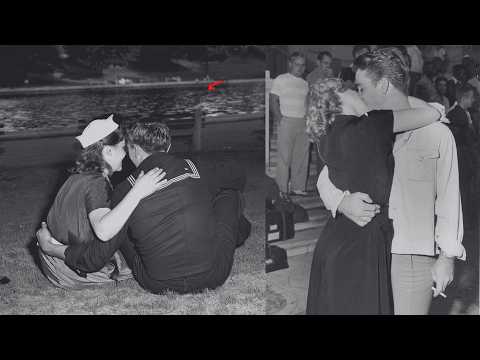
Take, for instance, the electrifying chemistry between Marilyn Monroe and Yves Montand during the filming of Let’s Make Love (1960). Their affair was an open secret on set, with Monroe’s then-husband Arthur Miller watching from the sidelines. The photos from that time show a flush of forbidden excitement on Monroe’s face, a spark that no script could manufacture.
Then there was Elizabeth Taylor and Richard Burton, whose torrid romance on the set of Cleopatra (1963) nearly broke the tabloids. Both were married to others, but their passion was a force of nature—caught in candid moments between scenes, their eyes locked in a gaze that spoke of a love that would endure for decades.
But not all on-set romances were doomed or scandalous. Some blossomed quietly, like Paul Newman and Joanne Woodward, who met during The Long, Hot Summer (1958). Their love story was a rare gem in a town of broken hearts—a partnership that lasted a lifetime. The rare photos of them laughing between takes reveal a tenderness that was both real and enduring.
These images, unearthed from studio archives and private collections, offer a glimpse into a world where love was both a risk and a reward. They remind us that behind the glamour and the gossip, these were real people with real desires, navigating a world that demanded perfection while their hearts craved authenticity.
As we delve deeper into this hidden archive, you’ll discover the moments that were never meant to be seen—the stolen kisses, the lingering touches, and the loves that changed Hollywood forever. But for now, let these first few glimpses transport you to a time when romance was an art form, and the camera was the only witness.
Not every backstage romance, however, burned with the heat of a scandal. Some flickered quietly in the corners of soundstages, sustained by whispered phone calls and carefully timed exits. Katharine Hepburn and Spencer Tracy began their decades-long affair on the set of Woman of the Year in 1942, and the rare frames of them sharing a cigarette between takes betray a devotion that neither ever fully acknowledged in public.
Tracy, married and Catholic, never divorced; Hepburn never pressed. Their love lived in the spaces between scenes, in the way she adjusted his collar before a shot, in the way he watched her rehearse with an expression no director could have scripted. Those photographs, grainy and unposed, are among the most tender relics of the era.
Then came the 1970s, when the old studio walls began to crack and a new generation of stars rewrote the rules entirely. On the set of The Way We Were (1973), Barbra Streisand and Robert Redford generated a chemistry so palpable that crew members swore the cameras caught something the script never intended. Whether it was love or performance—or both—remains a matter of debate among archivists who have studied the contact sheets.
And who could forget the unlikely spark between Diane Keaton and Warren Beatty during the chaotic production of Reds (1981)? Their romance unfolded against a backdrop of political idealism and grueling location shoots, and the candid photos of them rehearsing lines in dim hotel rooms capture a vulnerability that neither brought to the screen.
What these images share is a quality the studios could never manufacture: spontaneity. A hand resting too long on a shoulder. A laugh that arrives a beat too late. A gaze held just past the point of professionalism. These were the moments that the publicity machine couldn’t control—and the moments that, decades later, still feel achingly human.
As we move through the archive, the lens turns toward the romances that ended in heartbreak—the ones that left scars still visible in later interviews and memoirs. The next batch of photographs, pulled from a private collection long kept under lock and key, reveals a love triangle that threatened to bring down an entire studio.
The story begins with a name that still makes archivists lower their voices: Ingrid Bergman and Roberto Rossellini. When the Swedish star left Hollywood for Italy in 1948 to work with the director, she was married and the mother of a young daughter—and the world was watching. The photographs from the set of Stromboli show her standing barefoot on volcanic rock, her gaze fixed on Rossellini with an intensity that no script could explain.
When the affair became public, the scandal was seismic. Bergman was denounced on the floor of the U.S. Senate; her films were boycotted; her name became a cautionary tale. Yet the rare frames from that production, smuggled out by a crew member and hidden for decades, show not shame but defiance—two people who chose each other against the entire machinery of Hollywood.
Not every forbidden love carried such consequences. Some were quieter, more careful, and all the more heartbreaking for it. Greta Garbo and John Gilbert, the silent-era lovers, planned to marry in 1927—until Garbo left him at the altar, reportedly frightened by the intensity of her own feelings. The surviving photographs of them together, laughing on the set of Flesh and the Devil, are almost unbearable to look at now, knowing how it ended.
Then there is the story that the studio archives tried hardest to bury. In 1954, during the filming of A Star Is Born, Judy Garland found herself caught between her husband Sid Luft and her co-star James Mason—a triangle that played out in dressing rooms and late-night phone calls. The candid shots from that period reveal a woman exhausted but radiant, clinging to a love that was already slipping through her fingers.
What the archivists have long debated is whether these romances were genuine or manufactured—whether the passion we see in these photographs was love or simply the art of two performers who couldn’t stop performing. The answer, perhaps, lies somewhere in between. In a town built on illusion, even the heart learns to blur the line.
One photograph in particular has puzzled researchers for years: a dimly lit frame from the set of Some Like It Hot (1959), showing Tony Curtis and Marilyn Monroe in a corner of the soundstage, their faces inches apart. Curtis later called their affair “like kissing Hitler”—yet the image tells a different story, one of two people drawn together by something neither could name.
These contradictions are what make the archive so compelling. Every photograph is a fragment of a truth that the studios never wanted told, and every love story a reminder that even the brightest stars were, in the end, only human.
But the archive holds one final secret—a discovery that has haunted its curators since the day the box was opened. In 1987, while cataloguing a donation from a retired studio publicist, they found an unmarked envelope containing a single photograph: Audrey Hepburn and William Holden, caught in a quiet embrace on the set of Sabrina (1954).
The image had never been published. Hepburn, then newly married to Mel Ferrer, was rumored to have ended the affair when she learned she could not bear Holden’s child. Yet in the photograph, her eyes are closed, her hand resting on his chest—a moment of surrender the world was never meant to see.
“Some loves are too fragile for the light,” the publicist had written on the back in faded pencil. “I kept this because it was the only time I ever saw her truly unguarded.”
As the archive closes its doors each night, the curators often pause before that final image. They know the truth now: Hollywood’s greatest romances were never the ones scripted for the screen. They were the ones stolen in shadows, captured by accident, and hidden for decades—waiting for someone to finally look.
So we leave you with this question, dear viewer: if you could unearth one more lost photograph from Hollywood’s past, whose secret would you want it to reveal? Tell us in the comments below—and perhaps, together, we’ll bring one more forgotten love back into the light.
Report this article
Select a reason for reporting:






