He stood on the Oscar stage at 73, in a tuxedo, and dropped into one-armed push-ups while millions watched live. Billy Crystal tossed his script aside on the spot. Nobody in that room knew the real story.
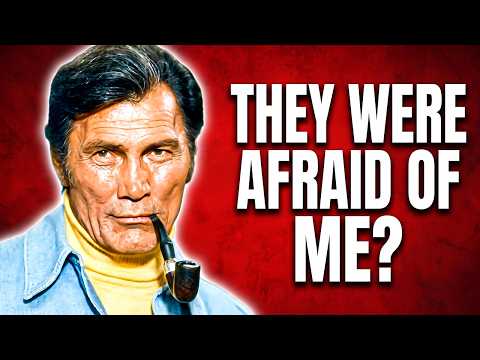
The face that made Jack Palance the scariest villain in Hollywood—the one in Shane, the one in Sudden Fear, the stare that froze Joan Crawford where she stood—was sold to the public as a wartime miracle. Studio publicists said a bomber crash had blown his features apart. They said surgeons rebuilt him from nothing. Palance called it a lie, flat out. “If it’s a bionic face,” he said, “why didn’t they do a better job?”
So, who was he, really? Volodymyr Palahniuk, born in a Pennsylvania coal patch during the Depression, a miner’s son. He boxed. He flew B-24 bombers. He broke Marlon Brando’s nose on a Broadway stage. He raised cattle he refused to eat. He painted. He wrote poetry. And decades later, he walked away from Putin’s people with five simple words, “I’m Ukrainian, not Russian.”
Now, why did he hate that face story so much? Not vanity, not even close. It was what the story did to him. It built a monster, and that monster belonged to everybody except Jack.
Let’s start where it all began. He learned to hate in the coal mines of Latimer. And no, it didn’t start with rage. It started with exhaustion, the slow, heavy kind that soaks into a family and never fully drains out.
Volodymyr Ivanovich Palahniuk was born on the 18th of February, 1919, in Latimer Mines, Pennsylvania. His parents were Ukrainian Catholic immigrants, and they’d landed in one of the roughest industrial corners of America. Picture the rhythm of that house. His father gone before sunrise. His father home after dark, coughing. That father, Ivan, spent 39 years working the anthracite mines. 39. And the company squeezed the family even on groceries. They were pushed to buy at the company store at inflated prices while cheaper food sat available just down the road.
Young Volodymyr went down into those mines himself as a kid. That’s not a colorful backstory. That’s a pressure cooker. But the ground under his feet carried something heavier than coal. Lattimer mines was the site of the Lattimer massacre on the 10th of September, 1897. A sheriff’s posse opened fire on striking immigrant miners, unarmed men mostly Slavic. 19 of them were killed. That was just 22 years before Palance was born. So, when he grew up there, the shooting wasn’t history. The people around him remembered it like yesterday.
Think about that. A boy raised in a town where his own community had been gunned down for asking for a fair deal. And yet, when Palance looked back, he didn’t paint it all black. He said, “I had a good childhood like most kids think they have.” He remembered playing in the third growth birch and aspen along the sides of the slag piles. Kids find joy anywhere. But then came the other line, the one that he thing. “I learned how to hate when I was a kid in the hard coal mines.”
His father Ivan would eventually die of black lung disease in 1955. The mines took him the way they took so many. And what did they leave behind in the sun? Toughness, anger, and the very face the world would never stop staring at.
So, how did he get out? Football. A scholarship to the University of North Carolina. But he lasted only two years. He walked away disgusted by how commercial the sport had become. And that decision, quitting a free ticket out of the mines because something about it felt rotten, tells you exactly who this man was about to become.
Boxing came next. And Palance never treated it like a credential, the way other actors did when they wanted to sound tough. For him, it wasn’t a story to tell at parties. It was a job and it hurt. Here’s the first thing most people never learn. Before Hollywood, before Broadway, Palance fought as a professional heavyweight out of Hazleton, Pennsylvania. His ring name was Jack Brazzo. By his own account, he won 15 fights in a row and 12 of them ended by knockout. Sounds like a heavyweight prospect, doesn’t it? But the official record tells a different story. BoxRec lists exactly one sanctioned fight, a four-round decision loss to a future heavyweight contender named Joe Baksi in December 1940. So, where did the rest of those wins come from? Most likely from unsanctioned club bouts in coal mining towns, the kind of fights that never made it into any record book. Those were rough rooms and nobody was keeping score for history.
There’s another piece of the legend worth clearing up. For decades, people repeated that Palance once fought Joe Louis. He didn’t. That story grew out of a mix-up between two names, Joe Louis and Joe Baksi, and it stuck around far longer than it should have. Palance’s own take on his boxing days was dry as dust. “Then I thought, ‘You must be nuts to get your head beat in for $200. The theater seemed a lot more appealing.’” Read that again. Brutal honesty, delivered flat with a shrug. That one line tells you how his mind worked.
Still, don’t think him untouched. It gave him something no drama class on Earth could teach. A physical presence and a real sense of menace. When he played dangerous men on screen, he wasn’t entirely acting. He knew what it felt like to throw a punch and he knew exactly what it felt like to take one.
Now we get to the big one, the crash, the face, and Hollywood’s greatest lie. This is the story that defined him and the one he spent his whole life trying to outrun.
So, what actually happened? In 1942, Palance enlisted in the Army Air Forces. He trained as a co-pilot on B-24 Liberator bombers. Co-pilot, not pilot, despite what you’ll read in plenty of places. Then came a training flight. Sources disagree on exactly where it happened, but they agree on the problem. His bomber lost an engine and went down.
Here’s the version the studio sold to the public. Palance bailed out of a burning aircraft. His face was badly burned. Surgeons had to rebuild it with extensive plastic surgery. And that reconstructed face, so the legend goes, became the weapon that launched a career playing the most frightening villains in Hollywood. It’s a perfect story. Almost too perfect. And for decades, Palance hated it.
He said so on national television. I know I’m no beauty, but he made it clear these were simply the Estonian features he was born with. And here’s the twist. He had the ethnicity wrong on purpose. He was Ukrainian, not Estonian. He said it just to show how little the truth mattered to anyone.
So, was any of it real? Yes, some of it. The AP obituary confirms his B-24 lost power on takeoff and that he was knocked unconscious. The LA Times reported severe head injuries and extensive facial reconstruction. Even his family repeated the burn story for years, but the accounts don’t line up. And that’s exactly the point. A crash did happen. Injuries were real. Palance was discharged in 1944. But the degree of reconstruction was almost certainly inflated, and the people doing the inflating were publicists who knew a gripping backstory when they saw one.
Hollywood didn’t just tell a story about the man. It decided it liked the myth better than the man himself. Here’s the twist most people never hear. The face that scared a nation might not have been scarred by anything dramatic at all. His features were most likely a mix of Eastern European bone structure, years of boxing damage, and some injury from a plane crash. For decades, the legend ran wild, and almost nobody checked it against a single record. The face that terrified America was probably the one he was born with, and Hollywood wrapped its most famous villain origin story around a myth.
Now, let’s talk about number four, because this one has a punch in it. He broke Marlon Brando’s nose, and in doing so, he stole a career that was supposed to belong to someone else. It was his first real lesson that luck doesn’t knock politely. Sometimes, it throws a punch.
Here’s how it started. After the war, the GI Bill sent Palance to Stanford University. He studied journalism, worked as a sports writer for $35 a week, and took drama classes under Michael Chekhov. He left Stanford one credit short of a degree, and headed straight for New York. Within two weeks, he had landed a part in a play. Then came 1947. Palance was hired as Marlon Brando’s understudy for the role of Stanley Kowalski in A Streetcar Named Desire on Broadway.
Brando, being Brando, rigged up a punching bag in the theater’s boiler room. And who did he invite down to work out with him? A former professional heavyweight. Think about that for a second. One night, Palance swung and missed the bag completely. His fist landed squarely on Brando’s nose. Brando went to the hospital, and the understudy? He walked out and played Stanley Kowalski. He was, the critics noticed, and he eventually took over the role for good. He even met his first wife, actress Virginia Baker, in that very production.
Let that sink in. A coal miner’s son accidentally broke the nose of the most famous young actor in America, then stepped into a spotlight meant for someone else. One stray punch in a boiler room changed everything. But if you think that’s wild, wait until you hear about number five.
He terrorized his co-stars with real violence, and here’s the part that makes it stranger. He never set out to scare anyone. Once he slipped inside a character, though, the line between performance and reality got dangerously thin.
Take the 1950 film, Panic in the Streets. One scene called for Palance to strike Richard Widmark on the head with a gun. They rehearsed it with a rubber prop, nice and safe. But when the cameras rolled, Palance swapped in a real gun and knocked Widmark out cold for 20 minutes. Widmark later shrugged it off with one line, “Why did he switch? Who knows?”
It didn’t stop there. Palance also got into character by beating on Zero Mostel off-screen. Mostel ended up in the hospital after the very first week. The crew had to soak him in Epsom pads just to get him functioning again. So, what did Hollywood make of all this? Widmark said it best: “The toughest guy I ever met. He was the only actor I’ve ever been physically afraid of.”
Now, here’s the twist that doesn’t fit the monster story. The people who knew him away from the set described someone almost shy, quiet, gentle with his kids, uncomfortable at parties. So, which man was the real one? On camera, the actors across from him never knew what was coming next. And that unpredictability gave his performances an electricity that no other screen villain could match.
His most famous role lasted just 13 minutes on screen, and he hated what it did to him. To Jack Palance, Shane wasn’t a triumph at all. It was a box, and he’d spend decades trying to claw his way out of it.
He played Jack Wilson, a hired gunfighter, arguably the most iconic Western villain ever put on film. The movie runs 118 minutes and Palance is on screen for fewer than 13 of them. 13 minutes. That’s all it took to earn his second Oscar nomination in a row. The author of the novel insisted nobody could fire a .44 while wearing gloves. Palance didn’t argue. He just showed him. He had his draw and fire down to three-fifths of a second.
Put him on a horse, though, and everything changed. Palance was terrified of horses. Director George Stevens waited until Palance finally pulled off one clean dismount, then used that single take for every dismount Wilson makes in the film. For the mounts, he ran the same footage in reverse. Stevens also scrapped the planned galloping entrance and had Wilson arrive at a slow walk instead. He never meant it to be scary. It just happened to make the scene scarier than the one they had planned.
Sam Peckinpah later said that when Jack Palance shot Elisha Cook Jr. in Shane, things started to change. Those 13 minutes didn’t just earn a nomination. They changed how Hollywood showed death on screen.
Elia Kazan betrayed him, and the man who took his place beat him for the Oscar. Kazan directed Palance in his film debut, then essentially promised him the part of Eufemio Zapata in Viva Zapata opposite Marlon Brando. Palance believed it. Then Kazan changed his mind and cast Anthony Quinn instead. The same Anthony Quinn Palance had understudied in the touring company of Streetcar.
It gets worse. Quinn won Best Supporting Actor for that role at the very same ceremony where Palance was nominated for Sudden Fear. Same category, same night. Quinn beat him with the part that was supposed to be his. And the pattern kept going. Quinn later starred in the film version of Requiem for a Heavyweight, another role Palance had originated on television. That’s not bad luck. That’s a pattern. Palance never spoke to Kazan again.
Still, the work from that stretch holds up. On Sudden Fear, his co-star Joan Crawford resisted casting him at first, and the two barely spoke off camera, but that friction fed the film. François Truffaut called it one of the most efficient thrillers he had ever seen, and it earned four Oscar nominations, including Palance’s very first.
He waited 40 years. And then he dropped to the floor of the Oscar stage and did one-armed push-ups. He wasn’t doing it to be funny. After four decades of being overlooked, words just weren’t enough.
This was a man who’d been nominated for Best Supporting Actor for Sudden Fear and Shane in back-to-back years and then watched the golden statue slip away. He lost both times. Hollywood moved on and nobody called. So he went where the work was. For decades, he made European B movies and spaghetti westerns, far from the studios that had once chased him, and he didn’t seem to mind. He later joked, “In Italy, everyone on the set has a drinking cubicle and no one is ever interested in working after lunch. That’s a highly civilized way to make a movie.”
Applause never mattered much to him. Privacy did. Europe gave him that. Television gave him everything else and it saved his career more than once. In 1956, he played the broken fighter in Rod Serling’s Requiem for a Heavyweight on Playhouse 90. That one performance won him an Emmy and a Peabody. Then came 1974. His TV Dracula was the first to blend the count with Vlad the Impaler. Sound familiar? It should. Francis Ford Coppola borrowed that very idea wholesale for his 1992 film.
Then the strangest turn of all. From 1982 to 1986, he hosted Ripley’s Believe It or Not. The show introduced him to a whole new generation of viewers, and his daughter Holly sat beside him as co-host. But the real shock was still coming.
In 1991, along came City Slickers. Nearly four decades after his last Oscar nomination, Jack Palance won Best Supporting Actor. Think about that gap. Almost 40 years, and he was on set for only 10 days. The role almost went to someone else. Palance had a scheduling conflict at first, so the production turned to Charles Bronson. Billy Crystal made the call and Bronson exploded. “I’m dead on page 53. How could you do this? Nobody kills Charles Bronson. Didn’t you see my Death Wish movies? I don’t die.” Then came his final answer: “F you, I’m dead.” Click. He hung up.
That slammed one door and opened another. Palance cleared his schedule and joined the cast. Now fast forward to Oscar night. Palance is 73 years old, standing at the podium, and he opens with a line straight from the film. “Billy Crystal, I crap bigger than him.” The room roars, but he isn’t done. He steps away from the podium. Then, right there on the Dorothy Chandler Pavilion stage in his formal suit in front of 40 million viewers, he drops to the floor and does three one-armed push-ups.
Why? Years later someone asked him. His answer was beautifully simple. “I didn’t know what the hell else to do.”
Backstage chaos. Crystal and head writer Bruce Vilanch looked at their prepared script and tossed it on the spot. What came next was pure improvisation. Crystal ran gag after gag for the rest of the night. Palance was on the StairMaster backstage. Palance had bungee jumped off the Hollywood sign. Palance had fathered every child in the production number. The writers ended up winning Emmy awards for a telecast they rewrote live.
And Palance had one more trick. He told the crowd that back in 1949, a producer had promised him he’d win an Oscar. Then he said, “42 years later, the man was right. How the son of a bitch knew, I’ll never figure out.” Afterward, at the reception, Palance walked up to Crystal and said, “I thought it would be you.” That was his way of saying thank you.
America laughed at the push-ups, but Palance wasn’t doing it for the laugh. A 73-year-old man simply needed the world to see he was still standing.
Hollywood’s scariest villain was a vegetarian poet who couldn’t eat his own cattle. Yes, really. He owned a 1,000-acre cattle ranch in California’s Tehachapi Mountains. He kept a 500-acre farm near his birthplace in Pennsylvania. And through all of it, he stayed a committed vegetarian. He walked out into the herd and the cattle came to him. “These little ones, they’ll run after you like a dog,” he said. Think about that for a second. The man who once knocked Widmark unconscious with a real gun couldn’t bring himself to hurt an animal.
He’d been painting since the late 1950s, and not as a hobby. His impressionist landscapes sold for more than $20,000 apiece. In 1996, at 77, he published The Forest of Love, a book of romantic blank verse filled with his own drawings. Poetry from Jack Palance. He signed copies the way a shy man would, with lots of love, plus a tiny sketch of a face. When people asked why he wrote it, his answer was simple. He said the book existed for one reason, the need to say something. That’s it. No grand scheme, no image to protect.
Peter Bogdanovich put it plainly. “In life, he was an exceptionally gentle, sensitive, and sentimental person. In Hollywood, everyone liked Jack.” So, where did the menace on screen come from? Maybe it was never really him.
Now, meet the one person who could give Jack Palance orders: his second wife, Elaine Rogers. She stood 5’1 and a half, and he stood 6’4. Yet, when she told him what to do, he did it every time. She’s the reason he made City Slickers, the film that changed everything for him late in life. By her own account, Jack didn’t want to do the film. “I read the script and told him he needed to do it.” He listened, and that one decision gave him a role the whole world would remember.
She also gave us the clearest picture of the man at home. “He could be very intimidating, but at home, he was not. He took out the trash whenever I told him.” Let that sink in. The face that frightened audiences for decades was taking out the garbage on command.
But a gentle heart carries a heavy price. The greatest tragedy of his life came in July 1998, when his son Cody died of melanoma at just 42. A father is never supposed to bury his child, and Jack Palance, the toughest-looking man in Hollywood, had no armor for that. At Cody’s memorial, he stepped up to speak about his boy. He got a few words out, then he raised his hands to his face and ran off in tears. No performance, no camera, just a father who couldn’t finish.
Here’s the detail that ties it all together. His ranch brand was an H with a B and a C woven around it. Those were the initials of his three children: Holly, Brooke, and Cody. Every animal on that land carried his kids’ names. That brand wasn’t a logo. It was a father holding his children close, the only way a private man knew how.
He walked out on Vladimir Putin to defend Ukraine. He’d carried this moment his whole life, and at 85, he had no plans to whisper. The year was 2004. At a Russian film festival in Hollywood, representatives of Putin’s Russia offered the 85-year-old Palance the title of People’s Artist. Most people would have nodded and taken the honor. He didn’t.
He refused it publicly. He stood up in front of the room and said, “I feel like I walked into the wrong room by mistake. My parents were born in Ukraine. I’m Ukrainian. I’m not Russian. So, excuse me, but I don’t belong here. It’s best if we leave.” Then he and his entourage turned around and walked out.
Was it just a moment of anger? Not even close. He served as chairman of the Hollywood Trident Foundation. He worked with Chernobyl orphans. He helped interview survivors of the Holodomor, and he petitioned for fair elections in Ukraine. He even narrated the 2003 documentary Between Hitler and Stalin: Ukraine in World War II. Think about the timing. Twenty years before the invasion, an 85-year-old coal miner’s son stood up at a Hollywood reception and said it out loud. “I’m Ukrainian. I’m not Russian.” Those words weren’t about politics. They were about who he was, and he carried that sentence from the coal mines of Latimer all the way to his last day on Earth.
Jack Palance died on the 10th of November, 2006, at his daughter Holly’s home in Montecito, California. He was 87. His family was with him, and the cause was natural. Ten days earlier, a visitor had found him resting in bed. He’d been sick for months, but here’s the part that sticks with you. Jack was in a good mood. His memory was sharp. He was smiling, cracking jokes, still the same man. And in the corner of the room, bandura music played softly. The bandura is a Ukrainian stringed instrument. It was the last sound keeping him company.
Think about that for a second. A man who spent decades in Hollywood, who stood on the biggest stages in the world, and at the very end, he was surrounded by the music of the people he came from. His memorial service was held at St. Michael’s Ukrainian Catholic Church in Hazleton, Pennsylvania. That’s the same community his parents joined a century earlier, the same coal country he’d fought so hard to leave. In the end, he went home. Some things never let go of you.
Then came October, and his ranch contents went to auction. More than 2,500 items, over $700,000 raised. Every saddle, every painting, every piece of a life he’d built far from the cameras sold off one lot at a time. And the tributes poured in. Billy Crystal, who shared that unforgettable Oscar night with him, said, “The one-arm push-ups will link us together forever, and for that I am grateful.”
Now stop and look at the whole picture. This man crawled out of a coal mine. He boxed for money. He survived a bomber crash. He broke Marlon Brando’s nose, then stole the spotlight right out from under him. He played the most iconic villain in Western history in just 13 minutes, and he did it while terrified of horses. At 73, he walked onto live television and dropped for one-arm push-ups in front of millions. He raised cattle he refused to eat, and he signed his poetry with lots of love. Who does that? Honestly, who?
His daughter Holly said it better than anyone could. “You have to remember that he clawed his way out of the mines. A lot of what he calls manhood is the simple love of privacy. He didn’t want to be a myth. He wanted to be left alone with the things he loved. Paint, poetry, cattle, bandura music, and the people who knew him without the mask.”
Without the mask. That’s the line that gets me. For decades, audiences saw the cold stare, the cracked voice, the menace. But behind it was a painter, a poet, a rancher, a son of Ukrainian miners who never forgot where he started. A man who played monsters and signed his poems with lots of love. That was Jack Palance.
So now it’s your turn. What’s your favorite Jack Palance moment? Was it the push-ups, Shane, Curly in City Slickers, or something we never even touched on? Drop it in the comments below.
Report this article
Select a reason for reporting:






