In 1834, a young woman walked into a New Orleans courtroom to prove who she was—and to claim the fortune of the father who had abandoned her as an infant. Her name was Myra Clark Gaines. She would fight the same case in court after court for fifty-seven years, and she would be dead six years before it ended. She was not the only one swallowed whole by the law.
A congressman would lose everything he built for the sake of a schoolgirl he had wronged. An actress would sue for the marriage she was promised, lose, and swallow poison a week after the verdict. America’s most popular preacher would sit for six months while a courtroom read aloud the story of another man’s wife. Four fortunes, four battles, and a bill that was always due. What is the cost of winning? If you love the stories the Gilded Age worked so hard to keep behind closed doors, stay close and subscribe before you leave—because this channel lives on exactly this kind of ruin, and there is plenty more still on the way.
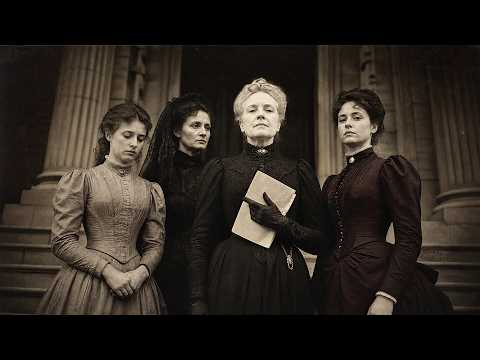
Chapter One. The Only Room Where a Woman Could Be Heard.
For much of the century, a married woman could own almost nothing in her own name. Yet there was one room in America where she could force a powerful man to stand and answer for himself. The courtroom. Everywhere else, the doors were nearly sealed. She could not vote. In most of the country, for much of the period, the moment she married, her property and earnings—and, in the old conception, even her legal existence—dissolved quietly into her husband’s. The law called it “coverture.” A wife was “covered” by her husband, the way a small stream dissolves into the river it feeds. She was not, in the eyes of the law, a separate being at all.
But the courtroom was different. The courtroom had to listen. If a woman could find a lawyer and a case the law recognized, she could summon a man who had wronged her into a public room, seat him a few feet away, and force him to sit while his private letters were read aloud to strangers. It was the only lever sufficient to move men who were otherwise out of reach. And over the final decades of the nineteenth century, a few women reached for it and pulled with everything they had.
The ground was shifting beneath them as they did. State after state passed married women’s property laws—cautious statutes that let a wife keep what was hers, her wages, her inheritance, her name on a deed. But the laws came at different times and left wide gaps between them. The old habit of mind that a woman belonged to her husband did not die with a legislative vote. For most women, for most of the period, the courtroom remained an exception in a world that preferred their silence. And it was an exception they entered at enormous risk, because to litigate was to be seen—and to be seen, for a woman in that century, was itself a kind of ruin.
The law even kept a set of tools designed specifically for this kind of wound. They carried a strange, tender name: heart balm suits. If a man promised a woman marriage and then withdrew, she could sue him for breach of promise. A jury could put a monetary value on the future he had taken from her. If another man seduced a wife away from her marriage, the husband could sue that man for what the age called “criminal conversation” or “alienation of affection.” Again, the loss was calculated in money. These were clumsy remedies that treated a broken heart or a collapsed marriage as a kind of damaged property—which tells you a great deal about how that century saw such things. But for a woman with almost no other standing, it was better than nothing. It was a way to make a wrong cost the man who committed it.
There was a second machine waiting for any woman who reached for the first, and it fed on her with the same appetite. The press. These were the years when the daily newspaper became mass entertainment. Scandalous trials sold hundreds of thousands of copies, and editors learned that nothing sold like the private ruin of a prominent name. A woman suing a powerful man did not face only him and his lawyers. She faced the reporters in the gallery, the telegraph wires that carried every word of her testimony to breakfast tables on another continent, the sketch artists planning her face for the front page—every instrument of a country that had discovered it adored watching. Her most private history, for the length of the trial, became a serial that strangers followed like a novel. The law could grant her a hearing. It could not give her back her privacy afterward, and the price of the hearing was that she surrendered it to everyone.
Here is what to hold onto, because it runs like a dark seam under every story in this film. A lawsuit is a kind of ledger. It has two columns. On one side lies what the fight might win. Money, or a cleared name, or a recovered reputation, or the fortune hoped for. On the other side lies what the fight will cost. And that column fills slowly, year after year, in legal fees and lost time and broken health and private life dragged into daylight. In the cases you are about to see, the cost column always won in the end. The thing the lawsuit was meant to protect was smaller than the lawsuit itself, and the lawsuit ate it.
Almost everything in these stories turns on a single piece of paper. A promise of marriage written in a letter, a love letter kept in a drawer for years, a line in a church register, or a will written in the last month of a dying man’s life. In each case, a court was asked to take that one piece of paper and put a price on it—to say what a promise, or a marriage, or a name, was worth. Watch the paper. It is the smallest object in every one of these rooms, and it is the thing all the money in the world comes down to.
There is one other figure present in every case, almost never mentioned, and worth naming plainly once. To see him standing in the background of every courtroom that follows: the lawyer. Whatever the plaintiff won or lost, whatever the verdict, however the fortune tilted in the end, one class of people collected their fees regularly and quietly through all the long years of the dispute. The lawyers were paid. Remember that. It will matter more with every case.
Four battles await us. A schoolgirl from Kentucky faced a congressman with a silver tongue and a great political name—and won, but spent her entire future in the winning. An actress sued for a marriage and a fortune she was promised, lost, and could not live with the loss. A preacher trusted by half the nation was dragged into six months of testimony about his best friend’s wife, in a trial that ended with no winner at all. And above them all stands that woman in the New Orleans courtroom, whose case outlasted every other civil suit in the history of the country—and who did not live to see how it ended.
Things begin gently, as they usually do, with a young woman and a train.
Chapter Two. A Promise Cut on a Train.
On the first of April, 1884, a girl of seventeen climbed aboard a train and sat down across from a man of forty-seven who possessed every advantage she lacked. Her name was Madeleine Pollard. She was a modest student at the beginning of a life she had not yet decided what to make of. The man across from her was one of the most admired figures in the state, and in his own way, in the whole country.
His name was William Campbell Preston Breckinridge, and the name alone was a fortune. The Breckinridges were a ruling family in Kentucky, a family that had stood at the center of the state’s public life for generations. William had the family gift for oratory to such a degree that people called him “the Silver-Tongued Breckinridge.” He had been a colonel in the Confederate cavalry. He held a seat in the United States Congress when she met him. He was married, and he was thirty years older than the girl in the seat across from him.
What passed between them on that train, and in the months and years that followed, would be argued word by word in a Washington courtroom while the whole nation followed. The broad outlines are not in dispute. A relationship began, and it became sexual. Madeleine Pollard was seventeen. William Breckinridge was a man of great influence and greater experience, and he knew exactly how the world would look at such a thing if it ever came to light. The world would blame her. It always did.
And so the relationship stayed in the dark, under the cover of his standing and her youth, for years. The double standard that made this possible was not one man’s personal failing. It was the settled arrangement of the age, written into its manners as firmly as into its laws. A man of Breckinridge’s position could keep a secret like this for a decade and lose nothing as long as it stayed secret, because the world had already agreed that such things, if they surfaced, were the woman’s fault and the woman’s shame. She was the one who would be called a lost girl. She was the one no respectable house would receive. He risked embarrassment. She risked her entire future.
In May of 1885, she gave birth to a child in a home for foundlings in Ohio, far from anyone who knew her. A second child came in February of 1888, and lived only about two months. Through these years, Breckinridge managed her the way a man manages a heavy obligation. When she was pregnant and in Washington, he found her a place—a clerk’s job in the Department of Agriculture, tucked inside the government machine he helped run. He kept her close, and he kept her quiet. And he made her one promise, across all those years. The promise that bound her through every concealment and every loss. He told her he would marry her one day.
There was an obstacle to that promise, and they both knew what it was. He already had a wife. But in the summer of 1892, the obstacle was removed. His wife died. And Madeleine Pollard, who had waited and hidden and borne his children in secret homes on the strength of a single spoken pledge, believed the pledge would finally be honored. She was thirty, or nearly. She had given the flower of her youth to this man, and to the future he had described to her in whispers. She thought that future was at last about to arrive.
Notice what the promise was and what it was not. It was not written anywhere. There was no contract, no settlement, no line in any record. It was words spoken by a man famous across the continent for exactly one thing—the power of his words. He had built his entire career on the trust people placed in what came out of his mouth. And Madeleine Pollard had placed the largest trust of all in it.
It is hard now to feel the full weight that a reputation for eloquence carried in that world. It was an age before the microphone and the moving picture, when a public man made his standing before crowds with his voice alone, and a great speaker was a blend of celebrity and moral authority at once. To be called “the Silver-Tongued Breckinridge” meant a standing that reached far beyond Kentucky. A sense that this was a man whose words could move a hall, a state, or a whole nation. People trusted that voice. And they trusted the character they believed stood behind it. The Confederate colonel, the dutiful churchgoing family man, the heir to a great and honorable name. All that trust was a wall around him, and behind that wall he made his private promises to a girl he never intended to marry—secure in the knowledge that if it ever came down to her word against his, the country had already decided which word it preferred.
She had bet her whole life on that silver tongue, and she was about to learn what his promises were worth when the light finally fell on her.
The verdict was a vindication, but the ledger’s cost column never closed. Madeleine Pollard won her $15,000, yet the trial had exposed every private wound, and the money could not buy back her name or her future. She lived the rest of her life in the shadow of that courtroom, a woman forever defined by the ruin she had survived.
William Breckinridge lost his seat, his influence, and the silver tongue that had built him—defeated by 255 votes, never to hold office again. The great name was silenced by the girl he had wagered would vanish.
And the lawyers? They were paid, as they always were, in every case, in every decade. The cost of winning was never theirs to bear.
So here is the question that lingers: if you had stood beside Madeleine on that train in 1884, knowing the price she would pay for justice, would you have told her to step off—or would you have let her ride toward the only room where her voice could be heard?
Report this article
Select a reason for reporting:






