They were supposed to be a myth. The Canadian government said they weren’t there. Parliament hadn’t been told. The newspapers hadn’t printed a word. But in the early hours of October 2001, forty men in forest green fatigues were already on the ground in southern Afghanistan, hunting the Taliban and Al-Qaeda before the world knew the war had begun.
Their first mission nearly ended in disaster. A Chinook helicopter, forced into a hard landing in hostile territory, left them stranded in the dark. They didn’t call for extraction. They didn’t abort. They walked out of the wreckage, reorganized, and finished the job—recovering a hard drive that would feed the hunt for months.
That was the easy part.
Because what happened next would put a defense minister in front of a parliamentary committee, end his career, and force the unit to vanish from sight. And it would all start with a single photograph.
The unit was called Joint Task Force 2. Canadians say it the same way Americans say Delta—quietly, and only when they have to. Created in 1993 at a former Mountie training facility called Dwyer Hill, its motto was Facta non verba: deeds, not words. That wasn’t a slogan. It was an operating constraint.
They don’t give interviews. They don’t write memoirs. Out of every operator who has served since 1993, only one is publicly named. The selection process is brutal: a 13-kilometer march carrying 35 kilograms in under two hours and 26 minutes, then a 25-meter swim with boots, uniform, and rifle—no flotation. Eight out of ten candidates don’t make it past the first week. Of those who survive, roughly one in ten earns the badge.
By autumn 2001, there were 297 JTF2 operators on the books. Their annual budget was between 25 and 40 million Canadian dollars. The American unit they were about to fight alongside ran on over a billion US dollars. Twenty-five times more money. Same standard. Different zip code.
On September 11th, the airliners hit the towers. The Canadian government’s official position was clear: no combat troops on the ground in Afghanistan until February 2002. That’s what Parliament was told. That’s what every newspaper printed.
Here’s what actually happened.
In early October 2001, weeks before the Canadian public would hear a single word, approximately forty JTF2 operators were loaded onto a Canadian C-130 Hercules and flown into southern Afghanistan. Prime Minister Jean Chrétien had not given formal permission. The documentation for that deployment, according to historian Sean Maloney, did not exist in any normal chain of authorization. The men were simply in the air, then on the ground, then operational before the political class understood the question well enough to ask it.
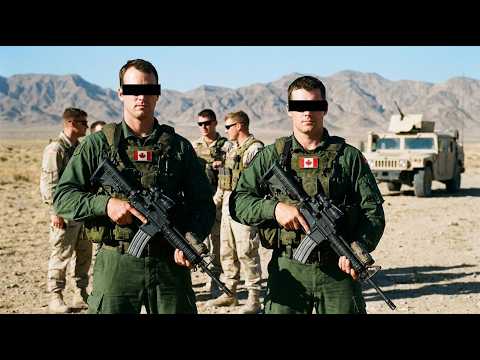
They landed at a strip outside Kandahar, dressed in forest green Canadian combat fatigues, carrying C8 carbines and SIG Sauer P226 sidearms. The average age was 28. Pay attention to that uniform—the forest green—because four months from now, on a tarmac in this same city, that exact color is going to put a defense minister in front of a parliamentary committee.
They joined Task Force K-Bar, a coalition of seven countries: American SEALs, German KSK, Norwegian Forsvarets spesialkommando, New Zealand SAS, Danish, Turkish, and Australian SASR operators. Thirteen hundred operators inside Afghanistan, fifteen hundred more across the theater. The commander was a US Navy captain named Robert Harward. He was 45, a career naval special warfare officer—the kind of man the Americans put in charge of things they did not want to lose.
His mission was simple to describe and almost impossible to execute: find the Taliban’s senior leadership, find Al-Qaeda cave by cave, compound by compound, mountain by mountain, get the intelligence out, kill or capture the rest. Harward needed people who would not need to be supervised. He’d been given seven countries’ worth of operators. In practice, he had to find out which of them could be trusted with the door-kicking work and which needed an American holding their hand on the radio.
He found out about the Canadians fast.
Their first joint mission with the US 3rd Special Forces Group was, in Harward’s own words, the first coalition direct action mission since the Second World War. The target was a Taliban command node. A team of Green Berets and a team of JTF2 operators were inserted by Chinook in darkness into territory that had not been swept, against an enemy whose strength was unknown. The mission almost died in the first hour. The Chinook carrying the JTF2 element was forced into a hard landing near the target site. The team did not abort. They did not call for extraction. They walked out of the wreckage, reorganized on the ground, executed the mission they had come for, and pulled out with the prize—a hard drive in the cargo space. It was the one the helicopter nearly ran out of fuel carrying home.
That hard drive, according to the Toronto Star investigation that broke the story years later, would feed the hunt for Taliban and Al-Qaeda leaders for months.
Now, pay attention to what an American Navy captain learned about Canadians in the space of approximately six weeks.
In January 2002, Harward led a reconnaissance mission into a cave complex called Zhawar Kili, 16 kilometers southwest of Khost, 4 kilometers from the Pakistani border. The Mujahideen had carved the caves out of the rock during the war against the Soviets. The Soviets had failed to take them. Al-Qaeda had been using them as a regrouping point after Tora Bora. The Canadians went in with a platoon from SEAL Team 3, a German KSK element, and a Norwegian SOF team. They spent nine days inside the rock. Seventy caves cleared. Sixty structures cleared. They recovered intelligence in volumes that took weeks to translate, plus weapons in quantities the Pentagon had not anticipated. The Soviet Army, even with multiple full divisions, had not gotten this deep into Zhawar Kili over the course of a decade. Four nations’ worth of special operators did it in nine days.
The Canadians, working in two-man and four-man elements, were carrying out the underground clearance work the doctrine said was the highest-risk task in modern warfare. The Soviets had refused to do it. Most NATO armies would not do it. The Canadians were doing it the way most people would clear a basement.
Then came the mountains. Operation Anaconda, March 2002, the Shah-i-Kot Valley—the largest set-piece battle American forces had fought since Vietnam. JTF2 reconnaissance teams were inserted onto exposed ridgelines above 3,000 meters. They sat in temperatures dropping below -15°C after dark. They radioed real-time intelligence to the conventional American forces fighting in the valley below. They held those positions for days without rotation, without resupply. According to US Navy Commander Kerry Metz, who gave congressional testimony on Task Force K-Bar’s operations, JTF2 reconnaissance teams were operating in the mountains of Afghanistan above 10,000 feet for extended periods without resupply. That sentence is in the United States Congressional Record.
Read it again. That sentence is in the record because an American officer was asked under oath how the war in southern Afghanistan was actually being conducted, and his honest answer included a reference to a foreign unit doing a thing his own service was not asking of his own people.
Then came the compound.
It was a routine direct action assignment. The location had been confirmed. The number of hostiles inside had been estimated by an American AC-130 gunship orbiting overhead, its thermal sensors manned by trained crew. The number the gunship called down to the assault element on the ground was 36 people inside.
The assault element was 24 JTF2 operators. The ratio was unfavorable. The operation was approved anyway.
They moved on the building in darkness. They breached. They cleared. Nobody fired a weapon. The defenders—every single one of them—surrendered the moment the Canadians came through the wall. The head count when it was finally completed by the operators standing over the bound prisoners was 53. Not 36. Fifty-three. More than double the size of the attacking force.
A US Navy gunship equipped with the most sophisticated thermal optics in the world had undercounted by seventeen people in a single small building. Twenty-four Canadians had walked into that building anyway—on the assumption that the gunship’s count was wrong by an unknown margin—and brought every one of them out alive.
You do not see that in the Hollywood version of the war. You do not see that in the books. The defenders surrendered to 24 men because the 24 men coming through the wall did not give them the option to do anything else. That is a different kind of competence. That is the kind of competence that takes a generation of selection and training to build, and that no amount of money on its own can buy.
By the time the unit’s six-month deployment closed in April 2002, the public record tally read like this: 42 confirmed reconnaissance missions, an undisclosed number of direct action engagements, 115 Taliban and Al-Qaeda fighters killed, 107 senior Taliban leaders captured. Task Force K-Bar was credited with a 100% mission success rate—a figure that traces back to Metz’s congressional testimony. Forty Canadians. One hundred seven captured senior Taliban leaders. The math by itself sounds invented. It is not.
And then came the photograph.
On the 21st of January 2002, an Associated Press photographer named Dario Lopez-Mills was on the flight line at Kandahar airfield when a US helicopter touched down carrying three hooded detainees. Walking the prisoners off the helicopter were four operators in forest green Canadian Forces combat fatigues—faces visible, unit indicators identifiable. The photograph ran on the front page of The Globe and Mail within the week.
In Ottawa, the political class read its own morning newspaper and learned for the first time that Canada had been running combat operations in southern Afghanistan for almost four months. Defense Minister Art Eggleton was summoned before the Standing Committee on Procedure and House Affairs. The charge was deliberately misleading Parliament. Vice-Admiral Greg Maddison was called to explain how Canada’s most lethal military instrument had been conducting offensive operations under American command for four months without the elected representatives of the country having been informed.
The detainees in the photograph were on their way to a place called Guantanamo Bay. That detail intensified everything.
It was not really about JTF2. It was about civilian oversight of the most dangerous weapon a democracy possesses—which is forty people trained to do anything they are asked to do without leaving evidence. The forty had performed flawlessly. The political architecture above them—the part that exists specifically to keep that capability under the control of the elected government—had not.
The operators were already on their way home when the photograph hit the front page. They had nothing to do with how the image got out. They could not have stopped it.
After January 2002, the forest green uniform was never seen on a JTF2 tarmac again. From that month forward, JTF2 deployed in generic tan kit, beards, ball caps, and sunglasses—the same operator profile every tier-one unit in the theater was using. The recognizable national signature, the thing that made the photograph politically lethal, was simply retired.
Two years later, in December 2004, President George W. Bush awarded the United States Presidential Unit Citation to the units that had served in Task Force K-Bar. Approximately forty members of JTF2 were among the recipients. They became the first Canadian unit in the country’s history to receive it. The citation said they had earned it for extraordinary heroism and outstanding performance of duty in action against the enemy in Afghanistan. Most of the names were not released. They will never be released.
And then, finally, the sentence. Captain Robert Harward, United States Navy, commander of Task Force K-Bar, was asked in the published record who he wanted for direct action missions going forward. He gave the answer the Canadian government had spent four months trying to keep classified.
He said the JTF2 team under his command was his first choice for any direct action mission. Not one of his choices. Not among his options. His first choice. Forty Canadians, a fraction of his budget, on a deployment their own prime minister had not authorized—in a coalition where every tier-one unit in the Western alliance was competing for his attention.
There is exactly one acknowledged JTF2 combat death from the Afghan War. Master Corporal Anthony Klumpenhouwer, born in Listowel, Ontario, one of thirteen children. On the 18th of April 2007, working on a communications tower in Kandahar City, he was knocked unconscious by an electrical surge and fell. He was 25. He remains the only JTF2 operator from that war whose name is in the public record.
The forty men who walked into Kandahar in October 2001 are not named. Their files are sealed. Their service records remain classified twenty-four years later. Facta non verba. The deeds are in the record. The words are classified. The price of being good at this work is that no one will ever know you were the one who did it.
So here is the question worth asking: if a country smaller than California produced the unit an American captain called his first choice—and then spent twenty-four years making sure you never learned their names—what else are we not being told?
Report this article
Select a reason for reporting:






