At 10:00 on the morning of June 19, 1944, radar operators aboard Task Force 58 picked up a massive formation of Japanese aircraft 150 miles out and closing. It was the first of four strikes that would come that day. More than 300 Japanese carrier aircraft flew east toward the Americans. Waiting for them were 15 American aircraft carriers and over 900 aircraft—14 of those carriers had not existed on December 7, 1941. The Hellcats met them 50 miles out, directed by radar before the Japanese pilots even knew they’d been seen. Wave after wave was broken up. By nightfall, more than 300 Japanese aircraft were destroyed. The Americans had lost 29. Two Japanese carriers, including the newest and largest in the fleet, had been sunk by submarines. The Imperial Japanese Navy’s carrier air arm would never fight another carrier battle.
In December 1941, Japan went to war on a calculation. It would strike first, seize an empire across the Western Pacific, and fortify it so thoroughly that the Americans would decide the cost of taking it back was too high. The United States, Japanese planners believed, would accept a negotiated peace. It would quit.
That belief was not simply arrogance. In 1941, the United States looked divided. Isolationist feeling ran deep. Congress had extended the draft that summer by a single vote. Japanese leaders expected a nation that had spent 20 years avoiding foreign wars to lose its appetite for a long and bloody one in the far Pacific. They were betting on American politics. They should have been looking at American factories.
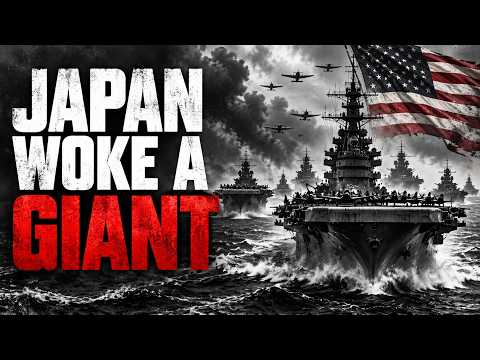
The Battle of the Philippine Sea is where that calculation came due. It was fought over the Mariana Islands in June 1944, and it was decided not by courage or luck, but by arithmetic. Six Japanese carriers had attacked Pearl Harbor. Two and a half years later, Japan brought nine to the Philippine Sea. The United States brought 15, backed by dozens of smaller escort carriers, thousands of new aircraft, and a pipeline of trained pilots Japan could not begin to match. In 1942, the United States built about 47,000 military aircraft. In 1944, it built about 96,000. Japan’s best year, 1944, produced about 28,000.
The usual story of America’s response to Pearl Harbor begins with a quotation. After the attack, Admiral Isoroku Yamamoto is supposed to have said that Japan had only awakened a sleeping giant and filled him with a terrible resolve. It appears in films, in books, and in countless documentaries. That is the version most people know. It is also wrong. There is no record that Yamamoto ever said it. The line comes from a Hollywood screenplay written a quarter of a century after the war. What Yamamoto did say before the war was more precise and more alarming. Asked how Japan would fare against the United States, he answered that he could run wild for six months or a year, but that he had no confidence at all about the second or third year. He had studied at Harvard. He had served as a naval attache in Washington. He had seen American oil fields and American factories. He knew what the United States could build.
The Philippine Sea was fought in the third year. It decided more than the fate of an air arm. It opened the Mariana Islands to American invasion. And from the Marianas, American bombers could reach the Japanese home islands. It was the last carrier against carrier battle of the war. And it answered in a single day the question Japan had gambled on in 1941: whether the United States would outbuild it or give up.
But the Marianas Turkey Shoot did not begin over the Philippine Sea. It began four years earlier in Washington in the summer of 1940 with a decision nobody recorded as important. In June 1940, France fell to Germany. The United States was not at war, but the collapse of France shocked Congress into action. On July 19, 1940, President Roosevelt signed the Two-Ocean Navy Act. It authorized a naval expansion of about 70 percent: seven battleships, six large cruisers, 27 cruisers, 115 destroyers, 43 submarines, and 18 aircraft carriers. It was the largest naval construction program in American history, passed 17 months before Pearl Harbor. By the time the Japanese struck, the Navy had already ordered about a dozen new fleet carriers of a single class. Not one of them was yet in service.
The act itself was recorded as important. It made headlines. The decision that turned it into a fleet did not. The carriers the Navy ordered under the new program were of a single design. It was called the Essex class, and it had been drawn up in 1939 and 1940 around the lessons of the carriers already in service. The Essex was about 27,000 tons, larger than the Yorktown class before it. She could carry around 90 aircraft. Her hangar deck was armored. She had an elevator on the edge of the flight deck outside the hull that could move aircraft up and down without blocking landings and takeoffs. She could make 33 knots. Her flight deck ran more than 800 feet, and her crew with the air group aboard numbered well over 2,500 men. She was designed to fight a long war far from home and to take punishment while doing it.
The unrecorded decision was this: once the design was fixed, the Navy kept it fixed. It did not start over with each new ship or redesign the class every time a new idea appeared. It built the same carrier again and again at shipyards across the country with the same drawings, the same parts, and the same machinery. Improvements were added along the way, but the ship stayed the ship. It was not glamorous. No one gave a speech about standardization, but it meant that shipyards could learn. The first Essex took about 20 months from keel to commissioning. Later ships of the class were finished in about 16. Before the war, an American carrier had taken three years or more to build. Twenty-four Essex-class carriers would eventually be completed. Seventeen of them joined the fleet before the war ended. They came from five yards: Newport News in Virginia, Bethlehem Steel at Quincy in Massachusetts, and the Navy Yards at New York, Norfolk, and Philadelphia.
The same logic spread to smaller ships. In 1942, with fleet carriers years away, the Navy took nine light cruiser hulls already under construction and finished them as light aircraft carriers instead. All nine of the Independence class were commissioned during 1943. Each could carry around 30 aircraft and keep up with the fleet at more than 30 knots. Below them came the escort carriers, small and slow, built on merchant ship designs. At a shipyard in Vancouver, Washington, the industrialist Henry Kaiser’s workers built 50 of one class, the Casablanca class, in about a year—roughly one new aircraft carrier every week.
It would take four years to learn what a fixed set of drawings was worth. And the Navy that would learn it first had spent the 1930s building the finest carrier force in the world.
In December 1941, the Imperial Japanese Navy was the most capable carrier navy on Earth. Japan went to war with 10 aircraft carriers. The United States had seven, and only three of them were in the Pacific. Six of Japan’s fleet carriers had been gathered into the Kido Butai, a single striking force that could put more than 350 aircraft over one target in one morning. No other navy could do anything like it. The aircraft were outstanding. The Mitsubishi A6M Zero could outclimb and outturn every Allied fighter it met, and it could fly more than 1,900 miles with a drop tank. The Nakajima B5N torpedo bomber carried the most effective aerial torpedo in the world. The Aichi D3A dive bomber would sink more Allied warships than any other Axis aircraft. The airmen were even better. Japanese naval aviators were chosen from enormous numbers of applicants and trained for years. Many had combat experience over China going back to 1937. In December 1941, the average Japanese carrier pilot had hundreds of hours of flying behind him and a record of results no Allied air force could match.
For six months, the results matched Yamamoto’s prediction. Pearl Harbor, Wake, Rabaul, Darwin, Ceylon. Japanese carriers struck across a third of the planet and did not lose a single ship. Japanese forces took Malaya, Singapore, the Philippines, the Dutch East Indies, and much of Burma. Japan’s shipbuilders were good, too. Japanese yards had built Akagi and Kaga, Shokaku and Zuikaku, and the largest battleships ever designed, Yamato and Musashi. Japan’s designers were among the most innovative in the world. What Japan lacked was not skill, it was scale. Japan produced only a small fraction of the steel the United States produced. It imported most of its oil. Its shipyards and factories could build superb ships and aircraft, but not in the numbers a long war would demand.
Japanese naval doctrine had been written with that in mind. For decades, the Imperial Navy had planned for a single decisive battle in which a smaller but superior Japanese fleet would destroy an American fleet advancing across the Pacific. Win that battle and the war would end before American numbers could matter. The Kido Butai was the sharpest instrument that doctrine had ever produced. Japanese carrier aircraft also had a reach the Americans could not match. Built light, without the armor and self-sealing fuel tanks American designers insisted on, they could fly farther. A Japanese carrier force could launch a strike from beyond the range at which American carrier aircraft could reply. Japanese admirals planned to use that margin in every battle, hitting the enemy from a distance he could not answer.
Six fleet carriers, 350 aircraft over a single target, six months without losing a ship. Every measure of carrier warfare in 1942 favored Japan. More carriers at sea in the Pacific, better fighters, better torpedoes, the most experienced air crews in the world. Japan’s planners believed that before the United States could change those numbers, the war would be over.
The numbers on the American side in 1942 read like a casualty list. The Lexington at Coral Sea. The Yorktown at Midway. The Wasp torpedoed off Guadalcanal. The Hornet abandoned at Santa Cruz. Of the seven carriers the United States had on December 7, 1941, four were on the bottom by the end of 1942. After Santa Cruz, the Enterprise—herself damaged—was the only American carrier in fighting condition in the South Pacific. Her crew put up a sign: “Enterprise versus Japan.”
And yet the ledger Japan could not see was the one not yet at sea. The war would be decided less by the pilots Japan had in 1942 than by the pilots each side could produce in 1944. Japan kept its veterans at the front until they died. The Americans rotated theirs home to teach. The lessons of 1942 were taught in 1943 by the men who had survived them.
Then came the Hellcat, ordered five months before Pearl Harbor, built by the thousands. On June 19, 1944, Japanese pilots attacked the most heavily defended fleet in history flying fundamentally the same aircraft that had struck Pearl Harbor. Radar found every strike 100 miles out. Proximity-fused shells finished what the fighters missed. Only one bomb hit an American battleship. No carrier was seriously damaged.
Ozawa brought nine carriers and 450 aircraft. He went home with 35. Two of his three sunk carriers were killed not by aircraft but by submarines—the Taiho dying of gasoline vapor, the very lesson the Americans had learned at Coral Sea and rebuilt their damage control around. Japan had built an armored flight deck and never learned it at all.
Six carriers attacked Pearl Harbor. Fifteen answered at the Philippine Sea, and fourteen of them had not existed on December 7, 1941. The fleet that fought that day was not the Navy of 1941 repaired. It was a new navy, designed before the war, built during it, and manned by men who had learned from its first two years.
Most of the Essex-class carriers served for decades after. Today four survive as museums—the Yorktown, the Intrepid, the Lexington, and the Hornet, which in 1969 recovered the crew of Apollo 11 and is moored at Alameda, the same air station where the first Hornet took 16 Army bombers aboard and sailed for Tokyo.
So here is the question the record leaves us: if Yamamoto was right that he could run wild for six months or a year, and if the arithmetic was always going to decide the rest—was Pearl Harbor ever a gamble Japan could have won, or only a clock they chose not to read? Tell us in the comments.
Report this article
Select a reason for reporting:






