Picture a family that ruled an empire stretching from Brazil to Japan, a dynasty so ancient that for nearly 800 years, Portugal and its monarchy were one and the same. Then, imagine it all vanishing in a single morning—flags lowered, palaces seized, and the royal family sailing away on a borrowed yacht, watching their homeland shrink behind them.
This is the story of the House of Braganza. But the question isn’t how the monarchy fell. It’s what came after. Did they fade into obscurity? Did they fight to reclaim the throne? The answer is stranger and more tragic than you can imagine.
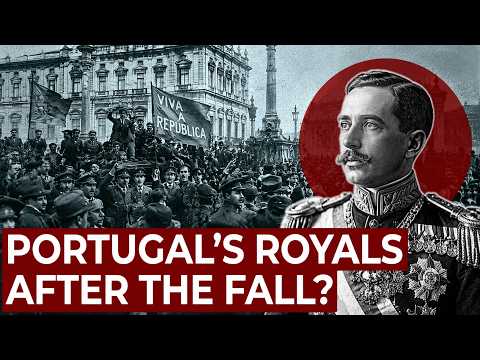
Let me take you back to February 1, 1908. Lisbon. The sky is overcast, the air damp along the Tagus River. King Carlos I returns from a holiday with Queen Amélie and their two sons, Prince Luís Filipe and Prince Manuel. They ride in an open carriage through the Terreiro do Paço, one of Lisbon’s most famous squares.
The king wears his blue military uniform, projecting calm. But the political climate is anything but calm. Portugal is in deep crisis—the economy stagnant, the government buried in debt. A humiliating 1890 British ultimatum shattered national pride, forcing Portugal to abandon its colonial ambitions in Africa. The Republican movement gained momentum. Carlos made it worse by backing a semi-dictatorial government that dissolved Parliament and ruled by decree.
As the carriage rounds the square, a bearded man steps out. His name is Manuel Buíça, a former soldier turned school teacher. He kneels, raises a Winchester carbine, and fires from eight meters. The bullet strikes King Carlos in the neck. He dies instantly.
Chaos erupts. A second gunman, Alfredo Luís da Costa, rushes the carriage with a revolver. Crown Prince Luís Filipe stands up, draws a hidden pistol, and fires four shots. But he becomes a target. A bullet hits him in the head. He collapses, dying twenty minutes later.
Queen Amélie, in an act of extraordinary courage, throws herself over her surviving son Manuel and beats at the attackers with a bouquet of flowers. It is desperate, almost absurd—but it works. Bodyguards gun down both assassins within a minute. Prince Manuel is hit in the arm but survives. He is 18 years old.
Just like that, everything changes. The king is dead. The crown prince is dead. And a young man who had been quietly training at the naval academy, who never expected to rule, is now King Manuel II.
Manuel is intelligent, bookish, more interested in literature than politics. He understands that his father’s meddling in government got him killed. So he distances himself from daily politics, ends the Franco dictatorship, and tries to govern as a true constitutional monarch. But it’s too late. The Republican movement has been building for decades. They see a weakened monarchy led by a boy who never trained for this role—and they smell blood.
In his two and a half years on the throne, Manuel goes through seven prime ministers. Nothing sticks. The country is unstable, angry, and tired of the old order. Meanwhile, the Carbonária, a clandestine Republican organization, expands rapidly through the military and working class. They are organizing. They are arming. They are waiting.
Then, in the summer of 1910, the final act begins. On the night of October 3, the army and navy revolt. Around 2,000 armed soldiers and sailors take positions across Lisbon. The cruiser Adamastor turns its guns toward the shore and shells the royal residence. Cannon fire echoes through the streets.
By the morning of October 5, it is clear the monarchy cannot hold. Manuel, his mother Queen Amélie, and his grandmother Queen Maria Pia flee to the coast and board the royal yacht Amélia IV. They plan to sail north to Porto, where monarchist sentiment is stronger. But during the voyage, they receive devastating news: Porto has also fallen. There is nowhere left to go.
The yacht changes course to Gibraltar, then England. King George V receives them personally. Manuel II, the last king of Portugal, is just 20 years old. He will never set foot on Portuguese soil again.
What happens next is a story few people know—a long, quiet, heartbreaking chapter of real human beings adrift. Kings and queens one day, exiles the next, trying to figure out who they are when the crown is taken away.
Manuel settled in Twickenham, a suburb of London with a painful poetry to it. His mother, Queen Amélie, had been born there in 1865, when her own family, the House of Orléans, was living in exile from France. She was born into exile, married into a monarchy, watched that monarchy collapse around her, and returned to the very place of her birth as an exile once again.
Manuel took up residence at Fulwell Park. Far from the palaces of Lisbon, he tried to build a meaningful life. He threw himself into scholarly work, becoming a serious bibliophile. He spent years collecting rare Portuguese books from auction houses across Europe, eventually assembling one of the most important collections of early Portuguese literature ever created.
He published a multi-volume work called Early Portuguese Books, covering 1489 to 1600. It became an indispensable reference for scholars. He attended services at the Catholic Church of St. James in Twickenham, became godfather to local children, and donated a stained glass window featuring the Braganza crest. The streets around his home were eventually named after him—Manuel Road, Lisbon Avenue, Portugal Gardens. Small monuments to a king without a kingdom.
When the First World War erupted, Manuel offered his services to the Portuguese army, hoping for an active military role. The Republican government in Lisbon denied his request—they were not about to let a deposed king rally troops under the royal banner. So instead, Manuel joined the British Red Cross. He organized fundraising drives, visited troops in field hospitals on the Western Front, and helped establish medical facilities in France and England.
There was one extraordinary instance where he served his country diplomatically. After the 1926 military coup in Portugal, the newly appointed Portuguese ambassador to London was not recognized by the British government. The Portuguese Ministry of Foreign Affairs, in desperation, asked Manuel—the exiled king—to use his personal connections to resolve the crisis. He personally intervened and smoothed over the impasse. It was perhaps the only time in his exile that he functioned, however briefly, like a head of state.
But Manuel never stopped caring about Portugal. He followed every political development, every crisis, every scandal. And there were many. The First Portuguese Republic, which lasted from 1910 to 1926, was one of the most unstable parliamentary systems in Western European history. In sixteen years, there were roughly forty-five governments, eight presidents, and multiple military coups.
This chaos gave the monarchists hope. In 1911 and 1912, monarchist incursions were launched, though both failed. But the most significant attempt came in January 1919, in an episode known as the Monarchy of the North.
In late December 1918, Portugal’s President Sidónio Pais was assassinated in Lisbon. His death created a power vacuum. Taking advantage of the turmoil, a veteran monarchist officer named Henrique Mitchell de Paiva Couceiro made his move. On January 19, 1919, monarchist forces seized Porto and proclaimed the restoration of the Kingdom of Portugal. They quickly gained control of several northern cities, including Braga and Viana do Castelo.
Paiva Couceiro declared himself head of a provisional government ruling in the name of King Manuel II. But here is the fascinating detail: Manuel himself was never consulted. He did not sanction it. In fact, he was deeply uncomfortable with the entire idea of an armed restoration.
From his exile, Manuel had consistently insisted that the crown could only be restored through the will of the people, expressed through legal and democratic means. He believed, with a principled stubbornness that is almost admirable in its naivety, that using violence to reclaim the throne would only lead to more violence and permanently poison the relationship between the monarchy and the Portuguese people.
And so, the Monarchy of the North was a restoration attempt carried out against the wishes of the very king it was trying to restore. That contradiction doomed it from the start. Within roughly a month, Republican forces from the south marched on Porto and crushed the uprising. By February 13, 1919, it was finished. It had lasted just twenty-five days.
After this final failure, the cause of restoration essentially died. Manuel continued his quiet exile. In 1913, he married Princess Augusta Victoria of Hohenzollern in a ceremony attended by European royalty, including the Prince of Wales and King Alfonso XIII of Spain. In a touching detail, Manuel stood on a box filled with soil brought from Portugal during the ceremony—a small gesture to maintain his connection to the homeland he could not return to.
The marriage was peaceful and contented, but it produced no children. And this absence of an heir would create an enormously complicated succession problem for the House of Braganza.
Manuel died suddenly on July 2, 1932, at Fulwell Park. He was just 42. The cause was a swelling of the trachea—he had appeared in reasonable health hours before. His body received a service at Westminster Abbey, a mark of British esteem, then by order of Salazar was returned to Portugal and interred at the Pantheon of the Braganzas. The man who spent twenty-two years watching his country from across the sea was finally home, but he came home in a coffin.
His death without children created a dynastic crisis. The male line of the constitutional Braganzas was extinct. The only surviving male line descended from the exiled King Miguel I, who had been banished forever in 1834 after the Liberal Wars. But that banishment law was passed under a constitution later replaced—so depending on the legal framework, Miguel’s descendants may or may not have been legitimate claimants.
The head of this Miguelist branch, Duarte Nuno, became the primary claimant. In 1942 he married Princess Maria Francisca of Orléans-Braganza, a great-granddaughter of Emperor Pedro II of Brazil—and a descendant of Pedro IV, the very brother who had defeated Miguel I a century earlier. The wedding in Petrópolis effectively reunited the two rival branches. A century-old wound was finally beginning to heal.
In 1950 Salazar repealed the laws of banishment, and in 1952 the family returned to Portugal for the first time since the monarchy fell. The Braganzas were back—not on the throne, but on Portuguese soil. It had taken forty-two years.
Duarte Nuno died on Christmas Eve, 1976, and the torch passed to his eldest son, Duarte Pio, born in Bern in 1945. Before taking on the role full-time, Duarte Pio served as a helicopter pilot in the Portuguese Air Force during the colonial war in Angola. The descendant of kings flying combat missions over the African bush—an image that almost defies belief.
In 1995 he married Isabel Inês de Castro Curvello de Herédia in Lisbon Cathedral—the first royal wedding on Portuguese soil since 1886, a gap of over a century. They have three children: Afonso, Prince of Beira, born 1996; Maria Francisca, born 1997; and Dinis, Duke of Porto, born 1999. The line continues.
Today Duarte Pio occupies a peculiar position. He is treated with courtesy by the government, represents Portugal in cultural matters abroad, and was granted East Timorese citizenship for his support of their independence. He performs many ceremonial functions of a monarch without any formal authority. Yet the prospect of restoration remains a non-starter. The republic, for all its messy history, is firmly established.
In 2008, the centenary of the regicide, the socialist government refused to participate in official ceremonies. Military personnel were forbidden from attending. It was Duarte Pio himself who led the commemoration, laying flowers at the exact spot where King Carlos was shot.
What does it mean to carry a legacy when the institution that gave it meaning no longer exists? Is it admirable or delusional? The House of Braganza did not simply fall. They fell, and then they kept going. And that, in its own way, is a kind of power no republic can take away.
But here is what still haunts me: if a crown can vanish in a single morning, what else are we quietly assuming will last forever? Let me know in the comments—and leave a crown emoji if you stayed till the end.
Report this article
Select a reason for reporting:






