Texas, 1945. The train wheels ground against the rails, a harsh sound that echoed across the endless panhandle. Inside the cattle cars, seventeen German women sat rigid, their faces masks of fear and defiance. They had been told Americans were savages—brutal cowboys who would work them to death. But as the door slid open, the scent of fresh bread cut through the dust and heat. A man in a weathered hat stood holding a cloth-wrapped loaf, and for a moment, the world held its breath.
“You folks will be staying at the Whitaker Ranch,” Sheriff Tom McKenzie said, his voice slow and steady. “Fair work for fair treatment. Plenty of food. No harm coming to you here.” Margarite Fischer, a 31-year-old schoolteacher from Hamburg, translated for the others. Disbelief flickered across their faces. This was not what they had been promised.
The women climbed onto flatbed trucks, gripping the wooden sides as they bounced along dirt roads. The horizon swallowed everything—fence lines, windmills, distant cattle—reduced to specks against the blonde prairie. In Germany, cities lay in ruins. Here, the land looked untouched, as if war were from another planet. The Whitaker ranch sat fifteen miles outside Hereford, a cluster of low buildings around a central yard. Sarah Whitaker, fifty-six and sun-weathered, emerged from the main house as they arrived. Her husband had died three years earlier, and she ran the ranch with her son, Jack, and five hired cowboys.
“Welcome to the ranch,” Sarah said slowly. “You’ll work, but you’ll be treated fair. Breakfast at six, lunch at noon, dinner at six. Sundays off for church if you want it, or rest if you don’t.” The women remained silent, watching her with expressions that mixed fear and confusion. They had been trained to see Americans as enemies.
That evening, Sarah brought them to the kitchen. It was large, designed for feeding ranch hands during harvest. She pulled out flour, yeast, salt, butter, and eggs. “I’m going to teach you how we make bread here,” she said. Her hands moved with practiced efficiency. In wartime Germany, bread had become a luxury—dark, heavy loaves made from sawdust and potato flour. Real wheat bread was a ghost that haunted empty stomachs.
Some of the women began to help, their hands tentative at first, then more confident as they felt the dough’s elasticity. Ursula Brown, twenty-four, found herself kneeling beside Sarah, matching the older woman’s rhythm. For a moment, she forgot she was a prisoner. For a moment, it felt like home.
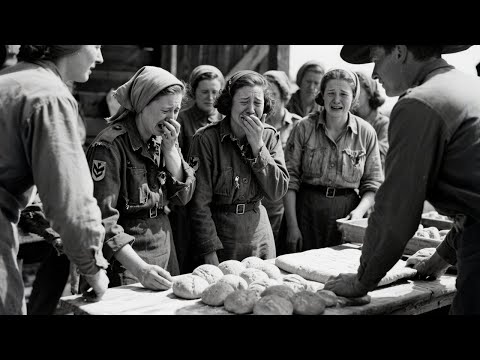
When Sarah pulled the first loaf from the oven, the crust crackled, steam rising from the golden surface. She sliced it thick, butter melting into the warm bread, and passed pieces around the table. The women stared at the slices in their hands. Some brought the bread to their faces, breathing in the smell before taking a bite. Margarite Fischer was the first to cry. She bit into the bread and tasted butter and wheat and salt, and something inside her shattered. All the propaganda, all the lies they had been told about American brutality—it dissolved in the warmth of fresh bread, given freely.
Tears carved lines down her cheeks, dripping onto the table. She tried to stop, embarrassed, but the crying only intensified. Then Ursula began. Then Greta, barely nineteen, who still believed the propaganda from her village near Munich. Within minutes, most of the women were weeping, some silently, others with sobs that shook their shoulders. They ate and cried and ate more, unable to separate the physical relief of good food from the emotional collapse of realizing how thoroughly they had been deceived.
Sarah didn’t try to stop them. She had seen grief before—after her husband died, after neighbors lost sons in the Pacific, after years of drought killed cattle and dreams together. She simply sat at the head of the table, pouring more coffee, cutting more bread, letting these women who had been told she was their enemy cry themselves empty in her kitchen.
The days found their rhythm. The women woke before dawn, dressed in work clothes Sarah provided—denim and cotton, practical and sturdy. They learned to cook American style: biscuits and gravy, fried eggs, bacon that sizzled in cast iron pans. The ranch hands ate breakfast in the main house, nodding politely, thanking them in slow English. Jack Whitaker, twenty-eight, treated the German women with the same courteous distance he showed all women—removing his hat when they entered a room, saying thank you for meals, offering help with heavy loads.
The cowboys—Luther, sixty-three, who had been riding since before automobiles; Hank, fifty-one, with a limp from a horse accident; Carlos, forty-eight, whose family had ranched this land since it was Mexico; Tom, fifty-five, steady and quiet; and Billy, thirty-four, whose childhood polio left one leg shorter than the other—taught the women ranch work. How to collect eggs without spooking the hens. How to mend fences, stretching wire tight between posts. How to recognize when a horse was lame or a cow was sick. The work was physical but not brutal. When the women struggled with English, the cowboys used gestures and demonstrations. When they made mistakes, the men showed them again, patient as teachers.
Greta Kernig, the youngest, was assigned to help Luther with the horses. She had been terrified—propaganda had shown cowboys as violent men who broke horses through cruelty. Instead, she watched Luther spend an hour just standing near a nervous mare, letting the animal grow accustomed to his presence before attempting to brush her. “Want to try?” he asked. She shook her head. “Dangerous. Horse kicks.” Luther smiled. “Only if you give her reason. Come here. Move slow.” He guided Greta’s hand to the mare’s shoulder. The horse’s coat was warm, the muscles beneath rippling like water. By the end of the week, Greta was grooming horses alone, speaking to them in German, which they seemed to accept as readily as English.
Summer arrived with heat that made the air shimmer. The women adapted. Their skin darkened under the sun. Their hands, soft when they arrived, developed calluses from rope and wood and leather. They learned English in fragments—practical words for tools and animals and food. The cowboys learned a few German phrases in return, enough to ask if someone needed help or to compliment a well-cooked meal.
Margarite Fischer kept a diary. She wrote in it each evening, sitting on her cot while the other women prepared for sleep. Her entries tracked the slow dissolution of everything she had believed. June 12th, 1945: Today Sarah showed me how to make pie crust. She was patient when I failed three times. In Hamburg, I taught children that Americans were godless and cruel. I am ashamed.
June 24th, 1945: Luther gave Greta a book about horses. She cannot read English well, but she studies the pictures each night. He asks nothing in return. I do not understand this kindness.
The Fourth of July was a revelation. Sarah declared it a holiday—no work except feeding the animals. She roasted a whole pig over a fire pit, made potato salad and baked beans and three types of pie. As the sun set, Jack and the cowboys set off fireworks bought in Amarillo—Roman candles and sparklers and bottle rockets that traced arcs of colored light against the darkening sky. The German women sat on the porch watching. For them, fireworks meant air raids, meant bombs falling on cities, meant running for shelters while buildings collapsed. But these fireworks were celebration, not destruction. Children from neighboring ranches ran across the yard, waving sparklers, laughing. The contrast was almost unbearable.
Ursula Brown found herself sitting next to Carlos. He offered her a beer, which she accepted. They sat in comfortable silence for a while, watching the sky light up. Then Carlos spoke, his English slow and careful. “My grandfather came from Spain. People here didn’t trust him at first. Said Spanish weren’t really white, weren’t really American. He proved them wrong by working hard, treating people fair. You folks are doing the same.” Ursula didn’t fully understand all the words, but she grasped the meaning. She nodded, unable to speak past the lump in her throat.
By August, mail service was established. The women could write letters to Germany if they had anyone left to write to. Margarite wrote to her sister in Hamburg, assuming the address still existed. Dearest Helga, I am alive and safe in a place called Texas. It is difficult to explain what has happened here. We are prisoners technically, but we live better than we did in the final year of the regime. We have food, real food, more than we can eat. We have beds and clean water and work that is hard but fair. The Americans who guard us are not what we were told. They are farmers and ranchers, simple men who do not hate us. Their boss is a woman who lost her husband, but still treats us with kindness I do not deserve. I think often of what we believed, how thoroughly we were deceived. These people we called enemies have shown more humanity than our own leadership ever did. I am ashamed of what I supported. I am grateful to be here, though it means I am far from you. I hope this letter finds you. I hope you are safe. I hope Germany can heal from what we allowed to happen. Your sister, Margarite.
Not all the women had someone to write to. Greta’s family had died in the bombing of Munich. Ursula’s husband was missing, last seen retreating east ahead of Allied forces. For them, the ranch became a kind of refuge—not home, but a place where the future might be imaginable. Sarah noticed their loneliness. She began inviting them to sit on the porch after dinner, bringing out lemonade or coffee, encouraging them to talk about their lives before the regime. Slowly, stories emerged. Margarite’s memories of teaching, the pride she felt when a slow student finally learned to read. Ursula’s descriptions of working in the textile mill, the patterns she had woven, the friends she had made. Greta’s recollections of her village, the church bells on Sunday mornings, her mother’s garden.
Sarah shared her own stories in return. Growing up during the Depression, marrying Robert when she was nineteen, building the ranch from almost nothing, losing him to a heart attack three years ago. She spoke of her son Jack and her fears that he would be drafted before the regime surrendered. She showed them photographs of Robert, of Jack as a boy, of the ranch in earlier years. The women studied the photographs with fascination. These were enemy people according to propaganda. Yet their lives looked remarkably similar to German lives—families, work, pride in land well tended. The similarities were more striking than the differences.
September brought cooler weather and news from Germany. The full extent of the regime’s actions was becoming public. Reports of camps where civilians had been detained and worse. Photographs of skeletal survivors. Testimony from liberators who found evidence of systematic brutality beyond anything the women had imagined. Margarite read about Hamburg in a newspaper Sarah brought to the ranch. The city she had called home had been used as a staging area for policies she had dismissed as enemy propaganda. She sat at the kitchen table, the newspaper spread before her, and felt her understanding of reality collapse.
Sarah found her there an hour later, still staring at the paper. The older woman didn’t speak at first. She simply made tea, set a cup beside Margarite, and sat down across from her. “I didn’t know,” Margarite whispered. “We were told it was enemy lies. We thought—” Sarah raised her hand gently. “I believe you. Not everyone who was there was responsible. But now you know. Question is what you do with that knowledge.” Margarite looked up, her eyes red. “How can I live with this? How can any of us?” “Same way anyone lives with shame and guilt. You acknowledge it. You carry it. And you do better going forward.” She paused, sipping her tea. “You’re young enough to have a whole life ahead. Don’t waste it on self-destruction. Use it to be someone different than who you were.”
That night, Margarite gathered the women in their quarters. She showed them the newspaper, translating the articles. Some of the women refused to believe it. Greta insisted it was American propaganda, that their leadership wouldn’t have done such things. Others, like Ursula, had suspected but hadn’t wanted to face the truth. The argument that followed was fierce, conducted in rapid German that none of the Americans could understand. Voices rose. Accusations flew. Old loyalties clashed with new realities. Finally, Margarite stood on her cot, commanding attention. “Look around you,” she said. “Look at how we’ve been treated here. Look at what we were told versus what we’ve experienced. If they lied about Americans being brutal savages, what else did they lie about?” The silence that followed was heavy.
One by one, the women began to confront what they had supported, actively or passively. It was painful, that confrontation—easier to believe the propaganda had been true, that they had been on the right side. But the evidence was all around them, in the kindness of cowboys, in bread baked by a woman who had every reason to hate them, in the simple dignity of being treated as human beings despite being enemies.
October meant harvest. The ranch’s gardens produced pumpkins and squash and late tomatoes. Sarah organized the women to help with canning, preserving food for winter. The kitchen became a production center, with pots boiling on the stove and jars cooling on every available surface. It was during this work that true friendships formed. The shared labor, the satisfaction of seeing shelves filled with preserved food, the practical skills being passed from American to German—all of it broke down the final barriers. The women began singing while they worked, German folk songs that Sarah didn’t understand but enjoyed hearing. Sometimes Sarah would teach them American songs, simple melodies like “Red River Valley” that the women could learn phonetically.
Luther taught Greta to ride. He started her on the oldest, gentlest mare, leading the horse around the corral while Greta gripped the saddle horn with white knuckles. After a week, she could walk the horse independently. After two weeks, she managed a slow trot. By the end of October, she was riding across the pasture with confidence, her face lit with joy that had nothing to do with politics or war or shame.
Jack Whitaker found himself drawn to Ursula. She was closer to his age, and despite the language barrier, they discovered they could communicate through work. He showed her how to fix a broken fence, how to read the sky for weather, how to gentle a nervous calf. She showed him German embroidery stitches, taught him a few words of her language, shared stories about textile patterns that had meanings beyond decoration. Nothing romantic passed between them—the circumstances made that impossible and inappropriate. But there was respect, the kind that grows between people who recognize competence in each other. When Ursula successfully predicted a storm by watching the cattle’s behavior, Jack nodded his approval. She had learned.
Sarah insisted the German women join the main Thanksgiving meal. She cooked turkey and stuffing and mashed potatoes and three kinds of pie. The cowboys came dressed in their cleanest clothes. Jack invited neighbors from surrounding ranches—other families who had heard about the German prisoners and were curious. The dining room table stretched nearly the full length of the room, extended with boards set on sawhorses and covered with white sheets. Seventeen German women sat alongside American ranchers, farmhands, and their families. For a moment before the meal began, the scene teetered on the edge of awkwardness. Then Sarah asked Luther to say grace. The old cowboy removed his hat, closed his eyes, and spoke in his West Texas drawl. “Lord, we thank you for this food, for this land, for the people gathered here. We’re grateful the fighting’s done, and folks can start healing. Bless these women who’ve come so far. Bless us with wisdom to be kind. Amen.”
The meal began. Conversation started slowly, then gained momentum. The neighbor families asked the German women about their homes, their work, their plans for after the prisoner program ended. The women, their English much improved, answered as best they could. They asked questions in return about Texas, about ranching, about American customs they still didn’t understand. Margarite found herself talking to a woman named Dorothy whose son had died at Normandy. Margarite expected hatred, blame, coldness. Instead, Dorothy asked about Hamburg, about Margarite’s teaching career, about what she planned to do after the program ended. When Margarite expressed her sorrow for Dorothy’s loss, the older woman nodded. “War takes from everyone,” Dorothy said. “Germans lost sons, too. That doesn’t make it right what your government did. But it doesn’t make you evil for being German.” She paused. “My son wrote letters about German prisoners he guarded in France. Said most of them were just scared kids who didn’t want to be there. I figure if he could see that, I can too.”
The meal lasted hours. After dinner, Carlos brought out his guitar. Someone produced a harmonica. The cowboys played songs—country and western melodies about cattle drives and lost loves and wide open spaces. Then Ursula began singing a German folk song, her voice clear and strong. Other women joined in. The Americans listened, not understanding the words, but recognizing the emotion—longing for home, sadness for what was lost, hope for what might come.
Winter passed with its cold and wind and occasional snow. The women learned to manage the wood stove, to dress in layers, to appreciate the warmth of the main house kitchen. Christmas came, and Sarah organized a modest celebration—a tree cut from the property, decorations made from paper and string, small gifts for everyone. Margarite carved a horse from wood for Greta. Ursula embroidered handkerchiefs for Sarah. The cowboys gave practical gifts—new gloves, warm socks, a book of poetry for Margarite, who had mentioned missing reading.
By spring, the program was ending. The women would be processed for return to Germany, or in some cases allowed to apply for residency in America. Margarite had already decided she would return to Hamburg, try to teach again, use what she had learned to build something better from the ruins. Greta wanted to stay if possible, perhaps work on a ranch, continue with horses. Ursula was torn—uncertain whether her husband still lived, unsure if Germany could ever feel like home again.
The night before the first group was scheduled to leave, Sarah organized a final dinner. The mood was bittersweet. These women had arrived as enemies and were leaving as something else—not quite family, not quite friends, but something more than former prisoners. Sarah stood at the head of the table. She wasn’t one for speeches, but the moment seemed to require something. “I won’t pretend this was easy,” she said. “War put us on opposite sides. But I think we’ve proven something here. People can be better than their governments. Kindness matters more than politics. And bread,” she smiled, “good bread can change hearts better than any propaganda.”
The women laughed through tears. Margarite stood, translating Sarah’s words for those whose English remained weak, then adding her own. “We came here expecting cruelty. We found humanity instead. You broke every lie we’d been told.” She paused, struggling with emotion. “I cannot undo what my country did, but I can promise to live differently because of what you showed us here.”
The meal continued. Stories were shared. Promises to write were exchanged. Addresses were carefully written on scraps of paper. Luther gave Greta a small horseshoe, telling her it would bring luck. Carlos taught Ursula one more guitar chord. Jack presented Margarite with a leather journal, encouraging her to keep writing. As the women walked back to their quarters that final night, they looked up at the Texas sky—vast and clear and full of stars. In that moment, they weren’t prisoners or enemies or representatives of a fallen regime. They were simply women who had learned that the world was bigger and more complicated and more kind than they had been taught to believe.
Margarite Fischer returned to Hamburg in 1946. She found her sister alive, living in the rubble of their childhood home. Margarite resumed teaching, focusing on critical thinking and questioning authority. She corresponded with Sarah Whitaker for 37 years, until Sarah’s death in 1983. In her letters, she often mentioned the bread.
Greta Kernig received permission to remain in America. She worked on ranches throughout West Texas, eventually becoming a horse trainer of some renown. She married a cowboy from Lubbock in 1952. They had three children, all of whom learned to ride before they turned five. She never spoke publicly about her time in the regime, but she told her grandchildren about the moment a patient old cowboy taught her that strength could be gentle.
Ursula Brown learned in 1947 that her husband had died during the retreat east. She chose to stay in America, settling in Hereford. She opened a seamstress shop using the embroidery skills she practiced at the ranch. Jack Whitaker courted her properly in 1949. They married that summer. She became Sarah’s daughter-in-law, helping to run the ranch until Sarah’s death, then continuing afterward with Jack. She mastered English but never lost her accent. Her apple strudel became famous at county fairs.
The Whitaker ranch continued operating through changing decades. The program that brought German women prisoners became a footnote in local history—an oddity that older residents remembered but younger generations barely knew. But the legacy persisted in small ways. The German women who passed through learned that enemies could become neighbors. The Americans who hosted them proved that decency transcended nationality.
In 2003, a historian researching prisoner programs interviewed Greta Kernig, then 77, at her ranch outside Amarillo. She was asked what she remembered most from her first months in Texas. “The bread,” she said without hesitation. “They baked us bread when they could have given us nothing. They treated us like people when we’d helped treat others as less than human.” She paused, looking out across the pasture where horses grazed. “That bread didn’t just feed us. It proved that everything we’d been taught was a lie. It broke something in us that needed breaking. It gave us permission to become something better.”
The historian noted this in her records. Later, she wrote that the simplest acts of kindness often accomplish what bullets and bombs cannot. They reveal our shared humanity, one loaf of bread at a time. The panhandle sky remains vast and clear. The land still stretches to horizons that swallow fear and hate and lies. And somewhere in the archives, preserved letters tell of German women and Texas cowboys who proved that even in war’s aftermath, there is room for transformation. For bread shared across enemy lines.
What small act of kindness have you witnessed that bridged an impossible divide?
Report this article
Select a reason for reporting:






