Autumn 1943. The knock on the door of the Blue Moon Club on 133rd Street wasn’t a request—it was a declaration of ownership. Sal, Anastasia’s collector in the same gray coat every night, walked past the bar, past the dancing couples, and sat down across from Clarence Webb, who had run that club for eleven years without missing a rent payment. On the back of a matchbook, Sal wrote a number: $300 every week. Cash. No receipts. The trumpet kept crying. Nobody at the bar heard a word. Three blocks away, Bumpy Johnson was eating pork chops. He listened to the report without putting down his fork. He asked two questions: How much? And which clubs? Then he went back to his dinner.
The young runner who brought the news waited for an order—a threat, a plan. Instead, Bumpy said, “Watch where the money goes after Sal picks it up. Don’t follow Sal. Follow the car.” That was it. Brooklyn saw the silence that followed and called it surrender. Bumpy saw Brooklyn seeing the silence and understood it was the most useful thing he had. Real power doesn’t announce itself at the door. It’s already sitting at the table, watching you knock.
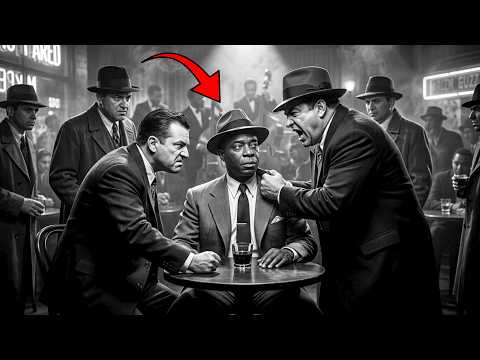
By the third week, Sal had a schedule: Tuesday nights, 11:00, six clubs, same order. He moved through Harlem like a man who owned the night—unhurried, unworried, nodding at bartenders who had learned to nod back without showing anything behind their eyes. He thought the routine made him look established. It made him look like a clock. And Bumpy Johnson had always known how to read a clock.
What Sal didn’t understand, sitting at Dorothy Price’s bar with his rubber-banded ledger and his free whiskey, was that Dorothy had been meeting Bumpy every Thursday morning for eleven years. Same diner. Same table. Coffee for her. Tea for him. The Thursday after Sal’s first visit, she told Bumpy the exact amount, the exact time, the exact words Sal had used. Bumpy stirred his tea. “Pay him. Smile when you do it. Give him slightly less than he expects. But not so little he gets angry.” Then he added, “And keep a record—exact amounts, exact times—and get it to Ellis by Wednesday morning.”
The money Sal collected was real. It crossed the bridge every Tuesday in a bag held by a driver named Carmine, who had no idea that Ellis had identified his car by the second week and his route by the third. Not following directly—two men, two separate nights, watching from distances that couldn’t be called surveillance. Pure geography. Pure patience. By week four, Bumpy knew the Tuesday money went to a social club in Carroll Gardens, arrived between 1:00 and 1:30 a.m., and was placed in a safe behind a painting of a ship. He hadn’t moved against a single one of them. He’d simply built a map while Brooklyn thought it was building an empire.
Meanwhile, the real economy of Harlem’s nightclub district underwent a quiet surgery. Not theft—nothing so crude. What Bumpy had begun was a restructuring: the private gambling, the backroom card games, the cash payments to performers who never signed a contract—none of it had ever touched a ledger Sal reviewed. But now Bumpy tightened that invisibility further. New people handling internal collections. New timing. New locations for the drops. A layer of separation between the front operation and the real one so clean that a man could spend a week inside those clubs and leave knowing exactly nothing.
When Sal started asking questions after collections—conversational, curious—Bumpy received the information and let a moment of quiet settle over the table. “When a man starts asking questions,” he said, “it means he already knows he doesn’t have the answer. He’s hoping you’ll hand it to him.” Ellis asked what they should do. “We keep handing him the same answer,” Bumpy said, “until he stops being curious and starts being confused. Then we hand him something a little different.”
Anastasia was not a patient man. Four weeks into the Harlem operation, the numbers were wrong—not dramatically, but persistently. The weekly collections Sal brought back were roughly 40% of what they should have been. He sent Enzo, a thin, gray-suited man who looked like a retired schoolteacher and was there not to threaten but to understand. Enzo arrived on a Thursday evening and went directly to the Blue Moon. He asked to see the books.
Clarence Webb handed him a ledger. It was beautiful—green cover, worn at the corners, pages dense with figures in three different hands. Eight weeks of revenue, itemized by night, expenses broken into categories. Every number in it had been invented. Not carelessly—this was architecture. The work of Harold Reese, who had kept financial records for three different Harlem operations over fifteen years and understood the difference between a number that was false and a number that was believable. The real accounts existed nowhere on paper. They lived in the memory of three people selected specifically because certain information stayed behind their teeth.
Enzo sat with Clarence for two hours. He asked good questions—sharp, specific, designed to produce contradictions. Clarence answered every one with the ease of a man telling the truth, because in a certain technical sense, he was. He was telling the truth about the club that existed in the ledger, a club he had come to know almost as well as the real one. What Enzo’s careful eyes never found: the door in the east wall of the storage room that opened onto a staircase leading to a basement room where six nights a week, starting at midnight, a card game ran that on its worst night generated more than the club’s entire legitimate Saturday revenue.
Enzo moved through all six clubs over three days. All six ledgers told the same story—consistent in aggregate, different in detail. Harold had written each one in a different hand. Bumpy received a full report each evening. Same question: Did he look satisfied? Each evening, yes. Each evening, Bumpy said nothing for a moment. Then, “Good. Let him look satisfied. Satisfied men stop looking.”
Enzo returned to Red Hook and told Anastasia the books were clean. Anastasia listened. He was not fully satisfied—a man like that built his survival on never being fully satisfied—but he had no thread to pull. He told Sal to continue. He told Enzo to return in a month. Bumpy received word of this by the following morning. He made one small adjustment to a Monday night route, then put on his jacket and walked out into the gray autumn light of 133rd Street.
The most dangerous lie is not the one that contradicts the truth. It is the one that becomes the truth—the one so carefully constructed, so thoroughly lived in, that the men trying to find the lie end up furnishing evidence for the story you built around it. Brooklyn sent an auditor into Harlem and got back exactly what Harlem wanted Brooklyn to believe. And somewhere below the streets, behind the door in the east wall, the cards were still being dealt.
The confession came on a Wednesday, not in a police station or a courtroom, but in the back office of the Starlight Room on 131st Street at 2:00 in the morning, with the smell of stale beer and cigarette smoke pressed into the walls like a second layer of paint. Walter Pruitt, forty-four years old, six years running that club, had the hollow look of a man who had been sleeping badly for weeks. He had asked Ellis for this meeting. He had used the word need. Bumpy already knew which kind of need it was.
He sat across from Walter in the narrow office, the door closed, a single lamp burning on the desk between them. The lamp threw yellow light upward into both their faces—the kind of lighting that makes everyone look like they’re telling the truth and guilty of something at the same time.
“I was the one who told them about Harlem,” Walter said. His hands lay flat on the desk. “About the clubs. About what we were running. I gave Brooklyn the information they needed to come in here.”
The words sat in the room like something dropped that couldn’t be picked up. Bumpy did not move. Did not blink. He looked at Walter the way a man looks at something he identified a long time ago and has simply been waiting to see confirm itself.
“I know,” he said.
The relief on Walter’s face lasted one second. Then the full meaning of those two words landed, and the relief curdled into something between terror and the sick vertigo of a man who realizes the ground he’s been standing on was never ground at all.
“You knew,” Walter said. “Before Sal walked into his first club.”
“I knew which direction Brooklyn was coming from. I knew the week. I didn’t know which door they’d use.” Bumpy paused. The lamp hummed between them. “You were the door.”
Walter’s mouth opened slightly. He looked like a man watching a wall he’d thought was solid turn out to be painted on canvas. “Then why didn’t you—”
“Because I needed them inside.” Bumpy’s voice was flat and quiet, carrying the particular authority of a man who never needed volume because the words themselves were enough. “A rat you know about is useful. A rat you’ve already caught is just dead.” He leaned forward slightly, and the lamplight shifted on his face. “You gave me six weeks of intelligence on Anastasia’s operation that I couldn’t have purchased for any price. Sal’s route. Carmine’s schedule. Enzo’s methods. The address in Carroll Gardens where the money sleeps. You gave me all of it because you gave it to them first—and I was watching everything they did with it.”
Walter looked at the desk. His flat hands were trembling now, very slightly, the way a surface trembles when something heavy passes close without touching it. “What happens to me?” he said. His voice had gone thin.
Bumpy sat back, studying him with the particular look of a man calculating not punishment but utility. “You work. Harder than you’ve worked since you opened that door. Every Tuesday you pay what you owe. Every Thursday you tell Ellis everything you see. You don’t speak to Brooklyn again—not because I’ll stop you, but because you’ll understand from this night forward that speaking to Brooklyn costs more than you can afford a second time.”
Walter nodded—the nod of a man who has just understood the terms of his survival.
“And you never tell anyone what I just told you,” Bumpy added. “Not the part about knowing. Not the part about the door. Not this room. This lamp. This conversation.” He stood and buttoned his jacket. “You came in here expecting to be punished. What you got was worse. You got to find out that your worst act was someone else’s best hand.”
Outside, the street was cold and quiet. Ellis fell into step beside him. “He going to be a problem?”
“He’s going to be extremely cooperative,” Bumpy said. “Shame does that to a man. Especially when the thing he’s ashamed of is being outsmarted instead of being caught.”
They walked half a block in silence. Somewhere above them a window was dark, the whole street dark that deep, the particular Harlem darkness that felt inhabited even when it looked empty.
“So Anastasia never found the door,” Ellis said.
“Anastasia found exactly the door I left open for him. He walked through it. Set up his operation. Spent six weeks believing he’d found a weakness.” Bumpy turned his collar up against the cold. “The weakness was the lock.” He walked a few more steps. “To trap something that believes it is hunting, you do not chase it. You build a room it wants to enter. You leave the door open. You wait inside with the lights off. And when it walks in far enough, you close the door from the outside.”
Ellis was quiet, turning it over. Then he asked the question that had been sitting behind his teeth since the Blue Moon. “And when the men in Brooklyn figure out they walked into a room built for them—what then?”
Bumpy stopped walking. He looked up the street, toward the avenue, toward the bridge that carried Brooklyn’s cars back and forth across the water every Tuesday night. “Then,” he said, “we stop making it about Brooklyn. We make it about the men who decide what Brooklyn is allowed to be.” He started walking again, slower now. “Anastasia isn’t the top of that chain. He’s a loud link in the middle of it. The men above him don’t care about Harlem. They care about what Harlem is worth, and whether the man collecting it is worth what they’re paying him to collect.”
“So we make him look expensive,” Ellis said.
“We make him look like a man who started something he couldn’t finish,” Bumpy said. “That’s a different kind of expensive. That’s the kind that travels.” He glanced at Ellis. “Word moves sideways in this city. Through walls. In the spaces between conversations at tables where people are technically discussing something else. Right now the word is that a neighborhood is giving Brooklyn trouble. By the end of the month, the word needs to be that Brooklyn has a man in Harlem who doesn’t know what he’s doing.”
They reached the corner. A delivery truck rattled past, its headlights sweeping the empty sidewalk. Bumpy watched it go.
“There’s a dinner,” he said. “Somewhere on the East Side, before the month is out. Four men at a table, maybe five. No agenda on paper. They’ll talk about revenue, and somebody will mention upper Manhattan, and the mention will sit there in the room like smoke until someone else decides whether to wave it away or lean into it.”
“How do you know there’s a dinner?”
“Because there’s always a dinner.” Bumpy smiled, just barely, the first crack in the stone of his face all night. “Men like that don’t make decisions in offices. They make them over wine, and then they let other men carry the decisions downstairs.” He turned toward home. “I don’t need to be at that table. I need the conversation at that table to arrive at a conclusion I’ve already prepared for it.”
Ellis walked beside him, and after a moment he said, “And what conclusion is that?”
Bumpy didn’t answer right away. The street was quiet enough that they could hear a radio playing somewhere above them, a woman’s voice singing something slow and old. “That Harlem is more trouble than it’s worth,” he said finally. “Not because it fights. Because it doesn’t. Because it pays, and smiles, and keeps its books clean, and still somehow costs more than any man should have to spend.” He looked at Ellis. “A neighborhood that fights can be beaten. A neighborhood that cooperates can only be outlasted. And Anastasia has never outlasted anything in his life.”
The dinner came, and so did the question. Word reached Carroll Gardens that Anastasia had spent seven weeks losing a neighborhood that was, by every visible measure, cooperating. “Harlem pays in full,” Bumpy told Ellis. “The problem is the man who made noise in a place that never required noise.”
So the Tuesdays changed. Full envelopes. Open doors. The gray coat collected and smiled and understood nothing. Then, one Tuesday, Sal simply wasn’t there. No announcement. Just absence, then more absence, until it became the new condition.
Harlem exhaled—carefully, measuring what survival had cost. Bumpy had protected the neighborhood. He had also claimed it, quietly, permanently, the way foundations claim the buildings above them.
“The hand that holds the door closed and the hand that holds the key,” Dorothy said years later, “depends entirely on which side of the door you stand.”
So tell us: if you had been one of those six club owners in 1943, would you have trusted Bumpy Johnson—and was what he built worth the price Harlem paid?
Report this article
Select a reason for reporting:






