Look closely at the photograph. Three figures sit in a Victorian studio, their expressions composed, their bodies still. One of them is already dead—and almost everyone guesses wrong.
Most people suspect the elderly woman first. Her posture is too rigid, her hands too flat. Then, attention shifts to the young woman. Her stare feels unnatural, too fixed, too direct. But in the 19th century, death wasn’t hidden in the face. It was hidden in support.
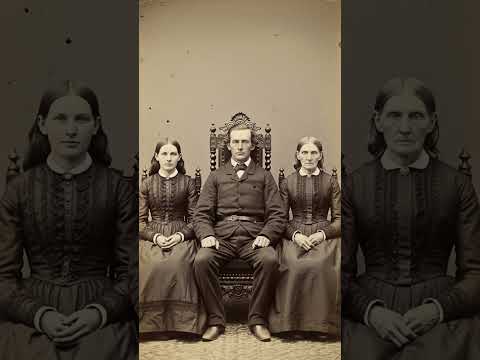
Look at the man in the center. Look lower—not at his hands, at his waist. That isn’t a belt. It sits too high, above the trouser line, and it disappears behind the chair.
The living hold themselves upright. The dead are held in place.
This single detail, overlooked by so many, reveals the truth. But the story behind this portrait is darker than you might imagine—and it begins with a photographer who specialized in the dead.
The photographer’s name was Elias Thorne, and by 1878 he had become something of a quiet legend among London’s grieving families. His studio sat above a milliner’s shop on a narrow street in Whitechapel, and his specialty was simple: he made the dead look alive.
It was a peculiar trade, born of both necessity and vanity. Photography was still expensive, still rare enough to be a luxury. When a loved one died suddenly, families who had never sat for a portrait faced the grim reality that this was their only chance to preserve a face they had loved. So they called for Thorne.
“The dead do not complain about the light,” he once wrote in a letter to a fellow photographer. “They do not blink, they do not fidget, they do not grow weary of the long exposure. In that sense, they are the perfect subjects.”
But Thorne was not merely a craftsman. He was a collector. Behind his studio, in a room he kept locked, he stored glass plates and prints—dozens of them, then hundreds. Families assumed he discarded the failed exposures. He never did.
The portrait in question, the one with the three seated figures, was taken on a cold morning in November. The family had arrived before dawn, carrying the body of the man in the center—a merchant named Algernon Pryce, who had died two days earlier of a sudden fever.
His wife and daughter sat on either side, dressed in black, their faces carefully arranged into expressions of composure. The daughter, the young woman with the too-fixed stare, had been instructed not to cry. Tears, Thorne insisted, ruined the plate.
What the family did not know was that Thorne had already photographed Algernon Pryce once before—three years earlier, alive, in the same studio, in the same chair. And when he developed the new plate, he noticed something that made his hands tremble.
The dead man’s eyes had moved.
Thorne compared the two plates side by side under the red glow of his safelight. The earlier portrait showed Algernon Pryce with his eyes fixed on the lens, a faint smile on his lips. The new one—the death portrait—showed the same face, the same posture, but the eyes had shifted. They now looked slightly to the left, toward his daughter.
He told himself it was an artifact. A trick of the collodion. A smudge on the glass. But he had been in this trade too long to believe in accidents.
“The dead do not move,” he whispered to himself, though his voice lacked conviction.
He locked the plates away and tried to forget. But the following week, another family arrived. A young boy, no more than seven, who had drowned in the Thames. His mother sobbed quietly in the corner while Thorne arranged the body. The boy’s eyes were closed, his hands folded over his chest.
When the plate was developed, the boy’s eyes were open.
Thorne began to keep a journal. He noted dates, names, and the precise nature of each anomaly. The dead, it seemed, were not content to be still. They shifted. They turned their heads. They opened their eyes. And always, always, they looked toward the living.
He stopped sleeping. He stopped eating. He spent his nights in the locked room, surrounded by faces that watched him from every shelf.
It was in December that he found the pattern. The dead only moved when the living in the portrait were looking away. In every anomalous plate, the living subject’s gaze was directed elsewhere—at a window, at their own hands, at the floor. The moment the living looked away, the dead took notice.
Thorne wondered what would happen if the living looked back.
He decided to find out.
He chose a family he had never met—a widowed seamstress named Mrs. Holloway and her two sons, aged ten and twelve. The older boy had died of consumption three weeks prior, and the family had scraped together enough coins for a single portrait. Thorne charged them nothing.
He arranged the scene with unusual care. The dead boy in the center, propped by the hidden iron frame that sat above the trouser line. The mother to his left, the younger son to his right. And this time, he instructed them differently.
“Look at him,” Thorne said softly. “All of you. Do not look away. Not for a single moment.”
The exposure took eleven seconds. Eleven seconds of three living faces fixed upon one dead one. Thorne held his breath behind the camera, watching the boy’s eyelids through the lens.
They did not move.
When he developed the plate, his hands were steady for the first time in weeks. The image was perfect—too perfect. The dead boy’s eyes were closed, his expression peaceful, and the three living faces wore expressions of such raw, unguarded love that Thorne felt something crack inside his chest.
He had spent months cataloguing the dead’s hunger for the living. He had never once considered what the living’s attention might give them in return.
That night, he returned to the locked room one final time. He took down every plate, every print, every face that had watched him from the shelves. He carried them into the yard behind the studio and built a fire that burned until dawn.
As the last glass plate warped and blackened in the flames, Thorne thought he heard something—a sound like a long-held breath finally released.
He closed the studio the following week. He never took another photograph. But before he left, he wrote one final entry in his journal, a single line that he underlined twice.
“The dead do not want to be seen. They want to be looked at—and then released.”
The portrait with the three seated figures passed through many hands over the decades. It hangs now in a small museum of Victorian curiosities, where visitors still lean close and guess wrong. They point at the elderly woman’s rigid spine. They whisper about the young woman’s stare.
They almost never notice the man’s waist, the hidden frame, the quiet truth that the living hold themselves upright while the dead are held in place.
And they never ask the question Thorne spent his life learning to answer: what does the dead man’s gaze follow when no one is watching?
So tell me—if you sat for a portrait beside someone you had lost, would you dare to look back?
Report this article
Select a reason for reporting:






