The Luzon Strait, night. A US submarine hangs just beneath the surface, where the ocean is black and the sky is worse. On the periscope, a moving city of steel — a Japanese convoy with escorts sweeping like sharks. Commander Gordon Underwood has a problem you can do the math on: one submarine, limited torpedoes, and an enemy screen built specifically to erase submarines. His only advantage is distance measured in yards and time measured in seconds. Every approach angle collapses into the same equation.
If he’s detected, he doesn’t fight. He gets crushed.
And then Underwood does something that makes no sense. He presses closer instead of breaking off.
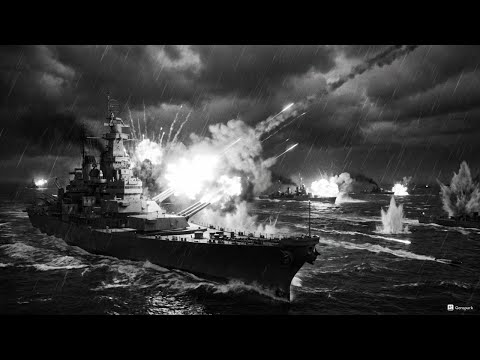
Most crews in this situation don’t get a second mistake. When escorts lock on, they don’t attack — they drown you in explosives until your hull fails or your air turns poison. Underwood doesn’t have air cover. He doesn’t have reinforcements. He doesn’t even have the luxury of a clean escape route, because the enemy is everywhere the convoy is. He has steel, batteries, crew discipline, and the knowledge that a single misjudged turn can mean a depth charge pattern so close the boat shakes like it’s being ripped apart bolt by bolt.
But Underwood is about to defy what should happen. Because in this stretch of the Pacific War, his decisions keep producing outcomes that sound fake. He’ll penetrate unusually alert escort screens, still land torpedo attacks, and keep coming back for more while the enemy tries to bury him alive. And in the broader campaign, his boat’s coordinated strikes help produce a number that sounds like a headline: 13 ships destroyed in one coordinated attack group action. A night where Japanese shipping simply vanishes from the surface.
His advantage? He doesn’t chase glory. He chases process.
Gordon Wait Underwood, born June 3, 1910, in New York, raised in Portland, Oregon — a Naval Academy athlete who later adds something even rarer: a master’s degree in marine engineering from MIT. He’s not just brave. He understands machines, failure modes, and how to keep a system alive under stress. But to understand how, you need to know what made him different.
In 1941, Underwood earns that MIT degree, and it rewires how he sees danger. Once you understand machines, you stop thinking in vibes. You think in limits. He doesn’t come out of MIT with swagger. He comes out with something deadlier: the ability to look at a failure in the dark and say, that noise means we have minutes.
By July 1944, Underwood takes command of USS Spadefish (SS-411) and goes into enemy-controlled waters. This isn’t a hunt. It’s a contest between a submarine and an escort screen designed to shred submarines. Underwood’s method is relentless. He penetrates heavy and unusually alert escort screens, sometimes with air support overhead, and still presses torpedo attacks. The results are not subtle: six enemy ships sunk, totaling 40,000 tons, and two more damaged for 14,500 tons. Then the enemy retaliates with heavy anti-submarine efforts — depth charges meant to break him psychologically and physically. Underwood evades with intelligent evasive tactics, gets the boat home, and his tone afterward is pure professional: the job got done. That patrol earns him the Navy Cross.
Second patrol, same ocean, smarter enemy. Underwood doesn’t become cautious — he becomes cleaner. Well-planned and smartly executed attacks, and the numbers follow: over 30,000 tons sunk plus another large vessel damaged. Another Navy Cross. The pattern is already clear. Underwood doesn’t gamble. He calculates, then commits.
Third patrol, January 1945. Conditions worsen — unusually numerous escorts. Underwood executes six attacks. In multiple runs, he penetrates the defenses of four escort vessels each time, concludes five of those attacks successfully, sinks four ships for 16,400 tons, damages another 7,500 tons, then evades extremely heavy countermeasures. This is where the citations start using a specific word: coolly. It is not a personality trait here. It’s a survival technique. When everyone else is reacting to fear, he is reacting to information.
By late war, Underwood’s operations connect to something bigger than single sinkings. In coordinated submarine group attacks, Spadefish’s results combine with sister boats to create a night of destruction recorded as a total of 13 ships and over 64,000 tons for the attack group. Underwood is now part of a machine that doesn’t just fight ships — it collapses supply lines.
By early 1945, Gordon Underwood had earned three Navy Crosses and a reputation for penetrating escort screens and returning alive. But nothing compares to what happens next. Return to that dark water. Return to the moment he chooses the absurd option.
Here’s how he does it. We’re back in the Pacific night, where convoy lights are dimmed, escorts patrol in arcs, and the sea smells like oil and salt. Underwood is not hunting a single ship. He’s hunting a system — a convoy’s rhythm, escort spacing, turn timing, and reaction lag.
He prepares in steps. Always steps. He studies the screen, not the targets. Escorts are the real enemy. He chooses the approach path that minimizes exposure time, not the one that feels heroic. He times his periscope use like a thief — up, down, never long enough to be caught. He plans the escape before the attack, because a torpedo run isn’t the end. It’s the beginning of the retaliation.
And there’s a deeper stake than personal survival. Every freighter sunk is less fuel, less food, fewer aircraft parts moving to where Americans and allies will face them later. Underwood’s boat is one blade in a much larger strategy of strangulation, turning Japanese shipping routes into graveyards.
Then the internal decision point arrives. The convoy is guarded tighter than expected. Underwood can break off and live to hunt later, or he can do what has defined him across patrols: push through the escort geometry, accept the risk, and fire from inside the danger zone. One sentence makes the absurd rational. The closer he gets, the less time the escorts have to understand what’s happening.
Problem one: the escort screen is unusually alert. Underwood can feel it in the pacing of the search patterns. He orders silence. No unnecessary movement. The boat becomes a held breath. He inches forward. The periscope rises — one thin column of vulnerability — then drops again.
Solution: he doesn’t chase the biggest ship. He chases the gap. Complication: the gap closes. An escort shifts. Adaptation: Underwood changes depth, changes speed, changes angle, micro-adjustments like tuning an instrument until the escort’s line of sight is wrong by just enough.
Problem two: if he fires too early, escorts will have time to react. If he fires too late, targets slip away and he wastes position. Solution: he waits until the convoy’s own movement locks them into predictability. He fires. Not dramatically, not with shouting — just controlled commands and the physical violence of launch. Compressed air, shutter, the fish gone.
Complication: now the ocean is a stopwatch. Torpedoes run and escorts begin the reflex — acceleration, turning, suspicion becoming certainty. Adaptation: Underwood pre-moves his boat, already sliding into the escape geometry he calculated earlier.
Problem three: depth charges. The enemy answer arrives. Explosions roll through the hull like a fist through a door. Light bulbs tremble. Metal complains. Air tastes like hot oil and battery acid. Solution: intelligent evasive tactics — the citations call it that. In practice, angle changes that break prediction, depth changes that break sonar solutions, speed changes that make the enemy’s pattern wrong.
Complication: evasion burns battery. Battery is life. Adaptation: Underwood chooses controlled evasion, not panic evasion. He refuses to be stampeded into wasting power.
Problem four: the escorts are too close — four of them in the pattern, overlapping. This is where most skippers turn defensive for hours. Solution: Underwood does the thing he’s become famous for. He penetrates the escort defenses again, coolly. He slides under the screen, uses their movement against them, and lines up another shot.
Each attack teaches the enemy. Adaptation: Underwood varies the timing, varies the angle, varies the depth. He treats the enemy as a learning machine and stays ahead by refusing to repeat himself.
Problem five: the moment of impact. Confirmation without celebration. A torpedo hit is not a cheer. It’s a distant concussion through water. Sometimes the only proof is a change in sound — metal tearing, steam venting, the convoy’s cadence breaking. Underwood doesn’t allow relief, because relief is how crews die.
And this is where the story expands beyond one submarine. Underwood is operating inside a wider campaign where coordinated action can tally into something almost unbelievable: 13 ships destroyed in a single coordinated attack group action, over 64,000 tons gone. That number isn’t one man’s trigger finger. It’s what happens when multiple boats, multiple commanders, and a doctrine of aggression converge. And Underwood is one of the operators good enough to make it real.
But the last obstacle isn’t the convoy. It’s what comes after — the enemy’s final attempt to solve him. A fresh pattern of depth charges begins, closer than before. The hull flexes. Men brace without being told. Every sense compresses: the groan of steel, the sour battery smell, the taste of stale air, the tiny sounds that become sacred because they mean the boat is still intact.
Underwood has one last resource. Discipline. He slows. He goes quiet. He stops trying to win the moment and focuses on not losing it. He turns the submarine into a ghost — minimal movement, minimal noise, maximum patience. Second by second, the explosions drift farther. The enemy loses the thread. The ocean finally opens.
Underwood doesn’t deliver a speech. He doesn’t celebrate. If anything, his reaction is the kind of understated calm his citations keep pointing at: professional, controlled, already thinking about the next problem.
In the aftermath, the Navy doesn’t describe Underwood’s patrols with poetry. It describes them with tonnage, dates, and the cold language of effectiveness. Ships sunk, ships damaged, escort screens penetrated, boat returned safely. Underwood receives the Navy Cross three times — one for each of his first three war patrols in Spadefish.
And that’s the absurdity. The recognition is official, but the work is almost invisible. There’s no camera footage, no cheering crowds at sea — just a submarine crew returning to port looking exhausted, like they’ve been holding their breath for weeks. Because they have.
Still, the story spreads, because numbers spread. Over 30,000 tons. Six ships. 40,000 tons. Coolly penetrated. Those phrases move through the fleet like a rumor with receipts. And then comes the proof that it wasn’t luck: the broader record. Across his three patrols, Underwood is credited with 76,000 tons of enemy shipping destroyed, including the aircraft carrier Shin’yō among the credited targets.
The point isn’t the tonnage as a brag. It’s the pattern. Underwood repeatedly enters enemy-controlled waters, repeatedly attacks through escort screens, repeatedly survives countermeasures designed to make survival mathematically unlikely — and repeatedly returns. That repetition is character.
Underwood retires from the Navy in 1962 after a long career. He doesn’t turn into a celebrity warrior. He becomes an executive vice president in private industry — work that sounds almost comically normal for a man who once guided a submarine through lethal geometry. And yet it fits. The same mind that keeps a submarine alive under depth charges is the kind of mind that finds satisfaction in systems that run clean and don’t fail. Some things you never stop being.
He dies January 15, 1978, at age 67. And like many of the silent service, his story risks becoming a footnote — unless you look at what the Navy chose to preserve. His name carried forward in ships like USS Underwood (FFG-36), explicitly named for him. Some stories don’t fit on headstones.
There are two ways to tell this story. One is the legend version: a cold-eyed commander who fires without mercy and destroys an impossible number of vessels because the war demanded it. The other is the documented record: a Naval Academy athlete with an MIT engineer’s brain, repeatedly launching well-planned and smartly executed attacks, coolly penetrating escort defenses, and bringing his boat home through extremely heavy countermeasures.
Both are true. Both are remarkable. But here’s what matters.
Underwood’s gift wasn’t that he felt no fear. It’s that he didn’t let fear write the procedure. When the rational choice is to withdraw, he asks a different question: what does the enemy think I will do? Then he does the unexpected thing — because unexpected is sometimes the only space left where survival exists.
And that’s the real story. Discipline can look like courage, and courage can look like calm. So if you ever find yourself in a situation where the math says you should lose, remember the submarine commander who treated death like an engineering problem — and solved it anyway.
Now tell me: when the math says you should lose, what’s the one unexpected move you’d make?
Report this article
Select a reason for reporting:






