The morning air hummed with engine noise and the sharp, familiar sound of my father’s laughter echoing through the private terminal. I dragged my suitcase across the marble floor, my heels clicking like a countdown, while his voice cut through the din like a blade. “You should be grateful if you even get to sit in the back with us,” he said, arms crossed, that razor-sharp grin plastered on his face.
My sister Amber snorted behind her sunglasses. “Maybe she can help load the luggage. That’s more her thing.” Her laugh drew stares—exactly what they wanted. They loved an audience. I just stood there, calm, soaking in the moment. I had wasted enough years trying to earn their respect. I was done.
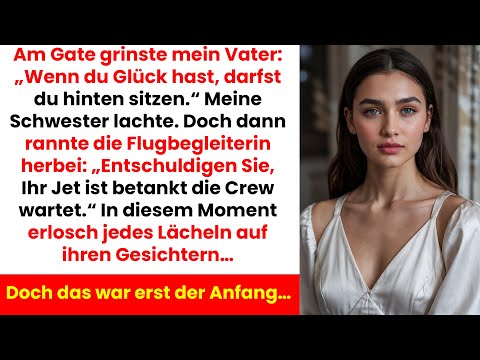
My father’s gaze swept over my simple coat and the worn carry-on I’d bought years ago when I was broke. “Do you really think you belong here?” he asked quietly. “This isn’t a cheap terminal. People who matter travel here.” I smiled faintly. Before I could answer, a young woman in a dark blue uniform came rushing toward us, nearly out of breath.
“Ms. Reynolds,” she said quickly, clutching her tablet. “I’ve been looking everywhere for you. Your jet is fueled and ready. Captain Hay just messaged—your crew is waiting for your signal to board.”
The world seemed to stop. Amber blinked first, confusion flooding her face. “Wait—her jet?” The flight attendant straightened and nodded respectfully. “Yes, ma’am. Ms. Reynolds, owner of Horizon Aeronautics.”
I turned to my father and sister. They looked like statues—the kind you find outside old banks, weathered by time and arrogance. I tucked a strand of hair behind my ear and said quietly, “Thank you. Tell Captain Hay I’ll be right there.”
My father’s mouth opened and closed. “You bought a jet?” “No,” I said calmly, meeting his eyes. “I founded the company that makes them.” Amber let out a weak, nervous laugh. “You’re joking.” “I don’t have time for jokes, Amber.”
I made my way toward the private terminal, each step heavier—not from pride, but from memory. The nights I slept in my car. The days I counted change for groceries. Every insult they’d thrown at me had turned into fuel. Behind me, my father called out, “Mia, wait!” I stopped but didn’t turn around. He sounded smaller than I remembered.
“When did you—how did you—” “While you were laughing,” I said softly, “I was busy working.” I glanced back once. Their faces were pale, eyes darting to the jet visible through the glass. Its silver fuselage gleamed in the sun, engines humming softly. My name was printed in clear letters on the side.
I didn’t smile out of revenge. I smiled out of peace. “Enjoy your flight,” I told them. “Mine’s waiting.” And as the automatic doors opened before me, I stepped into a world they said I’d never reach.
As the glass doors closed behind me, their shocked faces vanished, but their voices lingered. I could still hear every word they’d thrown at me over the years. Failure. Disappointment. Embarrassment. They thought I’d disappeared when I left home five years ago with a suitcase and $300. Maybe I did—but sometimes disappearing is the first step to becoming someone new.
I remember the first night at a bus station in Arizona. The smell of stale coffee. Messages from Amber lighting up my phone: “Come back before Dad changes the locks. You can’t make it on your own.” She was wrong. I didn’t make it on my own. I made it because I was on my own.
I worked double shifts at a roadside diner, washing dishes until my hands cracked, sleeping in a storage room behind the freezer because rent was too high. Every morning at 5 a.m., I watched private jets streak across the pink horizon and whispered to myself, “One day, I’ll fly higher than all of them.”
The turning point came on a rainy evening when a man named Lucas Blake walked in. Middle-aged, quiet—the kind of man who listened more than he spoke. He was a logistics consultant, stopping for coffee between flights. He noticed the sketchbook by the register, filled with scribbled plans for an aviation startup.
“You draw flight routes in your spare time?” he asked. I laughed. “More like dreams I can’t afford.” He studied the notebook for a long moment, then said, “Dreams that survive hunger and humiliation—those are worth investing in.”
That sentence changed everything. Lucas became my first investor and mentor. I built my first company from the ground up—a freight management app that helped small delivery businesses coordinate routes more efficiently. It wasn’t glamorous. It wasn’t easy. But within a year, it caught the attention of Horizon Air Logistics. They didn’t hire me. They partnered with me.
By 29, I was sitting in meetings with men who wouldn’t return my emails. I remember a board member saying, “You don’t look like a CEO.” I smiled. “That’s because you’re still looking for one in a suit. I built my empire in an apron.”
Two years later, Horizon merged under my leadership, and the first thing I bought wasn’t a mansion or a yacht. It was my own jet. Not to show off—but because every flight reminded me of the girl who used to watch from the diner window. Cold, tired, and still hopeful.
And then, out of nowhere, came an invitation. A family trip to the Bahamas—from Dad and Amber. The same people who once told me, “Don’t come back until you’re worth something.”
I didn’t go to prove them wrong. I went to see if they had changed. But standing at that gate this morning, watching them mock me all over again, I realized they never would. They hadn’t evolved. I had.
As I opened the door of my jet and the warm cabin air brushed my face, I whispered to myself, “They’ll never understand that I wasn’t chasing the money.” I was chasing peace—and for the first time in my life, I finally felt like I’d found it.
The jet cut through the clouds like a blade through silk. The engines hummed in a steady, unbroken rhythm. I sat by the window, staring at the horizon—endless, golden, out of reach. From up here, the world looked small. Maybe that was the point.
My phone vibrated for the third time on the leather armrest. I ignored it. He had never called to apologize before, and I doubted today would be the exception.
“Ms. Reynolds,” the flight attendant said softly, leaning closer, “Captain Hay wanted me to let you know we’re ahead of schedule.” “Would you like coffee or tea?” “Coffee,” I said quietly.
As she walked away, I finally picked up the phone. Missed calls. Three voicemails—all from him. I played the first one. “Mia, it’s your father. Call me back. We need to talk.”
The second came out a little shakier. “I don’t understand what’s happening. The flight attendant said you own the jet. Is this some kind of joke?” And the third—that one was quieter. “I made mistakes. But I never thought you’d surpass me.”
That word. Surpass. It tasted like a mixture of satisfaction and pain. The seatbelt sign chimed off. I leaned back, crossed my legs, and pressed redial. He answered immediately. “Mia—” I said nothing. I just listened to the panic in his breath.
“Why didn’t you tell us?” he asked, his voice trembling somewhere between anger and disbelief. “You could have said something. I could have helped you.” I almost laughed. “You mean like you helped me when I begged for tuition money? When you told me to marry rich instead of studying?”
“That was years ago,” he snapped. “Don’t twist things.” “I’m not twisting anything,” I answered. “I’m just reminding you of the things you like to forget.”
“Mia,” he exhaled. A sound of exhaustion—or regret. Maybe both. “You’ve proven your point. You’re successful. You’re—” “I wasn’t looking for validation,” I cut in. “I never needed your money. I never needed your name.”
A long silence stretched between us. I could almost hear the weight of everything he’d never said, pressing down on the line. “You’re still my daughter,” he finally said. “That should mean something.” “It used to,” I whispered. “But you taught me that being your daughter isn’t about love. It’s about winning.”
His tone sharpened again. “You think I’m the villain in your story, but everything I did was to push you harder. I wanted you to grow.” I smiled bitterly. “And I did. You just didn’t expect me to grow away from you.”
He sighed again, softer this time. “Amber told me you bought Horizon Aeronautics. That you’re the CEO now.” “Yes. And the majority shareholder.” His breath caught. “That was the company I built. My whole legacy.” “I know,” I said. “I finished the race for you. Funny how life turns, isn’t it?”
A pause, then his voice softened in a way I’d never heard before. “I underestimated you, Mia. I shouldn’t have. You remind me too much of your mother.” That caught me completely off guard. My mother died when I was twelve. She was the only one who ever told me I could be more than my father’s approval ratings.
Hearing her name felt like someone tearing open an old scar. “She believed in you,” he continued. “Maybe I should have too.” My throat tightened, but I forced myself to stay calm. “You had years to believe in me, Dad. You just never looked closely enough.”
Silence again—too heavy to break. Outside the window, the sun began to sink behind the clouds, painting the sky in gold and violet. For the first time, I wasn’t angry. I was just done.
“Dad,” I said quietly, “you don’t have to pretend to care. I don’t need it anymore.” “Mia, please,” he whispered. “Don’t hang up. Let’s talk when you land. I’ll come to the hangar.” I hesitated. The little girl in me still wanted to believe he meant it. But the woman I’d become knew better.
“I’ll think about it,” I said. And then I ended the call. The phone buzzed immediately again. This time, a text from Amber. “I’m sorry too. We didn’t know how strong you’d become.”
I stared at it for a while, emotions churning in my chest. Strength wasn’t something I was born with. It was something I built—from every rejection, every tear, every night I thought I’d break and didn’t.
The captain’s voice came over the intercom. “Ms. Reynolds, we’re beginning our descent. Estimated landing in twenty minutes.” I leaned back and closed my eyes. The hum of the engines was almost soothing. I thought about the diner, the notebook, the cold nights. I thought about the way the plane door had closed behind me while my father watched from the other side of the glass.
Maybe this was what freedom really felt like—not just flying above them, but flying without needing them to look up. As the wheels finally touched down, I whispered to myself, “You made it, Mia.” Not to get revenge. To make peace. And for the first time, I believed it.
The wheels touched the runway with a low thud that echoed in my chest. Through the window, I saw them—my father and Amber—waiting near the private hangar, their silhouettes small against the cold wind. Funny. They used to make me wait. Now they stood watching my jet roll toward them.
“Welcome home, Ms. Reynolds,” Captain Hay’s voice came through the cabin. “Shall I have the car brought around?” “Yes,” I said softly, and opened the door.
My father stepped forward first. “Mia—we need to talk.” I paused halfway down the stairs. “Now you want to talk?” He flinched. “I said things I shouldn’t have.” “Years of things,” I interrupted. “And you meant every one.”
Amber’s voice cracked. “We didn’t know you’d become this successful.” I laughed quietly. “That’s exactly the problem. You only value what has a price tag.”
My father’s shoulders slumped. “Can we start over?” I hesitated. Once, I would have given anything to hear those words. But that girl was gone. “Starting over means letting go of who we were. Can you do that, Dad?” He didn’t answer.
I walked to the waiting car. The driver opened the door. “Welcome back, Ms. Reynolds.” As we pulled away, my phone buzzed. A text from him: “I’m proud of you. You did what I couldn’t.”
I typed slowly: “I didn’t do it against you. I did it without you.” I pressed send, closed my eyes, and finally felt free.
Real success isn’t about who watches you rise. It’s about who you become when no one is watching. And as the car left the runway behind, I smiled—not running from them anymore. Finally running toward myself.
What would you have said to your family in that moment—forgiveness, silence, or something else entirely? Tell me in the comments.
Report this article
Select a reason for reporting:






