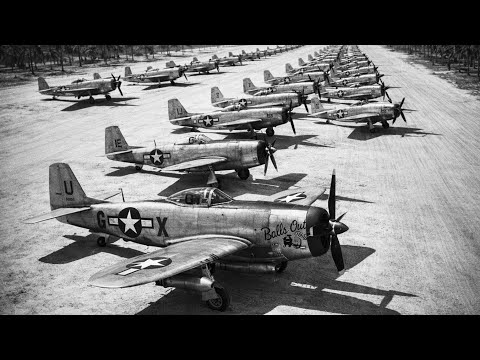
August 1945. Across airfields from England to the Philippines, thousands of Republic P-47 Thunderbolts sit in gleaming rows—not as relics of a defeated enemy, but as the victorious workhorses of the United States Army Air Forces. They had escorted bombers deep into Nazi Germany and strafed Japanese positions across the Pacific. Yet within months of Japan’s surrender, military planners faced an unexpected challenge: what to do with 15,683 of the heaviest, most rugged single-engine fighters ever built when the war they were designed to fight had suddenly ended?
Nicknamed the Jug—for its barrel-shaped fuselage and as shorthand for juggernaut—the Thunderbolt was unlike any fighter before it. Powered by a massive Pratt & Whitney R-2800 Double Wasp 18-cylinder radial engine producing over 2,000 horsepower, it weighed nearly 8 tons fully loaded. Eight .50-caliber machine guns filled its wings, and it could carry 2,500 pounds of bombs or 10 rockets. Pilots spoke of diving at speeds approaching 550 mph, the airframe howling as it plunged toward Earth.
Between March 1943 and August 1945, Thunderbolts flew over half a million sorties—some sources say as high as 746,000. They destroyed nearly 4,000 enemy aircraft in the air, achieving a kill ratio of 4.6:1. In the ground-attack role, they proved devastating: from D-Day to victory in Europe, P-47 pilots claimed 86,000 railway cars, 9,000 locomotives, 6,000 armored fighting vehicles, and 68,000 trucks. They dropped 132,000 tons of bombs. The aircraft’s loss rate was remarkably low—just 0.7% per mission. Of the 15,683 built, 5,222 were lost, including 1,723 in non-combat accidents.
Now the war was over, and the question became pressing: how to manage an aircraft too valuable to simply abandon, yet too numerous and too expensive to maintain indefinitely?
The immediate post-war period saw rapid decisions. Early-model P-47s and war-weary aircraft were quickly marked for scrapping. The older Razorback variants—with their framed canopies and high rear fuselages—were among the first to go. But later production blocks, particularly the bubble-top P-47Ds and long-range P-47Ns, received different treatment. These would continue as frontline fighters with the postwar Army Air Forces.
In 1947, when the United States Air Force became an independent service, the surviving Thunderbolts received new designations: P for pursuit became F for fighter. The P-47 was now the F-47. Strategic Air Command operated F-47s through 1947, and the active-duty Air Force maintained them until 1949. But as jet fighters entered the inventory in increasing numbers, the propeller-driven Thunderbolt found itself progressively pushed aside.
The Air National Guard became the Thunderbolt’s new home. Across the eastern United States, Guard units took delivery of F-47s as their primary equipment. The aircraft’s rugged construction and reliable radial engine made it well suited for part-time pilots. Unlike the liquid-cooled P-51 Mustang, which required careful temperature management and was less forgiving of rough handling, the Thunderbolt could absorb abuse and keep flying. Maintenance crews appreciated its straightforward systems and accessible components. For more than a decade, Air National Guard fighter units east of the Mississippi River flew Thunderbolts. The Hawaii Air National Guard’s 199th Fighter Squadron operated F-47s from 1947 until 1954. The Puerto Rico Air National Guard flew them as well.
The Thunderbolt saw one final American military action. In October 1950, nationalist insurgents in Puerto Rico attempted to declare independence during what became known as the Jayuya uprising. F-47 Thunderbolts were called upon to suppress the rebellion, strafing insurgent positions in the mountainous interior. It was an inglorious final chapter for an aircraft that had once dominated the skies over Europe.
When the Korean War erupted in June 1950, some military planners recognized the Thunderbolt’s potential value. General George Stratemeyer, the theater commander, specifically requested that F-47s be sent to Korea. The aircraft’s legendary ability to absorb ground fire made it theoretically ideal for the close air support missions being flown against North Korean and Chinese forces. The P-51 Mustangs then in service were proving vulnerable to anti-aircraft fire—their liquid-cooled engines easily disabled by a single well-placed round. Many suggested the more durable Thunderbolt should have replaced them, but the request was denied. By 1950, spare parts for the Thunderbolt had become critically scarce. The logistical complications of supporting an aging aircraft type in a distant theater outweighed the tactical benefits. The Mustangs continued flying, absorbing losses that the Thunderbolt might have survived. It remains one of the great what-ifs of the Korean War.
The last Air National Guard units retired their F-47s in 1953, with some sources indicating scattered examples flew until 1955. The Thunderbolt thus holds the distinction of being the last radial-engine fighter in United States Air Force service. An era had ended.
While American Thunderbolts headed toward retirement, a very different fate awaited those aircraft supplied to Allied nations during the war. The P-47 had served with numerous foreign air forces, and many of these relationships continued well into the post-war period.
The Royal Air Force had received 830 P-47s under Lend-Lease arrangements, including 240 Razorback variants designated Thunderbolt Mark I and 590 bubble-top aircraft designated Thunderbolt Mark II. With no need for another high-altitude fighter over Europe, the RAF adapted their Thunderbolts for ground attack in the Far East. Sixteen squadrons of Southeast Asia Command flew them from India against Japanese forces in Burma. The Thunderbolts proved devastating in this role. Armed with 500-pound bombs or British 60-pound rockets, they operated as cab ranks—circling over the battlefield and diving to attack targets on call from ground controllers. They flew escort for RAF Liberators bombing Rangoon. They savaged Japanese columns attempting to break out at the Sittang Bend in the war’s final months. RAF Thunderbolts remained in service until October 1946, even supporting Dutch attempts to reassert control over the Dutch East Indies before being replaced by British-built Hawker Tempests.
The Free French Air Force had received 446 P-47Ds during the final year of the European war. Six fighter groups equipped with Thunderbolts saw extensive action in France and Germany. But unlike other wartime recipients, France continued operating its Thunderbolts for years after the conflict ended. French P-47s were deployed to North Africa, where they would see combat once again. The Algerian War of Independence began in November 1954 when the National Liberation Front initiated armed struggle against French rule. Thunderbolts found themselves strafing insurgent positions in the Atlas Mountains, dropping napalm on rebel camps, and providing close air support for French ground forces. Groupe de Chasse 2/20 continued operating P-47s as late as 1960, making the Algerian conflict the last major combat experienced by the Thunderbolt anywhere in the world. The French finally phased them out at approximately the same time they withdrew from Algeria.
The Soviet Union had received 203 P-47s under Lend-Lease, though only 196 actually reached their destination. Soviet authorities assigned these aircraft to high-altitude air defense over major cities in rear areas. Unlike their Western Allies, the Soviets made little use of the Thunderbolt as a ground-attack aircraft, preferring instead their own Ilyushin Il-2 Sturmovik for that role. By war’s end, Soviet units still held 188 P-47s. Their ultimate fate remained somewhat obscure—likely scrapped without ceremony as more modern types became available.
Brazil’s experience with the Thunderbolt created lasting national pride. The Brazilian Air Force’s 1st Fighter Squadron had received 88 P-47Ds and flew them in combat during the Italian campaign from November 1944 through May 1945. Brazilian pilots flew 445 missions, losing 15 aircraft to German anti-aircraft fire. Five pilots were killed in action. The unit’s badge, Senta a Pua!, became a symbol of Brazilian military aviation. Brazil continued operating Thunderbolts after the war, eventually receiving recognition with a presidential unit citation from the American government in the early 1980s.
Mexico’s 201st Fighter Squadron had operated P-47Ds as part of the United States Fifth Air Force in the Philippines during 1945. In 791 sorties against Japanese forces, the squadron lost no pilots or aircraft to enemy action. It was an extraordinary record that demonstrated both Mexican competence and the Thunderbolt’s remarkable survivability.
Italy received 174 P-47Ds after the war, delivered between 1947 and 1950. These aircraft served with the reconstituted Italian Air Force as transitional platforms while Italy awaited delivery of more modern jet fighters. The Thunderbolts proved valuable as training aircraft, though some pilots accustomed to lighter European designs found the big American fighter intimidating.
Nationalist China received 102 P-47Ds for use during the Chinese Civil War. After the Nationalist retreat to Taiwan, the aircraft followed. An additional 70 P-47Ds and 42 P-47Ns arrived in 1952. These Thunderbolts saw extensive use in aerial clashes over the Taiwan Strait between Nationalist and Communist forces. Chinese Communists managed to capture five P-47Ds from Nationalist forces during the mainland campaign.
As the early 1950s progressed and the newly renamed F-47 was being retired from active United States Air Force service, American officials faced a familiar question: what to do with aircraft that remained serviceable but were no longer needed? The answer came through various military assistance programs that offered these aircraft to allied nations. South American countries proved eager recipients. Bolivia, Chile, Colombia, the Dominican Republic, Ecuador, El Salvador, Guatemala, Honduras, Nicaragua, Peru, and Venezuela all received Thunderbolts. Cuba took delivery of 29 former Air Force airframes. Iran, Portugal, Turkey, and Yugoslavia also operated the type. For the next 15 years, the F-47 continued as a frontline fighter with these nations, extending the aircraft’s operational career far beyond what its American designers could have imagined.
The circumstances varied from nation to nation. Some received their aircraft directly from American stocks. Others acquired them through third-party transfers as earlier recipients upgraded to newer equipment. The robust construction that had served pilots so well over Germany now proved equally valuable in the less developed maintenance environments of Latin America and elsewhere.
Nicaragua’s Thunderbolts achieved a remarkable distinction. In January 1955, during a border dispute with Costa Rica, a Nicaraguan pilot reportedly shot down a Costa Rican F-51 Mustang while flying an F-47N. If verified, it was among the last aerial victories ever achieved by a P-47 Thunderbolt. The aircraft that had scored its first kill over France in April 1943 may have claimed its final victim over Central America nearly 12 years later.
Peru became the last nation to operate the Thunderbolt in military service. The Peruvian Air Force maintained their Jugs through the mid-1960s, using them first as defensive fighters and later as advanced trainers as the country transitioned to jet aircraft. Peru finally retired its last Thunderbolts in 1966, marking the end of the type’s military career. Twenty-five years had passed since the prototype first flew.
Unlike the Mustang or Spitfire, which attracted civilian buyers for racing and personal transport, the P-47 held little appeal on the postwar civilian market. It lacked the sleek lines needed for an executive aircraft. Its fuel consumption was prodigious. Its sheer size made it impractical for most private airfields. For two decades after the war, the P-47 progressively diminished from American skies.
Shortly after Peru retired its Thunderbolts, American warbird collectors saw an opportunity. In the late 1960s, six aircraft were successfully imported from Peru, marking the first significant growth in the surviving P-47 population since the war ended. These South American aircraft would form the nucleus of the modern warbird Thunderbolt community. Through the late 1970s and early 1980s, more airframes returned from South American countries. Collectors and restorers located aircraft that had been sitting in hangars, on display as gate guardians, or simply abandoned on remote airfields. The tropical climates had taken their toll, but the Thunderbolt’s robust construction meant that many remained fundamentally sound beneath layers of corrosion and deterioration.
In the late 1980s, additional aircraft emerged from Yugoslavia. These had been supplied under post-war assistance programs and had survived decades behind the Iron Curtain. Their rediscovery and importation added to the slowly growing population of restorable Thunderbolts. More recent additions to the survivors have come from long-forgotten wartime crash sites. Recovery expeditions have located aircraft in remote locations across Europe and the Pacific, sometimes remarkably preserved in conditions that prevented complete deterioration. Each discovery requires years of painstaking restoration, often combining parts from multiple airframes to create a single complete aircraft.
Today, the statistics tell a sobering story of disappearance. Of the 15,683 Thunderbolts built between 1941 and 1945, around five dozen airframes are known to survive worldwide. The majority exist as static museum displays. Roughly a dozen or so remain airworthy in the United States, with barely a handful of additional flyable examples scattered elsewhere. Just three Razorback variants—the earlier models with their distinctive high rear fuselage and framed canopy—still take to the air.
Unlike Mustangs and Spitfires, there is no significant movement to rebuild Thunderbolts from scratch. The complexity of the aircraft, particularly its turbo-supercharger system, makes faithful reproduction extraordinarily difficult. Parts availability remains a constant challenge for those maintaining flying examples. Each airworthy Thunderbolt represents an investment of millions of dollars and countless hours of specialized labor.
Museum collections preserve the type for future generations. The National Air and Space Museum displays a P-47D-30 at its Steven F. Udvar-Hazy Center in Virginia. The National Museum of the United States Air Force at Wright-Patterson Air Force Base in Ohio holds multiple examples, including the Razorback variant Fiery Ginger IV. The American Air Museum at Imperial War Museum Duxford in England maintains a Thunderbolt painted to represent the aircraft of Colonel Hubert Zemke, commanding officer of the legendary 56th Fighter Group.
Private collections and commemorative organizations keep a handful of Thunderbolts flying. The Commemorative Air Force operates examples at various locations. The Planes of Fame Air Museum in California maintains a rare Curtiss-built P-47G—one of only 354 produced by Curtiss-Wright under license from Republic. Restoration projects continue at various facilities, though the pace remains slow and the costs substantial.
The Thunderbolt’s legacy extends beyond the surviving airframes. Republic Aviation, the company that designed and built the Jug, would go on to develop a very different aircraft bearing a similar name. The A-10 Thunderbolt II, better known as the Warthog, entered service in 1977. Like its namesake, it was designed around a massive weapon—in this case, a 30mm rotary cannon rather than eight .50-caliber machine guns. Like its namesake, it proved extraordinarily effective in the close air support role. Like its namesake, it earned a reputation for absorbing tremendous battle damage and bringing its pilots home. The connection was deliberate—a tribute from Fairchild Republic to the aircraft that had preceded it.
The story that began in August 1945 with thousands of Thunderbolts scattered across victory airfields concluded with systematic disappearance driven by military necessity, technological progress, and economic calculation. Most aircraft were neither carefully preserved nor ceremonially retired, but rather absorbed into foreign air forces, converted to scrap metal, or simply left to deteriorate in forgotten corners of distant nations. What survives today represents less than half of one percent of what was built—precious fragments of a massive manufacturing achievement that helped determine the Second World War’s outcome.
The few dozen Thunderbolts in museums and the handful still capable of flight serve as tangible evidence of what the Jug once was. Silent testimony to an aircraft that was too big, too heavy, and too powerful for anything except winning a war. For those fortunate enough to witness a Thunderbolt in flight today, the experience connects directly to history. The thunder of the R-2800 engine, the distinctive shape of the massive radial cowling, the bubble canopy glinting in sunlight—all recall an era when young American pilots climbed into these cockpits and went to war. The Jugs that remain are living monuments to those who built them, maintained them, and flew them into combat. Their survival against all odds ensures that the Thunderbolt story continues to be told—not merely in books and photographs, but in the unmistakable sound of a 2,000-horsepower engine roaring back to life.
Yet even as the last airworthy Jugs thunder over modern airshows, a quiet question lingers in hangars and museum halls alike. Will the Thunderbolt ever fly in numbers again, or will the roar of the R-2800 fade into memory within a generation?
Restorers speak of hidden airframes in South American jungles and Pacific lagoons, their aluminum skins still intact beneath decades of neglect. Each rumor sparks hope—and each recovery reminds us how much has already been lost.
The Jug was never meant to be precious. It was built to be used hard, discarded, and forgotten. That any survive at all is a testament to the ruggedness of its design and the devotion of those who refuse to let it disappear.
So the story ends not with a final flight, but with an open sky and an unanswered question: when the last Thunderbolt finally touches down for good, who will be there to remember the sound?
Have you ever seen a P-47 fly—and what did that moment mean to you? Share your story in the comments below.
Report this article
Select a reason for reporting:






