In 1945, as the ashes of the Third Reich still smoldered, a young German woman named Erna Beelart was dragged before a Soviet tribunal, accused of crimes that defied comprehension. She had served as a supervisor at Stutthof, one of the most brutal concentration camps in Nazi-occupied Poland, where over 100,000 people were worked to death, starved, or gassed. The public gasped as the charges were read—how could this seemingly innocent woman have participated in such savagery? But as survivors testified, a chilling truth emerged: behind the faces of these female guards lurked monsters capable of unimaginable cruelty.
The trials that followed would expose the horrors of Stutthof, Ravensbrück, and Bergen-Belsen, and the world would watch as justice was meted out to those who had turned human suffering into a daily routine.
Stutthof, established in September 1939, was the first concentration camp built outside Germany. Located in a remote region of Poland surrounded by swamps and forests, it was initially designed to intern the Polish elite—politicians, religious leaders, artists, and intellectuals. But as the war escalated, the camp swelled with Jews, prisoners of war, and forced laborers, all subjected to deplorable conditions. Disease ran rampant, and those too weak to work were selected for the gas chambers. Among the most chilling rumors was that the SS extracted fat from corpses to make soap—a claim never fully confirmed but emblematic of the camp’s depravity.
By early 1945, as the Soviet Army advanced, the Nazis forced thousands of prisoners on death marches, leaving a trail of bodies in their wake. When the Soviets liberated Stutthof on May 9, 1945, they found only about 100 survivors. The Allies quickly rounded up the remaining SS personnel, including six female supervisors: Jenny Barkman, Elizabeth Becker, Wanda Klaff, Eva Paradies, Gerta Steinhart, and Erna Beelart.
The trial, held in 1946, drew intense public scrutiny. Survivors recounted the torture they had endured at the hands of these women. Barkman, in particular, seemed indifferent, fixing her hair and flirting with the guards. Beelart, however, appeared nervous and claimed she had never harmed anyone. “I was affiliated with the National Socialist Party since 1933,” she said. “But I never liked my job. The prisoners were tormented too much. I had to look the other way.” She resigned after six weeks, but the court was not entirely convinced. In the end, she was sentenced to five years in prison.
The others were not so fortunate. Witnesses testified that Wanda Klaff proudly admitted to beating at least two prisoners a day. Eva Paradies was described as ordering inmates to strip naked in the snow and dousing them with ice-cold water. The evidence was overwhelming, and the five women were sentenced to death by hanging.
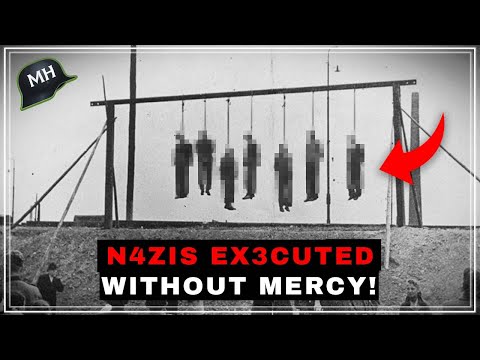
On July 4, 1946, a crowd of 20,000 gathered on a hill near Gdańsk, Poland, to witness the executions. A makeshift gallows was rigged: a rope passed through a post and tied to the back of a truck. As the vehicle moved forward, the women were left dangling, strangled slowly. Jenny Barkman’s last words were, “Life is a pleasure, and that is why it ends quickly.” One by one, they were executed, their bodies left hanging for the next to see. Six male guards were also hanged that day.
But Stutthof was only one chapter. In April 1945, the BBC broadcast a report that horrified the world. Allied troops had liberated Bergen-Belsen, finding 13,000 unburied bodies and 60,000 starving inmates. The announcer described “the dead and dying” lying together, with “emaciated people who look like ghosts.” Babies had been born there, only to die. A mother begged for milk for a child who had been dead for days.
The British public demanded justice. The camp’s commandant and staff were arrested, and among them were young women whose innocent appearance belied their crimes. Irma Grese, just 22, was known as the “Beast of Belsen” and the “Hyena of Auschwitz.” She personally selected victims for the gas chambers and beat prisoners to death with her bare hands. Elizabeth Volkenrath, 26, commanded the women’s section at Auschwitz and was known for her sadistic torture. Johanna Borman, the “woman of the dogs,” set her trained dogs on helpless inmates.
The trial began in September 1945. The jury was shocked to see that many of the accused were young women. “The crimes were so heinous that they deserved the death penalty,” the judge declared. Irma Grese, Elizabeth Volkenrath, and Johanna Borman were sentenced to hang. On December 13, 1945, the executions were carried out by Albert Pierrepoint, a professional executioner. Grese walked to the scaffold laughing, uttering only “Schnell” (fast). Volkenrath denied everything until the end. Borman, limping and in poor health, said, “I have feelings too.” Within minutes, all three were dead.
Meanwhile, at Ravensbrück, the only major women’s concentration camp, another reign of terror had flourished. Established in 1939, it housed political prisoners, Jews, Gypsies, prostitutes, and criminals. The female guards, trained to see inmates as beasts, indulged in aberrant tortures. Emma Zimmer selected women for the gas chambers. Greta Boesel said, “If any of the prisoners are too tired to work, they should be sent to rot.” But the most hated was Dorothea Binz, who rose from kitchen volunteer to chief supervisor. She inspected prisoners twice daily, whip in hand, and unleashed her dog on anyone who displeased her. One survivor testified that Binz once hacked a woman to death with an axe, then wiped her boots with the corpse’s skirt and cycled away.
As the Soviets advanced in April 1945, Binz fled but was captured by the British. She attempted suicide but was saved for trial. In 1947, she was sentenced to death. On May 2, she was hanged, her neck broken instantly.
The stories of these women are a grim reminder that cruelty knows no gender. But the full extent of their crimes—and the trials that brought them to justice—is a tale that continues to shock and haunt. In the next part, we will delve deeper into the testimonies, the evidence, and the final moments of those who turned concentration camps into hell on earth.
Yet the hangings at Gdańsk and Hameln did not close the book on the female guards of the Third Reich. As Allied investigators combed through captured documents and survivor testimonies, new names surfaced—women who had slipped through the cracks of the first trials, or whose crimes had been obscured by the chaos of defeat. Among them was a figure whose story would become one of the most haunting of the postwar era: Hermine Braunsteiner, a supervisor at Majdanek and Ravensbrück whose brutality earned her the nickname “the Stomping Mare.”
Braunsteiner was not present at the major trials. After the war, she vanished into the anonymity of civilian life, working as a waitress and later marrying an American citizen. For nearly two decades she lived quietly in Queens, New York—until a dogged Nazi hunter named Simon Wiesenthal traced her. Survivors were flown in to identify her, and the quiet housewife was revealed as a woman who had whipped prisoners to death and, according to testimony, “seized children by the legs and smashed them against the walls.”
Her case became a landmark: the first time a naturalized American citizen was stripped of citizenship and extradited for Nazi war crimes. But Braunsteiner was only one of many. At the Ravensbrück trials, held in Hamburg between 1946 and 1948, a new roster of defendants faced judges—women like Grete Boesel and Emma Zimmer, whose fates we have already glimpsed, but also lesser-known guards such as Margarete Rabe and Carmen Mory, whose stories revealed how ordinary women were transformed into instruments of terror.
What emerged from these trials was a pattern that disturbed psychologists and historians alike. The women were not monsters in the conventional sense—many were wives, mothers, and churchgoers. “They were ordinary people who chose to participate in extraordinary evil,” one prosecutor noted. The camp system had offered them power, status, and a sense of purpose. In return, it demanded only that they abandon their humanity.
Survivors, meanwhile, carried scars that no verdict could heal. Olga Golovina, whose testimony helped convict Dorothea Binz, later wrote: “The trials gave us a voice, but not peace. At night, I still see their faces—not the faces of the hanged, but the faces of the women who watched us suffer and smiled.” For many, the executions were not an end but a grim punctuation mark in a story that would never truly be over.
As the 1950s dawned and the Cold War divided Europe, the pursuit of Nazi criminals slowed. Yet the testimonies gathered in those early trials became a permanent record—a warning etched into history. The women of Stutthof, Bergen-Belsen, and Ravensbrück had been held accountable, but their crimes raised questions that still echo today: How does a society create such torturers? And what does it take to prevent it from happening again?
The answers, historians argue, lie not in madness but in the banality of ambition. Braunsteiner, Grese, Binz—none were born sadists. They were shaped by a regime that rewarded brutality and normalized atrocity. “The camp was a career,” one scholar observed. “And cruelty was the fastest route to promotion.”
Yet the trials also revealed something more unsettling: the ease with which ordinary people looked away. Neighbors in Queens knew Braunsteiner as a quiet woman who baked for church fundraisers. “I never suspected,” one said. “She seemed so normal.” That word—normal—became the darkest verdict of all.
Today, the barracks at Ravensbrück stand as a memorial. Visitors walk the roll-call square where women once stood for hours in freezing rain. A plaque bears Olga Golovina’s words: “Remember us—not as victims, but as witnesses.” The gallows are gone, but the silence remains.
And so the story ends not with a hanging, but with a question that refuses to fade. The women of the Third Reich were judged and punished. But the system that made them—the culture of obedience, the seduction of power, the silence of bystanders—was never fully brought to trial.
What do you think—can ordinary people be trusted with extraordinary power, or does evil always find a willing hand? Share your thoughts below.
Report this article
Select a reason for reporting:






