The engine roared, dirt flying as the captured Japanese Ha-Go surged forward, its light frame kicking up dust. Beside it, the American M5 Stuart matched pace, heavier and more powerful. This wasn’t a battlefield clash—it was a test, and the stakes were pride.
US testers had pitted these two tanks against each other, eager to see if the Ha-Go’s speed could overcome its weaknesses. The Ha-Go, with its thin armor and small 37mm gun, was no match for the Stuart’s firepower and protection. Yet, it had a secret: agility.
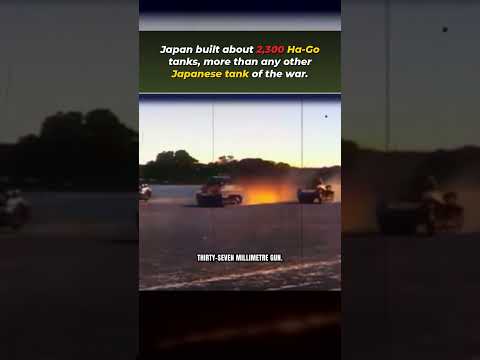
As they raced, the Ha-Go’s lightness gave it an edge in acceleration, but the Stuart’s稳定性 kept it steady. The testers watched, noting every detail. The Ha-Go was fast, but its armor was paper-thin—a single hit from the Stuart’s 37mm gun would pierce it easily.
“The Ha-Go can run, but it can’t hide,” one tester muttered, scribbling notes. The Stuart, though slower, was a fortress on tracks.
But the Ha-Go had proven itself in numbers. Japan had built about 2,300 of them—more than any other Japanese tank of the war. It was the backbone of their armored forces, despite its flaws. Light, fast, and cheap to produce, it was everywhere.
As the race ended, the testers exchanged glances. The Ha-Go had shown its speed, but the Stuart had shown its strength. The results were clear: in a real fight, the Ha-Go would need more than just speed to survive.
The sun dipped lower, casting long shadows over the test ground. The tanks rolled to a stop, their engines ticking as they cooled. The data was collected, the reports written, but the story was far from over.
One of the testers, a grizzled sergeant named Kowalski, climbed onto the Ha-Go’s hull and rapped his knuckles against the turret. The metal rang hollow, thin as a tin can. He shook his head and slid down.
“Speed’s fine,” he said, wiping dust from his brow. “But you put a real gun against this thing, she’s done in one shot.”
The others nodded. They’d all heard the reports from the Pacific—how Ha-Gos had been torn apart by Shermans, how their crews had learned to fear anything bigger than a machine gun. Yet the little tank kept showing up, again and again, on island after island.
That evening, the testers gathered around a table in the mess tent, the race data spread before them. The Ha-Go had won on acceleration and cornering, but the Stuart had dominated on every other measure.
“So why build so many?” a young lieutenant asked, tapping the production figures. “Two thousand three hundred of these things.”
Kowalski leaned back in his chair, folding his arms. “Because they weren’t building them to fight tanks. They were building them to fight infantry, to lead the charge, to be everywhere at once.”
The tent fell quiet. It made a grim kind of sense. The Ha-Go wasn’t meant to duel a Stuart—it was meant to swarm, to support, to overwhelm by numbers. And in that role, it had done exactly what it was built for.
The lieutenant frowned, still studying the numbers. “So they knew it was weak. They built it anyway.”
Kowalski nodded slowly. “They built it because it was cheap. Because you can put steel in the water faster than you can train a crew to use it right.” He tapped a finger on the table. “And because when you’re fighting on islands, you don’t need a fortress. You need a tin can that gets there first.”
The others shifted in their seats. Outside, the wind picked up, rattling the canvas of the tent. Somewhere in the dark, the Ha-Go sat silent, its engine cold, its thin armor catching the moonlight.
The next morning, the testers ran a new drill. This time, they pitted the Ha-Go against a simulated infantry line—sandbags, barbed wire, mock machine-gun nests. The little tank rolled forward, its 37mm gun barking, its light frame slipping through gaps the Stuart would have crushed flat.
“Look at that,” the lieutenant said, genuine surprise in his voice. “It’s not fighting. It’s weaving.”
Kowalski grunted. “That’s the trick. It’s not a duelist. It’s a brawler. Gets in close, hits hard where it can, and never stops moving.”
The Ha-Go pivoted sharply, dodging an imaginary shell, then charged a mock bunker and fired point-blank. The sandbags erupted. The testers exchanged glances—this was the tank Japan had built, not the one they’d wanted it to be.
But the drill also showed the cost. Twice the Ha-Go took simulated hits, and twice the referee’s whistle blew. In a real fight, those hits would have meant fire, smoke, and dead men inside. The little tank could dance, but one solid punch would end the song.
That afternoon, a courier arrived with fresh reports from the Pacific. The testers gathered again, reading in silence. The Ha-Go had been spotted in the Philippines, in Burma, in the Dutch East Indies—always in the vanguard, always outgunned, always pressing forward.
“They keep throwing them into the fire,” the lieutenant said quietly.
Kowalski folded the report and set it down. “Because that’s what they’ve got. And when you’ve got two thousand of something, you use it. You don’t save it for a rainy day.”
He stood and walked to the tent flap, looking out at the two tanks parked side by side—the Stuart squat and armored, the Ha-Go lean and eager. “The question isn’t whether the Ha-Go’s a good tank,” he said. “The question is what it cost them to learn that.”
The tent stayed quiet. The wind rattled the canvas again, and somewhere beyond the test ground, the war rolled on—unimpressed by races, unmoved by reports, waiting for the next island, the next charge, the next tin can full of brave men.
Weeks later, the test ground was quiet. The Ha-Go sat under a tarp, its engine drained, its guns removed for study. Kowalski walked past it one last time, coffee in hand, and stopped to look.
“You know what gets me?” he said to no one in particular. “We spent all this time proving it’s a bad tank. But it wasn’t built to be a good tank. It was built to be a tank, period.”
The lieutenant came up beside him, hands in his pockets. “So what do we write in the report?”
Kowalski took a long sip. “We write the truth. It’s fast, it’s light, it’s thin. It dies easy. And they built twenty-three hundred of them anyway.”
He turned away, boots crunching on the gravel. “Because when you’re losing, you don’t need perfect. You need something that moves.”
The Ha-Go stayed under its tarp, silent and still, a tin can that had done its job—not well, but often. And somewhere in the Pacific, another one was rolling forward, its crew knowing exactly what they had.
What would you have done, standing in that mess tent, staring at the numbers?
Report this article
Select a reason for reporting:






