The war was over, but the reckoning had only just begun. In the shattered cities of post-war Germany, the men who had orchestrated the systematic slaughter of millions were hunted down, one by one. They were not the faceless monsters of Nazi propaganda, but educated professionals—lawyers, economists, and musicians—who had transformed themselves into architects of genocide. Now, they would face the cold, unflinching gaze of justice.
But the path to that justice was neither swift nor certain. As the world learned the full extent of the Einsatzgruppen’s atrocities—mass shootings, gas vans, and the methodical murder of over a million people—the commanders who had led these mobile killing squads sat in the dock at Nuremberg. Their faces were calm, their testimonies chillingly bureaucratic. What followed would shock even the most hardened observers of the trials.
The Einsatzgruppen were the spearhead of Hitler’s racial war in the East. Formed by Heinrich Himmler and Reinhard Heydrich, these units were tasked with eliminating Jews, Communists, Roma, and any other perceived enemies of the Reich. Behind the advancing German front lines, they carried out mass shootings with terrifying efficiency. By the end of 1941, they had already murdered more than half a million people.
“The victims were forced to dig their own graves before being killed,” one survivor later testified. The method was brutal, public, and designed to spread terror. But as the war dragged on, even Himmler grew concerned. The psychological toll on the killers was immense—many turned to alcohol and drugs to cope. In response, the commanders sought to make mass murder a collective act, absolving individuals of guilt. Yet some men became excessively brutal, reveling in the slaughter. Otto Ohlendorf, commander of Einsatzgruppe D, noted this and ordered that any man too eager to participate would no longer carry out executions.
When the war ended in 1945, the world demanded accountability. The Einsatzgruppen Trial at Nuremberg, held from 1947 to 1948, was the first to focus solely on these mobile killing units. Twenty-four officers were charged with war crimes and crimes against humanity. The evidence was overwhelming: detailed reports, photographs, and testimonies from survivors and perpetrators alike. The verdicts were damning. Fourteen were sentenced to death, while the rest received prison terms. But the trials were not without controversy. Many argued that the sentences were too lenient, and some were later commuted due to political pressures.
Among the most notorious commanders was Werner Braune, the architect of death in Crimea. Born in 1909, Braune was a lawyer who joined the Nazi Party in 1931. As commander of Einsatzkommando 11b, he oversaw the massacre of thousands of Jews in Simferopol, Yevpatoria, and Feodosia. Survivors described his coldness during executions, his bureaucratic precision in carrying out orders. At trial, Braune showed no remorse. He was sentenced to death and hanged on June 7, 1951.
Erich Naumann was another key figure. A fervent anti-Semite, he commanded Einsatzgruppe B, which operated in Belarus. Under his leadership, over 17,000 people were killed in Smolensk alone. Naumann admitted to using gas vans and personally oversaw the Bobruisk massacre. Unlike others who tried to justify their actions, Naumann never expressed regret. “I believed the orders were correct,” he stated on the witness stand. He was found guilty and executed on the same day as Braune.
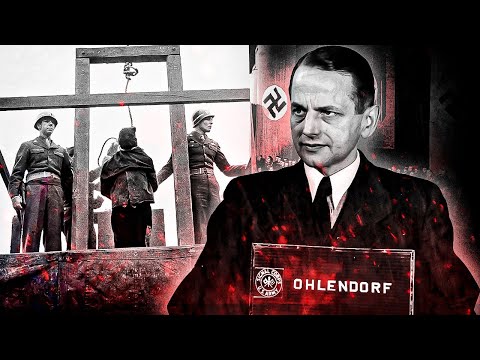
Otto Ohlendorf, the bureaucrat of extermination, was perhaps the most chilling. A lawyer and economist, he commanded Einsatzgruppe D and openly admitted to the murder of over 90,000 people. He refused to use gas vans, deeming them inefficient, but his methods were no less deadly. During his trial, he argued that his actions were necessary for Germany’s survival. “The Jews in America would suffer for what he had done,” he told a Jewish prosecutor. Ohlendorf was hanged on June 7, 1951, showing no emotion to the very end.
Friedrich Jeckeln was a different kind of killer. A veteran of World War I, he joined the SS in 1929 and rose to become one of Himmler’s most trusted officers. As Higher SS and Police Leader in the East, he was responsible for the Rumbula and Babi Yar massacres, where tens of thousands were killed in mere days. Jeckeln developed a system for mass murder that maximized speed and minimized effort—victims were forced to undress, lie down in layers, and were shot in the back of the head. He called it “sardine packing.” Captured by the Soviets, he was tried in Riga and hanged in 1946. Unlike most, he admitted his guilt and took full responsibility.
Paul Blobel, commander of Einsatzkommando 4A, led the Babi Yar massacre, where 33,771 Jews were killed in two days. Later, he was put in charge of Operation 1005, a macabre mission to exhume and burn the bodies of victims to erase evidence of the genocide. His efforts failed to hide the truth. At Nuremberg, Blobel was sentenced to death and hanged in 1948.
Bruno Streckenbach was the organizer who escaped justice. As head of Einsatzgruppe I in Poland, he oversaw the murder of Polish intellectuals. Later, he coordinated the deployment of the Einsatzgruppen during Operation Barbarossa. Despite being implicated in numerous crimes, he was never tried. A Hamburg court found insufficient evidence, and he died a free man in 1977.
Walter Blume, commander of Sonderkommando 7A, was responsible for the deaths of over 24,000 Jews in Belarus. He later oversaw the deportation of Greek Jews to Auschwitz. Sentenced to death at Nuremberg, his sentence was commuted to 25 years, and he was released in 1955. He lived quietly as a businessman until his death in 1974.
Waldemar Klingelhöfer, an opera singer turned interpreter, was convicted for his role in the executions. He was sentenced to death, but his sentence was also commuted, and he was released in 1956. He died in 1977.
The stories of these men reveal the many faces of evil—the ideologue, the bureaucrat, the sadist, and the opportunist. Each played a part in the Holocaust, and each faced a different fate. Some were hanged, others imprisoned, and many escaped justice entirely. As the years pass, the survivors dwindle, and the world moves on. But the scars of the Einsatzgruppen remain, a stark reminder of what humanity is capable of when hatred is given free rein.
But the trials at Nuremberg were only the first chapter of a much longer and more frustrating pursuit of justice. In the decades that followed, the West German judicial system struggled to hold former Einsatzgruppen members accountable. The Central Office of the State Justice Administrations in Ludwigsburg was established in 1958 to investigate Nazi crimes, but its efforts were hampered by legal technicalities and a lack of political will. “The majority of the people who carried out the executions were never charged,” notes historian Dr. Michael Wildt. “They returned to civilian life without being held accountable.”
By the 1960s, the statute of limitations for manslaughter had expired, and many perpetrators could only be prosecuted for murder—a charge that required proving individual acts of cruelty, not merely following orders. This legal hurdle proved insurmountable in most cases. Witnesses grew older, memories faded, and the likelihood of valuable testimony diminished. Funding for trials was often insufficient, and the governments of Austria and Germany became less interested in securing convictions than in forgetting the Nazi past.
One of the most striking examples of this failure was the case of Erich Naumann’s subordinate, Hans Schmidt, who had personally overseen the execution of hundreds of Jews in Belarus. Despite overwhelming evidence, Schmidt was never brought to trial. He lived out his days as a respected civil servant in a small Bavarian town, his past buried beneath a veneer of postwar normalcy. “It was as if the war had never happened,” a local journalist later remarked. “No one asked questions.”
The story of Werner Braune’s younger brother, Fritz, offers a particularly disturbing coda. Fritz Braune, who had commanded Einsatzkommando 4b under Ohlendorf, was captured by the Americans in 1945 but released two years later without charge. He returned to his hometown of Meissen, where he opened a law practice and became a respected member of the community. In 1965, a local prosecutor reopened the investigation into his wartime activities after a survivor recognized him on the street. But the case was dropped when the court ruled that Braune had acted under duress and that the evidence was insufficient to prove malice. He died in 1984, never having spent a day in prison for his crimes.
Such outcomes were not uncommon. The Einsatzgruppen had been composed of ordinary men—policemen, soldiers, and professionals—who had been radicalized by ideology and circumstance. After the war, many slipped back into the fabric of society, their crimes obscured by the chaos of defeat and the collective desire to move on. “The silence was deafening,” wrote one survivor. “We were told to forget, to rebuild, to look forward. But how can you forget when the murderers live next door?”
Yet the pursuit of justice was not entirely abandoned. In the 1960s and 1970s, a series of high-profile trials in West Germany brought some former Einsatzgruppen members to account. The Babi Yar trial in Munich, for instance, resulted in convictions for several low-ranking officers, though the masterminds like Paul Blobel had already been executed. These trials, however, were the exception rather than the rule. Most perpetrators escaped punishment, and the legal system’s inability to grapple with the scale of the crimes became a source of deep frustration for survivors and historians alike.
The legacy of the Einsatzgruppen extends beyond the courtroom. Their methods—mass shootings, gas vans, and the systematic dehumanization of victims—paved the way for the industrialized killing centers of the Holocaust. “The Einsatzgruppen were the laboratory of genocide,” argues historian Christopher Browning. “They tested the techniques that would later be perfected at Auschwitz and Treblinka.” The psychological toll on the killers, meanwhile, led to the development of new methods of mass murder that minimized direct involvement, such as the gas chambers. In this sense, the Einsatzgruppen were not merely a brutal aberration but a crucial step in the evolution of Nazi extermination policy.
As the 21st century dawned, the last surviving members of the Einsatzgruppen were in their nineties. A handful were finally brought to trial, more as a symbolic gesture than a genuine reckoning. In 2011, John Demjanjuk, a former guard at Sobibor, was convicted as an accessory to murder, setting a legal precedent that allowed for convictions based on service in a killing unit without proof of specific acts. But by then, the Einsatzgruppen commanders themselves were long dead, their fates sealed by history. The question of justice, always elusive, had become largely academic.
What remains, then, is memory. The testimonies of survivors, the documents left behind by the perpetrators, and the scars on the landscapes of Eastern Europe all bear witness to the atrocities committed by these mobile killing squads. “We must never forget,” said one survivor at a commemorative event in Kiev. “Not for revenge, but for the future. So that no one else will suffer as we did.” The Einsatzgruppen’s story is a warning about the capacity for evil that lies within ordinary people—and the fragility of justice when the world chooses to look away.
Yet even as the last perpetrators slipped into oblivion, a handful of determined prosecutors refused to let the darkness win. In the small town of Ludwigsburg, a team of young lawyers pored over crumbling documents, cross-referencing names and locations, determined to hold someone—anyone—accountable. “We cannot undo the past,” one prosecutor said, “but we can refuse to let it be forgotten.”
Their efforts yielded only a few convictions, but each one sent a message: the world had not entirely looked away. The Einsatzgruppen were not merely a chapter in history—they were a mirror, reflecting what ordinary men can do when ideology replaces conscience. The question that haunts us still is not whether such evil can happen again, but whether we would recognize it if it did.
As the final witnesses fall silent and the last trials fade into memory, the responsibility passes to us. The graves at Babi Yar, the forests of Rumbula, the ravines of Kiev—these are not just monuments to the dead. They are warnings. What will we do with the silence they leave behind?
Report this article
Select a reason for reporting:






