In the late summer of 1900, a dynamite blast tore through the limestone heart of Montana’s Pryor Mountains. When the dust settled, the railroad crew stared into a chamber that should not have existed—a perfect void, its walls smooth as cast iron, its floor swept clean. And in the center, a machine: a drum eleven feet high, seventeen feet long, its surface carved with a single unbroken channel that wound like a labyrinth but never crossed itself. Eight sockets lined its flanks. Seven held crystal rods as clear as ice. The eighth was empty.
The Crow had a name for this place: Hits with the Arrows. For generations, they had left offerings at the gap—arrows, beads, tobacco—asking permission to pass. Because inside the mountain, they said, lived a people no taller than a man’s knee, very strong and very old. And the machine belonged to them.
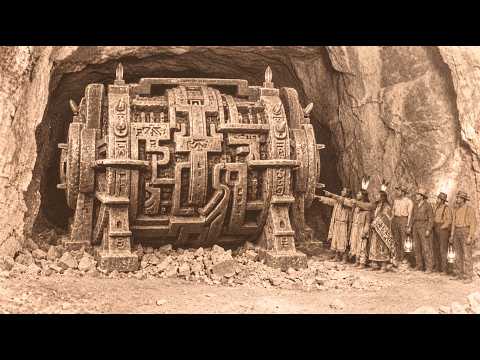
Seven years later, a twenty-four-year-old anthropologist named Robert Lowie arrived on the Crow reservation. He spoke with an elderly man who had never seen the chamber, yet described it with chilling precision: a round thing lying on its side, its face cut with paths that never cross. Eight places, one empty. At one end, a recess just big enough for a child’s hand. “It sang the song,” the old man said, placing a hand on his chest. “The song the little people sang to the stone.”
Lowie pressed his palm against the masonry wall that sealed the chamber. It was colder than the rest of the tunnel. A faint tingling lingered—the kind a hum leaves behind. He never published these notes. The old man died the following summer.
The official record tells a simpler story: a natural cave, walled up and forgotten. But the engineer’s field book describes walls without tool marks, a floor without dust, and a machine that could not be moved—its skids embedded in rock that had once flowed like wax and frozen in place. The chamber had no entrance. The machine had not been set inside. The chamber had formed around it.
And then there is the eighth crystal. The old man said it was taken long ago—before the iron road, before the white men. Ever since, the great thing has been sleeping. But the wall at Pryor Gap still stands. The tracks are gone. The tunnel is empty. And the question remains: what sleeps behind six feet of stone, waiting for someone to knock?
The archives hold their own kind of silence. In the Newberry Library in Chicago, a leatherbound field book sits in a box labeled with station numbers, not with the name Pryor Gap. In Berkeley, a notebook from 1907 is filed under Shoshoni word lists, its Crow pages beginning on the thirteenth leaf. And in the Smithsonian’s accession records, a card bears two words in a later hand: sample not found. No one hid anything. No one destroyed anything. The files simply drifted, as files do, into the wrong boxes.
But paper has a way of finding paper. In the winter of 1938, a graduate student named Eleanor Vance was cataloging the Lowie papers at Berkeley. She was looking for something else entirely—Shoshoni kinship terms—when she turned to the thirteenth page of a notebook and found a small pencil drawing in the margin: a hand, palm down, fingers slightly spread. Beneath it, one word: here.
Vance had read Lowie’s published works. She knew he had dismissed oral tradition as history. Yet here was a drawing that seemed to point somewhere, to mark a place. She wrote a letter to the American Museum of Natural History, asking whether any field notes from Lowie’s 1907 season had been deposited there. The reply came three weeks later: no such notes were in their possession.
She might have stopped there. But Vance was stubborn, and she had a brother in the railroad business. In the spring of 1939, she wrote to the Chicago, Burlington and Quincy Railroad, requesting access to any surviving records from the Pryor Gap section. The railroad, eager to appear cooperative, granted her a reading room and a clerk to fetch boxes.
She found Asa Whitcomb’s seventh field book on the second day. The chamber measurements were exactly as Lowie’s old man had described them: a single channel, eight bends, one empty socket. But it was the margin note that made her hands tremble. Someone was here before us.
Vance copied every relevant page by hand. She then asked to see the correspondence index. The clerk brought her a thin folder. Inside were four letters—fewer than the index listed. The telegram from Omaha. Two of Ostrander’s reports. And a short letter from the railroad’s engineering office to the Smithsonian, dated March 1901. The others were missing. The index itself was a carbon copy, the original presumably lost.
She wrote to the Smithsonian. The accession number was correct, but the specimen had never been located. The examination column was blank. Sample not found, the card said. Vance asked whether any other material from Pryor Gap had been received. The reply was a single sentence: no further shipments are recorded.
That summer, Vance traveled to Montana. She stood at the mouth of the tunnel, now empty, the tracks long gone. The masonry wall was still there, cold to the touch even in July. She pressed her palm against it and felt nothing—no tingling, no hum. But when she stepped back, she noticed something she had not expected. The wall was not perfectly vertical. It leaned inward, very slightly, as if something behind it had pressed against the stones for decades.
She took photographs. She measured the lean with a plumb line: three inches over six feet. She noted it in her journal, then walked north to the small cemetery. The headstones were weathered, most of them blank. But one, set apart from the rest, bore a name she recognized: Josiah Hale. The foreman who had refused to enter the chamber. The dates were 1862–1901. He had died a year after the wall was built.
Vance sat beside the grave for a long time. The wind came down through the gap, dry and warm, carrying the smell of sage. She thought about the old man’s words: they are leaving. And about Plenty Coups: a wall is not a door. And about the empty socket, the missing crystal, the machine that sang.
She returned to Berkeley and wrote a short paper, never published, titled Notes on a Sealed Chamber. In it, she concluded only that the records were inconsistent and that further investigation was warranted. She applied for a research permit to conduct a ground-penetrating radar survey. The application required signatures from three separate jurisdictions: the Forest Service, the Bureau of Land Management, and the Crow Nation. She obtained two. The third never came.
In 1941, Vance joined the war effort and left academia. Her papers, including the unpublished manuscript, were donated to the Bancroft Library after her death in 1972. They are cataloged under Vance, Eleanor: Miscellaneous. The box also contains a single photograph of the masonry wall, taken in 1939, with a note on the back in her handwriting: The stones are not where they were.
The photograph is not the only thing in that box. Beneath the manuscript, folded twice and brittle at the creases, lies a letter Eleanor Vance never sent. It is addressed to the Bureau of Land Management office in Billings, Montana, and dated October 1940. In it, she requests a second survey permit—this time for a seismograph, not radar. She had read Ostrander’s reports by then, the ones she had copied by hand in Chicago, and she wanted to measure the vibration he had felt on the tracks in January 1909.
The letter is polite, professional, and unanswered. There is no carbon copy of a reply in the box. There is no stamp, no receipt, no filing notation. Whatever happened to the request happened in a room Vance never saw.
But the archives keep their own accounts, and in 1953 a different researcher came asking a different question.
His name was Thomas Redfield, and he was a geologist, not an anthropologist. He had spent the summer mapping the Madison limestone along the Montana-Wyoming border for the United States Geological Survey, and he had noticed something odd in the strata near Pryor Gap. The limestone there was folded, but not in the way limestone usually folds. The folds were too tight, too localized, as if the rock had been squeezed by something beneath it rather than by the slow collision of continents.
Redfield’s field notes are held at the USGS library in Denver. They are technical, dry, and almost entirely free of speculation—except for one page, dated August 14, 1953, where he records a conversation with a rancher named William Trapper, whose family had grazed cattle along Arrow Creek since the 1890s.
Trapper told Redfield that his grandfather had worked on the railroad in 1900. He had been there when the chamber was opened. He had seen the machine. And he had told his family something that never appeared in any field book: the crystals were not all the same.
Seven stood in their sockets, yes. But the old man insisted that one of them—the one nearest the empty socket—was smaller than the rest. It had been replaced. Someone had put it back wrong, or put a different one in its place, and the machine had not sung since.
Redfield wrote the story down, as geologists do, without comment. Then he added a single line of his own: Checked the wall. No sign of recent disturbance. But the frost is still there.
He was right about the frost. In 1962, a road crew widening the gravel track through the gap reported that the west wall of the old tunnel sweated in summer and frosted in winter, long after the rails had been pulled up and the tunnel had been left open to the wind. The foreman, a Crow man named Daniel Big Man, told the crew not to touch the masonry. They didn’t. The road was routed around it.
Big Man’s account is not in any archive. It survives only in the memory of his grandson, who repeated it to a tribal historian in 1998. According to the grandson, Big Man said the wall was warm in winter and cold in summer—the opposite of what stone should be. And he said that on the coldest nights, when the wind came down through the gap, he could hear a sound from behind the stones. Not a rumble. Not a hum. A single note, low and flat, like someone holding their breath.
The tribal historian wrote it down. The notes were filed with the Crow Cultural Committee. They have never been published.
In 2003, a satellite passed over the Pryor Mountains and measured the ground temperature with an infrared sensor. The data was collected for a wildfire risk assessment and archived with thousands of other images. But in 2011, a graduate student at the University of Montana named Sarah Chen was analyzing thermal anomalies in the region and found something she could not explain.
A patch of ground roughly sixty feet long and forty feet wide, centered on the old tunnel alignment, was consistently two to three degrees colder than the surrounding limestone. The anomaly appeared in every image, in every season, for eight years. It did not correlate with elevation, slope, vegetation, or groundwater. It was simply cold.
Chen published her findings in a short paper in a regional geology journal. She noted that the anomaly might be caused by a subsurface void—a cave, perhaps, or an old mine working—where cold air collected and remained trapped. She recommended further study. No further study was conducted.
But Chen’s paper was read by someone who had been waiting for it. His name was Marcus Webb, and he was a retired engineer who had spent thirty years working for the Burlington Northern Santa Fe Railway—the successor to the Chicago, Burlington and Quincy. Webb had grown up in Sheridan, Wyoming, and had heard stories about the old tunnel from his father, who had heard them from his father, who had worked on the line as a young man.
Webb wrote to Chen in 2012. He told her about the wall, the chamber, and the machine. He told her about Asa Whitcomb’s field book and Robert Lowie’s notebook and the empty socket. He told her about the old man’s words: it sang the song.
Chen was skeptical. She was a geologist, not a folklorist. But she was also curious, and she had a colleague in the physics department who owned a ground-penetrating radar unit. In the summer of 2013, the two of them drove to Pryor Gap with the radar and a permit from the Forest Service—only one jurisdiction, because the anomaly lay just outside the reservation boundary.
They set up the radar on the gravel road, aimed it at the masonry wall, and turned it on.
The screen filled with noise. Then, slowly, an image resolved: a void behind the wall, roughly sixty feet deep and twenty-four feet high. The radar could not penetrate the machine itself—something in its composition scattered the signal—but it could see around it. The chamber was there. It had always been there.
Chen stared at the screen for a long time. Then she packed up the equipment and drove back to Missoula. She wrote a report for the Forest Service, recommending that the site be preserved and that no further investigation be conducted without tribal consultation. The report was filed. The wall was left standing.
But Chen kept a copy of the radar image. It is pinned to the wall of her office at the university, and when visitors ask about it, she tells them the same thing Eleanor Vance wrote on the back of a photograph seventy years earlier: the stones are not where they were.
Marcus Webb read Chen’s report and drove to Missoula. He asked to see the radar image, and when she unrolled it, he pointed to a shadow at the chamber’s far end. “That’s not the machine,” he said. “That’s a second void.” Chen had missed it—a narrow gap behind the drum, barely wide enough for a child.
They returned in 2014 with a seismograph. On the coldest night of January, they lowered it into the tunnel and waited. At 3:17 a.m., the needle jumped. A steady pulse, deep and rhythmic, like a millstone turning far below. It lasted eleven minutes, then stopped.
Chen never published the seismograph data. She filed it with the Forest Service and wrote one line in her notebook: The machine is not sleeping. It is waiting.
Today the wall still stands, cold in summer, warm in winter. The eighth socket is still empty. And somewhere beneath the Pryor Mountains, something still hums.
If you had the chance to knock on that wall, would you?
Report this article
Select a reason for reporting:






