At 3:00 in the afternoon on the 17th of April, 2021, St. George’s Chapel stood silent and cavernous. A woman of 94, dressed in black, a black mask covering half her face, walked to her place in the carved oak choir stalls and sat down with no one beside her. The seats to her left and right had been deliberately left empty. A coffin waited before her, a naval cap and a sword resting on its lid. No one sang. The choir’s voices arrived thin and far off, and the enormous quiet closed back over them each time they stopped. She kept her hands folded in her lap. She did not lean toward anyone because there was no longer anyone to lean toward. For more than seven decades, the seat beside hers had never once been empty. Now it was.
The woman was Queen Elizabeth II. The man in the coffin was Prince Philip, the husband who had stood at her shoulder for the whole of her reign. To the world, they had been the great fixed point of the age—the couple in the anniversary photographs, the marriage that outlasted every government and every crisis, held up as proof that something simply endures. That was the version the world was allowed to see. Behind it was something the photographs never captured: a relationship stranger, more unequal, and more human than the public romance ever suggested. What did it actually cost these two people to become the symbol a nation needed them to be? Who were they when the cameras were gone? And what did each of them surrender to keep the other? Not the fairy tale, not the scandal—the truth that lived underneath both.
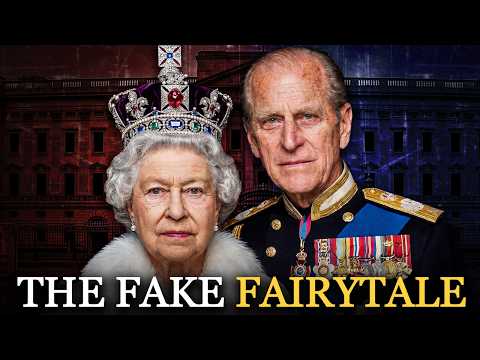
To understand how a marriage arrives at that kind of silence, you have to go back 73 years and then a little further still. Past the coronation and the state visits, past the anniversaries counted out in silver and gold and diamond and platinum, to two children born five years and more than a thousand miles apart into two versions of the same vanishing European world. One of them was raised inside the near certainty of duty. The other was carried into exile before he could walk. Neither was brought up to expect the life they would eventually build together. And neither could have guessed that the thing binding them for the rest of the century would also be the thing that kept pulling them apart.
This is the story of what was actually happening inside the longest marriage in the history of the British monarchy. The arguments over a name, the years of physical separation, the rumors that never fully died, and the strange arithmetic of a union in which one partner was required by law and by ritual to kneel before the other. It begins with a public image so complete that most people never thought to look behind it.
For most of the 20th century, and well into the 21st, Elizabeth and Philip functioned as a fixed point in a changing world. Their wedding gave ration-exhausted postwar Britain a morning of spectacle. Their anniversaries turned sheer endurance into a kind of national virtue, as if staying married for decades were itself a form of public service. Official photographs showed them inspecting troops, receiving presidents, standing with their children on the lawns at Balmoral, growing old side by side while governments rose and fell around them.
The sanctioned version of the marriage was simple and reassuring. She was duty made flesh. He was the brisk, capable husband who walked two steps behind her. On their 50th anniversary, Elizabeth would call him her strength and stay and acknowledge a debt she said neither she nor the country could ever fully repay.
The private arrangement was more complicated than the photographs allowed. Elizabeth held constitutional authority that Philip could never touch. Yet inside their own household, she often let him rule as the head of the family. He had freedom in certain private rooms, but the crown controlled his rank, his career, and even the surname his children were allowed to carry. Their marriage did not resolve the collision between what their era expected of a husband and what the constitution demanded of a queen. It simply absorbed that collision and lived inside it for 73 years.
To see how two people came to make that bargain, you have to meet them before either of them understood what they were agreeing to. She was born on the 21st of April 1926 in a tall townhouse at number 17 Bruton Street in Mayfair. At a moment when no one expected the child to matter very much to history, Elizabeth Alexandra Mary was third in line to the throne, the daughter of a second son, and the assumption in those years was that the crown would pass elsewhere.
Her early childhood was ordered, protected, and quiet. She was educated at home, kept close to her parents and to her younger sister Margaret, and grew attached early and permanently to horses, to dogs, to routine, and to the rhythms of religious observance. She was a watchful child in a household that prized composure. By every account, she was the steady one.
Then, in December of 1936, the certainty she had been raised inside simply dissolved. Her uncle, Edward VIII, abdicated the throne to marry a divorced American woman, and Elizabeth’s father became King George VI, almost against his will. At 10 years old, the watchful, careful girl became heir presumptive to the throne of the United Kingdom.
There is something about that detail worth sitting with. She did not choose the life. It arrived unannounced because a grown man upstairs had refused his. From that winter onward, everything about Elizabeth’s future was fixed by an inheritance she had done nothing to earn and could do nothing to decline.
She grew into a young woman who was reserved, cautious, observant, and disciplined almost to the point of self-erasure. She was not naturally demonstrative. Her way of showing love was not words, but presence—being there again and again without spectacle. During the Second World War, she trained with the Auxiliary Territorial Service, learning to service and drive military vehicles, becoming the first woman in the royal family to serve as a full-time member of the armed forces. What she wanted underneath the destiny she could not refuse was something ordinary and human: a dependable family, a private life, a person who might occasionally treat her as a woman rather than as a future institution.
And the person who would eventually offer her exactly that was a boy who had grown up with almost none of the security she took for granted. He was born on the 10th of June 1921 on a dining room table in a villa called Mon Repos on the Greek island of Corfu. The only son and youngest child of Prince Andrew of Greece and Denmark and Princess Alice of Battenberg. His early life was defined by loss of place. Political catastrophe drove his family out of Greece while he was still an infant. There is a much-repeated image of the baby prince carried into exile in a makeshift cot fashioned from a fruit crate.
After that he was passed between relatives and schools across France, Germany, and Britain. A boy with a title in no country, belonging everywhere and nowhere. The instability was not only geographic. His mother, Princess Alice, suffered a severe mental health crisis when Philip was a young child and spent years in psychiatric care. Afterward, his parents lived largely apart. His four older sisters married into German families and scattered across the continent. And in November of 1937, when Philip was 16, his sister Cecilia, her husband, and their young children were killed when their aircraft crashed near Ostend. He attended the funeral in Germany, a solitary teenage figure among relatives in dark coats, and then went back to school.
This was the pattern of his childhood. The people who might have been permanent kept disappearing, and each time he was expected to absorb it and carry on. He absorbed it by becoming hard. At Gordonstoun, the austere Scottish school built on cold water, physical hardship, and self-reliance, Philip thrived in exactly the conditions that would have broken a softer boy. He became head of the school and captained hockey and cricket. He entered the Royal Navy in 1939 and served with distinction through the war. Those who worked with him across his life described a man who was energetic, impatient, practical, competitive, and capable of genuine cruelty when he was crossed, and who, beneath the abrasiveness, carried a shyness and an insecurity that his rank never quite settled.
What he wanted was almost a mirror image of what Elizabeth wanted. He wanted a home that would not vanish, a profession he had earned rather than inherited, and useful work to fill his hands. He wanted, in the plainest terms, to belong to something. Marriage would give him the family he had never had. It would also, in time, take away the naval career through which he had planned to become his own man.
They met the way these things are later mythologized: as children, at a royal wedding in 1934, when almost nothing passed between them. The meeting that mattered came five years later. In July of 1939, 13-year-old Princess Elizabeth toured the Royal Naval College at Dartmouth with her parents, and an 18-year-old cadet named Philip was assigned to entertain the young princesses. He showed off. He jumped tennis nets. He ate several plates of shrimp and a banana split with the appetite of a boy who had learned not to waste a good meal. Elizabeth watched him with an attention that those around her noticed and remembered. By several accounts, she never really looked at anyone else again.
They wrote to each other through the war years, a princess and a serving naval officer exchanging letters while the world burned. He proposed privately in 1946. Her father, the king, gave his approval but insisted the engagement stay secret until Elizabeth turned 21. As if to test whether the feeling would survive a year of waiting, to marry her Philip gave up a great deal. He renounced his Greek and Danish royal titles, became a naturalized British subject, and took the surname Mountbatten. His royal bloodlines were impeccable, but he arrived at the palace gates with no fortune, a displaced and complicated upbringing, and sisters married to Germans in the immediate aftermath of a war against Germany. To the older guardians of the court, he was suspect. To Elizabeth, he was the one thing her ordered life had never provided.
They married at Westminster Abbey on the 20th of November 1947. She was 21. He was 26. Some 2,000 people filled the abbey, and the country beyond it, still under rationing, treated the wedding as permission to feel joy again. Elizabeth saved clothing coupons toward the ivory silk of Norman Hartnell’s gown, embroidered with 10,000 seed pearls, trailing a train 13 feet long. Picture the scene: Britain gray and rationed and tired, and inside the abbey a young naval officer in dress uniform waiting at the altar while the future queen moved toward him beneath that impossible train. Philip was not looking at a symbol. He was looking at the household he had chosen, the permanence he had been chasing since he was a boy in a fruit crate. Neither of them yet knew that within five years she would be sovereign and he would be kneeling at her feet in front of the world.
They honeymooned at Broadlands in Hampshire and then at Birkhall on the Balmoral estate, taking a young corgi with them, and beneath the ceremony an exchange had quietly been made. She had given him a country, a name to marry into, and a family that would not dissolve. He had given her an intimate relationship not built on deference—a man who would speak to her plainly, tease her, contradict her, and refuse, at least in private, to treat her as an institution.
Over the next 17 years that marriage produced four children, and each became a separate thread in the story of what the family really was. Charles, born in November 1948, sensitive and inward, less robust than the father who valued toughness above almost everything. Anne, born in 1950, direct and fearless, the one whose temperament most closely mirrored her father’s. Andrew, born in 1960 into a warmer phase of the marriage. And Edward, born in 1964, into a household no longer defined by the immediate crisis of accession. Four children, one marriage, and four completely different experiences of the same two parents.
But before any of that dysfunction had a chance to form, there was a brief window in the Mediterranean when Elizabeth and Philip nearly had an ordinary life. Between 1949 and 1951, Philip was posted with the Mediterranean fleet in Malta. For those months Elizabeth came out to join him and lived as closely as she ever would like an ordinary naval officer’s wife. She drove herself. She went to dances. She had her hair done at a local salon. Malta was the closest the two of them ever came to being simply a young married couple with a future still recognizably their own. Hold that picture, because it was about to become the life accession would take away and never give back.
In January of 1952, with her father the king visibly failing, Elizabeth and Philip were sent abroad on a tour of the Commonwealth. They left London on the 31st of January. Six days later, after a night spent watching wildlife from a hotel built into the branches of a fig tree at Treetops in Kenya, they were resting at a lodge nearby when the news reached them that George VI had died in his sleep. Philip was told first. He took his wife out into the garden and told her himself, walking her along the paths while he found the words. The 25-year-old woman understood in real time that she was now queen.
For Elizabeth, the moment held grief and duty in the same breath. For Philip, it was the quiet end of his own life. His naval command was finished. His wife had not merely been given a bigger job; from that morning forward, every room the two of them entered would rearrange itself around her, and there was no role anywhere in the British Constitution designed for the man standing beside the throne. That was the consort problem, and it defined the rest of his existence.
Philip gave up active naval service and found himself with no constitutional authority, unable even to see the state papers that consumed his wife’s days unless she chose to show them. The old guard regarded him as a disruption—too modern, too blunt, too eager to reform an institution that prized never changing. In time he would build an entire parallel life out of the pieces the Constitution left him: hundreds of patronages, a fierce interest in science and conservation, and in 1956 the founding of the Duke of Edinburgh’s Award. Inside the family, Elizabeth granted him a compromise. She was sovereign the moment she stepped outside the nursery door, but within it she often let Philip rule as head of the household. She could not make him king, so she gave him every scrap of territory the constitution did not forbid.
The paradox at the center of the marriage was made visible to the entire world on the 2nd of June 1953 at her coronation in Westminster Abbey. Philip had helped win the argument to televise the ceremony. And then during the service, this decorated naval officer knelt before his own wife, placed his hands between hers, and swore to become her man of life and limb. It was ancient constitutional ritual, but the image captured in a single frame the exact shape of the bargain they would live inside forever: a proud man on his knees before the woman he still expected to lead in his own home as a husband of his generation assumed he would.
The tension found its sharpest expression in a fight over a name. Soon after the accession, the question arose of what surname the royal house would carry. Philip and his uncle, Lord Mountbatten, wanted Mountbatten. Queen Mary, the Queen Mother, and Winston Churchill wanted it to remain Windsor. Elizabeth, weighing the advice of her mother and her prime minister against the wishes of her husband, ruled that the house would stay Windsor. Biographers have reported that Philip complained bitterly that he was the only man in the country not permitted to give his own name to his own children. He had surrendered his nationality, his titles, his church, and his career to enter her world, and now it seemed even his children’s identity would erase him. Years later, in 1960, Elizabeth softened the ruling: descendants without royal styles could use the name Mountbatten-Windsor. It was a compromise, not a surrender. The house stayed Windsor. His name survived, folded quietly into the family line, where it would one day resurface in a way none of them could have wanted.
For a while the compromise held, and the family settled into something that looked from the outside like contentment. In 1969 they let cameras inside for a documentary simply titled Royal Family, showing them at meals, watching television, cooking sausages at a Balmoral barbecue. It was meant to humanize them, and it did—but it also quietly made their domestic life into a product. The nation was allowed behind the palace walls, but only after the family had decided precisely which walls it would permit to be seen.
And the first time the world tested that deal, the gap cracked open over an absence. In October of 1956, Philip sailed from Britain aboard the Royal Yacht Britannia on a long solo voyage through the Commonwealth that stretched all the way to Antarctica. Elizabeth stayed home with the children. Into that gap the speculation flowed. On Christmas Day the two of them spoke by radio across thousands of miles of ocean—the technology made them sound close, but the distance between them was almost the width of the world. The rumor found its material in the man traveling beside Philip: his private secretary Mike Parker, going through the public collapse of his own marriage. When Parker’s wife filed for divorce, the newspapers turned their attention to the social lives of the two men aboard the yacht, and the questions bled outward onto the Duke of Edinburgh himself.
Parker resigned in early 1957 to spare the palace a scandal. Reports began to suggest the marriage was quietly coming apart. And then Buckingham Palace did something it almost never did: it issued a formal, forceful denial. The denial became the story. An institution built on the refusal to comment had decided that this time silence was more dangerous than speech—which told the watching press, more clearly than any headline, that there was something worth denying.
The most durable rumor reached back to a stage actress named Pat Kirkwood. Philip had gone backstage to meet her in 1948 and had later been seen dining and dancing in a group that included her. For the rest of her long life Kirkwood denied that anything more had happened and reportedly asked Philip more than once to say so publicly on her behalf. He never gave her the defense she wanted. He dismissed the whole thing in later years as press mythology. And here the honest version matters more than the sensational one. The surviving public record does not establish that Prince Philip was ever unfaithful. What it establishes is the imbalance in who paid for the suspicion. Philip was shielded by his rank and by the useful fog of never quite answering. Kirkwood and the other women whose names were attached to him carried the insinuation on their reputations instead. The rumors were chronic. The evidence was not.
Each person in the marriage met that first fracture differently, and the differences would echo for the rest of their lives. Elizabeth did what she always did: kept working, refused to perform her feelings, permitted no public rupture. Containment as a way of life. Philip responded with anger and humor by turns, pointing out that he was never without a protection officer at his elbow, asking how a man watched every hour of every day was supposed to conduct a secret affair. Charles and Anne, still small, experienced only another long stretch without a father already gone and a mother already consumed by the machinery of the crown.
The deeper truth of that first fracture was not adultery. It was the discovery that this marriage could be knocked off balance by rumor alone. Philip needed independence to survive being second. Independence meant absence. Absence created speculation. The palace answered speculation with secrecy. And secrecy only made the speculation more irresistible. It was a machine that would run in one form or another for the rest of their lives.
The marriage survived the voyage, the resignation, and the headlines. But survival was not the same as healing. And in surviving it, Elizabeth and Philip settled on the method they would use for the next six decades: private compromise, public silence, and relentless forward motion, no matter what was breaking underneath. That method would hold their union together across every storm that came. It would also, one crisis at a time, shape everything their children became.
By the middle of the 1960s, Elizabeth and Philip had built two lives that ran alongside one another without often touching. Her days belonged to the red dispatch boxes, the weekly audiences, the tours and investitures. His belonged to science and conservation and engineering, to polo and sailing and carriage driving, to a punishing calendar of solo engagements that took him around the world and back while she remained, as she always remained, in place. They reportedly kept separate bedrooms, which was ordinary among wealthy British couples of their generation and says nothing on its own about the state of a marriage. What mattered was the deeper agreement underneath: each granted the other room. You could read that arrangement as coldness. You could read it as a practical accommodation. You could read it as an unusually secure kind of trust. The truth is that it was probably all three at once, and the marriage was large enough to hold the contradiction.
But the same detachment that let two adults coexist so smoothly landed very differently on the children raised inside it. No child felt it more sharply than the eldest. Charles was not the son Philip knew how to raise. Where Philip was physically fearless, quick, and impatient with weakness, Charles was sensitive, inward, easily wounded, drawn to music and painting and the life of the mind. Philip looked at that softness and saw a problem to be corrected, because correction was the only tool his own childhood had ever handed him. And so in the spring of 1962, at 13 years old, Charles was sent north to Gordonstoun, the same austere school that had once given the exiled Philip a structure to survive inside. Philip saw the decision as a gift. Charles experienced it as exile. The cold showers and the forced runs and the ethos of hardship that had steadied his father left the boy lonely and miserable, and he later remembered the place as one of the unhappiest environments of his life.
The conflict between them was never really about a school. It was about two incompatible theories of what a child needs. Philip believed difficulty made you strong because difficulty was all that had ever made him. He tried to hand that lesson to a son who needed the opposite—who needed reassurance and got correction instead. And because Elizabeth so often deferred domestic decisions to her husband, granting him the authority the Constitution denied him everywhere else, Philip’s unresolved ideas about weakness and survival passed largely unchallenged into the next generation.
Anne fared differently, and the difference is instructive: the same two parents could produce opposite childhoods depending on the temperament of the child receiving them. She was direct, physically confident, allergic to self-pity, gifted with horses—and horses were a language Philip understood without translation. Where Charles absorbed his father’s bluntness as rejection, Anne absorbed it as ordinary weather. Her mother’s emotional reserve, which a needier child might have felt as absence, she experienced as steadiness. She had inherited the parts of Philip that function. It would take longer for the parts that did not to surface in her own life.
And then on the 27th of August 1979, the family lost the man who had been the closest thing Philip ever had to a father. Lord Louis Mountbatten, Philip’s uncle, mentor, and the great fixed point of his rootless youth, took his small fishing boat out from the harbor at Mullaghmore on the coast of County Sligo in Ireland on a bright late summer morning. The Provisional IRA had hidden a bomb aboard. It was detonated by remote control minutes after the boat cleared the harbor wall. Mountbatten was killed, and so were three other people, including his 14-year-old grandson Nicholas Knatchbull. For Philip, the assassination tore out one of the last living roots of his childhood. For Charles, who had come to lean on Mountbatten as a trusted elder and confidant, it was the loss of a second father. Once again the family was made to grieve inside a security operation and a political firestorm, its private devastation converted, as it always was, into public ceremony.
Here is the thing worth sitting with about Philip. He had built his entire adult character around refusing to be vulnerable. And the people who had shaped his idea of home kept dying anyway, and he kept absorbing it, and he never once let the world watch him do it.
The next wave of pressure did not come from Elizabeth and Philip’s own marriage. It came from the marriages they had helped arrange around it. On the 29th of July 1981, Charles married Lady Diana Spencer at St. Paul’s Cathedral before a global television audience that treated the day as a fairy tale. Philip had pushed his son toward the match, telling him in effect to make up his mind—to either propose or release the young woman from the uncertainty damaging her reputation. It was practical advice. It also helped accelerate a marriage between two people who barely knew each other and wanted fundamentally different things. By the end of the decade both Charles and Diana had formed serious relationships outside the marriage, and the fairy tale had curdled into one of the most watched marital collapses in the world.
Anne’s marriage was failing too. In 1989, private letters linking her to a naval officer named Commander Timothy Laurence became public. She and Mark Phillips separated, divorced in April of 1992, and by December of that year she had quietly married Laurence in a small ceremony in Scotland. Andrew had married Sarah Ferguson in the summer of 1986, and that marriage was disintegrating as well. And Edward, the youngest, was mocked across the press for a misjudged 1987 television spectacle called It’s a Royal Knockout, in which members of the royal family cavorted in medieval costume for charity while the public winced. Elizabeth and Philip had held their own marriage together through silence, privacy, and sheer institutional will. Their children had come of age in a media culture that made that same strategy almost impossible to sustain.
Philip’s role in the unraveling of Charles and Diana’s marriage is one of the clearest windows we have into the private man. As the marriage collapsed, he and Diana exchanged a series of letters. He did not simply defend his son. He criticized the conduct of both of them, tried to mediate, and framed the crisis as a failure of responsibility on both sides. Diana reportedly found real value in some of that correspondence, even when parts of it stung. It complicates the caricature of Philip as nothing but a cold, disapproving patriarch. But the letters also exposed the limit of the model he and Elizabeth had built their lives around. They believed a marriage could be sustained by duty long after passion, and even affection, had drained out of it. Diana did not accept a union preserved for the sake of the institution. Charles could not reproduce his parents’ arrangement because neither he nor his wife was willing to live by its terms. The endurance that had carried Elizabeth and Philip through the Britannia rumors and the surname war and the long parallel decades could not simply be handed down like a title. It required a private bond underneath it that the next generation did not have.
All of it came to a head in a single year. In 1992, three of the queen’s children saw their marriages break apart. In November, a fire tore through Windsor Castle, gutting more than a hundred rooms, and it broke out on the 20th of November—the anniversary of the day Elizabeth had married Philip 45 years before. Four days later, on the 24th of November 1992, the queen stood at the Guild Hall in London to mark 40 years since her accession. She had a cold. Her voice was rough. And in front of the assembled dignitaries she described the year with dry and devastating understatement as an annus horribilis, a horrible year. Philip was still beside her. Three of their four children’s marriages were not. The crisis laid bare the difference between endurance and health. Elizabeth and Philip had stayed together, but longevity turned out to be something you could not bequeath. Their children had inherited the expectation of sacrifice without inheriting the private thing that had once made the sacrifice bearable. And the worst of it was still to come.
Late on the night of the 31st of August 1997, Diana, Princess of Wales, was killed in a car crash in a road tunnel in Paris. Her sons, William and Harry, 15 and 12 years old, were with their father and their grandparents at Balmoral, where the family had gathered for the summer. In the first hours and days, Elizabeth and Philip made a decision the outside world would savage them for. They kept the boys in Scotland, shielded behind the walls of the estate, away from the cameras and the grief of the crowds, and they said nothing in public. Outside Balmoral, the mood curdled into open anger. The public wanted their sovereign in London. They wanted her to speak. They wanted a flag flying at half-mast over Buckingham Palace, and the palace, bound by its own protocol, initially would not raise one. For a few days, the monarchy and the nation stood on opposite sides of a grief neither fully understood.
Inside the family, one of the hardest questions was whether William and Harry should walk behind their mother’s coffin through the streets of London, exposed to the eyes of a million mourners and the lenses of the world. Philip was part of that conversation. The precise words he used have been reported differently by different people, and the honest thing to say is that the exact exchange is not settled. What is not in dispute is what he did. When the boys were wavering, he told them in essence that if they walked, he would walk beside them. And on the day, he did—moving through the silence of London on foot alongside Charles, the two boys, and Diana’s brother. The man accused for decades of coldness used the one thing he had, his physical presence, to carry his grandsons through the most public act of grief imaginable. It does not erase the severity. It sits beside it. Both things were true about him, which was true of almost everything about him.
Less than three months later, on the 20th of November 1997, Elizabeth and Philip reached 50 years of marriage. The tribute she paid him that day landed with a different weight, coming so soon after Diana’s funeral, in a season when the whole institution had been shaken to its foundations. She acknowledged that he disliked being complimented and that his contribution to her life and her reign was larger than he would ever admit or than most people would ever see. That was the point of Philip and the tragedy of him. His contribution was invisible by design. He had spent half a century absorbing the frustration of coming second, building alternative kingdoms wherever the constitution left him an opening, and asking for no credit. She in turn had protected just enough of his independence to keep him inside the role.
There was transaction in the marriage. There had always been transaction in the marriage. But transaction was not the opposite of love. Their love had simply taken the shape their circumstances forced on it: negotiated freedoms, mutual usefulness, private jokes no one else was allowed to hear, and an unbreakable agreement never to humiliate each other in front of the world.
As they moved into old age, the parallel tracks of their lives drifted even further apart, and this time nobody pretended otherwise. In August of 2017, at 96 years old, Philip formally retired from public duties, having carried out more than 22,000 solo engagements across the length of his wife’s reign. He withdrew increasingly to Wood Farm, a modest house on the Sandringham estate, where he read history and biography late into the night, painted in watercolor, drove his carriage ponies across the estate for as long as his body would allow, and kept up a wide correspondence with scientists and old naval friends. He had waited his entire life for the freedom to be simply a private man, and he took it without apology, while Elizabeth continued the work of the crown. The two of them separated now, not by duty or rumor, but by the plain geography of a couple who had earned the right to their own routines. She was still queen. He had simply finally stopped.
And then in the spring of 2020, the pandemic did something their entire marriage had rarely managed. It forced them back into the same house day after day with almost no one else around. They spent the long months of lockdown together at Windsor Castle, attended by a skeleton staff the household nicknamed with affection HMS Bubble. After decades of moving along separate lines, the two of them ate together, walked together in the castle grounds, and sat through the long, quiet evenings with the outside world shut down and shut out. There were no state banquets to prepare for, no red boxes competing for her attention, no engagements pulling him to the far side of the planet. For the first time since Malta, since a young naval wife had driven herself to a dance without a crown, there was simply time—a great deal of unexpected and unhurried time. And it arrived, as these things so often do, right at the very end.
By the early weeks of 2021, that quiet had thinned into something more fragile. In February, Philip, 99 years old, was admitted to King Edward VII’s Hospital in London after feeling unwell. He was later moved to St Bartholomew’s Hospital for treatment of an infection and a pre-existing heart condition, and he underwent a procedure there. He spent close to a month in hospital before returning to Windsor Castle in March. He did not want to be there. He had spent his whole life impatient with fuss, and he was impatient now with the fuss of dying.
When he came home to Windsor that spring, the marriage had entered its final weeks, though no announcement framed it that way, and in all likelihood neither of them said the words aloud. There were simply ordinary days of the kind they had shared more of in the last year than in the 50 before it. The two of them at Windsor in the pale March light, the war over the surname and the rumors of the yacht and the annus horribilis all decades behind them now, reduced at last to the plain fact of a wife and a husband running out of time in the same house.
On the morning of the 9th of April 2021, Buckingham Palace announced that Prince Philip, Duke of Edinburgh, had died peacefully at Windsor Castle. He was 99 years old, two months short of the 100th birthday he had made clear he had no particular wish to celebrate. He and Elizabeth had been married for 73 years and 139 days, the longest marriage of any British sovereign in the history of the monarchy. A biographer later reported that Elizabeth was not physically at his side in the moment he died and had not been summoned to the room before a doctor confirmed it. Because the palace never released a minute-by-minute account, that detail belongs to a biographer’s reconstruction rather than to the official record, and it should be held lightly. What is known is plainer and in its way harder. There was no grand deathbed tableau, no gathering of the family around him, no crowd, no cameras. Pandemic rules still governed every movement inside the castle. One of the most photographed marriages in the history of the world ended inside rooms the world was never allowed to see.
The public statement described him simply as the queen’s beloved husband. The palace entered mourning, and Elizabeth, who had been sovereign for 69 years and a wife for 73, remained sovereign. Government business continued. Funeral planning continued along lines Philip himself had drawn up years earlier, because he had been characteristically exact about how he wanted to go. He had asked for a ceremonial royal funeral rather than a full state funeral. He wanted no grand eulogy, no manufactured grandeur. He wanted the Navy and his regiments and restraint. And he had personally helped design the vehicle that would carry his coffin: a Land Rover painted military green, modified to his own specifications over the years. An engineer’s hearse for a man who had spent his life preferring machinery to ornament. The man who had bristled his whole existence at being decorative had built himself a funeral organized entirely around use.
At 3:00 in the afternoon on the 17th of April 2021, his coffin was carried from the state entrance of Windsor Castle toward St George’s Chapel. His naval cap and sword and a wreath rested on top of it. The modified Land Rover he had helped build bore it down the hill. Members of the family walked behind on foot, and the queen traveled separately. There was no vast crowd lining the route, because pandemic restrictions had stripped from a royal death the one thing royal deaths had always summoned: the mass presence of the public. Harry had flown back from the United States to be there. He and William did not walk shoulder to shoulder for the whole of the procession; their cousin Peter Phillips walked between them for part of the way. Even at his own grandfather’s funeral, the family’s unresolved fractures found a way to become the story.
Inside the chapel, 30 people sat where hundreds would ordinarily have been. Masks covered their faces. Households were kept apart, spaced along the carved wooden stalls with conspicuous gaps between them. The reduced choir sang from a distance, and the congregation was not permitted to sing at all. And the queen sat alone. There was no child close enough to reach, no lady-in-waiting at her shoulder, no husband beside her to steady the private woman inside the sovereign—because the husband was the reason they were there. The Dean of Windsor spoke of Philip’s loyalty, his courage, his fortitude, and his faith. There was no eulogy in the modern sense, because he had forbidden one. And then his coffin was lowered slowly into the royal vault beneath the chapel. And the service was over, and for the first time in more than 70 years, the frame that had always held two people held only one.
Her children carried their own versions of the man out of that chapel, because he had been a different father to each of them. To Charles, he was a life of remarkable achievement and a debt the family could never fully repay—the words of a son who had spent decades trying to earn an approval that came late and sparingly. To Anne, he was the person without whom life would simply be different in every direction. Andrew spoke of the enormous void his father’s death had left and of a grieving mother. And Edward, who had taken up much of Philip’s work with young people and would inherit the Edinburgh title itself, spoke of a father who treated public duty not as a performance but as an ordinary part of being alive. Four children, one coffin, and four separate men lowered into that vault.
Beyond the walls of Windsor, the image of the solitary queen became one of the defining photographs of the entire pandemic. Millions of people had by then buried someone from a distance, or been kept from a dying parent’s bedside, or been forbidden to hold a grieving relative. And here was the sovereign herself, 94 years old, sitting alone in her black mask in a nearly empty chapel, subject to the same cruel arithmetic of separation as everyone else. For a moment, the vast distance between palace ritual and ordinary human loss simply collapsed. That was the power of the picture and also its distortion. It suggested a pure and simple devotion, a lifetime of uncomplicated love ending in uncomplicated grief. It could not show the fight over the name, the parallel decades, the frustrations and the rumored betrayals, the long ledger of negotiated compromise. It showed only what was left when the arguing was finally over.
Philip’s funeral ended, but the marriage did not fold cleanly into history. The moment the vault was sealed, Elizabeth still had duties to perform, a platinum jubilee coming toward her, and a family whose unfinished crisis had outlived the patriarch who had held it in check. For the first time since she was a girl of 21, since a naval officer waited for her at the end of that 13-foot train, she had to be the monarchy without him. And the world was about to learn exactly how much of her had been leaning on the man they had just watched her bury alone.
She returned to public duty within days of the funeral, and it would be a mistake to read that speed as shallow grief. It was the only method she had ever owned. Duty had carried her through the death of her father, through the annus horribilis, through Diana, through every private loss a public life had ever handed her. And when the shape of her days threatened to collapse, she reached, as she always had, for the shape of the crown, because the crown was the one thing in 94 years that had never once left the room.
But the man had left, and the people closest to her understood exactly what that meant. For 73 years, Philip had been the single person on earth permitted to speak to her without bowing first, to contradict her, to tease her, to make her laugh in a way the institution never allowed. That kind of absence arriving at 94 is not something a person recovers from. It is something a person carries for whatever time is left. And Elizabeth did not have very much time left.
The world, meanwhile, marked his death the way it marks the passing of an institution. Gun salutes sounded across the United Kingdom and out at sea. Parliament was recalled to pay tribute, and the newspapers that had spent 70 years reducing him to a catalog of tactless remarks reached in his obituaries for a more complicated man: the exiled boy who had made himself indispensable, the consort who had served longer than any in the history of the British monarchy, the modernizer who had dragged a reluctant palace toward the century it was actually living in. He had been easy to caricature while he was alive because he made himself easy, deflecting with a joke whenever anyone came too close. In death, the caricature briefly fell away, and what stood behind it was a man who had surrendered almost everything he might have been in order to stand, for 73 years, two steps behind his wife.
Her own health and mobility declined across the year that followed, and she pulled the work in closer to Windsor, receiving visitors and dispatch boxes where once she had crossed oceans for them. In May of 2022, for the first time in nearly six decades, she was unable to attend the State Opening of Parliament, and Charles read her speech from the throne in her place while William sat close by. The future of the monarchy quietly rehearsing itself in public while the queen rested at Windsor. Those who saw her privately in that final stretch describe a woman still sharp, still funny, still entirely herself, but lighter now in a way that had nothing to do with happiness, as though some ballast had been removed.
On the 6th of February 2022, she reached the 70th anniversary of her accession—a milestone no British monarch in a thousand years had ever touched. She marked it the way she always marked that date: quietly, and with the private knowledge that it was also the anniversary of her father’s death, the morning in Kenya when Philip had walked her into a garden and told her that her whole life had just changed. Now the date carried a second grief folded inside the first. She stood at the summit of the longest reign in her country’s history, and the one person who had climbed the entire mountain beside her was not there to stand with her.
When the nation threw her a platinum jubilee that June, she appeared on the balcony of Buckingham Palace, small and bright and visibly frail, and filmed a gentle comic sketch taking tea with a computer-generated Paddington bear, confessing that she too kept a marmalade sandwich in her handbag for emergencies. The public adored it. They also understood, watching her, that the appearances were being rationed now, measured out carefully against a body that was running down. It was the last great public performance of the longest career in modern public life, and she gave it as she had given everything: without letting anyone see the cost.
The end came quickly, and it came in the place she loved most in the world. On the 6th of September 2022, at Balmoral in the Scottish Highlands where the family had always gone to be most themselves, she carried out her final constitutional act, appointing her 15th prime minister. Two days later, on the 8th of September, Buckingham Palace announced that Queen Elizabeth II had died peacefully at Balmoral. She was 96 years old. She had outlived Philip by 17 months—long enough to reach the Jubilee, long enough to see the reign to its natural summit, and no longer.
Her coffin traveled south, first to Edinburgh, accompanied on that journey by Anne, the daughter whose steadiness had come straight from her father, and then on to London, where hundreds of thousands of people stood through the night in a line that ran for miles simply to walk past her for a handful of seconds. After the state funeral on the 19th of September and the committal service at Windsor that evening, she was laid to rest in the small King George VI Memorial Chapel beside the parents who raised her and the sister she had loved and buried.
And then Philip was brought to her. His coffin was quietly lifted from the royal vault beneath the chapel floor where it had waited out those 17 months alone—the way he had so often waited, on a dock or in a corridor, two steps back, for her to be ready. And he was buried at her side. The marriage that had spent seven decades running along separate tracks—separate bedrooms, separate residences, separate hemispheres—arrived at last at the one arrangement it had almost never managed in life. They were finally, permanently, in the same place.
There was a bitter symmetry in the two farewells. Philip, who had craved usefulness over spectacle his whole life, had been buried in the emptiest royal funeral in living memory, in a chapel the pandemic had all but hollowed out. Elizabeth, 17 months later, was given the largest ceremonial gathering the nation had staged in a generation: world leaders filling the abbey, the queue running for miles along the Thames, a global audience counted in the billions. She received in the end the vast public farewell the pandemic had denied her husband. It was the last inequality in a marriage built on inequality, and perhaps the only one that neither of them would have minded.
Her death closed something larger than a single life. She had been the last living link to a vanished world—to a father who was king, to Winston Churchill in her first weekly audience, to an empire that no longer existed, to a Britain that had won a war and shed a hundred certainties in the decades since. For 70 years she had been the fixed point around which the country organized its sense of itself. And when she died, the machinery she had served her whole life did precisely what it was built to do. Within hours, her eldest son was proclaimed king. The crown did not pause. That seamless handover, the dead sovereign and the living one named in the same breath, was the very thing she and Philip had spent their lives protecting: the continuity that outranked any single person who happened to be wearing it. It had outranked Philip’s career and his name and his precedence. Now it outranked even her.
What the two of them left behind was a family, and the family scattered in every direction the moment the fixed points were gone. Charles had waited longer for the throne than any heir in British history—73 years, since the age of three—and when it came to him at last, in a quiet moment at Balmoral, he was already an old man himself. He became King Charles III, addressed a grieving country within hours, and was crowned at Westminster Abbey in May of 2023 in a ceremony deliberately smaller and shorter than his mother’s. That restraint was itself a kind of monument to his father. For half a century Philip had pushed a stubborn institution to shrink, to modernize, to shed its ornamental weight and justify itself through work, and had been told again and again that he was interfering. The slimmed-down monarchy Charles inherited was closer to the thing Philip had argued for than to the thing Philip had married into. The son who had spent his whole life struggling to earn his father’s approval ended up building, without quite meaning to, the monarchy his father had wanted.
Charles’s reign opened under a shadow. In early 2024 the palace announced that the king was being treated for cancer, but he worked through it in the way both his parents had drilled into all of them: you do not stop, and you do not explain more than you must. There was one more quiet rewriting of the family’s rules folded into that coronation. Beside Charles stood Camilla, crowned queen—the same woman whose relationship with him had helped detonate his first marriage decades earlier, now accepted at Elizabeth’s own stated wish in the role Philip had occupied for 70 years. The consort’s part, so long defined by Philip’s uneasy, improvised tenure of it, had been reshaped again for someone else entirely. Nothing about that position had ever been fixed. Each person handed it had been made to invent it and to pay for it in their own way.
Anne carried on exactly as she always had, which was the entire point of Anne. She had walked beside her mother’s coffin on its long journey out of Scotland, stood the silent vigil, and then gone straight back to the calendar of engagements that has made her, year after year, the hardest-working member of the family. Of the four children, she was the one who inherited Philip’s temperament most cleanly: the bluntness, the impatience with fuss, the conviction that duty is not a thing to be discussed but simply a thing you get on with. Edward, the youngest, inherited something more concrete. In March of 2023, his brother granted him the Dukedom of Edinburgh, the title their father had carried for 74 years, and with it the stewardship of the Duke of Edinburgh’s Award—the scheme Philip founded in 1956 to push young people through the kind of hardship that had once forged him. Of everything Philip built out of the pieces the Constitution left him, that award is the legacy that outlived him most intact, and it passed to the son who had spent years quietly tending it.
And then there was Andrew, whose story became the family’s gravest modern wound. He had stepped back from public royal duties in 2019 amid intense controversy, and in 2022 he settled a civil lawsuit in the United States, a settlement reached with no admission of liability. The trouble did not end there. In October of 2025, Buckingham Palace announced that a process had begun to remove his remaining styles, titles, and honors, and that he would henceforth be known simply as Andrew Mountbatten-Windsor. A further palace statement in February of 2026 referred to an investigation concerning suspected misconduct in public office while emphasizing that due process should be allowed to take its course. These developments came after Elizabeth was already in her grave, and they must be held carefully, without assuming any conclusion before the law reaches one. But the irony is impossible to miss, and it reaches all the way back to the fight of the 1950s. The surname Philip once demanded the right to give his children—the name whose loss he compared in his bitterness to being turned into an amoeba—now survives most publicly through the one child whose conduct brought the monarchy some of the heaviest reputational damage of the modern era. Philip spent decades wanting his name to mean something inside that family. He did not live to see the shape that wish finally took.
The pattern traveled down another generation, the way it always had in this family: from the parents who made the decisions to the children who absorbed them, and then to the children after that. The clearest inheritance in this story was never money. It was the pattern itself—the distance, the silence, the wound handed from one set of hands to the next. William became heir the moment his father became king, and he and his wife Catherine stepped into the roles of Prince and Princess of Wales that had belonged a generation earlier to his own parents, carrying that history with visible care. His younger brother Harry went the other way entirely, stepping back from royal duties in 2020 and moving with his family to California. By the time their grandfather was lowered into the royal vault, the estrangement between the two brothers who had once walked side by side behind their mother’s coffin was public and deep and apparently unhealed. In 2023, Harry published a memoir that laid the family’s private grievances open to the entire world—the precise opposite of everything his grandparents had spent their lives protecting.
There is something worth sitting with in that. Elizabeth and Philip built a marriage on the principle that you never hand your private pain to the public, whatever it cost you. Their grandchildren came of age believing the private pain was the only thing worth handing over. And the hard truth underneath both approaches is that neither one spared anyone. The silence did not save the children. The disclosure did not save the grandchildren. The family kept generating the same fractures under both regimes, which suggests the fracture was never really about silence or disclosure at all.
William, for his part, has spent his adult life trying to build the opposite of what shaped his father and his grandfather: a childhood with more warmth in it than boarding-school hardness, more presence than distance, raising his three children with a deliberate, visible ordinariness, as though the entire point were to interrupt the pattern before it reached one more generation. And still the ordeals came. In 2024, serious illness touched both the king and the Princess of Wales within months of each other, and the household absorbed it exactly as it had always absorbed everything: working through the fear in public and keeping the private part private. The instinct Elizabeth and Philip had built into the institution—endure, continue, do not explain more than you must—outlived them both, still running, still shaping the people who carry the name.
The story became in these same years one of the most watched dramas in the world, not on the news but streamed into hundreds of millions of homes. Peter Morgan’s series The Crown ran for six seasons and spanned the whole of the marriage, casting three actresses as Elizabeth across the decades—Claire Foy, then Olivia Colman, then Imelda Staunton—and three actors as Philip in Matt Smith, Tobias Menzies, and Jonathan Pryce. Netflix always described it as a fictional dramatization inspired by real events, and that description did real work, because the series moved fluidly between the documented and the invented. It got the public architecture right—the wedding, the accession, the coronation, the Britannia voyage, the fight over the name, the rumors that never died—and then furnished the private rooms with confrontations and confessions no living soul could possibly have witnessed. Some of its inventions were harmless. Some were not. Its suggestion that Philip bore some responsibility for the disaster that killed his sister as a young man was rejected by historians as a fabrication—a wound invented to explain a man who had always refused to explain himself. What the series captured better than any documentary was the constitutional cruelty at the center of the marriage: the plain, unbearable fact that Elizabeth’s promotion was Philip’s demotion, that the day she became everything was the day he stopped being able to become anything at all. What it could not resist, and what no dramatization ever resists, was treating emotional possibility as private fact—handing the audience the confessions the real couple spent 73 years declining to give.
The books came too, shelf after shelf of them, each one promising the marriage the photographs never showed. The 1969 film the family had once allowed inside the palace was by then locked away by the palace itself, judged too revealing and almost never shown again—a quiet admission that they had led the cameras too far in. One of the most careful of the biographies, by the writer and broadcaster Gyles Brandreth, who had known Philip for years, was titled simply Philip and Elizabeth: Portrait of a Marriage, and it caught something the dramatizations kept reaching for and missing: that the real truth of the couple was never a secret scandal waiting to be exposed. It was something quieter and far harder to film—two people negotiating an impossible arrangement day after day for the better part of a century, and mostly, improbably, making it work.
And the questions the two of them had held at bay for 70 years came loose almost the moment they were gone. Across the Commonwealth realms that had kept Elizabeth as head of state largely out of personal regard for her, the conversation about whether to keep a British monarch at all grew louder, with several nations openly weighing republics. The loyalty that had been owed to the woman did not transfer automatically to the son. At home, the polling that had held steady for decades began to soften among the young. The monarchy Philip had fought so hard to modernize survived both deaths intact, but it survived into a world less certain it wanted the thing at all. And that uncertainty was, in its way, the final entry on the long ledger of what the marriage had cost and what it had held together. Two people had spent their entire lives being the reason a very old institution felt personal. Without them, it would have to discover what it was worth on its own.
What remains now in the late summer of 2026 is a family still absorbing the loss of the two people who defined it. King Charles III is 77 years old. He came to the throne the instant his mother died, having waited longer for the crown than any heir in the country’s history, and he now reigns over the very institution his parents reorganized around his future. His temperament could hardly be more different from his father’s, yet the emphasis he brings to the role—duty, conservation, service—carries something of both parents inside it. Anne, the Princess Royal, turned 76 this month and remains one of the busiest working members of the royal family, still carrying out hundreds of engagements a year, her blunt and tireless public manner the clearest surviving echo of the father whose approval she never had to fight for. Andrew Mountbatten-Windsor is 66, living outside public royal life, his future shaped by proceedings whose outcome, as of this telling, has not been settled. Edward, the Duke of Edinburgh, is 62, a full-time working royal who lives with his family at Bagshot Park and carries forward the award scheme that now bears his title—a program that has, in the 70 years since Philip founded it, reached millions of young people across more than a hundred countries and remains quietly the most enduring thing he ever made.
William, the Prince of Wales, is the heir now, and behind him stands his own eldest son, George—a crown already reserving itself for a child, exactly as it once reserved itself for a watchful girl in a Mayfair townhouse who was never meant to wear it. William’s three children, George and Charlotte and Louis, are being raised by deliberate design, further from the glare than any royal children before them: an experiment in whether the pattern that ran through Charles and through Philip can finally be interrupted before it reaches one more generation. Balmoral and Sandringham, the private estates where the family was always most itself, passed to Charles on his mother’s death, though the true scale of the fortune she left behind has never been publicly established, and the honest thing is to leave that number where it has always sat: unknown. The houses remain. The two people who filled them are gone.
Their marriage was neither the flawless romance of the anniversary photographs nor the hollow arrangement whispered about in the rumors. It held love and hierarchy, anger and absence, companionship and a division of power no ordinary couple ever has to negotiate. She had the crown and depended for her balance on the one man who refused to treat her as a symbol. He had status and family and useful work, and gave up his career, his precedence, and for years even the public survival of his own name to get them. They lasted 73 years, partly because they loved each other, and partly because they had built a world in which leaving had become almost unimaginable—and it is not possible, even now, to say cleanly where the one reason ended and the other began.
In the memorial chapel at Windsor, their two names are carved together on a single stone. After all the distance, all the separate rooms and separate lives, the silence and the compromise and the long, patient negotiation of an impossible arrangement, that is what is left: two names, one stone, and a seat that will never be empty again.
So here is the question worth asking, now that the cameras are finally gone: was their marriage a love story that had to survive the crown—or a bargain that survived because neither of them could ever quite imagine the alternative? Tell us what you think in the comments.
Report this article
Select a reason for reporting:






