Hollywood romances often glitter on the surface while hiding deep fractures beneath. The union of Goldie Hawn and Bill Hudson was no exception. They seemed like the perfect pair: she, the radiant Oscar-winning actress; he, the charming musician with a smile that could stop traffic. But behind the velvet ropes and flashing cameras, their marriage was crumbling under the weight of unspoken expectations and one devastating request that Bill Hudson claims he simply could not stomach: Goldie’s suggestion of an open marriage.
For Bill, a man haunted by childhood abandonment, those two words were more than a proposition—they were a betrayal of everything he craved: stability, loyalty, and the proof that someone would stay. To understand why this marriage collapsed so spectacularly, you have to understand who they were long before they met at 30,000 feet above the ground.
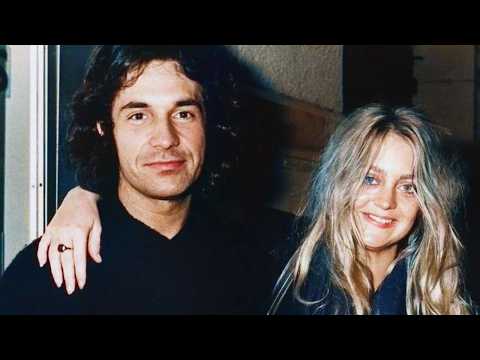
Goldie Hawn was already a cultural phenomenon by the mid-1970s. Born in 1945, she had clawed her way from suburban dance studios to the bright lights of Laugh-In and an Academy Award for Cactus Flower. She was funny, fiercely independent, and unwilling to shrink herself for any man—a lesson learned from her first marriage to Gus Trikonis, which imploded under the weight of their unequal fame.
Bill Hudson, on the other hand, carried a very different kind of baggage. The eldest of the Hudson Brothers, he had tasted brief pop stardom in the early 1970s. But beneath the confident grin was a boy whose father had walked out when he was just six years old. That early abandonment left a scar that colored every relationship he would ever have.
When they met on a commercial flight in the summer of 1975, the chemistry was electric. Within months, they were engaged. On New Year’s Eve, Goldie filed for divorce from Trikonis the same day she accepted Bill’s proposal. They married in July 1976, and for a moment, Bill felt like the luckiest man alive. But according to him, the first crack appeared almost immediately.
On their wedding day itself, Goldie allegedly leaned close and whispered a question that sent a chill down his spine: “Are you sure we did the right thing?” For a man who had spent decades searching for unconditional love, that question was not a playful aside—it was a tremor beneath the foundation. Whether it happened exactly as Bill described is impossible to verify, but what is undeniable is that the marriage began accumulating problems from the start.
Of all the allegations Bill has made, none has generated more controversy than his claim that Goldie proposed an open marriage. He says he reluctantly agreed, desperate to hold the relationship together, but the experiment quickly revealed itself to be profoundly unequal. He claimed Goldie was the one who actually exercised that freedom, while he found himself paralyzed by jealousy and humiliation. For a man abandoned by his father at six, this was not a philosophical concept—it was the antidote to everything he had lost as a boy. It was proof that someone would choose to stay.
Goldie has never confirmed the open marriage allegation in those specific terms, but she has made statements suggesting a more fluid view of monogamy. In a 2005 appearance on The View, she discussed why people stray, even admitting she chose not to ask Kurt Russell probing questions about fidelity because ignorance, in that context, was self-preservation. These are not the words of a woman who views marriage through a traditional lens.
The open marriage question, as explosive as it was, did not exist in a vacuum. It was one element in a larger, more corrosive dynamic: the staggering imbalance in their fame. By the time they married, Goldie was one of the most recognizable women on the planet. Bill, despite his talents, was increasingly cast as “Goldie Hawn’s husband.” For a man already wounded by self-doubt, being perpetually overshadowed was not just a professional inconvenience—it was an existential crisis.
By 1980, the marriage was effectively over. The divorce was finalized in 1982, the same year Goldie met Kurt Russell on the set of Swing Shift. That meeting would spark one of Hollywood’s most enduring partnerships—built not on formalities, but on mutual respect and the freedom to choose each other every day. For Bill, the aftermath was far less triumphant. He remarried, had more children, but the most painful chapter was yet to come: the slow, agonizing estrangement from his children, Oliver and Kate, who were raised primarily by Goldie and Kurt.
The story of Goldie Hawn and Bill Hudson is not a simple morality tale. It is the story of two deeply human people who wanted profoundly different things from love. Was the open marriage proposal the main reason their marriage ended? Probably not in isolation. It was the most visible symbol of a deeper incompatibility—a moment where Goldie’s commitment to freedom collided head-on with Bill’s desperate need for security. And that collision would echo through the years, leaving wounds that never fully healed.
But the silence that followed the divorce was not the quiet of healing. It was the quiet of a family quietly rearranging itself around an absence. Goldie moved forward into a life with Kurt Russell that looked, from the outside, like the very picture of domestic contentment. Bill moved forward into a second marriage and more children, but the children from his first marriage were slipping away from him with each passing year.
Oliver and Kate grew up in the warm, chaotic glow of the Russell household. Kurt was not their biological father, but he was there—at breakfast, at school plays, at the dinner table. In the language of childhood, presence is everything. Bill Hudson, whatever his intentions, was not there. And children, who cannot see the complicated machinery of adult pain, learn to measure love by who shows up.
That measurement has haunted Bill for decades. In his memoir and in countless interviews, he has insisted that he was not the indifferent father the world came to believe he was. He described a court system that favored Goldie’s fame and resources, a wall of handlers and lawyers who kept him at a distance, and a slow, grinding erosion of his role in his children’s lives. He has called himself a ghost—present in their DNA, absent from their daily reality.
Goldie and Kurt have always rejected the characterization of Bill as a deliberately erased figure. Their version is quieter and less dramatic: a man who drifted, who chose his own path, who did not fight hard enough for the children he claimed to love. The truth, as always, likely lives in the fog between these two stories, where memory and hurt and pride all distort the record.
Then came Father’s Day 2015, and the fog briefly cleared to reveal something raw and unmistakable. Oliver Hudson posted a message on social media, a pointed and painful note he titled “Abandonment Day.” It was a son’s public declaration of a wound that had never closed, and it landed like a grenade in the middle of a family that had spent years pretending the silence was peace.
Bill fired back. He gave interviews. He pointed fingers. He insisted that Oliver and Kate had been turned against him, that Goldie’s influence and Kurt’s easy presence had rewritten history. But beneath the anger was something more fragile: the same fear that had gripped him on his wedding day, the fear of a man who could never quite believe he was wanted.
What makes the Hawn-Hudson story endure is not the celebrity or the scandal. It is the way it mirrors something achingly common. Two people bring their childhood wounds into a marriage and ask the other to heal them. Goldie needed the freedom her first marriage had denied her. Bill needed the permanence his father had stolen. Neither could give the other what they needed most, and neither could forgive the other for it.
What the public rarely saw, though, was how those wounds rippled outward into the next generation. Oliver and Kate did not simply drift from their father; they built their identities in opposition to him. Kate, in particular, has spoken about the strange paradox of carrying a famous name she never truly earned from the man who gave it to her. She has described Bill as a stranger who happened to share her blood, a man she knew more from tabloids than from birthday parties.
For years, the siblings navigated their father’s occasional public eruptions with a kind of weary diplomacy. They did not want a war. They wanted, perhaps, a version of the story where they were not the villains and he was not the ghost. But Bill’s interviews kept reopening the wound, each one a fresh reminder that the man who was supposed to protect them seemed more interested in defending himself.
There were moments, brief and fragile, when reconciliation seemed possible. Oliver has admitted that he reached out at various points, driven by a son’s stubborn hope that the next conversation would be different. But hope, when it is repeatedly unmet, curdles into something harder. The Father’s Day post was not cruelty for its own sake. It was the sound of a door finally being slammed shut.
And yet the story does not end there, because real families rarely allow for clean endings. Bill Hudson remains a part of the Hawn-Russell mythology whether anyone likes it or not. He is the shadow at the edge of the family portrait, the unanswered question in every interview about Kate’s childhood. Goldie, for her part, has grown philosophical about it all, describing her marriage to Bill as a necessary chapter in a life she would not trade.
What she has never done is apologize for who she was. She has refused, again and again, to shrink her own story to make Bill’s version more comfortable. That refusal is both her greatest strength and, perhaps, the thing that made their marriage impossible. A woman who will not apologize for her freedom cannot live with a man who needs her to surrender it.
Bill Hudson, meanwhile, has spent the better part of four decades trying to explain himself to a world that has largely stopped listening. His memoir, his interviews, his pointed rebuttals—they all carry the same desperate undertone. He is still, in some sense, that six-year-old boy at the window, waiting for someone to come back.
The two of them never found that final, reconciling conversation. Bill kept giving interviews, kept insisting on his version, kept waiting for a knock on the door that never came. Goldie kept living, kept loving Kurt, kept refusing to apologize for a life she had chosen freely.
And Oliver and Kate kept growing into the people they had decided to become—not their father’s children, but their mother’s, and Kurt’s, and their own. The wound never fully closed, but it stopped bleeding. That, perhaps, is the closest thing to peace real families ever get.
Years later, Bill was asked whether he would do it all again. He paused for a long moment, then said something that sounded less like an answer and more like a confession: “I loved her. I just couldn’t survive being invisible.” It was the most honest thing he had ever said publicly.
Goldie, told of the quote, only nodded. She did not defend herself. She did not attack him. She simply said, “We were young, and we were both asking the other to be someone they weren’t.” It was not forgiveness, exactly. It was something quieter—acceptance.
That is where the story rests now: not in a courtroom or a tabloid, but in the ordinary silence of two people who finally stopped trying to rewrite each other. The open marriage question was never really the cause. It was the symptom. The marriage died of something far more common and far more incurable—two childhoods that never learned the same language of love.
So it ends not with a bang, but with a shrug. A famous marriage, a famous divorce, and two children who grew up learning that presence matters more than promises. What do you think—can two people with opposite wounds ever truly heal each other, or are some divides simply too deep to bridge?
Report this article
Select a reason for reporting:






