Maya Richardson had restored thousands of damaged photographs, but something about this one made her hands tremble. The package arrived on a cold January morning, carefully wrapped in acid-free tissue paper, sent from Charleston by a woman named Grace Thompson. The letter inside was brief: “This is the only image we have of my great-great-grandmother’s family. Please help me see their faces clearly.”
Maya unwrapped the photograph under her magnifying lamp. The image was in ruins—cracked emulsion, water stains, and a crude repair attempt that had only made things worse. But beneath the damage, she could make out seven figures posed in front of a wooden house. A date was scrawled on the back: June 1906, Charleston.
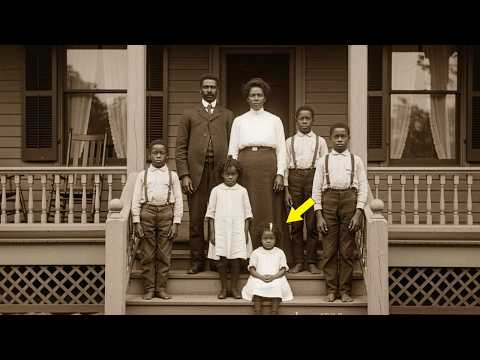
She photographed the original and began the painstaking digital surgery. For three hours, she cloned undamaged sections, smoothed stains, and removed discoloration. Slowly, the composition emerged: a family of seven on a porch, the adults in Sunday clothes, five children ranging from a teenager to a small girl of about four sitting on the steps.
Maya saved her work and stretched. Tomorrow, she would restore the faces.
The next morning, with fresh eyes and strong coffee, she began with the adults. The man had a strong jaw and serious expression, his hand resting protectively on his wife’s shoulder. The woman’s gaze was direct, determined—the exhaustion of managing a household and five children in 1906 Charleston etched into her posture.
Maya moved to the children: a teenage boy, two girls with braided hair and white ribbons, a grinning seven-year-old with a missing tooth. Finally, she zoomed in on the youngest—a little girl with small hands folded in her lap. The damage here was severe, a large water stain obscuring most of her face.
Layer by layer, Maya removed the discoloration. As the child’s features emerged, she paused. Something was off. She increased the magnification, focusing on the eyes and forehead. Her breath caught.
Even through the grain and imperfections of the old photograph, even accounting for 1906 camera technology, what she saw didn’t make sense. The child’s face showed characteristics that wouldn’t be diagnosed for another fifty years.
Maya sat back, her mind racing. She had seen every kind of human variation. But this was different—something the family in 1906 wouldn’t have had words for, something that would have made this child stand out in ways both remarkable and dangerous in the segregated South.
She picked up her phone and called Dr. James Wright, a colleague who taught medical history at Columbia University. “James, I need you to look at something,” she said. “I’m seeing signs of a genetic condition in a child’s face—but if I’m right, it wasn’t even identified until the 1950s.”
Dr. Wright arrived that afternoon, his curiosity evident. He leaned toward the monitor, studying the child’s face. His expression shifted from casual interest to astonishment.
“You’re seeing what I’m seeing?” Maya asked.
He nodded slowly. “If this photograph is authentic—and I assume you’ve verified that—then yes. Clear markers of Waardenburg syndrome.” He pointed to the distance between the inner corners of the eyes. “Dystopia canthorum. And here—a white forelock.” Then he pointed to the child’s eyes. “Heterochromia iridis. Different colored eyes.”
Maya felt a chill. “But Waardenburg syndrome wasn’t identified until 1951. This photograph is from 1906.”
“The condition has always existed,” James explained. “Petrus Johannes Waardenburg was simply the first to recognize it. Before that, people with these characteristics were considered unusual—or marked by God, or cursed. For a black child in the segregated South in 1906, looking this different…” He trailed off, the implications clear.
Maya thought about the little girl’s life. The heterochromia alone would have been startling—one dark eye, one pale blue. Add the white forelock and distinctive facial spacing, and she would have been unmistakably different. “How would people have understood this?” Maya asked.
“They wouldn’t have,” James said. “Some might have viewed her with suspicion or fear. Others might have considered her special, blessed, or cursed. In Charleston, with its rigid racial hierarchies, it would have been complicated—potentially dangerous.”
Maya returned to her computer and pulled up Grace Thompson’s letter. “Should I tell her what we found?”
“Absolutely,” James said firmly. “This is part of her family’s story. More than that—it could be historically significant.”
Maya spent the rest of the afternoon completing the restoration, enhancing the child’s features without exaggeration. When she finished, the little girl’s face was clear: the wide-set eyes with their striking difference in color, the white streak in her dark hair, the small, serious expression of a child who had already learned she was different.
She printed two copies—one for Grace, one for her files—and sat down to write an email, choosing her words carefully. She explained the discovery of Waardenburg syndrome, its history, and what it might have meant for the child in 1906. Then she hesitated before clicking send. She was about to tell a stranger that their ancestor had a genetic condition—information that might be surprising or distressing. But Grace had asked her to help see the faces clearly, and this was part of that truth.
She sent the email and packaged the restored photograph for shipping. Three days later, her phone rang. The caller ID showed a Charleston area code.
“Miss Richardson, this is Grace Thompson. I received your email about my great-great-grandmother’s family photograph.” Grace’s voice was warm but emotional. “I’ve been staring at the restored image for two days. The little girl with the different colored eyes—that’s my great-great-grandmother. Her name was Sarah.”
Maya’s heart skipped. The child in the photograph grew up.
“Do you know anything about her life?” Maya asked.
“That’s why I’m calling,” Grace said. “After I read your email, I went through all the family papers I have. Old letters, Bible records, newspaper clippings my grandmother saved. I’ve been trying to piece together Sarah’s story for years, but there are so many gaps. My grandmother never talked much about her own grandmother, and when she did, she was vague. I always wondered why. Now, I think I’m starting to understand.”
“What did you find?” Maya asked.
Grace took a deep breath. “I found a letter from 1924 written by Sarah to her daughter, my great-grandmother. In it, she talks about being different all her life, about people treating her with fear or fascination. She mentions a woman named Clara who protected her as a child and taught her everything. I never understood what that meant before, but now—now I know Sarah had Waardenburg syndrome.”
“And in 1906 Charleston, that would have made her very vulnerable,” Maya finished.
“Miss Richardson, would you be willing to help me find out more about Sarah? About this Clara who protected her? About what Sarah’s life was really like? I have so many pieces, but I can’t fit them together on my own.”
Maya didn’t hesitate. “I’ll come to Charleston.”
Two weeks later, Maya stood in the arrivals area of Charleston International Airport, holding a sign with Grace Thompson’s name. She had decided this story was too important to research from a distance. Grace had invited her to Charleston, offering to share all the family documents she had collected and to introduce Maya to the city where Sarah had grown up.
Grace emerged from the crowd—a woman in her early fifties with warm eyes and her great-great-grandmother’s high cheekbones. They recognized each other immediately, and Grace pulled Maya into a hug. “Thank you for coming,” Grace said. “I know you didn’t have to do this. Restoring the photograph was your job. This is something more.”
“This is history,” Maya replied. “And I want to help you find it.”
They drove into Charleston as the afternoon light turned golden, past elegant historic homes and live oaks draped with Spanish moss. Grace pointed out landmarks—the Old Slave Mart Museum, Mother Emanuel AME Church, the neighborhoods that had been the heart of black Charleston in the early twentieth century.
“The house in the photograph doesn’t exist anymore,” Grace explained. “It was torn down in the 1950s during urban renewal, but I know the street it was on, and I’ve been researching what the neighborhood was like in Sarah’s time.”
Grace’s home was a modest bungalow in North Charleston filled with family photographs spanning five generations. She had converted her dining room into a research center: a large table covered in organized stacks of documents, a computer, and a whiteboard covered with notes and a hand-drawn family tree.
“I’ve been working on this for three years,” Grace said, gesturing at the organized chaos. “Ever since my mother died and I inherited all the family papers she’d been keeping. I always knew our family had interesting stories, but I didn’t realize how much history was hidden in these documents.”
She pulled out a cardboard box and carefully lifted a stack of letters wrapped in ribbon. “These are from Sarah. She wrote them to my great-grandmother, her daughter, between 1924 and 1948. Sarah died in 1952 when my grandmother was just a teenager. By then, she wasn’t talking much about the past anymore. My grandmother said Sarah became quiet in her later years, like she was tired of remembering.”
Maya took the letters carefully, aware she was holding pieces of Sarah’s voice from across the decades. The handwriting was clear and educated, each letter dated and addressed with care.
Grace pulled out another document—a small leather-bound book with a broken clasp. “This is what made me reach out to you in the first place. I found it in my mother’s things after she passed. It’s some kind of journal or record book written by someone named Clara Bennett. It covers the years 1902 to 1928, and Sarah is mentioned throughout. But it’s not just a diary—it’s full of medical observations, descriptions of treatments, records of births and deaths in the community. I think Clara must have been a midwife or healer.”
Maya opened the journal carefully. The pages were filled with neat, precise handwriting, each entry dated and detailed. She flipped through randomly and found an entry from August 1906.
Sarah continues to thrive despite the talk among some families. Her eyes and hair make her a curiosity, but she is bright and quick to learn. I have convinced her mother to keep her close to home until she is older and stronger. The world is not always kind to those who are different.
Maya and Grace spent that evening going through Clara Bennett’s journal systematically, reading entries aloud and taking notes. The picture that emerged was of a remarkable woman who had served Charleston’s black community as a healer, midwife, and informal physician for nearly three decades.
Clara had been born in 1870, the daughter of formerly enslaved people who had learned herbal medicine and midwifery during slavery and passed that knowledge to their daughter. By 1902, when the journal began, Clara was thirty-two years old and had established herself as someone the community trusted with their most vulnerable moments—births, illnesses, deaths.
The first mention of Sarah appeared in June 1906, the same month as the family photograph.
Delivered Ruth’s fifth child today, a girl they named Sarah. The birth was straightforward, but the child’s appearance is unusual. Her eyes are two different colors—one dark like her parents, one pale blue like I have never seen in a colored child. There is also a white streak in her hair at the crown. Ruth is frightened, wondering if her baby is cursed. I assured her the child is healthy and whole, just different. I have read of such things in my medical books, though I do not have a name for this particular condition.
“Your great-great-grandmother was born in 1906,” Maya said, looking up from the journal. “This entry is from her birth.”
Grace nodded, tears in her eyes. “Clara was there from the beginning. She knew what Sarah was facing even as an infant.”
They continued reading. Clara’s entries over the following months showed her watching Sarah’s development carefully, noting that the child was meeting all normal milestones—sitting up, crawling, responding to sounds and voices. But Clara also recorded the community’s reactions.
People are talking about Ruth’s unusual child. Some say she is marked by God. Others whisper darker things. I’ve spoken to several families, trying to educate them, but superstition runs deep. Ruth keeps Sarah mostly at home, which is wise for now, but it cannot last forever.
By 1908, when Sarah was two years old, the entries showed Clara taking a more active role.
I have offered to help educate Sarah when she is older. Ruth is grateful but worried about how people will react if her daughter learns too much. I reminded her that knowledge is the best protection we can give our children—especially children who will face extra scrutiny for being different.
Maya noticed a pattern in the entries. Clara wrote about other children in the community—their illnesses, their growth, their families. But she returned to Sarah again and again with a level of detail and personal investment that went beyond medical observation.
“Clara became Sarah’s protector,” Maya said. “She saw something special in her and decided to shield her from the worst of what she would face.”
Grace pulled out another document—a faded newspaper clipping from the Charleston Messenger, a black-owned newspaper that had operated in the early twentieth century. The article was dated 1925 and featured a photograph of a young woman in a nurse’s uniform. The headline read: “Local Woman Completes Nursing Training.”
Maya looked at the photograph, then at the restored family portrait from 1906. The same distinctive features—the wide-set eyes, though the heterochromia was less visible in the newspaper’s lower-quality reproduction.
“That’s Sarah,” Grace confirmed. “She became a nurse. In 1925, in South Carolina, a black woman with a visible genetic condition became a certified nurse. Do you understand how remarkable that is?”
The next morning, Grace took Maya to the Charleston County Public Library, where an archivist named Frederick recognized Clara’s name at once. “My grandmother used to talk about a healer named Clara who delivered half the babies in the neighborhood,” he said, and disappeared into the back rooms.
He returned with records from the Cannon Street Hospital and Training School for Nurses. Sarah was admitted in September 1922—sponsored by Clara Bennett—and graduated in May 1925 with honors. Clara had spent thirty years of favors to make it happen.
They found Sarah’s employment file from 1926: registered nurse, home visits in the east side community, forty-five dollars a month. In a 1927 letter, Sarah wrote: “They forget about my difference. They see me as someone who cares.”
At the cemetery, an elderly woman named Dorothy approached Sarah’s headstone. “Sarah delivered me in 1949,” she said. “They called her the nurse with angel eyes. She saved my life.”
Three months later, Maya stood in the Charleston Museum at the opening of Hidden Faces, Revealed Lives, the restored photograph at its center. Grace addressed the crowd: “I only wanted to see their faces clearly. I never imagined how many lives Sarah had touched.”
Flying home, Maya thought of the damaged photographs waiting on her desk—and the hidden stories still buried in them. Every face, she knew now, deserved to be seen.
How many forgotten lives like Sarah’s are still waiting inside your own family’s old photographs?
Report this article
Select a reason for reporting:






