On August 29th, 1986, the streets of East Oakland became a stage for a spectacle that defied all logic. A horse-drawn glass carriage carried a $6,000 bronze coffin, topped with flowers arranged in the shape of a dollar sign. Behind it, fourteen white Rolls-Royce limousines gleamed in the California sun, stretching so far back that witnesses couldn’t see where the procession ended. Eight thousand people lined the sidewalks. Ushers in tuxedos directed the crowd. Television cameras broadcast the scene internationally. Reporters scrambled to describe what they were seeing—because nobody had ever seen anything like this. Not for a mayor, not for a senator, not for a general.
But this was for a 31-year-old heroin dealer from the housing projects. His name was Felix Mitchell. They called him Felix the Cat. And what happened next would become one of the strangest phenomena in the history of American crime.
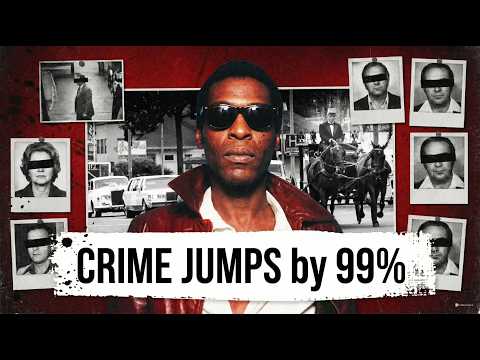
The police thought putting Felix Mitchell in prison would save Oakland. Instead, his arrest did not reduce crime. It did not save lives. It did not slow down the drug trade. It made everything worse. Criminologists would later name an entire paradox after what happened. This is the story of the drug dealer whose funeral looked like a president had died—and whose absence destroyed a city more than his presence ever did.
Years later, at Felix Mitchell’s federal trial, a prosecutor stood before the jury and said something that captured everything about the man in a single sentence. “Mr. Mitchell was flashy and always wanted to be seen.” That was the whole story. Felix Mitchell always wanted to be seen. In a neighborhood where nobody saw you. In a city that forgot you existed.
Felix Wayne Mitchell, Jr. was born on August 23rd, 1954, in Oakland, California. He grew up in the 69th Avenue San Antonio Village housing projects—a cluster of low-rise buildings in East Oakland that residents called 69 Ville. The buildings were crumbling. The streets were cracked. Jobs did not exist. Opportunity did not exist. The city of Oakland put money into downtown and the hills. The flats, the projects, got nothing.
Felix dropped out of high school. No diploma, no prospects, no way out that anyone could see. But Felix saw something. He looked at 69 Ville—this forgotten cluster of buildings that nobody cared about—and he saw a fortress. He saw a headquarters. He saw an empire.
While still a teenager, Felix started organizing the kids around him. His friends. His neighbors. Boys he had grown up with in the projects who had the same nothing he had. He called them “my other brother.” Think about that name. Not a gang name, not something designed to intimidate. My other brother. MOB. A family. That’s how the 69 Mob was born.
And here is what made Felix different from every other kid selling drugs on a street corner in the 1970s in America. He did not think like a dealer. He thought like a CEO. Felix connected with a Los Angeles kingpin named Tootie Reese. Through Reese, he built supply lines connecting the Bay Area to Los Angeles and Detroit. He was not just selling heroin. He was building a distribution network with suppliers, middlemen, territory managers, and soldiers.
Criminologists would later credit Felix Mitchell with creating the country’s first large-scale gang-controlled drug operation. Not the Crips, not the Bloods, not the Gangster Disciples. A dropout from the Oakland projects, he did it first.
The 69 Mob ran heroin through East Oakland like a corporation. They had structure. They had hierarchy. They had territory mapped out block by block. Felix sourced heroin from Mexican suppliers through his Los Angeles connections. The raw product came north, got cut in Oakland, and was distributed through a network that eventually spanned at least eight states, including California, Arizona, and Texas, with outposts reaching into the Midwest.
He created branded product—stamped packaging so customers knew they were getting 69 Mob heroin. Brand recognition for drugs in the 1970s before anyone else thought of it. And he innovated in ways that would change the drug game forever in the worst possible way. He used children. Kids as young as 12 became delivery agents and lookouts. They could not be prosecuted as adults. They were invisible to the legal system. And they were loyal to Felix because he was the only person in their lives who ever gave them anything.
Here is the contradiction at the center of this entire story—and you need to hold this contradiction in your mind for everything that comes next. Felix Mitchell, the man who flooded Oakland with heroin, who turned children into drug runners, who would popularize drive-by shootings, also gave candy and toys to kids in the neighborhood. He donated money to charities. He sponsored youth athletic programs. He opened swimming pools in poor Oakland neighborhoods. He took busloads of children to Marine World. He distributed turkeys at Thanksgiving. He went to church.
He was destroying the community with one hand and building it with the other. And the community loved him for it because nobody else was doing anything at all.
By the late 1970s, Felix Mitchell was untouchable. Picture the scene. It is a Saturday night in East Oakland. The streets around 69 Ville are cracked and neglected. Buildings are falling apart. The city forgot these blocks existed a long time ago. And then a procession of European sports cars rolls through. At the center, Felix Mitchell, full-length fur coat, diamonds catching the street light, diamond-encrusted frames on his glasses, surrounded by lieutenants carrying assault rifles. Not concealed, not hidden. Carrying them openly through the streets of Oakland like bodyguards for a head of state.
Nobody called the police. Nobody complained. Because in 69 Ville, Felix Mitchell was the authority. Rapper Too Short would later say, “Felix Mitchell was like Oakland’s leader, not its drug dealer, its leader.” And he played the role perfectly.
Estimates on how much money Felix was making varied wildly. $400,000 a week according to some. $800,000 a week according to others. A million dollars a month. Five million dollars a year. The numbers depended on who was counting—the feds, the journalists, the people on the street. But everyone agreed on one thing: Felix Mitchell had more money than anyone in Oakland, and he did not hide it. He weaponized it.
A different luxury car every day. Parties so lavish they became legends. Clothes that cost more than most families in 69 Ville earned in a year. He transformed himself from a housing project dropout into an Oakland folk hero, and he did it on purpose. Because Felix understood something that most drug dealers never figure out. Fear keeps people in line. But loyalty keeps them quiet. So he built loyalty.
His nephew Darryl Reed was one of those kids. Reed would later write in his book Wait that he was drawn to his uncle’s glamour—the thousands of dollars worth of jewelry, the clothes, the diamond-encrusted glasses frames, and the rides around town in exotic cars. Felix treated him like a son. He bought him expensive clothes. He showed him what power looked like.
Darryl Reed had once dreamed of being a baseball player. He played shortstop and left field for the Allen Temple Little League team. He played point guard on a basketball team that won a championship at the Rainbow Recreation Center. But that dream didn’t stand a chance. Not with Felix Mitchell as your uncle. Not with the diamond glasses and the fur coats and the Rolls-Royces rolling through 69 Ville every night. Reed didn’t know it yet, but he was watching a blueprint for his own destruction.
Because Felix’s empire had a problem. Other people wanted it. Felix Mitchell wasn’t the only drug dealer in Oakland. His two biggest rivals were Harvey Whisenton, who ran a gang called Funktown USA, and Milton Moore, known as Mickey Mo, the leader of a crew called The Family. Moore’s story alone would be a movie. Before he was a drug dealer, he was an R&B singer. A musician with actual talent who crossed over into the drug trade and built an organization powerful enough to challenge Felix’s monopoly head-on.
Think about that for a second. An R&B singer going to war with the most powerful drug lord on the West Coast. Moore’s crew called themselves The Family and they weren’t afraid of Felix Mitchell. For years, the three organizations—the 69 Mob, The Family, and Funktown USA—circled each other. Tensions simmered. Territory shifted. Small acts of violence escalated into bigger ones. Everyone knew a full-scale war was coming. The only question was when.
Then came August 1980, and the answer was now. In the first week of that month, three people connected to Mickey Moore’s Family gang were murdered. Vendisha Davis, Terry Hatter, Charles Dorsey. Three bodies in a matter of days, but the worst was still coming. On August 6th, 1980, Ricky “the Rocket” Walker, his 18-year-old brother Roger “Red” Walker, and their sister-in-law Sandy Adamson disappeared. The next morning, a jogger found them on a grassy slope near Skyline Boulevard in a hilly section of an Oakland park called Colorado Trail. Red Walker, 18, and Sandy Adamson, 31, had plastic bags pulled over their heads. They died of asphyxiation, strangled. Ricky the Rocket Walker, 26, was found nearby with two bullet wounds to the back of his skull. Execution-style. Three people, one family, found on a hillside above Oakland like a message written in blood. Six gangland murders in one week. The police called it Bloody August.
Federal witnesses would later testify that members of Felix Mitchell’s inner circle bragged about their involvement in the murders of the Walkers and Adamson. And Felix? Felix told an associate he had taken a trip to Los Angeles during the first week of August 1980. A convenient vacation. A perfect alibi. While his people were strangling victims and putting bullets in skulls on an Oakland hillside, Felix the Cat was in Los Angeles, far enough away to keep his hands clean.
He also pioneered something else during these wars, something that would spread across America like a plague. Felix Mitchell popularized the drive-by shooting. Before Felix, gangland murders were personal. You got close. You looked your enemy in the eye. Felix turned killing into something you did from a moving car. Fast. Impersonal. Devastating. A car rolls up. Windows come down. Shots fired. The car drives away. The victim bleeds out on the sidewalk. No witnesses who will talk. No evidence left behind. It spread from Oakland to every city in America. And it started here, with Felix the Cat.
Mickey Moore and the Family were eventually brought down in 1985, the same year Felix got arrested. The R&B singer who went to war with Oakland’s drug king is now a preacher. By 1985, Felix Mitchell had been at the top for nearly a decade. He had survived Bloody August. He had outlasted rivals. He had built an empire that stretched across California and into the Midwest, spanning at least eight states. But the bodies had piled too high. Local and federal law enforcement had been building a case for years. The FBI, the DEA, and Oakland Police Department were all watching. Wiretaps, informants, surveillance. In 1985, they finally got him.
Felix Mitchell was arrested, tried, and convicted. The judge sentenced him to life in prison. He was sent to Leavenworth Federal Penitentiary, one of the most notorious prisons in America. Law enforcement celebrated. They had cut the head off the snake. Oakland’s most dangerous drug lord was behind bars. The heroin trade would collapse. Violence would decrease. The city could breathe again. That is what they believed. They were catastrophically wrong.
When police removed Felix Mitchell from Oakland, crime got worse. Not a little worse—catastrophically worse. Heroin became cheaper, more accessible. More people got addicted. More people died. And the violence exploded. Without Felix controlling the market, smaller gangs rushed to fill the vacuum. They didn’t have his discipline, his structure, his ability to keep things under control. What they had were guns and ambition and no one to tell them no.
Criminologists gave this phenomenon a name: the Felix Mitchell Paradox. Felix had such monopoly power that he actually controlled the violence. He set prices, so there were no price wars. He policed the smaller gangs, so there were no turf wars. Remove him, and everything collapses. The police thought they were performing surgery, removing a tumor. Instead, they performed an amputation with no plan for what came after.
Felix Mitchell did not live to see what happened to his city. On August 21st, 1986, a little more than a year into his life sentence at Leavenworth, another inmate stabbed him to death. He was 31 years old. His 32nd birthday was two days away. Eight days later came the funeral—the horse-drawn carriage, the fourteen Rolls-Royces, the dollar sign flowers, the eight thousand mourners. A city mourning a drug dealer like a king.
His nephew Darryl Reed rose fast, becoming the Bay Area’s most powerful crack dealer by age 20, clearing $15,000 a day. Less than two weeks after throwing himself a $30,000 birthday party where he danced on stage with MC Hammer, the DEA kicked in his door. He got 35 years. When Reed went away, the second Oakland drug war erupted—16 murders in less than three years.
The problem wasn’t Felix Mitchell. The problem was a city so devastated by poverty and neglect that a heroin dealer from the projects became its most important leader. His funeral wasn’t just a drug dealer’s send-off. It was Oakland screaming: Look at us. Look at what we’ve been reduced to. Look at who we have to mourn.
That’s the Felix Mitchell paradox. And Oakland is still living with it. So here’s the question: if removing the villain makes everything worse, what does that say about the system that created him in the first place—and are we brave enough to fix that instead?
Report this article
Select a reason for reporting:






