She sold tens of millions of records, won ten Grammys, and possessed one of the most unmistakable voices in American music. Then, in 2009, Linda Ronstadt opened her mouth to sing and nothing came out. For years, no one—not even her—understood why. Now, at 80, the legendary singer is finally ready to speak. Not about the charts or the awards, but about the five people who truly shaped her life.
What she reveals is not a story of fame, but of love in its many forms—passionate, complicated, enduring, and, in one case, so foundational that it predates everything else. Some names will surprise you. One will break your heart. And the last one? That’s the one she’s been waiting decades to properly honor.
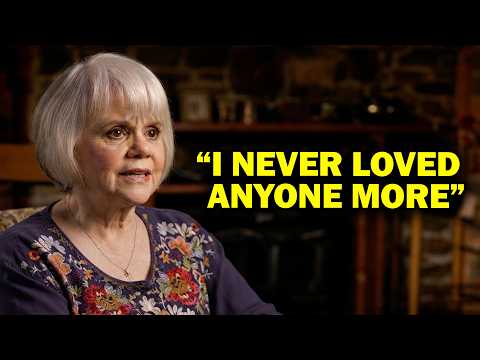
Linda Ronstadt was born on July 15, 1946, in Tucson, Arizona, into a family where music was as essential as breathing. Her father, Gilbert, ran a hardware store—but at home, he was a different man entirely. He sang Mexican songs on the porch, harmonizing in Spanish with his children long before Linda understood the words. “I believe almost everything I needed to become a singer, I absorbed before I turned ten,” she once said, sitting in that desert house, listening to her father’s voice.
By her late teens, Tucson couldn’t hold her. In 1964, she left for Los Angeles, drawn by the folk-rock scene blooming around clubs like the Troubadour. She joined a trio called the Stone Poneys, and in 1967, their version of Michael Nesmith’s “Different Drum” became a hit—and almost immediately ended the group. Audiences and executives only wanted Ronstadt. A solo career she hadn’t planned for was suddenly thrust upon her.
The late ‘60s and early ‘70s were years of hard, formative work. She recorded albums that sold respectably but never broke through. She was still finding her footing—as a vocalist, and as a young woman navigating an industry built almost entirely around men. The Troubadour became her second home, and there she crossed paths with a generation of musicians who would define the Southern California sound: Jackson Browne, Glenn Frey, Don Henley, JD Souther. These weren’t distant acquaintances. They were her band, her collaborators, her friends—and in more than one case, the people she loved.
In 1971, she hired a backing band that included Frey, Henley, Randy Meisner, and Bernie Leadon. Within months, the four men left to form the Eagles. Ronstadt never expressed resentment. If anything, she treated it as proof of the caliber of musicians she surrounded herself with—and those relationships carried forward into her own recordings for the rest of the decade.
The turning point came in 1974 with Heart Like a Wheel. Anchored by hits like “You’re No Good” and “When Will I Be Loved,” it went to number one and sold in the millions. It also included JD Souther’s “Faithless Love”—a small but telling detail, since Souther’s songwriting and his relationship with Ronstadt were by then deeply intertwined. The album made her, by most measures, the most successful female rock and pop artist in the country.
Throughout the rest of the 1970s, she released a string of platinum albums—Simple Dreams, Living in the USA—and became a fixture on magazine covers and awards stages. By the end of the decade, Linda Ronstadt stood at the summit of American popular music. She had the commercial success, the critical respect, the cultural visibility that almost no other woman in rock or country could claim.
And yet, when she later sat down to write her memoir and speak candidly in interviews, the story she chose to tell was not about charts or awards. It was about the people she loved along the way. It is time to begin that countdown.
George Lucas. By the early 1980s, Linda Ronstadt’s fame had carried her far beyond the music industry. It was during this period that she became involved with the filmmaker George Lucas, the creator of Star Wars and one of the most influential figures to emerge from American cinema in the twentieth century. The pairing of a chart-topping singer with a filmmaker of his stature drew significant public attention.
The two became engaged in 1983, and their engagement lasted until 1988. By any account, the relationship was serious—spanning several years and reaching the point of a formal commitment to marry. Ronstadt has spoken about it with respect and without bitterness, treating it as a meaningful chapter rather than something to be minimized.
What she has said plainly, without elaboration, is that she did not want to be married to anyone. That was not a statement aimed at Lucas specifically. It was closer to a broader truth about how she understood herself and the shape she wanted her life to take.
It is worth pausing on that point, because it says something important about the person at the center of this story. Linda Ronstadt spent decades surrounded by men who wanted to marry her—men of considerable accomplishment and public stature. In case after case, she chose not to take that step. She was not indecisive. She was, by her own account, clear-eyed about the kind of life she wanted: one built around her music, her family, and eventually her children, rather than around a traditional marriage.
The engagement to George Lucas ended not in scandal or public conflict, but simply because two people who cared for each other recognized that a shared life as husband and wife was not the path either was meant to walk. That willingness to walk away from a serious, high-profile relationship rather than force it into a shape that did not fit her is part of why Lucas belongs on this list at all. He was not simply a famous name attached to a famous woman. He was someone she loved enough to commit to for five years, and someone she respected enough, even after the engagement ended, to speak of without regret.
Their years together spanned a period when both of their careers were reaching new heights—hers in music, his in film. It set a pattern that would recur throughout the rest of her personal life, and it raises an obvious question: who exactly could possibly outrank a five-year engagement to one of the most famous filmmakers in the world? As it turns out, the answer involves an entirely different kind of famous man—one who very nearly changed the course of California politics because of her.
Jerry Brown. If the relationship with George Lucas placed Linda Ronstadt at the edge of Hollywood’s inner circle, her relationship with Jerry Brown placed her at the center of American political life. Brown served as governor of California from 1975 until 1983, and by the time he and Ronstadt became romantically involved in the late 1970s, he was already one of the most talked-about politicians in the country—a man frequently mentioned as a future presidential contender.
Ronstadt has said that she and Brown met years earlier at a well-known Hollywood restaurant, when Brown was serving as California’s Secretary of State, and that their relationship developed gradually from there into something the press eventually described with unmistakable curiosity: a genuine romance between a sitting governor and one of the biggest pop stars in America.
The relationship reached a particularly visible peak in April 1979, when Ronstadt accompanied Brown on an official trip to Africa. The trip put the couple on the cover of Newsweek—a striking image that captured just how unusual their pairing appeared to the American public. For a brief period, there was real speculation in political and media circles about whether Linda Ronstadt might one day become the first lady of California. And by extension, given Brown’s national ambitions, perhaps something even larger than that.
It is difficult to overstate how strange that possibility must have seemed at the time. Here was a rock and roll singer known for chart-topping albums and sold-out arena tours, being discussed as a potential political spouse. Ronstadt has since written about Brown with genuine affection, describing him as intelligent, funny, and remarkably disciplined compared to many of the musicians she had spent her twenties surrounded by. She noted that unlike much of the rock and roll world she knew, Brown had little interest in drinking or drugs, and that he approached his personal life with the same careful discipline he brought to governing.
She has also recalled that he cared seriously about issues she cared about as well—from nuclear safety to agricultural policy to the rights of farm workers—subjects that mattered to her both as a Californian and as the granddaughter of a Mexican immigrant.
At the same time, Ronstadt has been direct about why a life as a political spouse was never something she wanted for herself. She has explained that neither she nor Brown ever shared the illusion that they could realistically build a shared married life together, given how different their two worlds were. His life, structured around the demands and constraints of elected office, was in her words too restrictive for the kind of existence she led—while her own life, built around touring schedules, recording sessions, and the constant unpredictability of a music career, was by her own description entirely chaotic by comparison.
Rather than framing the end of the relationship as a rejection of Brown himself, she framed it as an honest recognition that two very different lives, however much affection existed between the people living them, were simply not built to merge into one household. What comes through clearly in the way Ronstadt discusses Jerry Brown is the complete absence of regret. She does not describe the relationship as a mistake, nor does she treat the fact that she never became a political wife as a loss.
Jerry Brown earns his place on this list not because of the Newsweek covers or the speculation about the governor’s mansion, but because of what the relationship revealed about Ronstadt’s priorities at a moment when the entire country was watching. And yet, remarkably, there is a friendship on this list that meant even more to her than a nearly presidential romance—one built not on politics or headlines, but on music, laughter, and decades of loyalty.
Dolly Parton. Long before the world heard Linda Ronstadt, Dolly Parton, and Emmylou Harris sing together, the three women had already become friends, drawn to one another by mutual respect and a shared sense that their voices might blend into something remarkable. The idea of recording together first surfaced in the mid-1970s, but scheduling conflicts and label politics kept the project from coming together for years. It was not until 1987 that the three finally released Trio, an album that became both a critical and commercial triumph, earning widespread acclaim and a Grammy.
The friendship between Ronstadt and Parton was never simply a professional arrangement. The two women genuinely liked each other, and their bonds survived years of exactly the kind of record company interference that tends to end collaborations permanently. Contractual disputes and years-long delays could have easily driven a wedge between them. Instead, they kept returning to one another, culminating in Trio II in 1999, more than a decade after the first. The very existence of that second record, made well after each woman had nothing left to prove, says something about how much the friendship itself meant.
In August 2026, Dolly Parton died at the age of 80. Ronstadt, by then largely out of the public eye due to her own health, released a public statement mourning her friend. She described herself as deeply saddened, called recording with Parton one of the most extraordinary musical experiences of her life, and added that the world was a poorer place without her. Coming from a woman who had spent decades recording alongside some of the greatest musicians in American history, that was not a small tribute.
JD Souther. Among all the men who moved through Ronstadt’s life during the 1970s, none occupied a more complicated, layered role than the singer and songwriter JD Souther. The two met in 1970, in the earliest days of her time in Los Angeles, when Souther was still an emerging songwriter working the same Troubadour circuit that connected nearly everyone in this story. They quickly became romantically involved and eventually lived together, at a time when both of their careers were still taking shape.
Souther’s songwriting became deeply woven into Ronstadt’s recorded output. His composition Faithless Love appeared on her breakthrough album, Heart Like a Wheel, and his songs continued to surface across her catalog throughout the decade. Souther went on to become one of the defining songwriters of the Southern California sound, co-writing hits for the Eagles including Best of My Love and New Kid in Town.
What made the relationship unusual was not how it began, but how it ended—or rather, how it did not end at all. Where other relationships concluded and faded into the past, the bond between Ronstadt and Souther shifted shape rather than disappearing. Their romance gave way over time to a friendship that proved remarkably durable, one that outlasted the initial passion by decades.
JD Souther died on September 17th, 2024, at his home in New Mexico at the age of 78. For Linda Ronstadt, his passing marked the loss of someone who had known her since she was still finding her footing as a young singer in Los Angeles—someone whose songwriting had helped define the sound of her most successful album, and whose friendship had survived every version of both of their lives for more than fifty years. He was proof that love does not have to remain romantic to remain real.
It is a fitting bridge toward the final name on this list, because the person who ultimately outranks even JD Souther in Linda Ronstadt’s heart offers a similar lesson about how love, once it takes root early enough in a life, tends to stay there permanently.
Gilbert Ronstadt. Everything in Linda Ronstadt’s life—the record sales, the Grammy awards, the engagement to George Lucas, the romance with a sitting governor, the decades-long friendship with Dolly Parton, the enduring bond with JD Souther—ultimately traces back to a small hardware store in Tucson, Arizona, and the man who ran it.
Gilbert Ronstadt was Linda’s father—a businessman by trade, and by every account she has ever given, a singer of extraordinary natural talent who never sought fame or a career in music at all. He simply sang at home on the porch, surrounded by his children, harmonizing in Spanish on traditional Mexican songs passed down through his own family for generations. Linda Ronstadt has said plainly, without exaggeration, that her father’s voice was better than her own—a claim she repeated more than once over the years, always with the same quiet certainty rather than as a passing figure of speech.
That connection to Mexican music, planted so early and so deeply, eventually led Ronstadt to record Canciones de mi Padre in 1987—an album whose title translates directly to Songs of My Father. The record was not a stylistic experiment or a commercial gamble, though it succeeded commercially beyond almost anyone’s expectations, becoming one of the bestselling non-English-language albums ever released in the United States. It was, more than anything else she ever recorded, a direct tribute to Gilbert Ronstadt and the childhood he had given her.
Gilbert Ronstadt died in 1995. Linda Ronstadt has said that every note on Canciones de mi Padre was recorded for him. It was not an album made to please critics or expand her commercial reach, though it did both. It was an album made as an offering to a man who had given her a voice in the most literal sense before the rest of the world ever had the chance to hear it.
Amid all the fame, the engagements, the political speculation, and the professional friendships that filled her extraordinary life, it was her father’s porch and the songs sung there decades earlier that Linda Ronstadt ultimately returned to again and again as the true source of everything she became.
Gilbert Ronstadt earns the top position on this list not because he was famous, not because he appeared on magazine covers or shaped national politics, but because he was quite simply the origin point of everything else. Every other name on this countdown represents a version of love Linda Ronstadt experienced as an adult, shaped by choice, by circumstance, and by the particular demands of fame. Her father represents something that came before all of that—something she did not choose so much as inherit, and something that never had to compete for its place at the top. It simply always belonged there.
Today, Linda Ronstadt can no longer sing the way she once did, silenced by a disease that took away one of the great instruments in American music. But the songs remain, and so does the record of exactly who she loved and why. Her father’s influence lives on every time someone plays Canciones de mi Padre, just as her years with Dolly Parton live on in Trio, and her friendship with JD Souther lives on in the songs he wrote for her voice to carry.
The voice may be silent now, but everything it was built from—the porch in Tucson, the men and women she loved along the way, and the father who taught her to sing before she knew what singing meant—remains exactly as she left it, preserved in the music, waiting for anyone willing to listen closely enough to hear where it all began.
So here is the question worth sitting with: if you had to name the five people who shaped your own life most profoundly, who would make your list—and would the person at the very top surprise everyone who thinks they know you? Tell us in the comments.
Report this article
Select a reason for reporting:






