March 17, 1943. 180 meters beneath the North Atlantic, the pressure hull of U-257 groaned like a wounded animal. Depth charges rained from above, each explosion a hammer blow against the steel coffin. The lights flickered. Cork insulation drifted down like snow. Forty-four men held their breath, trapped in a nightmare of pinging sonar and crumbling hope.
They had been hunted for seven hours. The batteries were at 22%. The decoys were gone. And the British destroyer above had perfect contact—its ASDIC pings echoing through the hull every eight seconds, a relentless promise of death. “All compartments rig for silent running,” the captain’s voice crackled over the intercom. But everyone knew what he didn’t say: they were out of options.
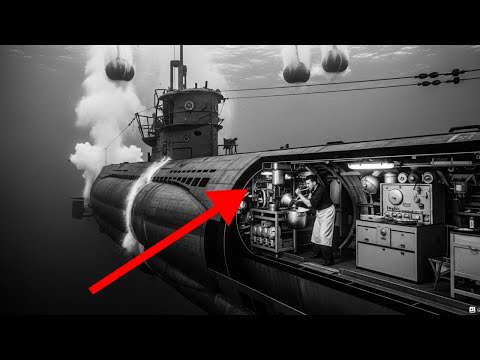
In the galley, 29-year-old cook Klaus Richter gripped the counter as another explosion rocked the boat. He was no stranger to terror—19 months aboard, 11 depth-charge attacks survived. But this time, the destroyer’s propellers changed pitch. Another attack run. And Richter, a former line cook from Hamburg, was about to violate every principle of submarine warfare.
What he did next would either save 44 lives or kill every man aboard in three minutes.
By March 1943, the Battle of the Atlantic had reached its turning point. German U-boats had savaged Allied convoys for 16 months, sinking ships faster than they could be replaced. The Type VIIC workhorse—67 meters long, 44 to 52 men, 14 torpedoes—was the terror of the seas. But Allied technology had caught up. Centimetric radar detected surfaced U-boats from over 8,000 meters. Improved ASDIC sonar held contact with submerged boats down to 200 meters. And escort groups had perfected “creeping attacks”: one ship held sonar contact while another approached silently to drop depth charges directly overhead.
The statistics were brutal. In March 1943 alone, 15 U-boats would be lost with all hands. The average life expectancy of a U-boat crewman was 62 days of combat operations. Of the 40,000 men who served in the Kriegsmarine’s submarine force, 30,000 would die at sea.
Depth charges were catastrophic even without a direct hit. A British Mark VII depth charge contained 130 kilograms of Torpex, creating a shock wave that propagated through water far more effectively than through air. Within six meters, the pressure hull would rupture. Within twelve, valves shattered, welds cracked, electrical systems failed. The psychological impact was equally devastating—veterans described depth-charge attacks as the most terrifying experience of the war. Worse than torpedoes, worse than strafing. The waiting. The metallic ping of sonar probing through the darkness. The distant splash as charges entered the water. Then the detonations—wham!—each one a hammer blow against the hull.
Survival depended on doctrine drilled into every crewman: dive deep, move slowly, maintain absolute silence. Conversations were conducted in whispers. Men wore felt slippers instead of boots. Machinery was secured except for essential systems. Even the gyro compass was switched off to eliminate its characteristic hum. The Germans had developed countermeasures—the Bold decoy, a chemical canister that released hydrogen bubbles to mimic a submarine’s sonar return. But each U-boat carried only 18 to 24 canisters. Once expended, the submarine had no defense except depth, silence, and prayer.
And Allied sonar operators had learned to distinguish Bold’s fizzing signature from an actual submarine.
Aboard U-257, Captain Leutnant Holtorf had already attempted every standard evasion tactic. After the initial attack at 0340 hours, he’d taken the boat deep—160 meters—and rigged for silent running. The destroyer lost contact briefly, but when U-257 attempted to creep away at two knots, the ASDIC ping returned. The enemy was using multiple escorts: one holding contact, others positioning for attacks. At 0445, Holtorf deployed the last Bold canister. For eleven minutes, the gambit worked. Then the pinging resumed. A Royal Navy corvette had recognized the decoy and reacquired the real target.
The chief engineer reported battery capacity at 28%. They could maintain life support and minimal way for perhaps four more hours, but every minute spent evading drew down their reserve. Eventually, physics would force them to surface directly into the guns of waiting escorts.
Then came the sound every submariner dreaded: the high-speed propeller cavitation of a destroyer making an attack run. Forty-four men held their breath. The destroyer’s screws passed directly overhead. Seconds ticked by. Five. Ten. Fifteen. The depth charges came down like the fist of God.
Six explosions in rapid succession. The nearest was close—perhaps twenty meters off the port beam. U-257 rolled hard to starboard. The hull shrieked. Every unsecured item crashed to the deck. In the forward torpedo room, men cried out as they were thrown against the torpedo tubes. Then silence returned. The terrible silence of waiting.
In the crimson dimness of emergency lighting, Richter saw the galley equipment that had been his domain for over a year. The cold, secured stove. The storage racks with dwindling supplies. The pots and pans, each hung on dampened felt to prevent rattling. The destroyer’s propellers were circling back for another run.
Richter picked up the internal communication handset. His hand was shaking. “Control, this is Galley.”
“Go ahead, Galley.” The chief engineer’s voice.
“Sir, I request permission to—I have an idea, sir, about the ASDIC.”
A pause. “Report to control room.”
Richter moved through the boat with the practiced stealth of a submariner, one hand on the overhead pipes for balance, feet placed carefully, breathing controlled. The control room was the nerve center—a cramped space filled with valves, depth gauges, the periscope well, and the chart table. Captain Holtorf stood at the periscope station, his face drawn. The hydrophone operator, Oberfähnrich Matthias Zimmermann, sat hunched over his equipment, headphones pressed tight against his ears.
Holtorf’s eyes fixed on Richter. “Well?”
“Sir, I believe I can create a sound signature that might confuse their sonar. Make them think we’re breaking up.”
“Explain. Quickly.” The destroyer’s propellers were getting louder. Another attack run.
Richter spoke rapidly. “The British ASDIC detects us by the echoes from our hull—but also by the sounds we make. What if we made sounds that suggested damage, hull failure? What if we created acoustic signatures that made them believe we’re breaking up?”
Holtorf stared at him. “You want to make more noise during silent running?”
“Controlled noise, sir. Specific sounds timed between their depth charge patterns. Metal stress. Groaning hull plates. Maybe they’ll think they’ve mortally wounded us. That we’re sinking. They might break off the attack.”
Zimmermann pulled off his headphones. “Sir, it’s insane. But if they think they’ve killed us, they’ll move on to protect the convoy. They won’t waste more charges on a boat they believe is already going down.”
Oberleutnant Krauss shook his head. “Any noise could give them a more precise firing solution. We could be signing our death warrants.”
The destroyer passed overhead. The characteristic rumble of its propellers filled the boat. Everyone froze. Here it came. The depth charges exploded—four of them. Farther away this time. The escort was searching, no longer certain of their exact position, but they were still there, still hunting.
Holtorf looked at Richter. “What do you need?”
“The aluminum stockpot from the galley. Access to the pressure hull in the galley compartment. And three minutes after their next attack.”
“And if this fails? If it draws them directly to us?”
Richter met his commander’s gaze. “Then we were going to die anyway, sir.”
For five seconds, Holtorf said nothing. Outside the hull, the destroyer’s propellers were circling again, repositioning. The ASDIC pings continued their remorseless rhythm. Ping. Ping. Ping.
“Do it,” Holtorf said. “After the next pattern, you’ll have exactly three minutes. Then we go deep and silent again.”
Richter returned to the galley. His hands had stopped shaking. He retrieved the 40-liter aluminum pot and positioned himself near a specific section of the pressure hull where the plating curved inward—a natural resonance point. He took several deep breaths.
The destroyer’s engines reached peak RPM. The crew braced. Six depth charges detonated in a carefully calculated pattern. The nearest was close enough that water sprayed from a dozen tiny leaks in the hull. The boat heeled 15 degrees to port. An electrical panel in the engine room short-circuited with a blue flash.
Then the immediate danger passed. The destroyer was moving away to reposition. Richter began.
He struck the aluminum pot against the pressure hull—not hard, but precisely. The metal-on-metal contact produced a groaning, reverberating sound that transmitted through the hull and into the surrounding water. He waited five seconds, then another strike. Slightly harder. The sound shifted in pitch—higher, more stressed. He dragged the pot’s edge slowly across a welded seam. The screech was agonizing, like tearing metal.
Throughout the boat, the crew listened in horror. What was he doing?
For ninety seconds, Richter created an acoustic symphony of destruction: grinding metal, periodic impacts suggesting structural failure, long shuddering groans as if the pressure hull was tearing itself apart. Each sound carefully modulated, carefully timed. Then he stopped. Absolute silence returned. He hung the pot back on its felt-padded hook and waited.
Aboard HMS Gentian, a Flower-class corvette 800 meters away, Sub-Lieutenant David Morrison stood beside the ASDIC operator. “Contact?”
The rating frowned. “Had good contact, sir. But after that last pattern, hearing metal stress noises—breaking up sounds. Classic indicators of a kill.”
Morrison checked his watch. “How long?”
“Two minutes since the pattern. Sir, the Jerry should be showing some sign of life if he’s still operational—changing depth, attempting to creep away, something.”
“Keep listening.”
Another minute passed. More groaning sounds transmitted through the water. Then nothing. Silence. The ASDIC operator looked up. “Sir, I’ve lost him completely. No propeller noise, no machinery noise—just those final stress sounds. Then nothing. I think we got him.”
Morrison weighed the decision. Seven hours of hunting, a convoy fifteen kilometers ahead and vulnerable, and every acoustic sign pointing to a kill. “Secure from attack,” he ordered. “Resume convoy escort course. Make a note in the log—probable U-boat kill.” HMS Gentian turned away, her propellers accelerating toward the departing convoy.
In U-257’s control room, Zimmermann kept his headphones pressed tight. Three minutes. Then the pitch changed—not accelerating for another run, but rising to cruising speed. “Sir,” he whispered, “the destroyer is departing. Moving away at fifteen knots.”
Holtorf didn’t allow himself to hope. “Certain?”
“Very certain, sir. Propeller sounds fading. No ASDIC pings for ninety seconds.” Another minute passed. The pings didn’t return.
Krauss checked the battery status. “Twenty-two percent, sir. We need to surface within four hours.”
Holtorf nodded slowly. “We wait two hours at this depth, then creep away at two knots and surface after dark.” He turned to Richter, who stood in the galley entrance. “You convinced them we were dead.”
“Or dying, sir. Either way, they decided to stop wasting depth charges on us.”
What Richter had understood—what no training manual stated—was the psychology of anti-submarine warfare. Escort commanders operated under enormous pressure. Depth charges were limited. And sonar operators, after hours of tracking, were susceptible to confirmation bias. If they heard what sounded like a submarine breaking up, they could be persuaded they’d achieved a kill. The grinding metal, the progressive groans, the eventual silence—all matched the acoustic signature of a boat in its death throes, timed perfectly after a depth-charge pattern.
U-257 survived the remaining two hours submerged without incident. At 0915, with batteries at 18%, Holtorf ordered periscope depth. No ships within visual range. The convoy had moved on. At 2130, under cover of darkness, U-257 surfaced. The diesels roared to life. Fresh air flooded through the boat, and men who had breathed the same recycled atmosphere for over eight hours gulped it gratefully.
Holtorf filed a detailed patrol report including Richter’s improvised tactic. The report went to U-boat headquarters in Paris, where Dönitz’s staff analyzed every patrol for tactical lessons. But the innovation came too late. In May 1943, just two months later, Dönitz would temporarily withdraw all U-boats from the North Atlantic after losing 43 boats in a single month.
The value of Richter’s technique lay not in strategic impact but in what it revealed. Sometimes the most effective weapon wasn’t a torpedo or a decoy canister. Sometimes it was an aluminum pot and an understanding of what an enemy expected to hear.
U-257 never made it home to report the technique in person. On February 24, 1944, the boat was sunk by British escort destroyers HMS Keppel and HMS Błyskawica west of Cape Ortegal, Spain. Holtorf and 42 crew members died. Only two men survived—neither of them Klaus Richter. The cook from Hamburg was 30 years old when he died.
But his patrol report had already entered the operational archives. Between March 1943 and the end of the war, at least six other U-boats successfully employed variations of his acoustic deception. U-480 used it in January 1945 to escape a British destroyer in the English Channel. U-1003 reported controlled metal-stress sounds confusing escorts west of Ireland in March 1945.
After the war, naval historians calculated that Allied claims of U-boat sinkings significantly exceeded actual losses. In many cases where escorts reported probable kills based on acoustic evidence, the submarines had escaped. Modern submarines now carry sophisticated systems for generating false acoustic signatures—electronic decoys simulating propeller sounds, hull signatures, even torpedo launches. But the principle remains identical to what a cook discovered with an aluminum pot in 1943: what the enemy hears is as important as what actually exists.
At the U-boat memorial at Möltenort near Kiel, Klaus Richter’s name is carved in stone alongside commanders, engineers, and radio operators. No special notation marks his contribution. But his story demonstrates how human ingenuity adapts under pressure—how knowledge of an enemy’s expectations becomes a weapon. One aluminum pot. Ninety seconds of carefully calibrated noise. Forty-four men survived to fight another day because a cook refused to stay quiet.
So here’s my question for you: if you were trapped in that steel coffin with the batteries dying and the depth charges falling, would you have had the courage to break every rule and bang that pot against the hull—or would silence have been your only answer?
Report this article
Select a reason for reporting:






