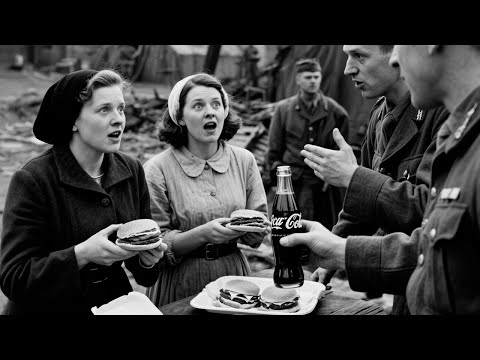
Texas, 1945. The mess hall door swung open, and twelve German women stood frozen at the threshold, staring at tables piled with food they hadn’t seen in years. Real butter. White bread. Mountains of hamburgers still warm from the grill. One woman, barely twenty, named Greta, whispered in broken English to the American sergeant, “Can we have leftovers?” He looked at her, confused, then laughed—not cruel, but surprised. “Leftovers. Ma’am, this is all for you.” She didn’t believe him. None of them did. They had been told Americans were wasteful, cruel enemies. The propaganda had prepared them for starvation. Instead, they found abundance.
The train had carried them for three days across an ocean of land. Through the small windows of the Pullman cars, the women watched America unfold—endless fields, towns untouched by bombs, children waving from farmhouse porches. Greta pressed her forehead against the glass, feeling the vibration of the rails beneath her. In Germany, every city she knew had been reduced to rubble. Here, church steeples rose intact against blue sky.
The heat hit them first when they stepped onto the platform at Fort Sam Houston. Texas heat, thick and still, wrapping around their wool uniforms like a second skin. Dust hung in the air, catching the late afternoon light. An American officer, young, maybe twenty-five, gestured them toward waiting trucks. His face showed neither hatred nor pity, just professional distance. “Welcome to Texas,” he said in careful German. “You’ll be processed. Assigned quarters, then fed.” The word hung there—simple and impossible.
Greta glanced at the woman beside her, Elsa. A nurse from Hamburg, who had worked in a field hospital until the collapse. Elsa’s eyes were hollow, her cheekbones sharp beneath pale skin. They had both lost weight during the journey across the Atlantic, crammed in the ship’s hold with hundreds of other prisoners. The Red Cross had provided basic rations, but nothing that satisfied.
The truck rumbled through gates topped with wire, past wooden guard towers where soldiers watched with rifles resting easy in their arms. No one shouted. No one struck them. The compound stretched wide—rows of barracks, a parade ground, laundry lines strung between poles. Women in similar uniforms moved between buildings, their movements slow in the heat.
“This is where we’ll die,” Elsa whispered in German. “They’re just being civilized about it.”
But Greta wasn’t sure. Something felt wrong about that assumption. The guards’ faces held no malice. The compound, though enclosed, looked clean, organized, almost… ordinary.
That first evening, they were led to the mess hall. The building was long, low, with screens on the windows to keep out insects. Inside, ceiling fans turned slowly, moving hot air in lazy circles. The smell hit them before they crossed the threshold—meat cooking, fresh bread, something sweet and unfamiliar. Coca-Cola. They would learn the name later.
Long tables stretched the length of the room, and at the far end, American soldiers in white aprons stood behind serving stations, lifting lids off steaming trays. Greta’s stomach clenched. She hadn’t smelled real food—abundant food—since before the war. In Germany, rations had dwindled to turnips and black bread, then less.
“Form a line,” the officer said in German. His accent was textbook perfect, learned from classes, not life.
They shuffled forward, uncertain. The American cooks watched them approach with expressions Greta couldn’t read. One was older, maybe forty, with thick forearms and a stained apron. He smiled when she reached the counter—a genuine thing that crinkled his eyes. “Hungry?” he asked in English.
She nodded, not trusting her voice.
He loaded her tray. A hamburger, thick and dripping juice. Green beans cooked with bacon. Mashed potatoes with butter melting into yellow pools. White bread with more butter. And at the end of the line, a young soldier handed her a cold bottle—dark glass sweating condensation. “Coca-Cola,” he said, pronouncing it slowly. “You’ll like it.”
Greta carried her tray to a table, movements careful, afraid something would shatter the illusion. Around her, the other women sat in silence, staring at their plates. Elsa sat across from her, tears running down her face, making no sound.
“It’s a trick,” someone whispered in German. “They’ll take it away.”
But no one came to take it away. The American guards stood by the doors, relaxed, talking among themselves. The cooks began cleaning their stations, scraping trays, laughing at some private joke.
Greta lifted the hamburger. The bun was soft, yielding beneath her fingers. She bit, and the taste exploded—salt, fat, char from the grill. Her body responded before her mind could catch up. Trembling with need, she ate slowly, forcing herself not to devour it, not to make herself sick.
Beside her, a woman named Anna drank the Coca-Cola and gasped. “What is this?”
“Sugar,” Elsa said, her voice thick. “It’s just… sugar and bubbles.”
They ate in silence. The only sounds: the scrape of forks on metal trays, the hiss of carbonation escaping bottles.
When Greta finished, her plate empty except for smears of grease, she looked up at the serving station. The older cook was watching them, his expression unreadable. She stood. Her legs felt weak, but she walked to the counter, pulse hammering in her throat. The cook straightened, curious.
“Can we have leftovers?” she asked in broken English, the words coming out smaller than she intended.
He frowned, not understanding at first. Then his face cleared, and he laughed—not mockery, but surprise tinged with something that might have been sadness. “Leftovers?” He glanced back at the trays, still half full. “Ma’am, this is all for you. You can eat as much as you want. That’s how it works here.”
She stared at him. Behind her, the other women had stopped eating, listening.
“Go on,” he said, gesturing. “Get whatever you want. There’s plenty more where that came from.”
Nobody moved. The impossibility of it—the sheer abundance—was too much. They had been trained to scarcity, to rationing, to stealing crusts from each other in the night. This generosity felt like a trap or a dream that would end when they woke.
But the cook just kept smiling, patient. And eventually Anna stood, walked to the counter, and held out her tray. He loaded it again, whistling some tune Greta didn’t recognize. One by one, the others followed.
That night, lying on her cot in the barracks, Greta felt something inside her shift. Not breaking—changing. The propaganda had been clear: Americans were decadent, wasteful. Their softness would be their downfall. But what she’d seen wasn’t softness. It was something else—something that scared her more than cruelty would have. They had plenty, and they were willing to share it, even with enemies.
The routine established itself over the following weeks. Wake at dawn, when light turned the barracks gold. Roll call on the parade ground—names checked against lists, then work assignments: laundry, kitchen duty, maintenance, clerical tasks. The Americans kept them busy but not brutalized. There were rules, structure, but no beatings, no starvation.
Greta was assigned to the laundry, a long building thick with steam and the smell of soap. She worked alongside American women—local civilians hired by the military, housewives and mothers earning extra money. At first, they didn’t speak. The American women eyed the German prisoners with suspicion, their movements careful, guarded. But silence erodes faster than stone.
One morning, an American woman named Betty dropped a basket of wet sheets. They spilled across the concrete floor, and she cursed—a sharp word that needed no translation. Greta moved automatically, kneeling to help gather the fabric. Betty hesitated, then joined her, and for a moment they worked together, hands moving in synchronized rhythm.
“Thank you,” Betty said when they finished.
“Bitte,” Greta replied, then corrected herself. “You’re welcome.”
Betty’s eyes widened. “You speak English?”
“A little. From school.”
“Where’d you go to school?”
“Berlin. Before the war.”
Betty nodded slowly, processing this. “My son’s over there. With the occupation forces.”
Greta didn’t know what to say. The distance between them was too vast, built from years of propaganda and blood. But they were standing in the same room, folding the same sheets, breathing the same humid air.
“I hope he’s safe,” Greta said finally.
Betty looked at her for a long moment. Then she smiled—small and sad. “Me, too.”
The compound had a library—a small room lined with donated books. Greta discovered it by accident one Sunday afternoon, wandering between buildings to escape the heat. Inside, it was cooler, quieter. Shelves held volumes in English, German, even a few in French. She ran her fingers along spines, reading titles.
“You like to read?”
She turned. An American chaplain stood in the doorway, collar marking him as clergy. He was older, maybe fifty, with gray threading his dark hair.
“Yes,” she said. “I studied literature at university. Before the war.”
He nodded, understanding the weight of those two words. “You’re welcome here, anytime. Take whatever you want.”
She selected a book—Hemingway’s The Sun Also Rises, in English. The chaplain watched her, his expression thoughtful.
“Can I ask you something?” he said.
She tensed. “Yes.”
“What did they tell you about us? About Americans?”
The question surprised her. She had expected judgment, interrogation about loyalties or politics.
“Not this,” she said carefully. “That you are greedy. Wasteful. That you cared only for money and comfort. That you had no culture, no discipline.” She looked down at the book in her hands. “Now I don’t know what to believe.”
He smiled—not triumphant, just sad. “Good. Doubt is the beginning of understanding.”
Later she would learn he had fought in the first war, had seen German trenches and German dead, had carried those memories for twenty-five years. But he bore no hatred. That confused her most of all.
Summer deepened. The heat became something alive, pressing down on the compound like a physical weight. Work continued—laundry, kitchen duty, clerical tasks that moved slower, languid in the thick air.
One afternoon in July, during a rare break, the women gathered in the shade of their barracks. An American guard approached—young, maybe nineteen, carrying a crate. He set it down with a wooden thunk.
“Figured you ladies could use something cold,” he said in careful German.
The crate held bottles of Coca-Cola, glass wet with condensation. He opened them one by one, using a metal opener hooked to his belt, and handed them out. The women accepted them hesitantly, still unused to kindness without expectation of payment.
Elsa took a long drink, then lowered the bottle. “Why are you doing this?”
The guard looked confused. “Doing what?”
“Being kind. We’re your enemies.”
He considered this, scratching his jaw. “War’s over. You’re just people now.”
Just people. The simplicity of it was revolutionary.
Greta drank her Coca-Cola slowly, letting the sweetness coat her tongue. Around her, conversations started—halting at first, then flowing faster. The guard sat down in the dirt, legs stretched out, and told them about his hometown in Kansas, about wheat fields that went on forever, about his girlfriend who wrote him letters every week.
“What will you do when you go home?” he asked Elsa.
She shook her head. “I don’t know if I have a home to go back to. Hamburg was bombed. My parents… I haven’t heard from them.”
His face fell. “I’m sorry.”
“It’s not your fault.”
But it was someone’s fault, wasn’t it? That was the terrible thing. All this destruction, all this suffering, could be traced back to decisions made in rooms far from here. And yet, sitting in the dirt drinking Coca-Cola, it felt distant, almost unreal.
That evening, writing in the journal she’d been given by the chaplain, Greta tried to capture the feeling. We are enemies who drink together. We are prisoners who laugh with our guards. Nothing makes sense anymore. And perhaps that’s the point. Perhaps the world only makes sense when we stop trying to fit it into the shapes we’ve been taught.
August brought news of the Japanese surrender. The war was over—truly, finally over. The compound erupted. Soldiers threw caps in the air, embraced each other. The German women watched from the barracks, uncertain how to react.
That night, the Americans threw a feast. Streamers, a band playing swing, mountains of hamburgers and apple pie cooling on racks. “Come on,” Eddie said, appearing at the barracks door. “You’re invited.”
“We’re prisoners,” Greta said.
“Tonight, you’re guests. Come eat.”
Someone pulled Elsa into a dance, and she laughed—for the first time since they’d arrived. A corporal led Greta onto the floor, clumsy and grinning. “Neither do I,” he admitted. “We’ll figure it out.”
Later, the chaplain sat beside her. “Good things and terrible things exist at the same time,” he said. “That’s the hardest lesson.”
“How do you live with that?”
“You choose which one to feed. Every day you wake up and choose.”
January 1946. The trucks rolled through the gates at dawn. Greta carried Betty’s cookbook, the chaplain’s cross in her pocket. At the dock, he pressed it into her palm. “Remember—doubt is the beginning of understanding.”
The ship pushed toward a ruined continent. “What do we do now?” Elsa asked.
“We rebuild. We tell the truth. We try to be the kind of people who would share their hamburgers with their enemies.”
And somewhere in the archives, a photograph survives: enemies smiling, holding Coca-Colas, all just people caught in the machinery of history. One woman asked for leftovers—and the answer changed everything.
What would you have done, standing at that threshold with your tray?
Report this article
Select a reason for reporting:






