The rain came in thin sheets that night, the kind that doesn’t soak you all at once but works its way through your collar, down your shoulders, into your spine until you feel it in your bones. On 135th Street, neon signs bled red and orange across the wet pavement, and Harlem moved the way it always moved after midnight—fast, quiet, deliberate. Like a machine that had been running so long it no longer needed anyone to watch it.
But on this night, the machine had a hole in it. Earl, a collector who had run his Tuesday route for four years without incident, had vanished. His route was found completed—five of six stops picked up—but the sixth envelope sat untouched behind a dryer in a laundromat on 131st. No body. No witness. No note. Just a man-sized absence in a system that didn’t tolerate holes. Across the East River, in a waterfront office above a Brooklyn shipping yard that smelled of salt water and diesel and old money, Vincent Mangano had been watching Harlem’s gambling operation for six months. He controlled the docks, the unions, the judges. What he didn’t control was Harlem—a $200,000-a-week enterprise that ran without his tribute. To Mangano, that wasn’t a business arrangement. It was an insult that had aged too long.
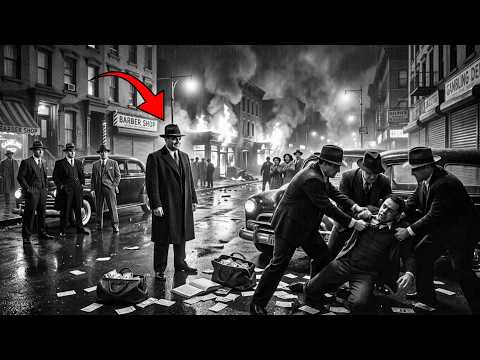
Mangano sent Michael Miranda uptown first—not as muscle, but as an accountant reading a balance sheet. Miranda spent three weeks counting locations, mapping routes, identifying weak operators. He came back with a single assessment: the operation was worth taking. The man running it was the only real obstacle. And that man could be managed. The man was Ellsworth “Bumpy” Johnson, who had controlled Harlem’s street economy since the early 1930s, surviving a war with Dutch Schultz that left better men in the ground. Bumpy wasn’t large or loud. He dressed well, spoke precisely, and read more books than most men who’d been to college. But he had a reputation for violence that was specific rather than general—he hurt the right people at the right moment in ways that sent a message so clear it rarely needed repeating.
Mangano’s first message to Bumpy wasn’t a letter, a meeting request, or even a phone call. It was Earl’s disappearance. A collector pulled off a route he’d run a thousand times. No explanation. No demand. Just the silence where a man used to be. And the knowledge that someone had reached into Harlem’s body and removed a piece without asking.
Bumpy heard about Earl before midnight. He was in his usual chair at a club on 133rd when the word came in, delivered by a teenager who spoke in a low voice and left without being told to. Bumpy set down his bourbon. He didn’t stand up. He didn’t make a call. He sat for another twenty minutes, finished his drink, and left. He already knew who had sent the message. What he wanted to know was what they thought it would make him do.
The old men of Harlem who lived through that winter would later piece together what happened from fragments—a detail here, a name there. The kind of history that gets carried in memory rather than written in files, which means some of it hardened into fact and some stayed permanently in the space between what was witnessed and what was assumed. Because in that world, the men who survived longest were never the ones who reacted fastest. They were the ones who understood that a provocation is also a question, and how you answer it tells your enemy exactly how much you know.
Bumpy wasn’t ready to answer yet. He was still reading the room. Real power didn’t come the night you took a street. It came when the street feared losing its rhythm the moment you pulled your hand away from it.
In the back room of the Blue Moon on 125th, Bumpy sat with a ledger open, a pen in his hand, and the expression of a man doing arithmetic that had nothing to do with numbers. He had been awake for thirty-one hours. Since Earl’s disappearance, he had quietly restructured every collection route in Upper Harlem—new times, new faces, staggered pick-up windows. He had pulled three runners off their regular beats and rotated them to locations they’d never worked before. He had told no one the full picture. Each man knew only his own revised instructions, delivered in person, never written down. This was not panic. This was maintenance.
Bumpy ran Harlem’s gambling economy the way a surgeon understands a body—not just the organs, but the connections between them. He knew which numbers banker on 118th was three weeks behind on his rent and therefore vulnerable. He knew which runner on 8th Avenue had a brother with gambling debts downtown. He knew which precinct captain had recently been passed over for promotion and was newly interested in supplemental income. Harlem was not a territory. It was a living system. And living systems don’t stay healthy through force alone. They stay healthy through constant invisible maintenance—the kind of work nobody sees until the day it stops.
Madam Stephanie Saint Clair had understood this before anyone. She had built the original policy network through relationships, not fear—through being the woman who paid your hospital bill when you couldn’t, who loaned money to the church when the heat got cut off in February. By the time Bumpy inherited the operation, Saint Clair’s method had become the skeleton underneath everything. He had added muscle and sharper edges, but the bone structure was hers.
He went to see her once during the second week of November, driving to her apartment on Edgecombe Avenue in the early afternoon. She was seventy-one years old and had been out of active operation for years, but her mind was a filing cabinet that had never lost a document.
“Mangano,” she said before he had finished explaining. She was seated near the window, a cup of tea going cold beside her. “I wondered when Brooklyn would stop being satisfied with the waterfront.”
“He’s not asking for partnership,” Bumpy said.
“No,” she agreed. “Men like that don’t ask. They position. Then they ask for surrender and call it a negotiation.”
Nobody recorded what else was said in that room. What came out of it lived only in the decisions Bumpy made in the days that followed. Back in his operation, he began the work of finding the leak. Because there was one. He was certain of it before he had any evidence—the way a man who knows his own house can sense a door that was opened while he slept. Earl’s disappearance wasn’t the work of an outside crew making a random grab. It was too clean, too targeted. Someone inside the network had given Mangano’s people the timing, the location, the window.
Bumpy’s method was systematic and cold. He created four separate pieces of false information—small operational details that would only matter to someone feeding intelligence to an outside party—and assigned each one to a different layer of his network. One to his collection supervisors, one to his banking operators, one to the intermediaries who managed the police relationships, one to his inner circle. Then he waited to see which false detail showed up in Mangano’s behavior.
It took nine days.
On the evening of November 18th, Mangano’s crew hit a collection on 126th Street—a location and time window that matched the false information Bumpy had given exclusively to his banking operators. The hit was precise, fast, and targeted with a surgical accuracy that left no room for coincidence. The leak was inside the money management layer. Someone who sat in rooms, saw the books, understood the cash flow. Not a runner. Not a collector. Someone with a chair at the table.
Bumpy closed the ledger in front of him and sat in the yellow light for a long moment. The enemy outside the door was manageable. The enemy who had memorized the layout of your rooms—that was the problem that could kill you quietly from the inside before you ever heard a sound. He didn’t move that night. He didn’t make accusations. He simply began narrowing the room quietly, restructuring information channels, watching who adjusted their behavior in the days that followed, noting who asked questions they had no reason to ask.
The man who had sold him was still sitting at the same table, still passing the bread, still meeting his eyes without flinching. Bumpy let that continue for now. Knowing was enough. A boss doesn’t fear the man standing across the street. He fears the one smiling in the same room.
The message arrived on a Thursday evening through a man named Caruso, a Brooklyn figure who ran a wholesale tobacco business on the Upper West Side and occasionally served as a bridge between organizations that preferred to keep their conversations off paper. Caruso asked for a sit-down. Bumpy agreed. They took a booth at the back of a diner on Amsterdam Avenue, ordered coffee neither of them touched, and Caruso delivered the terms in the flat, careful tone of a man reciting something he’d been told to memorize exactly as given.
The proposal was framed as a business arrangement. Brooklyn would provide expanded protection—its enforcement capacity, its reach into city offices above what Harlem’s existing police arrangements could access. In return, 30% of net weekly revenue from all numbers and policy operations in Upper Manhattan would route to Brooklyn on a monthly basis. Caruso used the word partnership four times in under three minutes.
Bumpy let him finish. Then he asked one question. What happens if the answer is no?
Caruso looked at the table. “Mr. Mangano believes an agreement would be beneficial to both parties. He hopes the question won’t be necessary.” Which was the answer.
What Mangano was actually proposing had nothing to do with partnership. A partner brings something to the table. What Mangano was bringing was the threat of what his organization could do to Harlem’s business if Bumpy refused—the street hits, the selective arrests through compromised precincts, the sustained pressure on individual operators who didn’t have the infrastructure to absorb it. He was offering to stop doing those things in exchange for thirty cents of every dollar Bumpy’s network produced. It was dressed in business language, a gun held below the table.
Bumpy told Caruso he would think about it. Caruso left quickly, visibly relieved to be outside.
In the days that followed, Bumpy did something that unsettled even the people closest to him. He let three small collection routes go dark. Not by announcement—he simply allowed the operational support around them to thin. Fewer runners, slower pickup windows, less visible presence on those particular blocks. Within a week, Mangano’s crew had moved on two of the three, disrupting collections and skimming from operators who found themselves suddenly without backup.
The operators came to Bumpy angry and frightened. He listened to each of them carefully, said very little, and watched everything. What he was tracking was not the money. He was watching who held their nerve and who started calculating exits. Who came to him first and who made other calls before they called him. Who used the disruption as cover to quietly test what a different arrangement might feel like. A crisis, he had learned, is the only instrument that tells you the truth about the people around you faster and more accurately than any amount of time spent in the same room under normal conditions.
The intelligence he gathered in those ten days was worth more than the revenue lost on those three routes, but it carried a cost he had not fully priced in advance. By the third week of November, word was moving through Harlem’s operator community that Bumpy wasn’t responding, that he was absorbing hits without hitting back. Two operators on the West Side had quietly made inquiries—not commitments, just inquiries—about what a Brooklyn-aligned structure might mean for their piece of the business. One banker on 119th had started making Bumpy’s collectors wait for a callback instead of picking up the first time. Small signals, but in a system built entirely on confidence, small signals travel fast and land hard.
The same patience that was his sharpest weapon was being read by the people who needed to believe in him most as the first sign of a man who had run out of moves. Whether Bumpy anticipated exactly how quickly that perception would spread—that part of the story depends on who you ask. And the people who were in those rooms have never fully agreed.
Caruso came back ten days later asking for an answer. Bumpy sent word that he needed more time. What he actually needed was one more week—because the men who lasted in that world understood something the impatient ones never grasped in time. Silence is not surrender. It is the distance between where you are standing now and where you intend to strike.
Mangano had sent his ultimatum softly wrapped in the language of business and mutual benefit because he expected Bumpy to weigh the math and make the practical choice. He had mistaken composure for calculation. He had mistaken patience for the early stages of giving in. He had badly miscalculated the man he was dealing with.
The rain had stopped, but the streets were still wet, and the yellow light from the lamp posts laid itself flat across the pavement like something spilled and never cleaned up. It was past two in the morning when a nineteen-year-old runner named Danny showed up at the side door of the Blue Moon with a cut above his left eye and his jacket torn at the shoulder. Two of Mangano’s men had held him in the back of a car for forty minutes, asked questions he didn’t answer, then let him walk.
They hadn’t touched his envelope. They had only asked one thing, four different ways: who set the pickup schedule for his route, and when did it change? Bumpy listened without interrupting, then told Danny to get his eye looked at and say nothing to anyone. He was smart enough not to ask why they’d let him walk. The answer wasn’t reassuring—they let him go because they already had what they needed. Someone had told them the schedule had changed. They were using Danny to verify it.
Bumpy sat with that for a long moment. Then he did something that shook his people more than gunfire ever did. He let it happen again. On the night of November 22nd, a West Side route was hit hard—two runners stopped, envelopes taken, one shoved against a wall hard enough to crack two ribs. Eleven thousand dollars gone in under four minutes, built on precise foreknowledge of exactly where those men would be.
When they brought him the report, they expected rage. They got silence. What almost nobody knew was that Bumpy had seeded that route with false scheduling information given to exactly one man three days earlier—Curtis, who had worked his money management for six years, who had a wife and two daughters in the Bronx, and who had apparently decided Brooklyn’s future looked more stable than Bumpy’s. The hit told Bumpy everything. Curtis was the door Mangano had bought.
Across town, Michael Miranda was drawing the same conclusion in reverse. His source had delivered again. The Harlem operation was destabilizing. He reported back to Mangano with the controlled satisfaction of a man watching a long investment begin to pay out. He was reading the situation with perfect accuracy and arriving at completely the wrong conclusion. What Miranda was witnessing was not a system in collapse. It was a diagnostic running at full speed.
Every hit that landed, every route that went dark, every operator who flinched—all of it was data. Bumpy was using Mangano’s aggression as an instrument to x-ray his own network, to find every fracture, every man whose loyalty had a price attached. The cost was real. Eleven thousand on the 22nd alone. Operators who were scared. A young man with cracked ribs who had done nothing wrong.
And then there was the harder cost, the one that lived in the looks Bumpy started getting from the men who had been with him longest. A collector named Robert came to him on the morning of November 24th and stood in the doorway before speaking. “People are saying you knew,” Robert said, “about the 22nd. That you knew it was coming and you let it go anyway.”
Bumpy looked at him across the table. “What are people saying about why?”
Robert was quiet for a moment. “Some say you’re testing us. Some say you’re protecting something bigger. Some say you’ve already made a deal and you’re letting the small operators take the hit so Brooklyn comes in clean.”
Bumpy didn’t answer immediately. He let the silence sit in the room, heavy and deliberate. “Which do you believe?”
Robert met his eyes without flinching. “I believe you don’t do anything without a reason. But I also believe the men on those routes have families. And right now they don’t know if their king is playing chess with their livelihoods or standing between them and what’s coming.”
It was the most honest thing anyone had said to Bumpy in weeks. He nodded slowly, and Robert left without being dismissed. What everyone close to Bumpy during those weeks agreed on is simpler. He absorbed the accusation without denying it, which told the people watching him everything they needed to know about how far he was willing to go.
Curtis was still coming to work every morning, still counting money, still meeting Bumpy’s eyes without flinching. Bumpy let that continue. The highest form of power was not saving every piece on the board. It was knowing which pieces had to fall so the board itself stayed yours.
The cold came in hard the last week of November, settling into the brick and leaking through walls and window frames of the numbers banks and card rooms that kept Harlem’s economy running through the night. On the morning of November 25th, Bumpy called Curtis in early, before the daily count started, while the back room still held the cold from overnight. Curtis came in with his coat still on, breath visible in the air, and sat across the table where he had counted money six days a week for six years.
Bumpy laid a single sheet of paper between them—a copy of the false scheduling document he had given Curtis, and only Curtis, three days before the hit. Curtis looked at it for a long time, then looked up.
“I want to know one thing,” Bumpy said. “Not who paid you, not how long. One thing. What did they tell you Harlem would look like when this was finished?”
Curtis’s jaw tightened. He understood the question was not a negotiation. It was an autopsy. After a long silence, he spoke. “They said the operation stays intact. Same people, same roots, same money. Just different management. Brooklyn oversight. Monthly settlement. Everyone keeps their position.”
Bumpy nodded slowly. “They told you it was a reorganization. Not a takeover.”
“That’s what they said.”
“And you believed them.”
Curtis didn’t answer, which was its own answer. What Curtis had been sold was a story about continuity—the transition would be clean, the existing operators preserved, the only thing changing was who sat at the top. It was a logical pitch for a man who wanted to protect his own position while hedging against what looked like a weakening boss. It was also completely false.
Bumpy had understood Mangano’s actual intention for weeks before Curtis confirmed it. The thirty-percent proposal was never a permanent arrangement. It was an entry point, a way to establish a financial relationship that could be tightened incrementally until the dependency was complete. Once Brooklyn controlled the settlement process, it controlled the cash flow. Once it controlled the cash flow, it controlled the operators. Once it controlled the operators, the man at the top of the Harlem operation became irrelevant, regardless of his title. Mangano didn’t want a partnership. He wanted to swap the engine while leaving the body of the car intact—so Harlem’s operators would keep running a machine that now fed Brooklyn instead of themselves. And erase Bumpy Johnson so completely from street memory that within two years the name would mean nothing above 110th Street.
That same week, Bumpy moved quietly through his network of loyal operators, delivering a message in person, one at a time. In back rooms, in car interiors, in a church basement on 127th that a pastor he trusted made available without asking questions. The message was simple. Stand still. Don’t negotiate with Brooklyn’s intermediaries. Don’t accept meetings with unfamiliar names. Don’t move money outside established channels. Anyone who holds their position through the next ten days will still have a position when it’s over.
He gave the same speech eleven times in four days. He shook eleven hands. He looked eleven men in the eye and told them the truth as plainly as he knew how. Ten of them held. The eleventh, a policy banker who ran three locations on the East Side, took a meeting with one of Miranda’s intermediaries on the evening of November 27th. The meeting lasted forty minutes. The banker walked out with an envelope and a handshake and the belief he had secured his future. He was gone two days later. His three locations went quiet overnight, then reopened under new management within the week without public explanation. The people who worked those spots didn’t ask questions. In that world, at that moment, asking questions about a man who had just disappeared was a way of announcing that you were thinking about making the same choice he had.
The records from that period, such as they are, don’t account for him. That gap is its own kind of testimony. The lesson moved through Harlem’s operator community faster than any announcement could have. Standing still was survival. Moving toward Brooklyn was the last decision a man made before he stopped appearing at his usual places. Money buys silence for one night. Only trust—the kind built over years, tested under pressure and held—buys an entire winter.
The city never fully slept, but Harlem in the first week of December 1943 breathed differently. Quieter in the wrong ways. Tighter. Like a chest that had been holding air too long and hadn’t decided whether to exhale or collapse. The numbers banks opened before dawn the way they always did. The runners made their rounds. The money moved. But underneath the surface rhythm something had shifted, and the people who knew how to read streets could feel it without being able to name it.
Bumpy had spent the previous two weeks dismantling Mangano’s financial infrastructure inside Harlem from the ground up without firing a single shot. The mechanism was simple in concept and brutal in execution. Mangano’s Harlem campaign was not self-funding. It required a continuous flow of capital from Brooklyn to pay intermediaries, maintain bought police relationships, compensate operators who had flipped, and keep enforcement muscle on retainer. That capital moved through a chain of informal credit arrangements handled by a small number of financial middlemen who operated between the legitimate and illegitimate economies with enough sophistication to keep transactions invisible.
Bumpy identified three of those middlemen through a contact he had maintained for years—a man whose name has never surfaced in any public record connected to these events, which is precisely why he was useful. He didn’t move against the three middlemen directly. He moved against their credit through a series of carefully timed interventions. Payments called in early. Lines of credit quietly closed. A precise word in the right ear about a discrepancy in one man’s accounts that may or may not have been real. He created a liquidity problem inside Mangano’s Harlem operation that looked, from the inside, exactly like internal theft.
This was the most precise instrument Bumpy deployed in the entire campaign. He didn’t need to prove anyone was stealing. He only needed Mangano’s people to believe it was possible. In an operation built on cash, running in secrecy, with multiple layers of intermediaries who all had independent access to money, the suggestion of theft is nearly impossible to disprove. Everyone becomes a suspect. Everyone begins watching everyone else. The paranoia does the work that no enforcer could do without leaving a body.
Within five days, two of Mangano’s Harlem intermediaries had accused each other of skimming. One had gone back to Brooklyn with a formal complaint. Miranda spent two days conducting an internal audit of an operation he believed he controlled, found nothing definitive—which made the suspicion worse rather than better. The operation was eating itself. And it hadn’t required a single overt move from Bumpy to make it happen.
But the mechanism had a dangerous edge. Paranoia doesn’t respect boundaries once it starts moving. By the second week of December, the suspicion seeded inside Mangano’s network had begun bleeding into Bumpy’s own operation. Operators who had heard about the internal accusations inside Brooklyn’s camp started wondering if similar dynamics were running closer to home. Two collectors got into a confrontation on 129th Street over an account discrepancy that under normal circumstances would have been resolved in ten minutes. It didn’t become physical, but it came close enough that people on the block noticed. And in that climate, noticing was its own kind of problem.
One wrong move, one trigger pulled by a man scared enough, armed enough, and far enough past clear thinking, and the invisible war Bumpy had been running would become a visible one. The moment it became visible, it became a different problem entirely. Other families would take notice. The commission would form an opinion. A conflict Bumpy was winning quietly could become one that buried everyone loudly. He understood this with complete clarity. It was the tightest line he had walked in years.
On the night of December 8th, he called a meeting in the private back room of a jazz club on 133rd, whose owner had been a trusted ally for a decade—a man who understood that the most valuable thing he could provide was a room where what got said stayed said. Three men came. His most senior operational figures. The ones who had been with him through every crisis since the Dutch Schultz years. He laid out the full picture for them, start to finish. For the first time, everything he had done, everything he had learned, and everything that was about to happen next.
He told them about the false information channels and what they had revealed. He told them about Curtis. He told them about the financial pressure on Mangano’s intermediaries and what it was producing inside Brooklyn’s camp. He told them how close the situation was to the edge of becoming something none of them could control. Then he told them what came next.
The men in that room spoke about it afterward in pieces, over years, in different contexts. The details don’t always match. But the one thing every account agrees on is the silence at the end. The specific quality of stillness that settles over men who understand they are sitting at the center of something larger than the room they’re in. Some empires don’t fall from bullets. They fall from the morning they wake up and can no longer tell who is stealing from whom. Mangano’s operation in Harlem was approaching that morning faster than he knew. And in the back room of a jazz club on 133rd Street, Bumpy Johnson was already three moves ahead of it.
The sky pressed down low that night, heavy and colorless—the kind of December sky that makes the city feel smaller than it is. From the basement clubs on Lenox Avenue, jazz leaked up through the sidewalk grates, slow and mournful, the kind of music that sounds like a eulogy for men who haven’t figured out yet that they’re already finished. Mangano sent four men uptown on the night of December 10th. Not enforcers in the crude sense. These were operators. Men who knew how to move through a neighborhood and apply pressure through presence rather than violence. Their job was to visit six specific locations, to warn ears who had been wavering. One numbers banker whose loyalty Mangano believed he had purchased. One rooming house operator who controlled a block of housing that Mangano’s people used when they needed to stay in Harlem overnight. And two runners who had been identified as potential recruits.
The visits were meant to consolidate. To walk through a door. Sit down. Remind the person on the other side of the table that Brooklyn was real and present and not going anywhere. The first stop was a bar on 128th Street. The owner, a man named Wallace who had run the place for eleven years, was behind the counter when Mangano’s man walked in at 9:15. The bar had six customers. Wallace looked at the man who walked in, then looked back down at the glass he was polishing, and said he was closed for a private event. The bar was clearly not closed. There were six people drinking at the counter. Mangano’s man stood at the door for a moment, then left.
The second stop was the rooming house on 131st. The woman who ran it, a Mrs. Tate, who had operated the building for twenty years and who knew every person of consequence in a twelve-block radius, answered the door. Listened to thirty seconds of explanation. Said she had no vacancies. Closed the door before the sentence was finished.
By the third stop, Mangano’s men understood something was wrong. The numbers banker on 127th—the one whose loyalty had been purchased with an envelope three weeks earlier—wasn’t at his location. His second-in-command was there. A young man who said the banker was out of town for a family matter and couldn’t be reached. He said it with the flat, rehearsed delivery of someone who had been told exactly what to say and had practiced it enough times that the nervousness was almost invisible. Almost.
What Mangano’s men were walking into was not a neighborhood in the process of changing hands. It was a neighborhood that had been methodically sealed. In the two weeks since the jazz club meeting on December 8th, Bumpy had worked through every layer of Harlem’s social infrastructure—the bar owners, the rooming house operators, the church deacons who knew which men were reliable and which ones were for sale, the precinct-level officers whose cooperation had been maintained through years of careful relationship management. The message delivered to each of them was not dramatic. It didn’t need to be. Brooklyn men come to your door. You don’t know them. You don’t have room. You don’t have what they need. You didn’t see anything. You’re closed.
By ten o’clock that night, Mangano’s four men had been turned away from five of their six stops. The sixth—one of the runners they’d meant to recruit—had simply not been where he was supposed to be. His usual corner was empty. The people on the block, when asked if they’d seen him, looked through the questioners like they were made of glass. Harlem had closed itself around these men like water closing over a stone.
One of the four, a Brooklyn operator named Sal who had worked neighborhoods in Red Hook and Brownsville and believed he understood how streets worked, later described the night to a colleague in terms that got repeated enough times that the account, in various forms, has survived. He said it wasn’t hostility that got to him. It was the absence of it. Nobody threatened them. Nobody raised a voice. The street just looked straight through them—the way a city looks through people it has collectively decided do not exist.
Sal and his three colleagues regrouped at a diner on the edge of Harlem’s boundary at eleven o’clock that night and made the call back to Brooklyn. Miranda took the report in silence. Then he asked one question: had anyone been threatened or confronted? No, Sal said. That was the problem. Nobody did anything. Nobody said anything. It was like the whole neighborhood had agreed without a meeting, without a signal, to simply not acknowledge that they existed.
Miranda understood immediately what had happened and said nothing about it on the call. Because a neighborhood that refuses to see you is more dangerous than one that fights you. Fighting means engagement. Fighting means there’s still a negotiation happening, still a price being discussed. Refusal means the decision has already been made and the price has already been paid and nobody uptown is interested in reopening the conversation. Bumpy had not locked Mangano out of Harlem with guns. He had locked him out with thirty years of relationships, obligations, trust earned in increments so small that no single one of them was worth noting until the moment you needed all of them at once.
But Bumpy understood what the sealed door would do to a man like Mangano. A man who had controlled waterfront operations, union bosses, city officials—a man whose authority had never been refused to his face—would not absorb this quietly. Humiliation in this world does not produce retreat. It produces escalation. A man who is hungry calculates. A man who is humiliated reaches for whatever is closest to his hand. The next move from Brooklyn would not be four operators making polite visits.
Harlem that night was quieter than the people who lived there had heard it in months. The kind of quiet that doesn’t feel like peace. It feels like the moment between the lightning and the sound that follows it, when you already know what’s coming and you’re just waiting to feel the ground shake. A city only truly belongs to you when the enemy walks into it and realizes nothing there will answer him.
The room smelled like cigar smoke, coffee gone cold, and the specific tension of men who are being careful with every word because they understand that the wrong one will be remembered. It was the third week of December. Outside, Harlem was cold and quiet in the way it had been since the night Mangano’s men had walked through it like ghosts nobody acknowledged. Inside this room, the war was moving to its final terrain.
Bumpy had not come to this meeting alone. The intermediary who arranged it was a figure who operated in the space between Harlem’s independent structure and the larger Italian organizational world—a man with relationships on both sides of that line who had, over many years, made himself useful precisely by being trusted by people who trusted almost nobody. His name is not important here. What matters is that he had access to two men who sat above Mangano in the informal hierarchy of organized crime on the East Coast, and that he had agreed, after a series of conversations whose content has never been fully reconstructed, to facilitate a private meeting.
The two men who came were not from Mangano’s family. They were from the layer above it—figures whose primary concern was never ideology or territory or personal pride. Their concern was arithmetic. Money flowing. Operations running. The minimum amount of disruption necessary to keep both. Mangano came with Miranda. He sat across from Bumpy with the rigid posture of a man who has decided in advance that he will not be the one to blink first, and who is using every ounce of his discipline to maintain that decision.
Bumpy opened a leather folder and placed three documents on the table. The first was a revenue summary—six weeks of Harlem’s numbers operation showing weekly intake before Mangano’s campaign began and weekly intake during it. The numbers told a story that required no interpretation. The disruption had cost Harlem’s operation approximately nineteen percent of its weekly revenue over the six-week period. Not because Bumpy’s network had collapsed, but because the uncertainty generated by the conflict had made operators cautious, slowed collection cycles, and pushed some cash transactions off the books entirely as a protective measure. Nineteen percent of a two-hundred-thousand-dollar-a-week operation was not a small number. Multiplied over six weeks, it represented money that had not flowed, had not settled, had not moved through the informal credit networks that kept dozens of legitimate-facing businesses in Harlem solvent.
The second document was a cost summary for Mangano’s side. Bumpy laid it on the table without explanation. It showed the approximate expenditures of the Brooklyn campaign—the payments to intermediaries, the compensation to flipped operators, the enforcement costs, the police relationships purchased at the precinct level. Bumpy did not explain how he had obtained the figures. He didn’t need to. The fact that he had them was the explanation.
The third document was a single page with two columns of numbers. On the left, projected revenue from a stable Harlem operation over the following twelve months. On the right, projected revenue from a Harlem operation that continued under active contest for the same period. The difference between the two columns was just over one million dollars. One of the two men from above Mangano’s level picked up the third page, looked at it for a long moment, and set it back down without speaking. Mangano’s face did not change, but something behind his eyes did.
“The operation runs because it’s trusted,” Bumpy said. “The operators run because they trust the structure. The moment the structure becomes a question, the money becomes a question. You can’t extract revenue from a system you’ve spent six weeks teaching people to distrust.”
He paused. “I’m not asking for recognition. I’m not asking for a seat at any table outside this room. I’m telling you what the numbers already say—that what you started up here has cost everyone in this room money. And that the only way to stop it from costing more is to let Harlem run the way it runs.”
Miranda started to speak. One of the two senior men raised a hand, and Miranda stopped. The room was quiet for a long moment. The specific silence of men recalculating. What Bumpy had walked in with was not a threat and not a plea. It was a business case. And the men sitting across from him were, above everything else, businessmen. They had not built their organizations through sentiment. They had built them through the disciplined application of a single question: does this make money or does it cost money? Mangano’s Harlem campaign, by every metric on the table, was costing money. It had been costing money since the third week. And the man who had been absorbing the campaign had just demonstrated, by producing documents that should have been impossible for him to possess, that he understood the operation from the inside out.
The bitter truth Bumpy had accepted before walking into the room was this: he would not leave with public acknowledgement. He would not leave with a formal agreement that bore his name. In the world these men operated in, a black independent operator from Harlem did not get that kind of recognition from the structure above him, regardless of what he had demonstrated. What he could leave with—what he did leave with—was the result, the outcome, without the credit. In the underworld, justice rarely belongs to the man who is right. It belongs to the man who proves he is more profitable than the chaos surrounding him.
No minutes were taken in that room. No record was made of who said what or in what order or how the conversation ended. That absence is deliberate, and it is its own form of documentation.
The pale light of a December dawn came in slow across the rooftops of Harlem, thin and colorless, spreading over streets that had just endured six weeks of a war so carefully constructed that most of the people who lived on those streets had felt it without ever being able to point to it directly. No bodies in the road. No burned storefronts. No public confrontations that made the papers. Just the slow grinding pressure of a system under attack, and then the gradual, almost imperceptible easing of that pressure as the attack withdrew.
Mangano’s people began pulling back from uptown in the final days of December. It did not happen all at once, and it was not announced. It happened the way a tide goes out—incrementally, quietly, each individual withdrawal small enough to be explained away as routine. The full picture only visible when you stepped back and looked at the whole shoreline. The intermediaries who had been facilitating Brooklyn’s financial operations in Harlem stopped making contact. The flipped operators who had taken Brooklyn’s money found that the support structure around them had dissolved—no backup, no communication, no one answering when they reached out to the contacts they had been given.
Curtis, the man who had been Mangano’s door into Bumpy’s operation, was the first to fully understand what had happened. He had been kept in a kind of operational limbo for weeks—still present, still technically employed, but systematically written out of any information that mattered. By late December, he was counting money that he had no context for, moving figures through books that no longer connected to the real operation. He was performing the function of an accountant in a building whose wiring had been completely rerouted around him. He resigned in the first week of January 1944. Bumpy accepted the resignation without comment and did not replace him immediately. The message was clear enough without being stated. The position Curtis had held no longer existed in the form it had taken. The architecture had changed.
Mangano returned to Brooklyn having spent six weeks and a significant sum of money attempting to take control of an operation that had closed around his campaign like a fist and simply waited for him to exhaust himself. He had lost the money spent on intermediaries and enforcement. He had lost the intelligence network Curtis had provided. He had lost two of his Harlem side operators permanently—one to Bumpy’s operation, one to the kind of disappearance that stops a man’s name from being spoken aloud. He had lost the confidence of the two senior figures who had sat in that room and looked at his campaign’s financials and made the calculation they made. Most importantly, he had lost the narrative in the world he operated in. The story of what had happened would travel carefully in pieces through the informal channels where such stories always traveled, and the story was not flattering. A major Brooklyn boss had moved on an independent Harlem operator, spent six weeks applying everything in his toolkit, and come away with nothing. The operator was still standing. The operation was still running. The boss had been walked to a table and shown his own numbers and sent home.
The traders who had survived watched this conclusion from whatever positions they had managed to salvage. Some of them were still in Harlem working reduced roles, grateful to be working at all. They had lived to see the price of the choice they had made—not a dramatic price, not a violent one in most cases, but a permanent one. They worked now at the edge of the thing instead of the center of it. They were present but not trusted. Employed but not included. That condition, Bumpy understood, was its own kind of punishment, more durable than anything faster and louder would have produced.
By the second week of January, Harlem’s numbers operation was running at full capacity again. The weekly intake had recovered to pre-conflict levels within ten days of the pressure lifting. The operators who had held through the crisis found, as promised, that their positions were intact. A few of them found their positions slightly improved—routes consolidated, competition reduced by the exits and disappearances the conflict had produced.
Bumpy moved through the weeks of 1944 with the particular quietness of a man who has just finished something difficult and is not interested in discussing it. He didn’t celebrate. He didn’t make speeches. He sat in the same chair at the Blue Moon. Ordered the same bourbon. Read the same books. But the streets knew. The streets always know. Even when nothing is said out loud. The knowledge moved through Harlem the way all important knowledge moves through a place like that—in half sentences and meaningful silences and the way people conducted themselves when Bumpy walked into a room. The posture of acknowledgement that doesn’t need to be performed because it’s already been established at a level below language.
His name was larger now than it had been in November. And a larger name in that world was never simply an asset. It was also a new kind of target—a flag planted in ground that other men with other ambitions would look at and begin to calculate. Bumpy understood this without needing it explained. He had always understood it. The game he was playing had no final level. Winning one iteration of it simply meant the next iteration began under higher stakes, with more serious opponents, and with less margin for the kind of patience that had just saved him.
The real history of those streets was always partly shadow—the part that lived in memory rather than record, that got passed down in the form of what people chose to emphasize and what they chose to leave out. Which means that some of what happened in those six weeks hardened into fact and some of it became something else: the kind of story a neighborhood tells about itself to explain why certain men are spoken of the way they are.
The worst defeat, in the end, is not losing money. It is not losing men. It is being forced to live on afterward knowing that you were read completely, from the first move to the last, by the man you came to bury. Mangano had walked into Harlem believing he understood what he was dealing with. He left knowing he had never understood it at all.
Harlem went back to its rhythm—dice rolling in basement rooms, numbers books open before dawn, jazz covering the sound of money changing hands in the dark. But it wasn’t the same order as before. It was Bumpy’s order, rebuilt from the inside out, tested under fire, and held by the one thing no outside power could purchase or replicate: the trust of every man who had stood still when standing still was the hardest thing to do. Mangano went back to Brooklyn understanding something he hadn’t known in November. There are places that cannot be taken from the outside. They can only be lost from within. And Bumpy Johnson understood something colder—that keeping a kingdom sometimes means letting your own people see the darkest part of how it’s kept.
If you stayed with this story all the way to this street corner, thank you. The files on men like Bumpy don’t close cleanly, and there are more names in those old Harlem ledgers that have never been read aloud. If that’s the kind of history you want to keep walking into, stay close. Now tell me this—if you had been one of Bumpy’s operators that winter, would you have held the line or looked for a way out? And do you think a man like Bumpy could exist today, or did that world die with the streets that made him? Leave your answer below. I read every one.
Report this article
Select a reason for reporting:






