In April 1943, high over occupied Belgium, Captain Werner Schroer of the German Fighter Wing 26 stared at the approaching American formation and could barely believe his eyes. He keyed his radio, disbelief thick in his voice: “The Americans are flying barrels.” Compared to the sleek Bf 109s and powerful Fw 190s, the Republic P-47 Thunderbolts looked absurd—massive round engines, thick fuselages, stubby wings. They seemed more like flying cargo containers than combat aircraft. German pilots, veterans of years of aerial slaughter, laughed. What threat could these bulky monsters possibly pose?
They were about to find out.
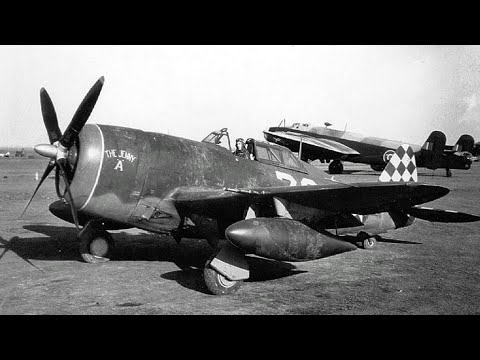
Beneath that awkward shape lay a machine built for one purpose: to absorb punishment and dish out annihilation. Weighing nearly 10,000 pounds empty and powered by a 2,000-horsepower Pratt & Whitney R-2800 radial engine, the P-47 could climb to altitudes where German engines gasped. It couldn’t out-turn a Focke-Wulf, but it didn’t need to. It had something else—something the Luftwaffe had never faced.
Eight .50 caliber Browning machine guns, each loaded with 425 rounds. When all eight fired together, they spat 100 bullets per second into a lethal zone just six feet wide. American engineers had tuned the convergence so every round met at 300 yards—a wall of lead no aircraft could survive. As ace Francis Gabreski later said: “When the P-47’s guns hit a target, the enemy didn’t just fall, they disintegrated.”
On June 26, 1943, Lieutenant Robert Johnson learned just how tough the Thunderbolt was—and how dark the war was about to become. His formation was ambushed by Fw 190s. Cannon shells exploded through his cockpit, shredding the canopy, destroying his instruments, filling the air with smoke and burning oil. A machine gun round nicked his nose, destroying his oxygen mask. The P-47 spun out of control. Johnson tried to bail out, but the canopy was jammed. He was trapped.
Then the fire went out on its own. Half-blind, gasping for air, he regained control and turned for England. But a blue and yellow Fw 190 appeared behind him—flown by Lieutenant Colonel Egon Mayer, one of the Luftwaffe’s most skilled aces. Mayer closed in and fired at point-blank range. Cannon shells and machine gun rounds tore through the Thunderbolt. Somehow, impossibly, it stayed airborne.
Mayer pulled alongside, examined the shattered plane up and down, and shook his head in mystification. How was this thing still flying? He fired again. And again. Each time, the P-47 absorbed the punishment and kept going. Out of ammunition, Mayer rocked his wings in salute and turned back. Johnson limped home to RAF Manston, where he had to be pried from the cockpit, covered in shrapnel wounds and burns. He gave up counting bullet holes after 200—without even walking around the entire plane. The Thunderbolt had taken 21 cannon hits and over 200 machine gun rounds. No German fighter could have survived that.
Word of Johnson’s ordeal rippled through German squadrons. The Americans had built something different. Something terrifying. And this was only the beginning of why the Luftwaffe would come to hate—and fear—the P-47.
The first reason was simple: the Thunderbolt was everywhere. By 1945, American factories had rolled out 15,783 of them, making the P-47 the most produced American fighter of the war. American industry had turned overwhelming firepower into standard doctrine, and it seemed that anything with wings on the battlefield had at least one heavily armed fighter attached to it. The Americans never suffered the ammunition shortages that plagued the Germans. The sheer scale of production meant the Luftwaffe faced Thunderbolts constantly—in the air and on the ground.
The second reason was the firepower. Those eight .50 caliber guns delivered between five and ten times more energy than standard infantry weapons. A two-second burst from all eight launched 200 bullets at an enemy aircraft at 300 yards, creating a wall of lead. Nothing could survive. The ammunition included armor-piercing incendiary rounds that burned at 3,000 degrees Fahrenheit—hot enough to melt aluminum instantly. When these rounds hit an aircraft, they didn’t just damage it. They caused fuel tanks to explode, engines to disintegrate, and pilots to die instantly, often before they even knew they’d been hit.
The psychological effect was immense. German ace Hans Philipp, a veteran with over 500 missions, met his end on October 8, 1943, when P-47s caught his formation at high altitude. The combat report was brief: “Saw hits along the body, aircraft exploded, no parachute.” If Philipp, one of Germany’s best, couldn’t survive an encounter with Thunderbolts, what hope did average pilots have? German fighter pilot Heinz Bär later admitted the P-47 could absorb an astounding amount of lead and “had to be handled very carefully.”
The third reason was durability. That massive Pratt & Whitney radial engine was air-cooled, meaning it had no vulnerable radiator like the liquid-cooled German fighters. One hit to a Bf 109’s cooling system meant the engine would seize and the pilot would be forced to bail out or crash. The P-47, by contrast, could lose entire cylinders and still fly home. There are documented cases of Thunderbolts returning to base with half their cylinder heads missing, massive chunks of wings shot away, or control systems nearly destroyed. The heavily armored cockpit protected pilots even when the aircraft took incredible damage. Many American pilots preferred to belly-land damaged Thunderbolts rather than bail out, because the airframe often held together when other fighters would have broken apart.
While the P-47 initially served as a high-altitude escort fighter, by 1943 it found its true calling: ground attack. In March 1944, Major Glenn Duncan of the 353rd Fighter Group pioneered low-level strafing tactics with the Thunderbolt. He found 16 volunteers who tested how the aircraft performed attacking ground targets. After five successful missions proving the concept, the Ninth Air Force adopted ground attack as a primary role for the P-47. This decision terrified German ground forces.
The Thunderbolt could carry up to 2,500 pounds of bombs or ten 5-inch high-velocity aircraft rockets in addition to its eight machine guns. It had the strength to hit targets hard and the durability to survive intense anti-aircraft fire on the way back. P-47 pilots flew low—sometimes at just 50 feet—strafing anything that moved: tanks, trucks, trains, supply convoys, artillery positions, and troop concentrations. The effect was devastating. From D-Day in June 1944 until Germany’s surrender in May 1945, Thunderbolt pilots claimed destruction of 86,000 railway cars, 9,000 locomotives, 6,000 armored fighting vehicles, and 68,000 trucks.
During Operation Cobra near Ron, France, on July 29, 1944, the 405th Fighter Group trapped a German column and attacked it for over six hours. Ground investigations afterward found 66 tanks, 204 vehicles, and 11 guns destroyed in that single attack. For German troops on the ground, the distinctive sound of P-47 radial engines became a sound of terror. The noise announced incoming devastation.
If you were fighting from a house, concrete or brick walls wouldn’t protect you. The .50 caliber rounds would either punch through the wall and kill you, or concentrated fire would collapse entire wall sections. Sandbag bunkers offered little protection—sustained fire would shred them completely. Even better-armored German tanks like the Panzer IV could be penetrated from the side or rear, or have their optics, tracks, and turrets damaged. A US Army Air Force observer watching one P-47 strike on the road to Bad Dürkheim, Germany, in March 1945 wrote: “It is so enormous that the mind cannot measure it. The only impression made is that this is the acme and ultimate of death, destruction, and chaos.”
German forces scrambled to adapt. They shifted from daylight movement to night operations, dispersed their columns to minimize casualties from strafing runs, and prioritized taking out Thunderbolt pilots with snipers, tanks, and indirect fire whenever the aircraft came in low. But these were the desperate measures of an army losing control of its own skies. For the men on the ground, every distant drone of a radial engine meant the same thing: run, hide, and pray.
For the P-47 pilots themselves, ground attack carried a psychological cost that many found difficult to bear. German logistics in the later years of the war relied heavily on horse-drawn supply columns due to crippling fuel shortages. Thunderbolt pilots were ordered to strafe these columns to keep supplies from reaching the front. Tom Glenn of the 365th Fighter Group later recalled in his memoir that one of his saddest duties was strafing columns of horse-drawn guns and equipment. “The horses were not our enemy,” Glenn wrote. “But our assignment was to prevent those columns from harming our troops.”
The gruesome aftermath sometimes made pilots physically ill. Tangled, bloody carcasses of horses mixed with destroyed equipment and dead soldiers created scenes of horror that haunted many airmen long after the war ended. Yet the strategic necessity was undeniable. Stopping German supplies meant saving Allied lives, regardless of how disturbing the methods. This moral burden extended to civilian casualties as well. While pilots tried to avoid harming non-combatants, the chaos of low-altitude combat at high speed made perfect target identification impossible. There are accounts of P-47s accidentally strafing civilian vehicles or hitting targets near populated areas. The violence necessary to win the war created ethical dilemmas that troubled many pilots for the rest of their lives.
By late 1944, as Allied armies pushed into Germany, the Thunderbolt took on an even more unusual role: urban combat support. During the assault on Brest, a German-occupied coastal fortress city, the Ninth Air Force reported that in the final phases of the assault, fighter-bombers were directed to attack individual houses obstructing the ground advance. In effect, it was street fighting with P-47s. The aircraft proved so effective that when General Major Botho von Boehm surrendered his entire command of 20,000 troops to advancing American forces in September 1944, he pointedly surrendered not to the Ninth Army’s commanding general, but to the general’s Army Air Force representative. The symbolic gesture acknowledged what German commanders had learned: Allied air power, particularly the devastating P-47, had become impossible to counter.
German commander Gerd von Rundstedt later expressed the exasperation felt by many of his countrymen when he told his captors that Allied air attacks had made it impossible to bring a single railroad train across the Rhine. While an overstatement, it reflected the genuine desperation German forces felt under constant Thunderbolt attacks. The aircraft had become more than a weapon—it was a constant, inescapable presence that dictated how the German army could move, supply itself, and fight.
Yet while ground attack became the P-47’s signature role, it remained deadly in air-to-air combat. By autumn 1943, American pilots had learned to leverage the Thunderbolt’s strengths. They avoided turning fights at low altitude where German fighters held the advantage. Instead, they climbed to 30,000 feet, where the turbocharged R-2800 engine gave them superiority. From that height, P-47s would dive at speeds exceeding 500 miles per hour, often outrunning German fighters even late in the war when jets like the Me 262 appeared. The diving speed was so extreme that pilots had to use careful throttle techniques to prevent propeller tips from approaching the sound barrier, which would shatter the blades under stress. German fighters caught in these high-speed dives had little chance of escape.
Robert Johnson went on to score 27 aerial victories, all in the P-47, becoming the first American fighter pilot in the European theater to surpass Eddie Rickenbacker’s World War I record of 26. Fellow ace Francis Gabreski, flying with the 56th Fighter Group—the famous Wolfpack—scored 28 victories. Together, these pilots and their squadrons proved that the bulky barrel the Germans had laughed at in 1943 was actually one of the most lethal aircraft in the sky. P-47s shot down 3,572 Luftwaffe aircraft, more than any other Allied fighter.
Even as Germany unleashed revolutionary jet fighters like the Me 262 in 1944, the Thunderbolt proved it could still compete. The jets were faster—over 540 mph—but they were vulnerable during takeoff and landing. On March 14, 1945, three P-47s of the 62nd Fighter Squadron caught two Arado 234 jet bombers flying low and shot down both. Eleven days later, Major George Bostwick and his wingman destroyed two Me 262s coming in for a landing at Parchim Airfield. Skill, tactics, and the P-47’s strengths could overcome even jet engines.
On April 13, 1945, the 56th Fighter Group executed one of the war’s most devastating attacks. After failing to find enemy fighters on an escort mission, they descended on Eggebek airfield. Their chattering machine guns expended 85,000 rounds, destroying 95 parked aircraft on the ground. An Air Force report later noted that enemy aircraft burned after being hit only two or three times.
There was a grim reason German soldiers particularly feared being caught by P-47 strafing runs. When a .50 caliber bullet strikes a person, the hydrostatic shock causes catastrophic damage. If hit in a limb, that limb is often severed completely. If hit in the torso, the wound is almost always fatal. The armor-piercing incendiary rounds added a horrific element—they would burn through tissue at temperatures that could ignite clothing. German soldiers who witnessed the aftermath described scenes too gruesome to detail. Bodies weren’t just killed—they were destroyed beyond recognition. Soldiers knew that if caught in the open by a Thunderbolt, there would be no wounded survivors, no chance to be carried to a field hospital. There would only be death, sudden and total.
The German military’s frustration was compounded by the fact that they had nothing comparable. Their heavy machine gun was still the MG 42, firing 7.92mm rounds. The closest thing Germany had to the P-47’s armament was their 13mm heavy machine gun, but it was used only on fighter aircraft and in limited quantities. They even produced copies of .50 caliber ammunition for potential use with captured American heavy machine guns—a clear sign of respect for the weapon system. But the Germans never developed their own equivalent ground attack aircraft with similar capabilities.
By the war’s end, the P-47 Thunderbolt had proven itself as one of the most versatile and effective combat aircraft of World War II. It destroyed more enemy aircraft than any other Allied fighter, devastated German ground forces with an effectiveness that changed modern warfare, and proved nearly indestructible in combat, earning the undying loyalty of pilots who flew it. American pilots joked about the aircraft’s size and weight, but they loved it for bringing them home alive.
The P-47’s legacy continued after World War II. It served in the Korean War, where its durability again proved valuable, and the concept lived on in its spiritual successor, the A-10 Thunderbolt II. Designed in the 1970s for the same ground attack role, the A-10 is not beautiful or graceful—but it’s tough, heavily armed, and feared by enemy ground forces. Like its ancestor, it was built for one purpose: to bring destruction to the enemy and survival to its pilot.
For the Germans in World War II, the P-47 represented everything they came to fear about American military power: overwhelming production, devastating firepower, incredible durability, and the willingness to use all of it without hesitation. What began as mockery in April 1943 turned to respect by autumn and finally to dread as the Thunderbolts dominated the skies over Europe. As one German pilot reportedly said after examining a shot-up P-47 that had somehow made it home: “We do not build fighters like this. We cannot build fighters like this. And now we understand why we are losing this war.”
The P-47 Thunderbolt. The flying barrel that became a flying nightmare. A testament to the engineers who designed it, the pilots who flew it, and the brutal reality of modern warfare, where survival often depends not on elegance, but on raw, unstoppable power.
What do you think—was the P-47 the most underrated fighter of World War II? Share your thoughts in the comments below.
Report this article
Select a reason for reporting:






