She stepped off the train into the December dusk, a small bag in her hand and a wedding on her mind. Elsie Cameron had waited two years for Norman Thorne to make good on his promise. Now, with a secret she believed would force his hand, she walked the dark country lane toward his chicken farm. No one ever saw her alive again.
The town of Crowborough, perched on the Sussex Weald, was a place of bare trees and muddy smallholdings—a refuge for ex-servicemen scratching a living from the soil. Norman Thorne’s farm was one of these: a wooden hut surrounded by wire runs, where a young man lived alone among his chickens. Elsie, a typist from London, had known him since their days at Sunday school. They were engaged at Christmas 1922, but the wedding kept being postponed. The farm wasn’t paying. He couldn’t afford a wife.
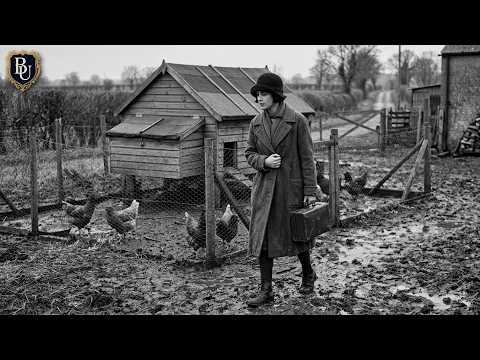
By 1924, Elsie was growing desperate. She wrote letters that grew more anxious, more insistent. And then she discovered something—or believed she had. She thought she was pregnant. A medical examination after her death would prove she wasn’t, but that didn’t matter. What mattered was that she believed it, and she was coming to Crowborough to settle the question of their marriage once and for all.
On Friday, 5 December 1924, Elsie left her parents’ home in Kensal Rise carrying a small bag. Two locals later reported seeing a young woman walking toward the farm at about a quarter past five, in the fading December light. Another witness saw her enter the farm gate. After that, she vanished.
Five days passed before her father, John Cameron, sent a telegram to Thorne asking where his daughter was. Thorne replied that she had never arrived—and even wrote a letter to Elsie’s home address, asking about her whereabouts. By mid-December, John Cameron had reported her missing, and East Sussex police began searching the heathland and ponds around Crowborough. They found nothing.
On Boxing Day, police took a statement from Thorne. He insisted Elsie had never come to the farm. But as December turned to January, more witnesses came forward. They had seen Elsie walking toward the farm that evening—and entering the gate. The case began to attract newspapermen, who descended on the smallholding. Thorne posed for photographers among his chickens, and the images appeared in the press while Elsie was still missing.
Sussex police, overwhelmed, called in Scotland Yard. In January 1925, Chief Inspector Gillan took charge. The investigation now focused on the farm itself. On 14 January, police began digging. In the dirt they found Elsie’s small bag—the one she had carried from London—buried in the ground. Thorne was arrested and detained.
The next morning, 15 January, Thorne made a new statement. He told police where to dig. Elsie’s dismembered remains were found buried beneath the chicken pen. The wooden hut he had built stood on raised beams; the wire run had been placed over the shallow grave. The search was over. What remained was a charge of murder—and a courtroom battle that would hinge not on what was found, but on what two doctors could not agree upon.
The medical evidence was contradictory from the start. Sir Bernard Spilsbury, the Home Office pathologist whose authority in the criminal courts was then almost unchallenged, testified that Elsie Cameron had died from blows to the head. He found no marks on her neck consistent with hanging. He examined the wooden beam in the hut—the one Thorne later claimed she had hanged herself from—and noted that the dust upon it was undisturbed. There was no trace of a rope. The examination also proved she had not been pregnant.
Against Spilsbury, the defence produced Dr Robert Brontë, who had examined the remains on Thorne’s behalf and reached a different conclusion. Brontë said there were marks on the neck consistent with a rope. The two doctors contradicted each other directly, and that contradiction became the substance of the case.
Thorne’s own account of that night was given in his statement of 15 January. He said that on the evening of 5 December, he and Elsie had quarrelled. He had gone out to meet Miss Coldicott, and when he returned to the hut at about half past eleven, he found Elsie hanging from the beam. He panicked, he said—thought of the letters that would be found, of how it would look—and he concealed what had happened. That was his explanation for why her remains were found where they were.
The prosecution’s case, and the one the court ultimately accepted, was that Elsie Cameron died from blows to the head and that Thorne killed her. The trial began in March 1925 at the Sussex Assizes in Lewes. Mr Justice Finlay presided. Sir Henry Curtis-Bennett led the prosecution; Mr J. D. Cassels appeared for the defence. Thorne pleaded not guilty.
The trial became, more than anything else, a contest between Spilsbury and Brontë. Curtis-Bennett built his case on Spilsbury’s findings: the undisturbed dust on the beam, the absence of rope marks, the conclusion that Elsie could not have hanged herself. The buried bag, found before Thorne led police to the body, formed part of the prosecution’s story of a man who had lied for six weeks.
Cassels emphasised that Spilsbury, for all his eminence, could not be certain. When two distinguished doctors disagreed on how a woman had died, the prosecution had not proved its case beyond reasonable doubt. He brought Thorne himself to the witness stand to tell of the quarrel, the meeting with Miss Coldicott, the return to the hut late at night.
The jury retired in less than an hour. The verdict was guilty. The sentence was death.
Thorne appealed. The appeal was dismissed. The conviction stood. The case was widely reported—The Times, the Daily Mail, the Sussex Daily News all carried the details—and the coverage spread beyond England, with London telegrams reprinted in newspapers as far away as New Zealand. Among those who followed the case and formed an opinion was Sir Arthur Conan Doyle, who lived in Crowborough itself. He stated publicly that the case had not been proved beyond reasonable doubt. His doubts, and those of others who shared them, rested largely on the conflict between Spilsbury and Brontë—on the idea that where experts contradicted each other directly, a man should not be condemned and hanged.
Norman Thorne was hanged at Wandsworth Prison on 22 April 1925. He maintained his innocence to the last. The date would have been Elsie Cameron’s twenty-seventh birthday. The case became known throughout the country as “the chicken run murder,” and by that name, and as “the Crowborough chicken farm murder,” it entered the popular memory of English crime.
What kept the case alive in later literature was not so much the figure of Thorne as the figure of Spilsbury—the question of how far the certainty of one expert should decide the fate of a man’s life. The Crowborough case became one of the test cases in the long argument about Spilsbury’s authority in the courts, and about the weight that 1920s courts placed on a single pathologist whose opinion juries were reluctant to question. The verdict stood. History still argues about it.
The second case begins in Holland Park, London, in mid-January 1919, two months after the Armistice that ended the Great War. Holland Park was a district of tall stuccoed houses from the previous century, white façades and porticoes along quiet streets behind iron railings. These were the homes of wealthy and professional families, staffed by resident servants—maids and cooks who lived in the house and answered the door.
In January 1919, the streets of such a district reflected the peculiar condition of the capital in the first winter of peace. The war had ended two months earlier; demobilisation had begun; men were returning from France, and among the returning were those carrying the scars of what they had seen. At one of these houses, number 13 Clarendon Road, a returning officer came one January evening to visit a man staying there, and in that house Miles Seton died.
Miles Charles Carston Seton was born in Edinburgh in 1874, a Scottish-born member of the Seton family and a cousin of Sir Malcolm Cotter Carston Seton, the senior civil servant. He became a doctor and served in the Great War as a medical officer with the Australian Army Medical Corps, rising to the rank of major in September 1918. He was, in January 1919, a man of forty-four, about to turn forty-five.
The man who came to visit him was Lieutenant-Colonel Norman Cecil Rutherford, DSO. Rutherford was himself an army doctor. Before the war he had been an academic at the University of London, teaching embryology and comparative anatomy, and had served earlier in South Africa. In the Great War he won honours for his work at a dressing station during the Third Battle of Ypres in 1917, and was said to have been buried alive at one point on the front. He had no previous record of trouble with the law.
The two men had met during military service. Rutherford was a friend of Seton’s—and a friend of the Rutherford family, not a blood relative. Rutherford returned home from France in January 1919. He had come to believe that Seton had turned his wife and children against him, that Seton had become too close to his family. This was his belief, and it must be understood as his belief alone. There was no strong evidence of any romantic attachment; the press of 1919 exaggerated the matter beyond what the facts would bear. The belief was never proven true.
It was later said that Rutherford had confessed to a psychiatrist that he had entertained thoughts of killing Seton for weeks, and that he had questioned his servants about Seton’s visits to the family home. He returned from the war carrying this conviction about a man he had once called—
On the evening of the shooting in mid-January 1919, Rutherford came to number 13 Clarendon Road, where Miles Seton was staying with his cousin, and asked to see him. The maid announced the visitor. Sir Malcolm Seton was upstairs in the house. Shortly after Rutherford was admitted, Sir Malcolm heard several shots in succession from below. He came down and found his cousin shot dead in the room. Rutherford had fired a revolver. Accounts of the number of shots varied later, but they are described as “several.”
Among the words exchanged in that room immediately after the shooting, one sentence is consistent across all accounts and may be taken as Rutherford’s own. When Sir Malcolm reached the scene and spoke to Rutherford, Rutherford said he wished only that he had another bullet for himself. Sir Malcolm asked him what he had done.
Present in the house were Sir Malcolm Seton, his wife who came down from upstairs, and the maid who had announced the visitor. There was, from the first moment, no doubt about who had fired the shots. The question the household answered in an instant, the law would spend the following months considering in a different form. There was never any doubt about the identity of the shooter. What remained to be determined was the state of mind of the man who had fired, and on that question, not on the fact of the shooting itself, everything later turned.
Police arrested Rutherford in the house. There was no search for a culprit, no combing of the neighbourhood, no pursuit of an unknown assailant—the assailant was known and remained at the scene. Rutherford was detained and charged, and committal proceedings were held at West London Police Court, which sent the case for trial.
Dr Bernard Spilsbury examined the body of Miles Seton. The cause of death was not in dispute. Seton had been shot. The medical question that would matter at trial was not the cause of the victim’s death but the mental state of the accused, his war service, the delusions he was said to have suffered about his family, and what the doctors would say about his condition at the moment of the shooting.
Because of the immediate arrest and the absence of any dispute about the facts of the shooting, the investigation was a short one. There was no mystery of identity to solve, only statements to be taken from those in the house, the revolver to be secured, and the medical evidence to be prepared that would reveal Rutherford’s mental state. A formal inquest was held into Seton’s death as the law required in cases of sudden and violent death, followed by appearance before a magistrate at West London Police Court. At the committal hearing, it was indicated on Rutherford’s behalf that the defence would rest on the contention that he had been of unsound mind when he committed the act. And so the course of the case was set before it reached the High Court.
The trial at the Old Bailey in April 1919 was not about whether Rutherford had killed Seton. That was never in doubt. It was about the state of his mind. The jury returned a special verdict: guilty but insane. He was ordered detained at His Majesty’s pleasure and sent to Broadmoor.
The decorated colonel who had returned from France in January passed, by spring, from the courts to the walls of the asylum. He was released quietly in 1928, after nearly ten years. When the press learned of it in 1929, there was public unease that a man who had shot another dead in a London living room was once again at liberty. He was said to have worked abroad—Canada, Austria, Persia—and was later divorced by his wife.
The case raised no legal doubt. It was a simple, telling example from the first year of peace: one of the earliest occasions when the psychological damage of the Great War stood before an English criminal court. The questions it left were moral, not legal—and they belonged to the public and the press, not the law, which closed the file at the Old Bailey in the spring of 1919.
The third case begins in South Croydon, Surrey, in the spring of 1928. In the centre of it was a family linked by blood and marriage, living within a short distance of one another, accustomed to dining together at a house on Birdhurst Rise. The matriarch was Violet Amelia Sidney, a widow in her late sixties, who lived there with her unmarried daughter, Vera. Vera was in her forties, unmarried, comfortably off, and described as active and sociable. Violet had a son, Tom Sidney, living nearby, and a second daughter, Grace, who had married Edmund Clayton Duff in 1911—against her family’s wishes, it was said—and also lived close by her mother.
Edmund Duff was the first to die. In late April 1928, he returned from a short shooting trip, ate his dinner, fell violently ill, and died the next day. His death was initially put down to natural causes, and the first inquest returned that verdict. It was later said he had taken poison in a glass of beer, being the only member of the family who drank beer.
Nearly a year passed before the deaths that reopened the question. In February 1929, Vera Sidney fell ill after eating soup at a family meal at Birdhurst Rise. Others who ate the same soup were also taken ill. A relative, an aunt, was severely sickened but survived. Vera Sidney died on 15 February 1929. Then, on 5 March 1929, less than three weeks later and under the same roof, Violet Sidney took a dose of medicine prescribed for her, said at once that she had been poisoned, and died that evening.
Two deaths in one house in three weeks, following sudden illness and collapse, could not be ignored as the first had been. The question the family doctor had not asked in April the previous year became unavoidable, and Scotland Yard was called in. The bodies of Vera and Violet Sidney were exhumed from Queen’s Road Cemetery in the spring of 1929, and then that of Edmund Duff, who had died nearly a year before. Analysis revealed arsenic in all three bodies.
The inquests were held at Croydon before Dr Jackson. On 29 July 1929, the jury in Vera Sidney’s case returned a verdict of murder, concluding she had died poisoned, perhaps by her soup, at the hands of some person or persons unknown. In Violet Sidney’s case, the jury concluded on 31 July that she died of arsenical poisoning, but there was insufficient evidence to say whether she had taken it herself or whether it had been given to her. In Edmund Duff’s case, the second inquest, concluded in August, returned that he had been killed by some person or persons unknown.
Three deaths and three verdicts, and in none of them was a single name named. Two of the three were classified as murder; the third was considered arsenical poisoning that the jury could not attribute to any hand. The inquests had proved the family had been poisoned, but they could not identify the poisoner. In August 1929, the authorities announced that, for lack of evidence, no charges would be brought against anyone in the Croydon poisoning cases. That announcement closed the case legally. There was no trial. No one was ever charged.
Grace Duff and Tom Sidney lived on. Neither was ever charged with anything. The law closed its investigation without fixing responsibility on any person, and the cases remained as they were. What followed was not a legal reckoning but a long series of literary speculations by writers who formed their own views and set them down—conclusions that were theirs alone and not the verdicts of any court.
The case became one of the classics of unsolved English poisoning crime. In 1975, Richard Whittington-Egan published The Birdhurst Rise Mystery, a comprehensive study in which he interviewed surviving witnesses and found that almost all of them believed in Grace’s guilt. The evidence his book gathered, by his account, pointed to one of two heirs of the family. A review of his work noted that the argument he built remained dependent on circumstantial evidence and inference. Later, Janet Hennessy wrote The South Croydon Poisoning Crimes, which raised open questions about whether Grace had used arsenic and whether she had been involved with the family doctor, and noted that lawyers at the inquests had reportedly described Grace as a devil incarnate. In a television treatment produced in later decades, a different candidate among the family members was proposed. These are the doubts of later writers, formed long after the deaths, and they are attributed to those writers and go no further. No legal charge was ever built on any of those suspicions.
As a piece of English crime history, the case is remembered as one of the great unsolved poisoning mysteries of the interwar years. Three arsenic deaths in one respectable family within eleven months, two of them within three weeks and under one roof, and not a single charge ever brought. It stands as a study in the limits of the criminal law when poisons meet a close-knit family and an absence of witnesses—where the fact of murder can be proved beyond doubt, but the hand that did it cannot be reached.
The circumstances that made this possible belong to their time and place: to the suburban households with servants of the interwar years, to a period when arsenic was still present in weedkillers and household preparations and could enter a house unnoticed, and to a self-respect so settled that those who knew the family found it almost impossible to think of any of them as a poisoner. The case has returned in books, on television, and in local and national press retrospectives, a permanent item in the literature of unsolved British poisoning.
Those were the three cases of the night. In none of them was anyone ever charged. In one, a man was hanged protesting his innocence; in another, a decorated officer was found insane and quietly released; in the third, arsenic killed three and the law could name no hand. Three stories, three verdicts, and the same question trailing each of them through the decades: when the evidence is enough to prove a crime but not enough to prove a killer, what is justice supposed to look like? What do you think—was each of these verdicts the best the law could do, or a failure of it? Tell me in the comments where you’re listening from, and which of the three cases you find most troubling.
Report this article
Select a reason for reporting:






