The rain fell hard on Lennox Avenue that Tuesday night in June 1935—the kind that kept honest people inside and drove everything else into the open. Solomon Price was counting the register when the bell above his door rang. He didn’t look up right away. He thought it was a neighbor ducking in from the storm.
Then he raised his eyes.
The man in the doorway was tall, wide-shouldered, wearing a gray wool coat that hadn’t gotten wet—which meant someone had driven him here. In his right hand was a dark wooden cane, not because he needed it to walk. He held it the way a man holds something he wants you to notice. His shoes were clean. Everything about him was clean.
“You Solomon Price?” the man said. His voice was low, not threatening, just flat—the way a man speaks when he already knows the answer.
The man stepped inside and walked slowly down the center aisle, eyes moving across the shelves. He picked up a can of peaches, turned it over once, set it back down.
“Nice little store. How long you been here?”
“Eleven years,” Price said.
“Eleven years. People trust you. That’s worth something.” He smiled. “My name is Vince Marrow. People call me Cain.”
Price kept his hands flat on the counter. He was sixty-one years old. He had lived in Harlem since 1919. He had seen men like this before—not this exact man, but this type. The clean shoes, the cane, the way they moved through a room like they already owned it.
“Harlem is changing,” Cain said. “There are costs to doing business here now. Three hundred a week. That keeps your windows whole. That keeps your suppliers showing up.”
In 1935, three hundred dollars was more than most men in Harlem made in a month. Price felt something cold move through his chest—not quite fear, not yet, something older than fear. Recognition.
“I don’t have that kind of money,” Price said.
Cain leaned forward until his face was close enough that Price could smell his cologne. Something expensive. Something that didn’t belong in this neighborhood.
“Mr. Price, I didn’t ask you what you have. I told you what this costs.”
He held the eye contact for three full seconds. Then he straightened up, picked up his cane, and turned toward the door.
“Three hundred. Friday. I’ll be back.”
The bell rang. The door swung shut. The rain kept falling.
Solomon Price stood behind his counter for a long time after that. The store felt different now—smaller, somehow, like the walls had moved in six inches while that man was standing in it. He looked at the forty-two dollars in the register. He looked at the door. Then he reached under the counter and pulled out a small notebook.
He wrote down a name, an amount, and a date. And then he wrote down a number. Not a phone number. A pickup point. A code that anyone running numbers in Harlem would recognize immediately.
He was sending a message. Not to the police. Not to his family. To the one man in Harlem who needed to know that something had just walked through that door.
The bar on 133rd Street had no sign outside. It didn’t need one. Everyone in Harlem knew what that unmarked door meant. You knocked twice, waited, knocked once more. If the slot opened and the man inside recognized your face, you got in. If he didn’t, you walked away and didn’t ask questions.
Inside, the air was thick with cigarette smoke and the low sound of a trumpet coming from somewhere in the back. Ellsworth “Bumpy” Johnson was sitting at a corner table with a glass of bourbon he hadn’t touched in forty minutes. He was thirty years old in 1935—not tall, not physically imposing in the way that Cain Marrow was. But there was something about the way Bumpy Johnson sat in a room that made men unconsciously lower their voices when they walked past him.
He had eyes that moved constantly—not nervously, but methodically. Like a man who had trained himself to see everything and react to nothing.
Across from him sat a man named DeWitt, small, nervous, with ink-stained fingers and a habit of pulling at his collar when he had bad news. Tonight, he was pulling at his collar.
“Talk,” Bumpy said.
DeWitt talked. He laid it out carefully. Cain Marrow, the grocery store, the three hundred a week, the Friday deadline. He mentioned the cane, the cologne, the clean shoes. He mentioned that Cain had been seen in at least four other businesses on 135th and 136th over the past week. Same speech, same number, same Friday.
Bumpy listened without interrupting. When DeWitt finished, Bumpy picked up his bourbon, looked at it, set it back down.
“How many stores?” he said.
“At least seven, maybe more.”
“How long has he been moving through the neighborhood?”
“Ten days, maybe twelve.”
Bumpy turned that over in his mind. Ten days in Harlem and nobody had sent word until now. That told him something. Either people were scared or they were waiting to see which way the wind blew before they committed to anything. In Harlem in 1935, both were possible.
“Who’s he connected to?” Bumpy asked.
DeWitt hesitated. That hesitation lasted exactly two seconds too long.
“DeWitt, there’s a name.”
DeWitt said carefully, “A name that keeps coming up when people talk about where Cain gets his protection, but I can’t confirm it. Not directly.”
“Give me the name.”
“Roark. Detective Frank Roark. Out of the 28th Precinct.”
The table went quiet. Even the trumpet in the back seemed to pause for a moment—though it didn’t.
Bumpy had known about Roark for years. Every serious operator in Harlem knew about Roark—a fifteen-year veteran who had built a quiet side business running protection for certain interests that wanted access to Harlem’s economy without the visibility of direct involvement. He was careful. He never took money directly. He worked through intermediaries and looked the other way at the right moments. He was the kind of corrupt that was almost invisible because it was so deeply institutional.
The fact that Roark’s name was attached to Cain Marrow changed everything. This wasn’t a freelance racketeer who had wandered into the wrong neighborhood. This was something organized, something with infrastructure. Something that had been planned.
Bumpy didn’t move for a long moment. Then he said, “I want to know where Cain’s money goes after he collects it. Every stop. Every hand it passes through. I want the full map.”
“That’ll take time,” DeWitt said.
“You have until Thursday.”
DeWitt nodded and stood to leave. Bumpy stopped him with one word.
“Quietly. Nobody moves. Nobody says anything. Nobody looks at Cain Marrow sideways. I want him to think this street is still asleep.”
DeWitt left. Bumpy finally picked up his bourbon and drank half of it in one slow swallow. He set the glass down and looked at the candle on the table, the flame moving slightly in a draft from somewhere he couldn’t see.
What troubled him wasn’t the money. Three hundred a week per store was aggressive, but not extraordinary. What troubled him was the timing. Harlem’s numbers network had been under pressure for months—a combination of law enforcement attention and competition from Italian operations moving north. Someone had looked at that pressure and decided it created an opening. Someone had decided that right now was the moment Harlem could be walked into.
That calculation was either very smart or very wrong. Bumpy intended to find out which.
What followed in the next forty-eight hours was never fully documented. The men involved had reasons to keep it that way.
By Wednesday morning, Bumpy had the basic shape of Cain’s financial network. The money moved from the stores to a counting room on 140th Street, then split two ways. One portion to a car that drove it downtown. One portion held locally as operating cash. The downtown portion was what interested Bumpy. That was where Roark’s cut went. That was the thread.
He didn’t pull it yet. He sat with the information and waited. Patience was a discipline he had developed over years of operating in a city that punished impulsiveness severely. He had seen men act on incomplete information and pay for it for the rest of their lives. He had learned to let situations develop until the full picture was visible.
Friday was coming. He would let Friday come.
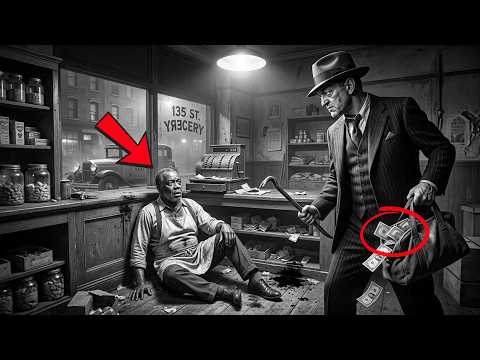
Friday came three days later, and Cain Marrow didn’t wait until evening. He arrived at Solomon Price’s store at eleven in the morning, while the street was still active. Women with groceries, children running errands, men standing outside the barber shop two doors down. He came with two men behind him. He didn’t knock. He pushed the door open hard enough that the bell above it cracked against the frame and went silent.
Price was behind the counter. He had known since Wednesday that Friday was coming. He had not slept well in three days. He had the money—two hundred and forty dollars, which was everything he could pull together without draining the store’s operating account completely. Not three hundred. Not what Cain had asked for.
“Mr. Price,” Cain said. His voice was the same as the first night—flat, almost friendly. He walked to the counter and looked at the envelope sitting on top of the glass case. He picked it up. Felt the weight of it. And set it back down.
“This feels light.”
“It’s two forty,” Price said. “It’s everything I have right now. I can make up the difference next week.”
Cain looked at him for a long moment. Then he looked at the two men behind him. Then he looked back at Price.
“I told you three hundred,” he said. “I didn’t say two forty. I didn’t say what you have. I said three hundred.”
“I understand that. I’m asking for one week.”
Cain picked up his cane from where he had leaned it against the counter. He turned it slowly in his hand, looking at it like he was considering something. Then he swept it sideways across the glass case. The display cracked—not all the way through, but a long fracture ran across the surface from one end to the other. The sound was sharp and loud in the small store. A jar of pickles near the edge of the counter vibrated and fell. Hit the floor. And shattered.
“Get out here,” Cain said.
Price didn’t move. One of the men behind Cain came around the counter in two steps. Grabbed Price by the front of his apron. And pulled him forward. Price grabbed the edge of the counter, but his grip didn’t hold. He was sixty-one years old and the man holding him was not. He was pulled around the counter and dragged toward the door.
The street outside went quiet in the way that streets in Harlem went quiet when something serious was happening. Not silent, exactly, but the texture of the noise changed. The women slowed. The men outside the barber shop turned. Two children on the sidewalk stopped and stared with the particular stillness of children who have learned that sometimes the right thing to do is not move.
Cain’s man pushed Price out through the door and onto the sidewalk. Price stumbled and caught himself against the outside wall of his own store. He was breathing hard. His apron was torn at the shoulder. Cain stepped out after him, unhurried, and stood in front of him on the sidewalk. He looked at the small crowd that had formed—not large, maybe fifteen people, but enough.
“This man owes a debt,” Cain said loudly—not shouting, just projecting, like a man used to being heard. “He made a commitment and he didn’t keep it. I want everyone on this street to understand what that looks like.” He looked at Price. “Next Friday, five hundred. You’re late now. That costs extra.”
He turned and walked back to his car. His two men followed. The car pulled away from the curb slowly—no hurry—and moved up 135th Street and out of sight.
The crowd dissolved. People went back to what they were doing or pretended to. Solomon Price stood against the wall of his store for a long moment, one hand pressed flat against the brick. His face was controlled. He had too much dignity to cry in the street, but his hand against that brick was shaking. The barber shop men went back inside without saying anything. The women with groceries kept walking. Two people crossed to the other side of the street to go around the space where it had happened. As if the sidewalk there had been contaminated by something invisible.
Within two hours, the story had reached every numbers runner in Harlem. By nightfall, it had reached every bar, every back room, every informal meeting place where men who operated in the underground economy of the neighborhood gathered to talk. And by ten o’clock that night, it had reached the unmarked bar on 133rd Street, where Bumpy Johnson was sitting at his corner table with a glass of bourbon he had not touched.
The man who brought him the news—a young runner named Calvin, who could not have been more than nineteen—told it straight and fast, the way Bumpy had trained his people to deliver information. No editorializing, no drama, just the facts in order.
When Calvin finished, Bumpy sat quietly for a moment.
“Where is Price now?” he said.
“At the store. His daughter came. He sent her home.”
Bumpy nodded slowly. He looked at the candle on the table—the same candle or one just like it—still moving slightly in a draft from somewhere he couldn’t find.
The thing about Harlem was that it had a memory. Not a written memory—nothing that went into official records or newspapers—but a living memory carried by the people who had been there, who had seen things, who had understood what those things meant. And that memory knew the difference between a man who had power and a man who was performing it.
Cain Marrow had just performed in front of fifteen people on 135th Street. He had pulled an old man out of his own store and humiliated him in public to send a message to everyone watching. The message had been received.
Harlem was watching now. Harlem was waiting. And Bumpy Johnson understood, with the particular clarity that came to him in quiet moments like this one, that waiting was over.
By Friday night, the street had gone quiet in that particular way—not empty, but settled. Cain Marrow walked out of Harlem and never came back. Walter Pruitt simply wasn’t there one day. Nobody asked where he’d gone.
Solomon Price opened his store the next morning at seven, same as always. He unlocked the gate, propped the door, started his coffee. A woman buying cornmeal said he looked tired. He said he hadn’t slept well.
He didn’t mention the register open on the counter, the men in every corner, or the hour-long conversation in the back room. He just made his coffee.
An old man on that block said years later: “The winner wasn’t the one who fired first. It was the one still standing when the street went quiet again.”
What would you have done in Solomon Price’s shoes that first night—make the call, or pay the three hundred?
Report this article
Select a reason for reporting:






