August 22, 1961. The air in Harlem was thick with heat and the scent of something far more sinister. Six men had just crossed a line that no one dared to cross: they had stolen $250,000 from Bumpy Johnson, the man who ruled the streets with a quiet, calculated violence. By the next afternoon, New York would learn the price of that mistake.
This wasn’t a crime of passion or a fit of rage. It was a strategy, measured hour by hour, designed to send a message that would echo for decades. One man didn’t chase the thieves; he rewrote the rules. But what exactly did Bumpy Johnson do in those 48 hours that left everyone utterly stunned?
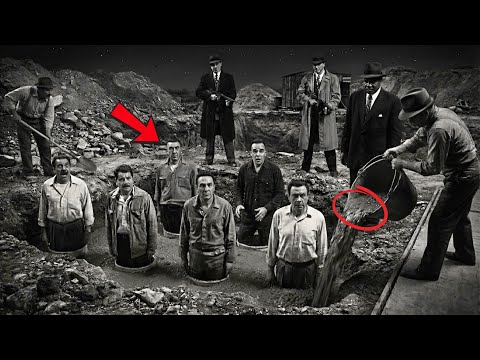
To understand the outcome, we must go back to the first phone call. It was 4:30 PM when Detective Raymond Kowalski pushed through the chain-link fence of a construction site in Queens. His partner, Frank Torres, was three steps behind. The anonymous call had come 20 minutes earlier—a calm, clear voice that gave only the address before hanging up. Now Kowalski understood why the caller sounded like someone reporting a car accident rather than a murder.
The smell hit first. Wet concrete mixed with the metallic tang of blood, oxidized by the August heat. The cement dust was so thick it coated the back of the throat, making it hard to breathe without coughing. The place was supposed to be empty. Workers had left at 3 PM. Machinery was silent. Nothing moved but the dust, settling slowly in the heavy air.
Six men stood in a foundation pit, buried from the waist down in concrete that had hardened like stone around them. Each had a bullet wound in the center of their forehead. The entry wounds were clean, surgical—the kind made when the barrel is pressed directly against the skin and the trigger pulled while the target stands perfectly still. None of them had fallen. The concrete held them upright.
Their hands were tied behind their backs with wire that had cut so deep the marks were visible from 20 feet away. Their eyes were open, staring at nothing. One had bitten through his lower lip before the bullet, the teeth marks still visible. Another had emptied his bladder at some point during the 12 hours he’d stood there, waiting for a fate that everyone promised was coming but refused to arrive until the man who orchestrated this had ensured the psychological aspect was complete.
The police photographer raised his camera. His hands were shaking so badly that the first shot was blurred. He lowered the camera, turned away, and vomited onto the ground. Torres, a 19-year veteran of homicide, made the sign of the cross despite not having been to church since his mother’s funeral.
“Jesus Christ,” Torres whispered, the words sounding like a prayer despite his lapsed faith. “This isn’t a murder. This is a ritual.”
Kowalski climbed down into the pit, his boots crunching on the gravel, to examine the bodies more closely. The concrete had been poured perfectly, stopping exactly at waist height. Why not just shoot them in an alley and dump them in the river? Why go through the trouble of burying them standing up and making them wait?
“Because whoever did this wanted to send a message,” Torres answered, lighting a cigarette with hands that still trembled slightly. “Not just to these six, but to everyone who hears about it.”
You don’t get a bullet in the back of the head for crossing the wrong people. You get buried in concrete for 12 hours, standing in your own waste, watching the sun move across the sky, knowing that when it reaches a certain angle, someone will walk up and put a bullet in your skull—and you can’t move, run, or fight back.
To understand this, we need to know the players. Bumpy Johnson ran Harlem with an intelligence that made violence unnecessary 90% of the time. But when violence was necessary, it was measured to achieve maximum impact with minimal repetition. In August 1961, he was 56, with gray at his temples. He wore suits to conceal that his physical strength hadn’t diminished at all. Those who knew him knew his reputation wasn’t for being the most brutal operator in New York, but for being the most precise.
Vito Genovese controlled the family that bore his name. He operated on the belief that Italian blood entitled him to certain rights—including testing whether Harlem’s black operators truly held power or were merely holding ground through luck and temporary tolerance. He had been testing boundaries for months, sending enforcers into territories that were supposed to be off-limits by mutual understanding. He was waiting to see if Bumpy would respond with force or choose a negotiation that would reveal his weakness.
In Illinois, Gordon served as Bumpy’s right hand—the man who kept the schedules, the obligations, and the debts. He had a memory that forgot nothing and a patience that allowed him to wait years for the right moment to remind someone that accounts always balanced in the end. The six men standing dead in Queens were Genovese’s professional soldiers—experienced at breaking fingers with pliers when businessmen failed to pay, skilled at setting fires that looked like accidents, comfortable with the kind of violence that kept neighborhoods in line and sent tribute to men who never got their hands dirty.
Kowalski walked around the pit, examining each body from different angles, trying to understand the sequence behind the tableau. The concrete had fully set. That takes hours—at least eight, maybe 12 depending on the mix and temperature. Which meant these men had been standing here all night and half the day, buried to the waist. Waiting.
“Why not just kill them immediately?” Torres asked, grinding his cigarette under his boot. “Why make them stand here for 12 hours before putting a bullet in their heads?”
“Because someone wanted them to think about what they’d done,” Kowalski said, his voice flat. “Wanted them to feel every moment of waiting. Wanted them to try bargaining, pleading, threatening, and finally accepting that none of it would change the outcome.”
This wasn’t about killing six men. It was about making their last moments so terrifying that when the story spread, everyone who heard it would understand that a quick execution is a mercy—and mercy is earned through behavior, not given freely.
A member of the forensic team, Sarah Chen, arrived—a woman who had processed 300 homicide scenes and prided herself on maintaining professional detachment regardless of the circumstances. She looked at the pit, and her jaw tightened. That was her only visible reaction before she began taking photos from multiple angles and reciting her observations aloud. These observations would later be typed into reports, circulated between NYPD and the FBI, and eventually reach prosecutors’ desks. They would read them and decide that this case would require resources and witnesses that didn’t exist and probably never would.
“Execution-style. All six,” Chen said, her voice steady despite the scene. “Single shot each, no exit wounds, small caliber, probably .22 or .25. Professional. No shell casings visible, which means the shooters either collected them or used a revolver. The concrete is standard construction material—nothing distinctive to trace to a specific supplier. The wire ties are industrial-grade, the kind you can buy at any hardware store in the city. Whoever planned this knew exactly what they were doing and took steps to ensure we’d find the bodies but have no evidence connecting them to any specific person or organization.”
Torres lit another cigarette—his third in 15 minutes. “This didn’t start here. It started somewhere else. Probably 48 hours ago, based on the rigidity and decomposition. These men did something that made someone feel this particular response was necessary. The question is, what did they do and to whom?”
Until they found the story behind this, the scene would make no sense. The trail had to lead back from this pit in Queens to the event that had triggered a response designed for maximum psychological impact. Someone had invested enough time and resources to bury six men in concrete for 12 hours before killing them. And that investment suggested that the offense was serious enough not just to eliminate, but to display. Not just to punish, but to teach a lesson that would be remembered, discussed, and used as a reference whenever anyone considered doing the same thing.
There are endings that are done simply to end a life—quickly and efficiently, forgotten within weeks as the next crisis demands attention. And there are endings designed to create fear, a fear that spreads like a disease among those who hear the story, reshaping their understanding of what consequences look like when applied by someone who sees violence not as an emotional release but as a strategic communication requiring careful planning and flawless execution.
The phone rang, shattering the silence like a gunshot in a church. Bumpy Johnson answered on the second ring. He already knew that a call at this hour meant someone had crossed a line that would require broken bones or worse to correct.
“Illinois,” Gordon’s voice came through the line, stripped of everything but information. “The counting house on Lenox has been hit. Guard found with his skull fractured. Probably a pipe or a sap to the base of the skull. The safe is open. Combination used perfectly. $250,000 in cash. Gone. They knew exactly what they were doing and exactly when to do it.”
Bumpy’s hand tightened on the receiver until the plastic creaked. “How many people knew that combination?”
“Five. You, me, Marcus, Samuel, and Jimmy.”
“One of them talked. Or someone put a blowtorch to their balls until they told everything.”
The money from every gambling den in Harlem was kept in that counting room—money from people who bet on the system being honest, that winners actually got paid, that there were rules to this operation even if those rules existed outside the law. Someone coming in and taking that money wasn’t just theft. It was a knife to the throat of everything Bumpy had built in 30 years.
Bumpy walked to his study, his bare feet silent on the hardwood that was so cold it made him conscious of every step. The room looked like a crime scene photograph in the lamplight. Duke Ellington played on the turntable, the needle stuck in the final groove, making the same scratching sound every two seconds like a heartbeat that refused to stop.
Twenty minutes later, Illinois came through the back door, moving with the careful silence of a man who knew that loud footsteps at 4:30 AM attracted the attention of neighbors—neighbors whose faces might be remembered when police came asking questions no one wanted to answer.
“Tell me where the discrepancy is,” Bumpy said, pouring two glasses of whiskey because this conversation required something stronger than coffee.
Illinois pulled out a notebook and flipped to pages of observations written in code—the kind that looked like a grocery list to anyone who might see it. “The safe was opened with the combination, not blown or drilled. Inside job, no question. The guard was disabled without a shot, which means professionals who understand that gunfire brings police and police bring complications. The timing was perfect—between the midnight collection and 6 AM, when the safe holds the most cash and the guard is at his least alert. This was military precision, not a street crew getting lucky.”
Bumpy downed his whiskey in one swallow, the burn traveling down his throat and settling in his chest, mixing with the cold realization that someone had just declared war using him as the first shot. “They’re not testing our security. They’re testing whether I’ve gone soft. Whether Harlem can be looted without consequences. Whether a black man’s business is fair game for anyone with the balls to kick in the door and take what they want.”
“We get the money back,” Illinois said, though both already knew the answer. “We negotiate. We look weaker. We go to the Commission and cry for arbitration. We might as well hang a sign on Lenox Avenue that says ‘Rob us. We won’t fight back.’ The only response that works is one that makes everyone understand that stealing from us means death without appeal or mercy.”
Illinois leaned against the wall, arms crossed. “What do we do?”
“We find the six men who did this,” Bumpy said, his voice carrying the flat certainty of a man who had already planned every move and was now simply reciting the conclusions. “We make them understand that they made a mistake that can’t be fixed by returning money or apologizing or begging. We do something that people will talk about for the next 20 years, whenever anyone suggests that Harlem might be an easy target.”
By 10 AM that morning, the same information had arrived from three different sources. Six soldiers from Vito Genovese’s Brooklyn crew had carried out the operation—professionals skilled at high-value asset retrieval where planning mattered more than weaponry. The information came with names. Faces that police had photographed at previous crime scenes. Men who had broken legs with baseball bats for debt collection and burned buildings to the foundation when businessmen refused to pay tribute.
Bumpy studied the list of names written on paper that would be burned before sunset. He memorized each one as if writing it into a mental ledger where he recorded debts, debts collected, and those who had tested him—measured not in dollars but in years of suffering.
“Genovese sent them,” Illinois said, lighting a cigarette and blowing smoke toward the ceiling. “This wasn’t freelance. This was Vito’s test—whether you still have teeth or whether you’ve become an old dog that barks but no longer bites. Vito thinks that because I’m 56 and my hair has grayed, and because I haven’t personally broken anyone’s ribs with a tire iron in five years, that means I’ve lost the capacity for violence.”
Bumpy’s jaw tightened—the only visible sign of the rage building inside him, like pressure in a boiler sealed too tight. “He thinks Harlem’s black operators survive on his sufferance, that we pay him tribute because we lack the power to refuse, that our territory is his territory and he merely allows us to manage it as long as we remember our place.”
“So what do we do?” Illinois asked, though he already knew the answer, having seen this particular expression on Bumpy’s face three times before. Each time, the result had been people disappearing, rumors spreading, and everyone recalibrating their understanding of what consequences looked like when applied by someone who saw violence not as a loss of control but as a precision tool for teaching lessons that words couldn’t convey.
“We take the six men,” Bumpy said, his voice dropping to the register he used when explaining something that couldn’t be repeated outside this room. “We don’t kill them quickly. We don’t dump them in the river where they become statistics. We do something that makes every soldier in every family and every crew understand that Bumpy Johnson is not a man to be robbed. We create a monument that lasts. Something visible, permanent, and so terrifying that 20 years from now, people will tell this story to new recruits as a warning about what happens when you mistake patience for weakness.”
The money could be recovered. The operations could absorb the loss and continue. But reputation, once damaged, took decades to rebuild. And in those decades of weakness, other predators would circle, test, and gradually consume everything until only the memory remained of what had once been—before someone decided that mercy and weakness were the same thing, and that weakness invited exploitation that would continue until corrected with extreme prejudice.
Six men scattered across Brooklyn, each following routines that had kept them alive through years of work that would have killed most people. They lived in different neighborhoods, drank in different bars, left at different times, and trusted different women who might or might not be willing to sell information about their movements to someone offering cash. Each was easy to take individually. But taking all six together before any could warn the others required a level of precision that most operations never achieved.
“If we grab one, the other five disappear within an hour,” Illinois said, spreading photos across Bumpy’s desk. Each showed a different face, a different build, a different pattern of movement that would need to be identified and predicted. “These are professionals. They have escape routes planned. Safe houses stocked. Cash buried in locations only they know. If even one fails to check in, the others will assume compromise and initiate protocols that make finding them impossible.”
Bumpy studied the photos with the same focus a surgeon gives an X-ray before cutting. He understood that success required not just knowing where these men were, but where they would be at a specific moment, how long they would stay there, and what methods of extraction would work without any of them making a sound that would alert the others.
“The problem isn’t finding them,” Bumpy said. “The problem is taking all six within the same 60 seconds—before any of them can make a phone call or trigger an alarm that spreads through their network. We need to know their routines down to the minute. Where they sleep. Where they eat. Where they drink. Where they screw. Where they collect money. Where they meet with their handlers. We need to know their daily patterns minute by minute. When they leave their apartments. What route they take to their first destination. Who they talk to. Who they trust.”
Illinois nodded, mentally compiling the list of informants to activate, the surveillance points to establish, the bartenders and building superintendents and prostitutes who would need to be bribed with enough money to overcome their fear of retaliation.
“Phase one, identification,” Bumpy said, tapping the first photo. “We need their complete schedules. We have 48 hours to build profiles accurate enough to predict their location within five minutes.”
Illinois nodded again, already mentally compiling the list of informants to activate, the surveillance points to establish, the bartenders and building superintendents and prostitutes who would need to be bribed with enough money to overcome their fear of retaliation.
“Phase two, isolation,” Bumpy continued, moving to the second photo. “We cut their communications. No phone calls to warn each other. No runners carrying messages from one location to another. We put people at key intersections who can intercept anyone trying to pass information from one target to another. We create an information blackout that prevents them from coordinating their response or activating their escape protocols.”
“Phase three, coordination,” Bumpy said. “All six takedowns happen within the same 60 seconds—not one minute apart, not five minutes apart, but simultaneously, hitting them in a way that none of them can send a warning or put up a fight. We need 12 men—two for each target—working at the same time, executing on the same signal.”
Illinois pulled out a list—names of men who had worked for Bumpy for years, who understood that discipline mattered more than aggression, that following orders exactly as given was worth more than improvising a solution that might work or might create complications that cascaded into failure.
“I can assemble 12 men who will do exactly what they’re told without questions or noise.”
“Phase four, neutralization without gunfire,” Bumpy continued, his voice dropping to the register he used when explaining details that couldn’t be repeated outside this room. “Chloroform or ether applied from behind. Chemical control that drops them fast, without giving them a chance to shout, struggle, or alert anyone nearby. Guns make noise. Noise attracts attention. Attention brings police, witnesses, and complications that turn a clean operation into an investigation that never ends.”
“Phase five, disappearance,” Bumpy said. “We load them into vehicles that aren’t registered to anyone connected to us. We drive routes that avoid traffic cameras and toll booths. We take them to the location where the next phase begins. No witnesses see the takedowns. No cameras record the vehicles. No evidence connects these disappearances to any specific person or organization.”
Illinois finished writing and looked up from his notebook. “This requires flawless execution at every phase. One mistake—one target who deviates from his routine, one surveillance point that falls asleep, one driver who takes a wrong turn—and the entire operation falls apart.”
“Then we don’t make mistakes,” Bumpy said, his jaw setting in the expression Illinois had learned meant the decision was final and arguing would waste time that should be spent executing.
Forty-six hours of surveillance produced schedules accurate to within five minutes. By 11:30 PM on August 22, 12 men were positioned at six locations across Brooklyn. Each pair watched a target who had no idea that tonight was different from any other night. The routines they had followed for years, predictable and documented, were now being used against them with the precision of a machine built for a single purpose.
At 11:47 PM, the signal spread across watches synchronized to the same second. Six pairs moved simultaneously, approaching from angles calculated to avoid detection and maximize speed. Chloroform-soaked rags came out of pockets and pressed against faces from behind with enough pressure to cut off breathing and force the targets to inhale the fumes that would render them unconscious within 15 seconds.
At a bar on Atlantic Avenue, Vincent Moretti was lifting his whiskey glass when two men grabbed him from behind. One hand clamped over his mouth while the other pressed the chemical-soaked cloth to his nose. His glass shattered on the floor, but the sound was lost in the noise of conversation and jukebox music, and no one noticed he was gone—already in the trunk of a Chevrolet heading toward Queens.
At a diner in Flatbush, Tony Scalise was paying his bill when the takedown happened—fast and efficient, his body going limp before he could reach the revolver holstered at his waist. The waitress who saw him leave with two men assumed he was drunk, which wasn’t unusual for Tony, and went back to filling coffee cups without a second thought.
Four more takedowns happened at four more locations with the same precision, each completed within the same 60 seconds. Each target neutralized and removed before anyone nearby realized they were witnessing an abduction rather than a drunk being helped home by friends.
By midnight, all six men were unconscious in vehicles heading toward the construction site in Queens, where concrete had already been mixed and forms built, where a pit had been dug to exact specifications that would be obvious when the sun rose and revealed what had been constructed during the night.
The true power wasn’t in making people disappear through violence that left bodies in alleys or investigations that occasionally resulted in arrests. The true power was in making people disappear so completely that witnesses saw nothing worth reporting and victims understood nothing until they were already buried and realized that escape was impossible and the only question was how long they would stand waiting before the final bullet arrived to end the waiting.
At 1:30 AM, six men woke to find themselves buried to the waist in concrete that had already begun to harden like stone around their legs. The heat from the chemical reaction was noticeable through their pants and skin. The construction site in Queens was nearly empty except for these six men and four guards armed with shotguns. The prisoners tested their bonds and found their wrists wired so tightly that circulation was already compromised. Vincent Moretti tried to move his legs, straining against concrete that was as unyielding as steel. Tony Scalise twisted his body, trying to free his hands, but the wire only cut deeper into his wrists until blood began to trickle down his arms.
“Where are we?” Moretti shouted, his voice echoing off the concrete walls. “Who did this? You know who we work for. You know what Vito will do when he finds out you’ve taken his men.”
One of the guards chambered a round in his shotgun, the mechanical sound carrying more threat than words. The message was clear: you can talk. Scream and you’ll get a response from the butt of this gun.
At 2:10 AM, a black Lincoln pulled up, headlights cutting through the darkness. Bumpy Johnson stepped out, wearing a suit despite the hour. Illinois Gordon followed at a slower pace, carrying a folding chair that he placed 10 feet from the edge of the pit. Bumpy sat down, pulled a cigar from his jacket, and lit it with a wooden match, letting the flame burn down to his fingers before shaking it out. He smoked in silence for two full minutes while six men buried in concrete waited.
“You took $250,000 from my counting house on Lenox Avenue,” Bumpy said, his voice carrying across the pit without shouting. “You opened my safe with a combination that one of my own men gave you—probably after you broke his fingers with pliers or held a blowtorch to his feet. You took my money and walked out thinking that Vito Genovese’s protection would keep you safe.” He paused, smoke drifting up into the night sky. “You were wrong.”
Tony Scalise’s voice cracked. “We’ll give the money back. All of it, with interest. Just let us out of this hole and we’ll make it right.”
Bumpy shook his head. “The money isn’t the issue. The issue is that you thought you could take from me without consequences. The issue is disrespect.” He stood and walked to the edge of the pit. “It’s 2:15 AM. At exactly 2:00 PM today—12 hours from now—six men will come to this pit and put a bullet in each of your heads. You have 12 hours to think about what you did.”
“You can’t do this,” Vincent Moretti said, his voice breaking. “Vito will come after you. The Commission will come after you. You’ll start a war.”
“Vito will do nothing,” Bumpy replied, his voice flat as steel. “Vito will accept that his men broke the rules and paid the price. The Commission will review what happened and conclude that I responded proportionally. And everyone will understand that this is what happens when you steal from Bumpy Johnson.”
“Please,” Tony whispered. “We have families. We have children.”
“So did the people whose money you stole,” Bumpy said. “So do the runners who collect from neighborhoods where your children would go hungry if someone robbed them. You thought about your families when you spent my money. You can think about them while you wait.”
He turned and walked back to the Lincoln. “12 hours, gentlemen. Use the time wisely.”
The sun rose at 6:17 AM, the light slowly spreading across the site and illuminating six men who had been standing for five hours. Their legs were numb, circulation cut off by the concrete. Thirst dominated everything now—mouths dry, throats aching, tongues swollen.
“Water,” one of them croaked at 7 AM. “Please, just water.”
The guard said nothing. Vincent Moretti began to pray. “Hail Mary, full of grace, the Lord is with thee. Blessed art thou among women…”
“Stop with that,” Tony Scalise snarled. “Your prayers won’t save us. Nothing will save us.”
“Maybe someone will come,” another voice said, desperate and hollow. “Maybe Vito will send men to find us.”
“Vito doesn’t even know we’re missing yet,” Tony replied. “And when he finds out, do you think he’ll come rescue us? He’ll let this happen and then tell everyone it was what we deserved for being stupid enough to rob Bumpy Johnson.”
By 9 AM, the sun had turned the pit into an oven. Sweat soaked through their clothes. Skin blistered where the sun hit exposed flesh. One man’s head drooped forward, unconscious, but the concrete held him upright, turning his body into a monument whether he was awake or not.
“How much longer?” someone asked.
“Five hours,” another voice answered. “Five more hours.”
At midday, the guards sat near the pit eating lunch, drinking water from canteens, biting into sandwiches. Vincent Moretti watched the meat, his throat convulsing as he tried to produce saliva that no longer existed.
“You’re eating in front of us,” he screamed. “You’re all animals. When this is over, when Vito hears about this, he’ll do worse to you. He’ll make you beg for bullets.”
One of the guards looked up, chewing slowly, swallowing before he spoke. “Vito already knows. Got a call at 8 AM this morning. Told me to tell you—and I’m quoting exactly—’Let Bumpy do what he needs to do. Those six idiots earned what they’re getting.'”
The words hit like physical blows. Vincent’s head dropped forward. Tony began to laugh—a broken sound with no humor in it, the sound of a man whose last hope had just been extinguished.
“We’re already dead,” Tony said. “We’ve been dead since we walked into that counting house. We just didn’t know it yet.”
1:30 PM. 90 minutes left. The sun had passed its peak and was beginning its slow descent toward evening that they wouldn’t live to see. Two of them had stopped responding to anything—eyes open but seeing nothing, minds retreating to places where concrete and heat and waiting didn’t exist.
“I want to say something to my wife,” Vincent said suddenly. “I want someone to tell her I’m sorry. That I should have been better. That she deserved better than what I gave her.”
“No one’s going to tell her anything,” a guard replied. “Your body stays in that concrete until police find you. Your wife will hear about it in the news like everyone else. That’s part of the message.”
At 2:00 PM, the executioners arrived—six men who stepped out of a black panel truck that had parked 50 yards away at 1:30, giving the condemned time to see them coming, to understand that the waiting was over, and that whatever had sustained them through 12 hours of standing in concrete would now be tested in their final moments. The executioners wore no masks. They walked with the slow pace of professionals doing a job that required precision rather than speed. Each carried a revolver that had been cleaned and loaded that morning, the chambers checked twice to ensure no mechanical failure would interrupt the work or force a repetition that would diminish the impact of what was about to happen.
Vincent Moretti began screaming when he saw them coming, his voice broken from dehydration but loud enough to echo off the construction equipment. “Please. Please. We’re sorry. We’ll do anything. Just let us go. We’ll leave New York. We’ll never come back to Harlem. Please.”
The words cut off as the first executioner raised his weapon and pressed the barrel against Vincent’s forehead—cold metal against skin that had been heated by 12 hours of August sun. “Close your eyes or keep them open. That choice is yours. Everything else has already been decided.”
The six revolvers rose in unison, each barrel finding the center of a forehead. Each executioner stood close enough that missing would require not just a mistake but an active effort. The condemned reacted differently in their final moments. Vincent squeezed his eyes shut, his lips moving in a prayer that he didn’t have time to finish. Tony Scalise kept his eyes open, staring at the man who was about to kill him, his face showing no fear—only the exhausted surrender of someone who had run out of the ability to feel anything but the desire for this waiting to end.
“On the count of three,” the lead executioner said, his voice carrying across the pit to where the other five stood, their weapons pressed against flesh and bone, the thin wall between consciousness and oblivion. “One.”
Two of the condemned began to cry, tears cutting through the sweat and grime that had dried on their faces. Another’s breathing accelerated, his chest heaving so rapidly that it seemed his heart might stop before the bullet arrived.
“Two.”
Tony Scalise spoke his last words, his voice surprisingly steady. “Tell Bumpy he made his point. Tell him we understand.”
“Three.”
Six shots fired simultaneously, the sound echoing across the construction site and bouncing off the surrounding buildings—a sound that workers in nearby warehouses and residents in apartments three blocks away heard. Each would later tell police they heard something but couldn’t identify the source or direction, couldn’t say for certain whether it was gunfire or construction equipment or a truck backfiring on the street.
Six bullets entered six skulls, destroying the tissue that separated life from whatever came after. The mechanical process of lead penetrating bone and soft tissue happened so quickly that nerves had no time to send signals of pain, no time for consciousness to register the impact. The six bodies jerked from the force, heads snapping back then forward, but none of them fell. The concrete held them upright—hands still tied behind their backs, legs still planted in the ground up to the waist, bodies transformed into monuments that would stand until someone decided to remove them or until weather and time eroded the concrete enough to let them collapse into the pit that had become their grave.
The executioners lowered their weapons, each checking his target to confirm the work was complete, that no second shot would be necessary, that the job they had been paid to do was done with the professionalism Bumpy Johnson’s operation demanded. They walked back to the panel truck without speaking, the engine turning over, the vehicle pulling away and disappearing into the afternoon traffic that swallowed it like water absorbing raindrops.
At 4:30 PM, Detective Raymond Kowalski’s phone rang. A call from dispatch, reporting an anonymous tip about bodies at a construction site in Queens. The voice on the tape was male, calm, giving the address with a precision that suggested familiarity with the location. Then the line went dead before the operator could ask follow-up questions or attempt to trace the call—procedures that sometimes worked and sometimes wasted time that could have been spent otherwise.
Kowalski and Torres arrived at 4:32 PM, pushing through the chain-link fence and immediately understanding why the caller had sounded calm rather than panicked. This wasn’t a crime scene where victims had been discovered by accident. This was a deliberate display, designed to be found, photographed, and discussed. It was constructed specifically to send a message that would spread through the networks of people who needed to understand what happened when violence was applied by someone who saw it not as a loss of control but as carefully measured communication.
By 5:00 PM, three more detectives had arrived, along with a forensic team, a medical examiner, and a photographer who documented the scene from every angle before anyone attempted to move the bodies or disturb evidence that probably didn’t exist beyond what was visible to anyone standing at the edge of the pit.
By 6:00 PM, word had spread through the NYPD that something unusual had been discovered in Queens. By 7:00 PM, every organized crime detective in the city knew the basic details, even though no formal reports had been filed or circulated. By 8:00 PM that evening, the story had reached Brooklyn, the Bronx, and Manhattan—carried by police who talked to informants who talked to criminals who talked to their bosses, the information traveling through channels faster than any official investigation could track or intercept.
By 9:00 PM, Vito Genovese had received phone calls from three different sources, all describing the same scene, all asking the same question: did he know the six men, and did he have any response to what had been done to his soldiers? Genovese’s response was brief and carefully measured, designed to avoid escalating a situation that wouldn’t benefit anyone. “They violated agreements that have kept peace in this city for 20 years. They paid the price for that violation. Anyone who disagrees can join them.”
The message was delivered, received, and understood. A message only has value when it doesn’t need to be repeated—when the initial demonstration is so clear and so brutal that those who hear about it modify their behavior accordingly without needing to experience the consequences personally. Bumpy Johnson had taught a lesson that would be remembered for decades—not for the six men who died, but for the method of their killing. Those 12 hours of waiting that turned an execution into psychological torture. That concrete that held them upright even after death, a permanent monument to the understanding that some boundaries, once crossed, trigger responses that far exceed the original transgression.
On August 24, the FBI opened a case file and assigned agents who interviewed witnesses who had seen nothing and heard nothing. Forensic examination found no fingerprints on the wire, no shell casings, no tire tracks—nothing but six bodies standing in concrete and bullet wounds that couldn’t be connected to any person or organization that could be prosecuted.
On August 27, the Commission met in a private room above a restaurant in Little Italy. Vito Genovese sat at the table, explaining that his soldiers had violated protocol by operating in Harlem without permission, that Bumpy Johnson had responded proportionally to an attack on his operation. “He buried six of my men standing up and made them wait 12 hours before killing them,” Genovese said, his voice tight with anger he couldn’t fully suppress. “He turned them into monuments.”
“He made them an example,” Frank Costello replied, lighting a cigar. “He demonstrated that the cost of stealing from him exceeds the value of what’s stolen. If we punish him for this, we tell every crew in the city that they can encroach on independent operations without consequences.”
The vote was four to one against taking any action against Bumpy Johnson. Genovese was reprimanded and ordered to return the $250,000. Three days later, a courier delivered the money to Illinois Gordon, handing over a briefcase without speaking and leaving without waiting for a response.
For the next seven years—until Bumpy Johnson died of heart failure at the Wells Restaurant on July 7, 1968—no one attempted to rob his operation. The counting house on Lenox Avenue operated without extra security because everyone understood that taking money from Bumpy Johnson wasn’t theft; it was suicide with extra steps. Other families revised their understanding of Harlem. What had once seemed like a potentially vulnerable territory was now seen as protected by a man whose response to violation exceeded the normal boundaries of proportional retaliation. Bumpy Johnson had demonstrated that he valued reputation over efficiency, and that crossing him meant facing consequences designed not just to punish but to teach every criminal in the city a lesson.
The story spread beyond New York, carried by criminals who traveled from city to city, telling the tale in bars and prison yards. The burial of Bumpy Johnson’s six men became shorthand for extreme response—a reference that required no elaboration because everyone understood exactly what kind of man would conceive of such a punishment.
Bumpy Johnson died suddenly at a restaurant table in 1968, his heart failing after 62 years of stress, violence, and the constant pressure of maintaining control in an environment where weakness invited predation. The burial incident became legend, retold countless times, the details embellished but the core truth preserved: six men stole money, and they were buried standing in concrete for 12 hours before being executed, their bodies left as monuments. The source of the power wasn’t that six men died—people died in New York’s underworld every day. The source of the power was the method. Those 12 hours of waiting that turned execution into psychological torture. That concrete that held the bodies upright even after death. The care taken to create a tableau that would be remembered decades later.
In the 1970s and 1980s, young criminals entering the life heard the story from older men as a cautionary tale—the same way fathers teach sons about dangers that can be avoided through proper behavior. The principle that you don’t steal from a man like Bumpy Johnson governed behavior long after Bumpy himself was gone, his reputation outlasting his physical existence and influencing decisions made by people who had never met him.
In 1975, in a social club in Brooklyn, a young soldier asked his captain whether the burial story was true or just a myth created to frighten new recruits into compliance. The captain, who had been active during Bumpy’s time, set down his drink and looked at the young man with an expression that contained no humor. “It was real,” the captain said. “I know because I was one of the guards who stood watch while those six men waited to die. I watched them go from anger to bargaining to prayer to acceptance. I watched the sun burn them for 12 hours. I watched them piss themselves in fear, cry, and beg for mercy that wasn’t coming. And I’ll tell you something else—every time I’ve considered doing something stupid, every time I’ve thought about crossing a line or taking something that wasn’t mine, I’ve remembered those six men standing in that concrete, and I’ve decided that whatever I wanted wasn’t worth ending up like them.”
True power doesn’t come from killing many people. True power comes from making people understand that testing your boundaries is a mistake they will regret for the entire duration between the test and its consequence. Bumpy Johnson achieved that with six men standing in concrete, and that achievement outlived him, becoming part of the criminal landscape in territories where formal law was something to be avoided rather than respected.
Bumpy Johnson never spoke of that night again. But the city did. The story traveled through Harlem like a whispered psalm, a warning stitched into the fabric of every deal, every handshake, every loaded silence. “Some men build walls,” Illinois once said. “Bumpy built a mirror. You look at it and see exactly what you are.”
The concrete pit eventually crumbled, but the memory never did. It became a ghost that patrolled the streets long after the men who lived it were gone. And in the quiet of a Harlem bar, an old man raised his glass to no one in particular. “Here’s to the ones who learned,” he murmured.
What do you think—is fear the only language that never needs translation?
Report this article
Select a reason for reporting:






