Step into a time machine and witness the City of Light as it truly was—vibrant, bustling, and on the brink of modernity. These rare colorized photographs from the turn of the 20th century offer a breathtaking glimpse into Paris during the Belle Époque, an era of unparalleled prosperity, peace, and joy. For the first time, you can see the streets, the people, and the monuments not in faded sepia, but in vivid color, exactly as they appeared over a century ago.
Imagine strolling down the Champs-Élysées, the air filled with the hum of early automobiles and the clip-clop of horse-drawn carriages. The Eiffel Tower, newly built and controversial, stands tall against the sky. Cafés overflow with artists, writers, and thinkers who are shaping the future. This was a Paris that dazzled the world—a beacon of cultural and technological progress.
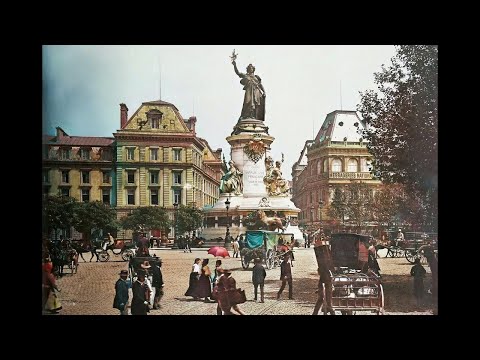
But beyond the iconic landmarks, these photographs capture the soul of the city: the flower vendors, the street performers, the fashionable ladies in their elaborate gowns, and the workers who built the modern metropolis. Each image is a window into a lost world, frozen in time yet bursting with life.
As you scroll through this collection, you’ll notice the meticulous detail that colorization brings—the blush of a child’s cheek, the vibrant hues of a market stall, the golden glow of gas lamps at dusk. It’s not just history; it’s an experience.
So join us on this journey into the past. Let these incredible rare photos transport you to a Paris that no longer exists, but will forever live in our imagination. Prepare to be amazed by the beauty and elegance of a bygone era.
Look closely at the faces in these images, and you’ll see more than just period clothing. There is a spark of optimism in their eyes—a belief that the future was bright and full of promise. The Belle Époque was not just about grand boulevards and glittering opera houses; it was about a society that believed in progress, in art, in the sheer joy of being alive.
One photograph captures a group of children playing near the banks of the Seine, their laughter almost audible through the colorized grain. Another shows a solitary lamplighter at twilight, his silhouette against the soft violet sky as he brings light to the cobblestone streets. These are the unsung heroes of Paris—the everyday people who made the city hum.
And then there are the grand spectacles: the Universal Expositions that drew millions, the glittering cabarets of Montmartre, the fashionable crowds spilling out of the newly opened Galeries Lafayette. Paris was a stage, and everyone—from the wealthiest aristocrat to the poorest street urchin—had a part to play.
But what makes these photographs truly remarkable is the color. Colorization breathes life into history, turning distant ancestors into neighbors, strangers into friends. You can almost smell the fresh bread from the boulangerie, hear the clatter of hooves on stone, feel the warmth of the afternoon sun on your skin.
As you continue through this gallery, pay attention to the small details—the way a woman clutches her parasol, the tilt of a man’s hat, the intricate ironwork of a balcony. These are the fingerprints of a lost world, preserved for us to discover.
The journey is far from over. Ahead, we’ll venture into the hidden corners of the city—the artists’ studios, the bustling markets, the quiet gardens where lovers whispered secrets. Each photograph is a door, and behind every door, a story waits to be told.
Consider the women in their corseted silhouettes, parasols twirling above their heads like flowers in bloom. They move through the Jardin des Tuileries with practiced grace, their laughter mingling with the distant strains of a street musician’s accordion. Fashion was not merely vanity in the Belle Époque—it was a declaration of status, a language spoken in silk and lace.
Beside them, men in top hats and tailored frock coats stroll with canes in hand, discussing politics, philosophy, or the scandalous new paintings at the Salon des Indépendants. The air crackles with debate and ambition. This was a city where ideas were currency, and everyone had an opinion worth defending.
Now look upward, toward the wrought-iron balconies of Haussmann’s grand apartments. Laundry flaps in the breeze beside potted geraniums, a reminder that even amid grandeur, ordinary life persists. A concierge sweeps the doorstep; a delivery boy balances a tower of hatboxes on his bicycle. Paris was a symphony of small, unremarkable moments stitched together into something extraordinary.
Venture deeper into the arrondissements, and you’ll find the city’s beating heart in its markets. The scent of ripe Camembert and fresh oysters hangs heavy in the air at Les Halles, where vendors shout their prices and housewives haggle with practiced ferocity. A fishmonger holds up a gleaming trout; a flower girl weaves through the crowd with baskets of violets.
Nearby, in a cramped atelier above a bakery, a young artist mixes pigments by candlelight. His canvases lean against the walls—unfinished portraits of dancers, dreamers, and the occasional stray cat. History does not always record their names, but these were the hands that shaped the aesthetic of an age.
And what of the children? You’ll spot them everywhere in these photographs—chasing hoops down cobblestone alleys, peering into shop windows, or perched on the edge of fountains with their feet dangling in the water. Their clothes are patched but their smiles are radiant. The future belonged to them, and they knew it.
As evening falls, the city transforms. Gas lamps flicker to life along the boulevards, casting long shadows and a warm amber glow. The cafés fill with the clink of glasses and the murmur of conversation. Somewhere in Montmartre, a can-can dancer kicks her skirt above her head, and the crowd roars its approval.
It is here, in the twilight hours, that the Belle Époque reveals its most intimate face. Not the grand monuments or the glittering expositions, but the quiet moments of connection—a shared glance, a whispered joke, a hand reaching for another in the dark.
These photographs are more than historical documents. They are invitations. They ask us to step through the frame, to walk beside these ghosts of Paris past, and to remember that they, too, once stood where we stand now—alive, uncertain, and utterly human.
So linger a moment longer in that amber twilight. Watch the lamplighter disappear around the corner, his ladder tapping softly against the iron posts. He does not know he is the last of his kind—that electricity will soon make his craft a memory. Yet tonight, he lights each flame with the care of a man who knows his work matters.
And there, on a bench in the Jardin du Luxembourg, a young couple sits close enough that their shadows merge into one. She holds a letter; he holds her hand. They are not posing for history—they are simply living it. A century from now, strangers will study their faces and wonder what became of them.
That is the quiet magic of these photographs. They do not answer our questions; they only deepen them. Every colorized face is a promise that the past was not so different from the present—full of hope, worry, love, and the small daily courage of simply carrying on.
The Belle Époque would not last. Within a decade, the world would be torn apart by war, and the gas lamps would dim for darker reasons. But in these images, that future has not yet arrived. Here, Paris is still a city of light, and its people still believe in tomorrow.
So we leave them where we found them—frozen in a golden moment, forever on the brink of something new. The music fades, the screen goes dark, but the invitation remains: to remember, to wonder, and to see our own world with fresh eyes.
Which of these lost faces would you most like to meet, and what would you ask them? Share your thoughts in the comments below.
Report this article
Select a reason for reporting:






