April 1945. Europe was a corpse-strewn graveyard, and the SS—the most feared instrument of Nazi terror—was bleeding out. Around 200,000 men, fragmented into desperate pockets of resistance, still clutched their rifles. They were the last true believers, ordered by Heinrich Himmler to fight to the death, to execute deserters, to hold cities like Vienna and Berlin until the rubble itself was soaked in blood.
But the end was not a clean surrender. It was a frenzy of fanaticism, betrayal, and cowardice. Himmler, the architect of the death camps, was already plotting his own escape. While teenagers of the Hitler Youth were hanged from lampposts for desertion, their Reichsführer was swallowing poison in a British prison, cheating the hangman’s noose.
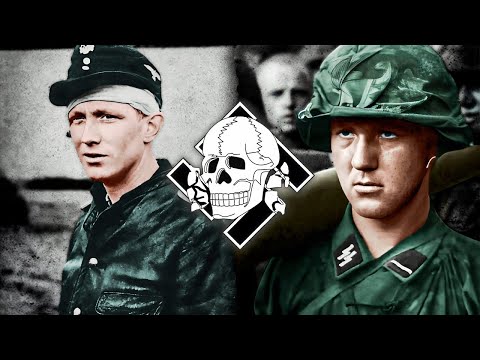
The collapse began in Vienna. On April 6, 1945, Soviet artillery thundered into the Austrian capital. The Waffen SS—hardened veterans of the Eastern Front and barely trained boys—dug in among the baroque palaces and apartment blocks. “No surrender, no retreat, no weakness,” Himmler’s telegrams screamed. But the orders were fantasy. The Red Army, fueled by years of suffering, smashed through the city’s defenses in a week of house-to-house butchery. Civilians were trapped between two hells: SS execution squads behind them, Soviet guns ahead.
By April 13, the swastika had fallen from the Hofburg. Over 19,000 German soldiers lay dead, along with thousands of civilians. The survivors of the SS garrison fled west, hoping to surrender to the Americans or British before the Soviets could take revenge. Most never made it.
In Berlin, the final act was even more grotesque. The 11th SS Division Nordland—Scandinavian and Baltic volunteers—held the government district. Alongside them fought French SS men of the Charlemagne division, a few hundred fanatics who had chosen to die for a country that had already abandoned them. They defended the Reichstag, the Chancellery, the bunker where Hitler’s corpse would soon burn. Children as young as twelve manned anti-tank guns. Old men of the Volkssturm were shot for cowardice if they flinched.
Himmler, meanwhile, had been stripped of power by Hitler for daring to negotiate with the West. His last orders were carried out by men who no longer had a leader. The death marches continued—tens of thousands of skeletal prisoners forced westward, shot when they stumbled, locked in barns and burned alive. “The war is not over,” Himmler had insisted. But for him, it ended on May 23, 1945, with a cyanide capsule crunching between his teeth.
The SS did not die in a blaze of glory. It died in a whimper of forged papers, suicide, and silence. But the horror it left behind—the mass graves, the death marches, the fanatical teenagers hanging from trees—would stain Europe for generations. And the men who survived would vanish into the chaos, some to be hunted, many to disappear forever.
But the collapse of the SS in the field was only one half of the story. In the smoldering weeks after the surrender, another battle began—one fought in filing cabinets, interrogation rooms, and the fog of Allied bureaucracy. The question was simple and monstrous: what do you do with two hundred thousand men who belonged to a criminal organization?
The Nuremberg Tribunal had declared the SS as a whole criminal. But applying that verdict to a teenager conscripted from a Baltic village, or a French volunteer who had never set foot in a camp, was a legal labyrinth. The Americans, British, and French set up denazification boards, questionnaires, and internment camps. The Soviets, less patient, simply shipped their captives east.
In the West, the process quickly became a farce. Millions of Germans filled out forms asking if they had ever been members of the Nazi Party or the SS. Most lied. Many claimed they had been forced. Some were telling the truth. The distinction between a frontline soldier of the Waffen SS and a guard at Auschwitz was often lost in the paper shuffle.
And then the Cold War changed everything. By 1948, the Americans needed a strong, stable West Germany to face the Soviet threat. Former SS men with military experience suddenly became useful. Reinhard Gehlen, the Wehrmacht intelligence chief who had offered his anti-Soviet network to the Americans, was just the most famous example. Others followed—engineers, scientists, propagandists—their pasts quietly buried in exchange for their expertise.
In the East, the German Democratic Republic took a different approach. It condemned the SS wholesale, turned the trials into showpieces, and used the legacy of fascism as a weapon against the West. But this too was a form of forgetting. The East German state declared itself the heir of the antifascist resistance, not the perpetrator nation. The ordinary SS man, the camp guard, the death march driver—they were absorbed into a new narrative of socialist victimhood.
It was not until the 1960s that the silence cracked. The trial of Adolf Eichmann in Jerusalem, broadcast around the world, forced a new generation to ask uncomfortable questions. “What did you do in the war, Papa?” became a question that shattered families. The Frankfurt Auschwitz trials of 1963–1965 put former camp guards in the dock, but by then many had died or disappeared.
The truth is that most SS men were never tried. They went home, found jobs, raised children, and died in their beds. Some joined veterans’ associations like HIAG, which lobbied for pensions and rehabilitated the Waffen SS as a “regular military force.” They published magazines, held reunions, and rewrote history in a thousand small, quiet ways.
Others had already fled. The rat lines—the clandestine escape routes through Italy, Spain, and South America—had carried thousands to safety. Klaus Barbie, the Butcher of Lyon, lived openly in Bolivia. Josef Mengele, the Angel of Death, drowned on a Brazilian beach, never having faced a court. The Vatican, the Red Cross, and sympathetic governments all played their parts, wittingly or not.
By the time Nazi hunters like Simon Wiesenthal began their work in earnest, the trail was cold. More than 1,100 Nazis were eventually located and brought to justice, but tens of thousands were not. The SS did not simply vanish. It dissolved into the fabric of postwar Europe, its members protected by silence, bureaucracy, and the convenient amnesia of a continent eager to rebuild.
And yet the shadow remained. In the archives, in the testimonies of survivors, in the mass graves that still surface in forests and fields, the truth kept leaking out. The SS was not an aberration. It was a choice—made by hundreds of thousands of ordinary men who believed in a monstrous cause or simply followed orders. Their escape from justice was not a historical accident. It was a decision made by the victors, one that would echo through decades of unanswered questions.
The rat lines were not the only escape routes. In the chaos of May 1945, another kind of flight was underway—one conducted not by the guilty, but by the terrified. Thousands of Waffen SS soldiers, many of them foreign volunteers, simply walked away. They stripped off their uniforms, buried their pay books, and melted into the flood of refugees. A Dutchman from the Nordland division could become a farmhand in Friesland. A Frenchman from Charlemagne could slip across the border and be home within a week. The Allies, overwhelmed by millions of displaced persons, had neither the manpower nor the will to check every identity.
But some could not walk away. The men of the Totenkopfverbände—the Death’s Head units who had guarded the camps—knew they were marked. Their emblem, the skull and crossbones, was a confession. They had overseen the gas chambers, the crematoria, the death marches. They had shot prisoners at the edges of mass graves. They could not pretend to be ordinary soldiers.
Many of them tried anyway. Some shaved their heads, discarded their blood-group tattoos, and forged new identities. Others sought protection from the very organizations that had once served the Reich. In the Bavarian Alps, small bands of SS men held out for weeks after the surrender, convinced that the Americans would soon turn against the Soviets and need them again. They were wrong. The Americans disarmed them, processed them, and released most within a year.
In the Soviet zone, the reckoning was different. The Red Army had seen what the SS had done in Ukraine, Belarus, and Russia. Villages burned with their inhabitants locked inside. Partisans tortured and hanged. Jews shot by the thousands in ravines and forests. For the Soviets, the SS was not an abstract criminal organization. It was a personal enemy.
Captured SS men were marched east in columns, often without food or water. Those who survived the journey faced interrogation, forced labor, and the brutal conditions of the gulag system. Between 1945 and 1950, an estimated 70,000 to 100,000 German prisoners died in Soviet captivity—many of them SS. The survivors were not released until the mid-1950s, after Stalin’s death. By then, they were broken men, their ideology burned out of them by hunger and cold.
But even in the East, justice was uneven. The Soviets were more interested in punishing the symbols of fascism than in individual guilt. A low-ranking SS clerk could receive a longer sentence than an officer who had ordered massacres, simply because the clerk had been captured in uniform. The Soviet system, like the Western one, was shaped by politics, not principle.
Meanwhile, the survivors of the camps were scattered across Europe. They had seen the SS up close—the polished boots, the barking orders, the casual cruelty. They had watched their families marched into gas chambers. They had survived the death marches, the frozen roads, the bullets that came when they stumbled. For them, the escape of SS men was not a legal technicality. It was a betrayal.
Simon Wiesenthal, himself a survivor of the camps, understood this better than anyone. He had lost eighty-nine relatives in the Holocaust. He had weighed less than a hundred pounds when American troops liberated him from Mauthausen. And yet he chose not revenge, but justice. He began collecting names, addresses, and testimonies. He opened an office in Linz, then Vienna. He wrote letters, filed complaints, and refused to let the world forget.
His first great success came in 1954, when he tracked down Adolf Eichmann’s former secretary. The trail led to Argentina, where Eichmann was living under the name Ricardo Klement. In 1960, Mossad agents kidnapped Eichmann from a Buenos Aires street and smuggled him to Israel. His trial, broadcast around the world, forced a new generation to confront the Holocaust—and to ask why so many SS men had escaped.
Wiesenthal’s work was lonely and dangerous. He received death threats. His office was bombed. Neo-Nazi groups called him a liar and a traitor. But he kept going, driven by a simple conviction: “When history is forgotten, it is repeated. When criminals are forgiven, they multiply.”
By the time he died in 2005, Wiesenthal had helped bring more than 1,100 Nazi war criminals to justice. But he knew the numbers were incomplete. Tens of thousands of SS men had died in their beds, surrounded by families who never knew—or never asked—what they had done. The silence of the postwar years had protected them. The Cold War had made them useful. And the passage of time had made them invisible.
Yet the shadow of the SS did not fade. In the 1990s, after the fall of the Berlin Wall, new archives opened. Historians found files that had been sealed for decades—operational reports, photographs, personnel records. They found the names of men who had ordered massacres, who had guarded camps, who had driven the death marches. Some were still alive. Some were still living in Germany, drawing pensions, attending reunions, insisting they had done nothing wrong.
The trials that followed—in Germany, in Italy, in Poland—were few and late. But they mattered. They sent a message that the passage of time does not erase guilt. They gave survivors a chance to speak, to face their tormentors, to hear the words “I am sorry” from men who had never before admitted anything.
And yet, for every trial, there were a thousand silences. For every conviction, a thousand acquittals. The SS had been declared a criminal organization, but its members had been absorbed into the new Europe—some punished, many protected, most forgotten.
The survivors of the camps and the death marches carried their testimony like a wound that would not close. For them, the SS did not vanish—it simply changed clothes and names. The men who had guarded the gas chambers became farmers, clerks, and pensioners. Their children grew up ignorant. Their neighbors never asked.
But history has a way of returning. In the 2000s, new generations of prosecutors reopened old files, driven by a simple principle: murder has no statute of limitations. Trials in Germany, Italy, and Poland—against aging men in their nineties—sent a final, unambiguous message. Justice may be slow, but it does not forget.
Yet the verdict of history was never a courtroom. It was the silence of a continent that chose to look away. The SS was not an aberration of the German soul—it was a choice, repeated by hundreds of thousands of ordinary men. And their escape from justice was not an accident. It was a decision made by the victors, one that echoes in every unresolved case, every unmarked grave.
So we are left with a question that refuses to die: What do we owe the dead—and what do we owe the truth?
Report this article
Select a reason for reporting:






