What if the future of aviation wasn’t sleek jets and stealth fighters, but flying pancakes, atomic-powered bombers, and planes that stood on their tails? In the decades following World War II, engineers and dreamers pushed the boundaries of flight into realms that seemed equal parts genius and madness. Some designs promised to revolutionize warfare, while others were so bizarre they were almost laughable—yet each played a role in shaping the skies we know today.
This is the story of the aircraft that defied convention, the visionaries who risked everything, and the machines that captured the imagination of a generation. From the XCG-16 glider, a flying wing that could carry tanks, to the X-13 VertiJet, a fighter that took off and landed on its tail, these oddities were more than just experiments—they were bold statements about what the future could hold.
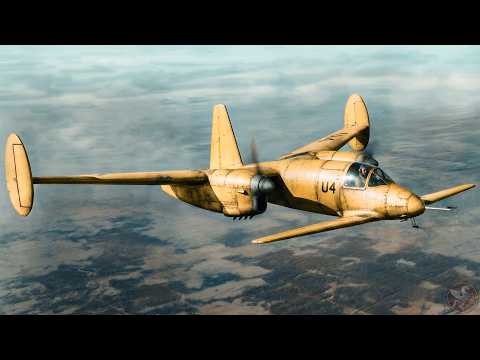
In the 1950s, as the Cold War heated up, the U.S. military poured millions into projects that seemed ripped from science fiction. The Ryan X-13 VertiJet was one such endeavor: a compact fighter designed to launch vertically from a trailer, transition to horizontal flight, and then return to its tail-sitting perch. Test pilots like Pete Girard and Lou Everett trained relentlessly, mastering the delicate art of hovering and docking with a specially designed trailer. “It was like balancing on a beach ball,” one pilot recalled. The X-13 proved the concept was feasible, but its impracticality—poor visibility during landing and the need for constant radio guidance—kept it from operational service.
Yet the X-13’s legacy lived on. Its thrust-vectoring technology, initially mocked as a gimmick, became a cornerstone of modern fighters like the Harrier and the F-35B. The program’s successes and failures provided invaluable lessons for future VTOL designs.
Meanwhile, another audacious project was taking shape: the Convair Sea Dart, a supersonic seaplane fighter that could take off and land on water. With retractable skis instead of wheels, it promised to turn any body of water into an airstrip. On April 9, 1953, test pilot Sam Shannon lifted off from San Diego Bay, marking the first flight of a jet-powered seaplane. The Sea Dart later became the only hydroplane to break the sound barrier, but tragedy struck when a prototype disintegrated mid-air, killing test pilot Charles Richbourg. The Navy’s interest waned, and the program was canceled, leaving behind a tantalizing glimpse of what might have been.
These stories are just the beginning. From the nuclear-powered NB-36 to the asymmetrical Blohm & Voss BV 141, the history of aviation is filled with daring concepts that challenged the status quo. Some flew, some failed, but all contributed to the relentless pursuit of innovation that defines flight.
As we delve deeper into these aviation oddities, we’ll uncover the technical hurdles, the human dramas, and the sheer audacity that drove engineers to build machines that seemed impossible. Stay tuned as we explore the flying pancake, the Spruce Goose, and the atomic bomber that never was.
The Chance Vought XF5U-1, better known as the Flying Pancake, was one of the most striking of these experiments. Designed by Charles Zimmerman, it featured a disc-shaped wing-fuselage that promised to fly at speeds as low as 40 mph and as high as 425 mph—a range that seemed almost magical. Two piston engines buried in the fuselage drove massive propellers that turned in opposite directions, canceling torque and allowing extreme angles of attack. The Navy was intrigued, but the war ended before the Pancake could prove itself. By 1947, the age of jets had arrived, and the propeller-driven oddity was scrapped. It never flew.
Across the Atlantic, the British firm Miles Aircraft pursued a different kind of unconventional: the M39B Libellula, a tandem-wing design meant to solve the visibility problems of carrier landings. With a small foreplane and a large main wing, it looked like a dragonfly—hence the name. Test pilot Tommy Rose found it surprisingly docile, but the Royal Air Force had little interest in a bomber with such an unorthodox layout. The project faded, though its lessons echoed in later canard designs.
Then there was the Avrocar, Canada’s flying saucer. Funded by the U.S. Army and Air Force, it was intended as a vertical takeoff and landing vehicle that could hover like a helicopter and dash like a jet. But the Avrocar proved tragically unstable, wobbling like a coin on a tabletop. Test pilot Peter Cope compared flying it to balancing on a beach ball. The project was canceled in 1961, but its ducted-fan technology influenced later VTOL aircraft.
Perhaps the most ambitious—and most dangerous—of all was the Nuclear Powered Aircraft program. In the 1950s, the U.S. Air Force modified a B-36 bomber, the NB-36H, to carry a live nuclear reactor. The reactor was shielded by 12 tons of lead and rubber, but the crew still flew in a specially armored cockpit with leaded glass windows. The NB-36 made 47 flights, but the reactor was never used to power the engines. The program was eventually abandoned when intercontinental ballistic missiles and aerial refueling made it obsolete.
These aircraft were more than just engineering curiosities. They were expressions of a time when the future seemed limitless and the only limit was imagination. Each design, no matter how impractical, pushed the boundaries of what engineers believed possible. And in doing so, they laid the groundwork for the aircraft that would follow.
As we continue our journey through aviation’s strangest corners, we’ll meet the pilots who risked their lives, the designers who dared to dream, and the machines that, for a brief moment, made the impossible seem real.
One of the most peculiar chapters in this saga belongs to the Bartini Beriev VVA-14, a Soviet machine that looked less like an aircraft and more like a spacecraft from a pulp magazine. Conceived by the Italian-born engineer Robert Bartini, it was designed to hunt submarines by combining the speed of a jet with the buoyancy of a flying boat and the ground-effect cushion of a hovercraft. The VVA-14 could, in theory, take off vertically from water, skim the surface on a bubble of compressed air, and then dash to altitude on its cruising engines.
Bartini was a true original—a socialist idealist who had left Mussolini’s Italy for the Soviet Union, survived Stalin’s purges, and earned a reputation as a wizard of unconventional aerodynamics. His VVA-14 featured two huge lifting fans buried in the fuselage and a pair of turbofans for forward flight, a configuration that promised unprecedented versatility. But the lifting engines never arrived, and the complex machine proved a maintenance nightmare. Only two prototypes were built, and the project quietly died in the early 1970s.
Yet Bartini’s vision of a multi-environment aircraft was not entirely in vain. His work on ground-effect vehicles and vertical takeoff influenced later Soviet ekranoplan programs, including the massive Caspian Sea Monster. The VVA-14 itself now rests in a museum in Moscow, a silent monument to a dream that was decades ahead of its time.
While the Soviets pursued amphibious oddities, the Americans were busy exploring a different kind of radical: the tail-sitting fighter. The Convair XFY-1 Pogo was perhaps the most extreme expression of this concept. Powered by a massive turboprop, it was designed to take off and land vertically on its tail, then transition to conventional horizontal flight. Test pilot James F. “Skeets” Coleman made history in November 1954 when he completed the first full transition from vertical hover to forward flight and back again.
Landing the Pogo was another matter entirely. Coleman had to approach at 300 mph, pull the nose up into a vertical climb, and then carefully reduce power while looking over his shoulder at the ground. A simple traffic-light system on the instrument panel—green, amber, red—told him whether his descent rate was safe. Even so, the Pogo was described as “diabolically difficult” to land, and only Coleman’s exceptional skill kept it in one piece.
The Navy eventually lost interest. The Pogo could never match the speed of jet fighters, and its limited payload and range made it impractical for combat. But the XFY-1 had proven that vertical flight was possible, and its data fed directly into later VTOL programs. The dream of a fighter that could operate from any clearing or ship deck would not die.
As the 1950s gave way to the 1960s, the focus shifted from tail-sitters to fan-in-wing designs like the Ryan XV-5 Vertifan. This machine used enormous lift fans embedded in the wings, driven by exhaust from its jet engines, to achieve vertical takeoff. The fans could generate nearly 16,000 pounds of thrust—three times the engines’ own output—but the transition from hover to forward flight was abrupt and dangerous.
Tragedy struck during a public demonstration in 1965 when an XV-5 crashed, killing test pilot Lou Everett. A second prototype was later destroyed in a rescue-hoist test, killing Major David Tittle. The program was canceled, but the ducted-fan concept lived on in later aircraft and even in the F-35B’s lift fan.
Not all unconventional aircraft were military. The Miles M57 Aerovan was a humble, piston-powered transport designed for short, rough airstrips. With its high wing, bulbous fuselage, and huge rear clamshell doors, it could swallow a family car whole. It was cheap, simple, and surprisingly capable, but the timing was terrible—postwar Britain had little appetite for new aircraft, and Miles went bankrupt in 1947.
Then there was the Ryan XV-8 Fleep, a “flying jeep” that used a flexible Rogallo wing. The wing could be folded up for transport and deployed in minutes, and the whole machine weighed barely half a ton. It was meant to carry troops or cargo into tiny clearings, but early tests revealed severe control problems. A revised version with a proper tail flew better, but by then the Army had decided helicopters were the better answer.
Perhaps the strangest of all was the Avrocar, a Canadian flying saucer that looked like a prop from a 1950s sci-fi film. Powered by three jet engines driving a central turbofan, it was supposed to hover on a cushion of air and then transition to supersonic flight. In reality, it could barely lift off, and when it did, it wobbled uncontrollably.
Test pilot Fred Drinkwater compared flying the Avrocar to balancing on a beach ball. The project was canceled in 1961 after spending millions, but its legacy endured in the development of hovercraft and ducted-fan technology.
These machines were not failures in the traditional sense. They were experiments, and every experiment teaches something. The X-13 taught engineers about thrust vectoring; the Sea Dart proved that supersonic seaplanes were possible; the Flying Pancake showed that extreme low-speed flight was achievable. Each one pushed the boundaries of what was known, and in doing so, made the next generation of aircraft possible.
As the Cold War arms race intensified, another radical concept took shape: the lifting body. These wingless wonders, like the M2-F2 and HL-10, proved that a pilot could guide a spacecraft back from orbit and land it on a runway. Their success paved the way for the Space Shuttle and a new era of reusable spaceflight.
Yet the most audacious project of all was the nuclear-powered bomber. The NB-36H carried a live reactor aloft, its crew shielded by tons of lead and rubber. Though it never dropped a bomb, it flew 47 times, proving that atomic power could be harnessed—but at a cost too high to bear.
From the flying pancake to the Spruce Goose, these machines were more than curiosities. They were bold statements about what the future could hold, and their lessons echo in every aircraft that flies today.
So what do you think—was the age of unconventional aviation a golden era of innovation, or a cautionary tale of ambition outpacing practicality? Share your thoughts in the comments below!
Report this article
Select a reason for reporting:






