In August 1931, a schoolteacher stepped out of her car in Druid Hills, an Olmsted-planned suburb on Atlanta’s edge, to call a mechanic. She left her purse on the front seat. When she returned, something was sitting in her car. It was a baboon the size of an Airedale, belonging to her neighbor—the son of Coca-Cola’s founder. The animal lunged, she stumbled on the door mat, and she fled inside. The baboon took her purse and shredded the cash inside. A jury later awarded her $10,000.
What was living behind that granite wall? And what did the mansion cost the people who kept it? If the hidden life of grand homes is what drew you here, subscribing is the surest way to find the next one. Now, I’ll meet you at the gate on Briarcliff Road.
The money that built Briarcliff was made by a man who would never have built it without his own effort. Asa Griggs Candler was an Atlanta druggist with a sharp mind and a Methodist conscience. In 1888, he bought the rights to a tonic called Coca-Cola. Within years, he owned it outright—for about $2,300, by one account. From 1892, he ran the company as president. He turned a soda fountain drink into a national brand.
His encyclopedia entry describes a man raised on hard work and strong faith. His family remembered his strictness. He gave his children no free money and never forgave their debts. When they borrowed for college, they repaid with interest. In his will, he said the best inheritance he could leave was a good name.
He had four sons and a daughter. The second son, born August 27, 1880, carried his father’s full name: Asa Griggs Candler Jr. The family called him Buddy. From the start, Buddy was a problem his father kept trying to solve.
In 1888, the boy was sent to his aunt’s school for girls in Cartersville, which his father called a good school. In 1895, he joined his older brother Howard at Emory College, then in the small town of Oxford, Georgia. According to his biographer, Sarah Butler, the brothers were thrown out of their uncle Warren’s house in 1898. Howard graduated with honors. Buddy did not graduate at all.
What he did at Emory became a documented legend. He skipped lectures, smoked, and reportedly smuggled a goat into the bell tower. The yearbook called him the class boxer. Butler describes those years as a descent into vice. The jobs his father gave him went no better.
In 1899, he was sent to Los Angeles to manage the company’s West Coast business. He returned home the next year, having struggled, Butler says, with organization and numbers. He became treasurer of a cotton mill in Hartwell, Georgia, and lost control of his finances. But Hartwell gave him two things that lasted longer than the mill.
On July 16, 1901, in Hart County, he married Helen Magee. They had seven children, and Helen became a prominent figure in the city’s civic and social life. In Hartwell that same year, Butler’s research shows, he met a man named Landrow Anderson, who followed him to Atlanta and spent the rest of his working life in Buddy’s service.
The record keeps Helen’s dates and her parties, but only her words. The book keeps Landrow’s name and job, and nothing he ever said. He sold coal, managed his father’s buildings, and helped set up bottling plants. One broadcaster summed up the pattern simply: his father gave him prestigious positions, and always made excuses for him.
Howard was the upright son. Perhaps there is a reason the second son always reaches for the biggest achievements. If he could not outdo his older brother in diligence, maybe he could outdo him in grandeur. Buddy never wrote that down, but his life’s path follows it, project after project.
The first of those projects was a racetrack. In the summer of 1909, Buddy and a group of friends bought farmland in Hapeville, south of Atlanta. He was 28 and president of the new Atlanta Automobile Association. The numbers sounded like bragging. The company was founded with $250,000 in capital. It bought 290 acres, about seven miles from downtown, covering 11 farms. It built a two-mile oval and grandstands for 30,000 people at a cost of $300,000.
The opening meet in November featured 34 races over five days. The track was promoted as the fastest motor speedway in the world. The first race ran on November 9, 1909, for the Coca-Cola Cup. Barney Oldfield, Louis Chevrolet, and Ray Harroun competed. Then the track faded. A driver named Al Livingston was killed during practice in November 1910. Partners fell out over money, in what one account called petty disputes. Big races stopped after that season, and the track never turned a profit.
As Butler put it: “Everyone thought it was just a fad.” The land waited. Fifteen years later, in April 1925, Atlanta’s mayor signed a five-year lease on the abandoned 287-acre speedway and renamed it Candler Field. The first commercial flight left in September 1926, carrying mail for Florida Airways. In April 1929, the city paid $94,400 for the land. Candler Field became the airport known today as Hartsfield-Jackson.
This is Buddy Candler’s pattern in brief: a grand idea, a huge opening, a quiet failure, and then, years later, something useful born from the wreckage. His biographer has a description for it. His legacy, she says, is full of failures, but Atlanta’s skyline was somehow shaped by them.
In 1911, all of that was still ahead. He was a rich man’s son with a failed racetrack, a wife, and a growing family. Within eight years, the family would sell his father’s company, and Buddy would become rich enough to build anything he wanted. They called it “Dreamland,” spread over 40 acres.
In 1919, a group led by a man named Asa Candler—who was said to hate the company—bought Coca-Cola for $25 million. The buyer was Ernest Woodruff. The company had passed from father to sons a few years earlier, though sources differ on the exact date. According to one company historian, Frederick Allen, Howard, Asa Jr., Lucy, Walter, and William each owned 69 shares and controlled it together. Then they sold.
By one account, each of the five received nearly $4 million. Some say the old man was furious. Butler calls it a huge gain for the time. The old man had already let go. In 1916, he was elected mayor of Atlanta as a reformer, and the state encyclopedia notes he handed most of his business interests, including Coca-Cola, to his sons. The diligent father had built the machine. Now it belonged to his children, and they sold it.
Buddy already had land ready for the money. He had even planned a mansion before. In 1909, the Atlanta Journal reported he was planning a $100,000 mansion in Druid Hills. A few months later, another paper, the Atlanta Georgian, reported the house, expected to cost about $100,000, had been abandoned. Perhaps there wasn’t enough money to make the dream real. After 1919, there was.
On Williams Mill Road, he owned a 42-acre farm in the new Druid Hills suburb. The suburb had been planned by Frederick Law Olmsted and the firm that bore his name. In 1908, his father’s company had bought the farm. The Candlers didn’t just live in Druid Hills; they owned the idea of the farm itself.
Buddy’s move with his family to the farm is one of the small mysteries of his life. One local history says 1910, while Butler, relying on newspapers, says June 1911, a few months after a fire in his Inman Park garage destroyed his insured cars. The house’s nomination to the National Register of Historic Places says the family built their first home there in 1912 on land he inherited from his father.
Whatever the date, the farm is the foundation. At first, it was a chicken farm. Butler found an advertisement for it as the largest and greatest chicken farm in the South. Then it became a dairy, a modern one. A trade magazine called The Electrical Review described it in December 1918. The magazine reported that Briarcliff was originally a chicken farm, refitted for dairy production. The barn was cooled in summer by Westinghouse ceiling fans. The barn had concrete floors, electric lights, and steel stalls. The cows drank from automatic fountains and were milked by machine.
During World War I, the farm supplied milk to the Army, with sources differing on whether the site was Fort Gordon or Fort McPherson. This dairy herd had the same appetite for everything Buddy touched. There were 180 registered Holstein cows. One cow was said to produce 44 quarts of milk a day. Silage was harvested by a 15-horsepower electric cutter and blown into a 40-foot silo. In 1920, the herd, which had reached 162 head, was sold. The prize bull sold for $1,500.
The farm was being cleared to make way for something hungrier. The family moved to a house on Oakdale Road while a demolition crew took the farm apart. Buddy hired an architect named Charles Frazier, a Griffin, Georgia, native, later joined by a younger partner, Daniel Bodin. In October 1921, a trade paper ran an announcement that Candler would build a three-story house with ten bathrooms, and that the tile work alone would cost about $30,000.
Candler wasn’t building alone in that suburb. His older brother, Howard, had just finished his own mansion nearby called Callanwolde, complete with its own organ. His younger brother, Walter, was about to build Lullwater on about 185 acres. One Emory University history book makes it plain: it was sibling rivalry that led to Briarcliff. No one in the family admitted it, but the houses admitted it for them.
Buddy did something unusual. He finished the grounds before the house. In August 1921, before the mansion’s interior was complete, the press was given a tour of the grounds, and the Atlanta Constitution, according to Butler, ran a headline that still sticks: 40 Acres of Dreamland. The paper said it would be one of the South’s showplaces. Its greenhouses held six sections for roses, carnations, orchids, and palms, supervised by two flower-arranging experts. There were cottages for the superintendent and the gardener. There was a 250-foot water garden with more than 2,000 water lilies and about 3,000 goldfish.
The public could visit the gardens, but there was also a wall. A granite wall ran along both sides of the property, seven feet high and two feet thick. The house would sit about 600 feet from the gate. A wall that size says something about its residents. It says the world can look, but it stays outside. Seven feet of granite.
Behind it, the main house rose in yellow brick, three stories over a basement on a base of rough granite with carved stones at its corners. Its front door sat under an arched portico about 30 feet high, supported by four Corinthian columns. The roof was red tile. The house was designed in the Georgian Revival style, a look that suggested the old Southern wealth built on Coca-Cola money. According to the National Register, it was completed in 1922, and the family moved in that same year.
For most men, that was enough. But within three years, the house needed a new wing and a room the size of a chapel, plus a cathedral organ in the music room. By April 1925, Briarcliff had added a new wing, and the bricks didn’t match exactly. It’s a small thing, but it tells the whole story. The house was finished, then opened up again because its owner wanted something he didn’t have.
The publisher of his biography notes that the music room was added two years after the main house was built, and its brick doesn’t quite match. But inside, no one would notice. The music room was designed by the young architect Daniel Bodin, and one architecture writer called it his most lavish Tudor-style interior. It reached three stories at its peak, and its walls were carved oak, as was the organ screen. At one end stood a hand-carved stone fireplace, so massive that one report estimated its length at nine feet and its opening at six feet.
Next to the music room, added during the same building campaign, was a guest dining room that seated 75, under a carved wood vaulted ceiling, with a fireplace of imported marble. Beside it, a commercial-scale kitchen was built. The family didn’t need to seat 75 people. The house did. It had become a place to impress Atlanta.
In June 1925, the room received what it was built for. The Aeolian Company made pipe organs for the homes of the wealthy. The instrument it built for Briarcliff was Opus 1542. One history of American organs describes it as a cathedral-sized Aeolian, costing $94,000, with 88 ranks and 187 stops, the largest privately owned organ in Georgia at the time. Butler, who studied its documents, counted 4,764 pipes, including a pair of 32-foot stops. There was a second, smaller organ played in the sunroom. A player roll allowed the instrument to play itself when no one sat at the keys.
According to Butler, Buddy liked to say it was the eighth-largest Aeolian ever built. That was his claim. If you add up the rooms, it would look like a cathedral dropped into a suburb. A music room of about 1,700 square feet, three stories high, and an organ costing $94,000, with 88 ranks of pipes and 187 stops. A dining room seating 75. And above it all, on the third floor, a ballroom 50 feet by 75 feet, with a vaulted ceiling 14 feet high at its peak. All of it, 600 feet from a gate in a granite wall.
In November 1925, a family friend named Palmer Christian played the opening concert. It was broadcast on WSB radio. Atlanta didn’t need an invitation. Its people could listen from their front rooms to music from a house most of them would never enter.
The rest of the mansion kept its own secrets. On the second floor were seven bedrooms and six bathrooms. In the master suite, beneath a fireplace of imported white marble, was a hidden door opening onto the music room balcony. In the basement was a large walk-in vault, built for Asa Candler Jr., still usable decades later. On the third floor, the ballroom walls were gilded, according to Butler. Near the ballroom, behind another hidden door, was a small passage no one recorded the purpose of.
The house was built, floor by floor, to receive the public. That was how Buddy built everything. In November 1922, a company he chaired bought a retired military transport ship called the Logan for $1,180,000. He intended to convert it into a floating school, a college at sea, sailing around the world with 400 students aboard. He told a reporter it was purely a business idea, because only the rich could afford to send their children on such a voyage. But the costs proved impossible. By spring 1923, the ship was sold for scrap and dismantled in Baltimore.
Butler remembers the project differently, with a higher price and a new name painted on the bow. Both accounts end the same way: the ship went to the scrapyard.
The house was also opened for a wedding. The eldest daughter, Lucy, was engaged to a man named Homer Thompson, so a summer porch and a guest wing were added to the house. The National Register nomination says 1924, while Butler places the reception in July 1923. Either way, Briarcliff had learned that every family occasion could be met with a new room.
He owned yachts, too. One was named Hellas, according to Butler, a name derived from Helen and Asa. Another was bought in 1928. He also owned apartment buildings and hotels, and sold a commercial project that same year for $4 million in cash. A family friend once described him in a sentence that could have been carved over the music room door: “He didn’t think in small things; everything that interested him was large-scale.”
By the late 1920s, Briarcliff embodied everything that sentence promised: the wall, the gardens, the organ, the gilded ballroom, the vault. On a winter night, with the organ playing and seventy guests at dinner, it was a house built to be noticed, and perhaps that was the point.
But a house that size doesn’t run itself. There were people to light the fires and set the tables. There were people to drive the cars and tend the roses. And when the census taker came up the long drive in 1930, he counted exactly how many people passed through it. Fifteen servants for one family.
When the census taker came up the drive in 1930, he listed twenty people with the address 1260 Briarcliff Road. Butler studied that census. Of the twenty people living at Briarcliff that year, fifteen were servants and staff. The family that owned the house made up the smaller part of its population. The rest ran the household.
They were spread across the property according to an order as old as great houses. Some lived above the garage in a three-story building of granite and brick, with cars below and servants above. Some had their own cottages. The newspaper that toured the gardens in 1921 mentioned a cottage for the superintendent and one for the gardener, plus two flower arrangers in charge of the greenhouses. The house needed people the way the organ needed air.
Landrow Anderson was among the longest-serving. In the 1910 census, he was listed as a servant to Buddy. He had met his employer in Hartwell in 1901, and by 1906 he had reached Atlanta. In family accounts, he was called Brother Landrow. Butler discovered he rented a small house on the property for one dollar a month. According to her account, he served the family until 1953 and died the following year. Half a century of a man’s life summed up in those few lines, and almost nothing else. No letter of his survives in the records she could find. No interview, nothing of what he thought about the house he managed.
The others appear only as a name beside a job. In the 1920 census, Landrow’s wife, Jessie Anderson, was listed as a servant. Fannie Upshaw was the cook. Eli Johnson was the chauffeur. Ten years later, a man named James Stark was in charge of garden maintenance. In 1929, Buddy hired the pilot Beeler Blevins. The house even had rooms for other people’s servants. Near the covered carriage entrance was a small glass porch, according to one local account, meant for chauffeurs and other staff who arrived with guests. While the guests dined, their drivers could wait in their own glass room, close enough to be called, far enough to disappear.
If you count the household, the true size of the house becomes clear. Its population was 20 in one census, 15 of them working. There was a butler who lived there from 1906 to 1953 and paid one dollar a month for his roof. There were two flower men for the roses and orchids. Seventy-five seats in the dining room, each set, served, and cleaned by hand. A commercial kitchen, a power plant, and two greenhouses. It took 15 people to support one family in a mansion.
In April 1925, the house received three more men from much farther away than Hartwell. Butler traced their arrival from Manila on April 7. Filamon Cruz came as a servant, Vincenzio de Vera as a valet, and Filamon’s brother, Jose Cruz, as head of service. The brothers shared an apartment above the garage, and that apartment still stands. According to surviving accounts, Buddy met Jose on his trips to the Philippines and invited him to Atlanta. Jose was hired for more than opening the door.
The family the staff served was changing, too. On January 29, 1927, Helen Magee Candler died at Briarcliff. She was about 40 years old. The Atlanta Constitution’s headline the next morning called her a beloved woman. She had borne him seven children and buried one, a son named Asa, who died in 1905 at seven months old. She had seen her eldest daughter married at Briarcliff. Then she was gone, and the house kept running without its mistress.
It didn’t take long. In October 1927, nine months after Helen’s death, Buddy married again. The Constitution reported that Asa Candler Jr. had married secretly. His bride was Florence Adeline Stephenson, a woman who had worked as his secretary for nine years. The National Register nomination adds another detail about her. Florence was a talented organist, but no record was kept of the family that formed after the marriage. The secretary who had taken the master’s letters for nine years became the lady of the house, and the servants who had followed Helen now followed her. In a house built around a $94,000 organ, the new Mrs. Candler could play it.
The old man was changing, too, and noticeably. In June 1923, Asa Candler Sr. married for the second time, to May Little Ragin. In February 1924, news from Atlanta reported that Mrs. Asa G. Candler Sr. had been arrested in a police raid on an apartment with two businessmen. In June of that year, he filed for divorce, but withdrew it by December. In 1926, he suffered a stroke, and he died in 1929.
The careful father who built a fortune, who asked his children to keep their good name above all, spent his last years in the newspapers for unfortunate reasons. And his second son had by then realized that a good name and fame are not always two sides of the same coin.
Briarcliff’s record in those years is full of parties, musicales, and dinner parties, while it ignores the hard work entirely. Who lit the first fire on a winter morning? Who polished the brass on the great organ console? Who cleaned the kitchen that fed 75 people? The newspapers don’t say. The names survived because a census taker wrote them down. Those days are gone.
Yet one name from that household soon spread through every newspaper in Atlanta. The Filipino butler, who arrived from Manila in 1925, had been hired for a skill that had nothing to do with serving food. He was a magician. The ballroom filled with magic shows.
After climbing two flights of stairs under a vaulted ceiling, the ballroom at Briarcliff gradually filled with things designed to hide. Buddy’s interest in magic appears in the records around 1925, the year Jose Cruz arrived. According to Butler, the first public trace of that interest dates to 1928. After that, it grew as everything at Briarcliff grew. In 1928, Butler writes, he sent an order to the magic maker Floyd Thayer with a check for $10,000 and a request for one of everything in the catalog. In 1929, he was a founding member of the Atlanta Society of Magicians. By 1930, as Butler described it, the grand ballroom was crowded with magical apparatus. He told people he learned his tricks abroad. One newspaper reported on New Year’s Day 1930 that he had acquired them on his travels to China and India, and that he held a magic show and a raucous party every spring.
The National Register nomination simply notes that he was an amateur magician who entertained his children’s friends. According to surviving accounts, Jose Cruz was his teacher and magic assistant. Grown men also frequented that room, and some were famous. Butler documents visits by two of the most famous stage magicians, Howard Thurston and the man who performed as Dante. Harry Blackstone was flown in on Buddy’s private plane. In 1931, Thurston and an artist called Raymond the Great were listed among the passengers on that plane. For several years, the third floor of a house in Druid Hills was a stage where famous magicians arrived by air.
Near the ballroom, behind a hidden door, a small passage still runs in the dark. Butler believes it was used for vanishing acts, so a performer could disappear from sight in one place and appear in another. It’s just a theory, a good one, but no one who used the passage left a note. Buddy had a bigger claim about his magic. He liked to say that Harry Houdini, the most famous magician in the world, was his close friend and taught him some tricks. Butler searched for that friendship and found something less significant. Houdini’s film company rented an office in a Candler building in New York, and Buddy managed the lease. Houdini died in 1926, before the magic shows at Briarcliff began. He appears never to have made the trip south. The friendship seems to have been one of Buddy’s illusions.
Perhaps there is a reason a man like this fell in love with magic. A magician is loved for a lie the audience agrees to believe. Perhaps Buddy spent his life as a son whose promises went unfulfilled. And here was an art whose essence was the promise. A portrait painted by his biographer: a charismatic, exaggerating man, capable of stirring people’s enthusiasm, a, in her words, merry prankster. A portrait that fits the ballroom perfectly.
Magic wasn’t the only illusion in the room. Those were the Prohibition years, when alcohol was outlawed across the country, and Georgia had banned it earlier. But he drank. His biographer and local histories agree that he suffered from alcoholism and depression for most of his life. In April 1928, the Coast Guard searched his new yacht in Miami and found 88 bottles of various kinds of liquor aboard. He told the passengers, including friends of his 16-year-old twin daughters, that they were small souvenir bottles. Butler said he was involved in rum-running from the islands during Prohibition. Accounts differ on whether it came from Cuba or Haiti, and only one search is documented.
Late in life, he gave an interview statement that might have defined a whole decade: “If I felt any guilt about moral laxity, I suppressed it.” The money still seemed limitless. In June 1928, he sold a controlling interest in a warehouse company for $4 million in cash. In May 1930, he leased the Robert Fulton Hotel for 50 years for $800,000. He and his brother Walter owned a frontage on Peachtree Street valued at more than $3 million. His obituary later credited him with owning as many as 33 apartment buildings and several hotels.
Against these vast sums, a $10,000 check for magic shows was pocket money, and 88 bottles were the price of a weekend. He spent on the city as generously as he spent on himself. Butler credits him with bringing Macy’s to 200 Peachtree Street, which one account calls the first Macy’s in the South. When the Shriners began building their great mosque in 1928, the building Atlanta now knows as the Fox Theatre, Buddy chaired the finance committee and raised a large sum, though not enough to finish it. His real estate company owned or managed a building opened in 1924 as the Bon Adventure Arms, which later became the Hotel Clairmont. On Ponce de Leon Avenue, his company built a nine-story building that would one day be known as the Briarcliff Hotel. At its top was a nine-room penthouse. In the 1920s, this property was just another addition to a long list. The penthouse was waiting for him.
Butler notes that his big sale of 1928 came more than a year before the stock market crash of October 1929. In her interpretation, any ruin that came later, he created himself. For now, the ballroom was full and the house was loud. The organ played downstairs. Upstairs, the butler from Manila was teaching his employer how to make things disappear.
In January 1931, the butler gave his final trick. He gave it in the driveway leading to the house. That was the last trick of the butler in the driveway leading to the house.
At about six o’clock on a Sunday morning in January 1931, James Stark, the gardener, found a car parked in the west driveway. It was January 18. Inside the car were two people, both dead. One was Jose Cruz, the butler and magic teacher who had come from Manila six years earlier. The other was a young woman named Gladys Freaks, who was 19 years old.
The butler’s story of what was known about the previous night was reconstructed from the newspapers that covered the event. On Saturday, January 17, the group had gone to a roadhouse called the Green Dragon in Hapeville, the town where his old racetrack had been. At some point that night, probably between eleven and midnight, near the golf course or the driving range at Briarcliff, shots were fired. Gladys Freaks was hit in the abdomen, while Jose Cruz was hit in the right temple. The pistol was found with them. The newspapers described it as a .32 automatic with a pearl handle and nickel plating, and it belonged to his employer, Asa Candler Jr. Sheriff Jake Hall was told the homeowner did not know the butler had the gun.
In the car, there was also a dagger with an ivory handle. There was also a note, said to be in Cruz’s handwriting, that read: “We, Gladys Freaks and Jose Cruz, are ending our lives because we love each other.” Another report, published later by the Atlanta Journal-Constitution, described a note that blamed the objections of two women, Louise Freaks and Mrs. Clay, and said the couple preferred death to remaining apart forever. The two versions may describe two different notes. The surviving record does not settle it.
Then there were the slates. In the car were two small slates, the kind a child uses in school, and the kind a magician might use on stage. One read: “This is my last trick, and I hope you enjoy the show.” The other read: “Good night, happy new year, and merry Christmas.” It is the strangest thing in the entire Briarcliff story. A stage prop left as a farewell in the driveway of a house that filled its ballroom with illusions. Whoever wrote it knew the house well enough to know what it valued.
There were other notes, and these were never read publicly. Two of them, addressed to Buddy himself, were found in Cruz’s apartment above the garage. Their contents were never published. That same Sunday, a coroner’s jury chaired by Dr. C. E. Battle refused, according to Butler, to let the prosecutor’s investigator show the jurors the letters addressed to the homeowner. The jury concluded that Cruz killed Gladys Freaks and then himself. The investigation was over in one day.
Gladys Freaks was buried on January 20 in Rose Hill Cemetery in Austell. Her gravestone gives her date of death as January 17, the night before she was found. Jose Cruz was buried in Westview Cemetery in Atlanta in a simple pine coffin paid for by his employer. There was no gravestone to mark his place. Decades later, Butler searched for him and found his unmarked grave. She also discovered that the police report on the case had been deleted.
For one day, the house at the end of the long drive belonged to the newspapers. Butler found the story in the Atlanta Journal, the Macon Telegraph, and even the Baltimore Sun. All of it on Monday, January 19. A butler and magician, a girl of 19, a pearl-handled pistol, the driveway of a millionaire’s mansion, and a slate with what looked like a stage cue. Every element was the kind the newspapers print in large type. Later accounts went further, adding details of the scene that no record supports, and these details belong to legend.
James Stark, who found them, was a gardener, one of the 15 people the census had counted the year before. That Sunday, at exactly six in the morning, he had to walk to a car and look inside. The record keeps his name because of what he found, not for any other reason. As for how he felt or whether he continued to serve Buddy, nothing is said.
As for Gladys Freaks herself, the record keeps even less information than it does about the man beside her. Her age, 19, her burial in Rosehill Cemetery in Austell, and her family’s objections, if the second note is to be believed. Whatever hopes she had when she went to the Green Dragon that Saturday night, no one recorded them.
Why did the case disappear so quickly? A question with no documented answer. Butler suspects the family’s influence kept it quiet. That is her interpretation, and she offers it as one of several. What the records do show is how close the deaths were to the family. The gun belonged to Buddy. The car was parked in his driveway. The letters in the apartment were addressed to him. And the public never learned what the butler wanted his employer to know. The house kept that secret. Its walls were built for it.
After that, silence fell over the house. Butler noticed it in the sources. She writes that 1931 was the last year magic appeared in the public discourse about his life. The ballroom full of apparatus remained upstairs. The records don’t indicate whether parties continued in secret. One popular account says he was embarrassed by the publicity and gave up magic entirely. The teacher died and the tricks stopped.
Filamon Cruz, the brother who shared the apartment above the garage, disappears from the story here. The record doesn’t say whether he stayed or returned home to Manila. The house was not used to silence. For ten years, something new had been added every few seasons. A dairy, a mansion, a wing, an instrument, a wedding porch, a ballroom full of illusions. Now its new appetite ended with a car in the driveway and a slate inside it.
Silence settled over the ballroom that winter, but in the same year, something with fur and teeth was already living on the property, and before the summer ended, it would find its way into a neighbor’s car.
The baboon arrived before the zoo did. The popular story of the zoo begins with a telegram. The court record begins somewhere else entirely. The popular story says: during the Depression, on a trip to Hamburg, Germany, Buddy heard about a small circus about to go bankrupt. He bought it. On his return to Atlanta, the two architects who built his mansion, Frazier and Bodin, received a telegram from him. It read: “Bought a circus. Built a zoo.” It’s a perfect sentence, and that’s the problem. The telegram appears in the house’s National Register nomination in 1988, and even there it comes with a caveat. The architects are said to have received it, but the source is only a 1986 student questionnaire. The circus is never named. The phrase has been repeated many times since in newspapers, magazines, and local history books. It is essentially just hearsay.
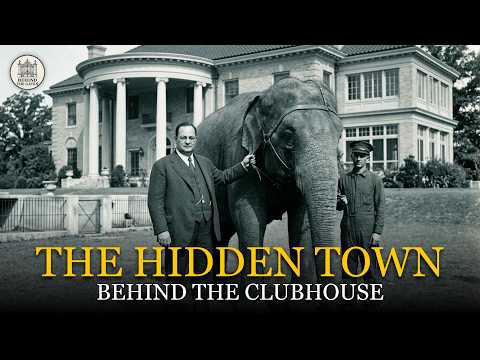
There is a second account, from people who researched seriously. Butler’s research indicates the animals arrived one by one. At the end of 1931, she writes, he bought a bear. At the beginning of 1932, he bought an elephant. Just one, she adds, perhaps to keep the bear company. One review of her book mentions he bought a zoo with elephants, tigers, and monkeys from a farm. At least the elephants have a documented story. Her name was Coca, sometimes spelled Cocoa, and she was a female Asian elephant born in the wild. Records from the Atlanta History Center indicate she arrived at Candler’s zoo via the Hamburg Zoo in Germany. So Hamburg is part of the story, in one way or another. Of all the animals that passed through Briarcliff, she is the one whose path can be traced the farthest, a path much longer than that of the zoos.
Other accounts circle the same idea. Emory University’s alumni magazine says only that he bought the animals in Europe from a struggling circus owner. Jennifer Richardson of the Druid Hills Civic Association, retelling the telegram, adds that he wired the news home and shipped the animals by train. Each account is more lavish than the last, and that is how stories about Buddy evolved, sometimes with his help.
It’s important to know when he was buying. The early 1930s were the depths of the Great Depression. The state encyclopedia notes that Atlanta was more isolated than most cities. Yet the 1930 census showed only 48% of the city’s workforce was employed for wages. On Briarcliff Road, a man who had filled one wing with an organ and another floor with magic shows was offering a bear and an elephant for sale.
Then there are the court records, which indicate the beginning was earlier than either account. In August 1931, months before the bear and the elephant appeared, Buddy kept a baboon. It lived in a cage on the property, and near it lived a deer. Whatever the telegram said, and whenever the circus came, the zoo at Briarcliff began before it was called a zoo.
The court papers tell us the rest, and clearly. A woman named Mrs. M. L. Smith lived nearby. One judge who later heard her case described her as a schoolteacher. On that day in August, her car was parked in her driveway, not working. She left her bag on the front seat and went into the house to call a mechanic. When she returned, she found a baboon in her car. The court described it as a large baboon, about the size of an Airedale. It approached her, the court noted, in a threatening manner. She backed away, tripped on the door mat, fell, and was bruised. She went into the house and shut the door on it. Outside, the baboon returned to the car. It took her bag and destroyed what was inside, which the court classified as money and other valuables.
The deer is a mystery of its own. Where it came from and when, the record doesn’t say. It appeared only because a lawyer needed to explain a hole in a cage. It is the first animal at Briarcliff that no one bothered to write down its name, and it wouldn’t be the last. How it got there was a simple matter of engineering. The baboon’s cage was near the deer’s cage, and as the evidence at trial showed, the deer used its antlers on the wire and tore it. The baboon escaped through the opening. The trial evidence noted it had bitten other animals before.
There was a trial and an appeal, and a verdict published by Time magazine across the country. All of that is part of the story later. For now, what matters is the date. The baboon entered a schoolteacher’s car before the famous zoo officially opened. And there is another thread connecting the events of that year. In the spring of 1931, a few months after the death in the driveway, Buddy and Florence bought a plane of the same model as Charles Lindbergh’s and set out to break his transcontinental record. According to Butler, bad weather and a near-crash ended the attempt.
Grief does strange things to a troubled man, and what follows is only speculation. In one winter, Buddy lost the butler who taught him magic, and with him the hobby that filled his ballroom. Within months, he was chasing a record in the sky, and by the end of the year, he was buying a bear. The record doesn’t suggest one led to the other, but the house always offered something new when the old was finished, and the next new thing appeared. Whatever the order of events, by spring 1932, the animals began arriving in numbers, and they came by train.
On the day the circus arrived in Druid Hills, the animals were shipped in April 1932. First to New York, then by train to Atlanta. That is what the National Register nomination says. Local memory adds another scene. According to Richardson, the animals arrived by train at the small station serving Emory University, a short distance from Briarcliff, and so many students came to watch that the university had to cancel classes that day due to low attendance. It is a story usually told in neighborhoods, and no one has produced a record of empty classrooms. But it suits the man. Everything he did drew a crowd.
The cost of the animals is another number not mentioned in any receipt. Emory University’s news agency, in a report on the house, stated that the cost of the exotic animals brought through the nearby Emory train station was $50,000. The receipt itself never appeared. Someone must have built them shelter. That work fell to Daniel Bodin, the architect who designed the Tudor music room around a millionaire’s organ. One architecture writer noted that Bodin would not have expected to design wild animal cages. The same writer said building the cages was an odd thing for an architect, but he built them anyway. The cages were erected in the northeast corner of the property, near the corner of Briarcliff and University roads. According to Butler, the front garden itself was reshaped with concrete pools and picnic areas. The house that had once been a dairy farm and then a mansion was now full of cages. Briarcliff had never fed creatures that ate this much.
Then came the parade. Butler found the story in the Atlanta Constitution. Buddy walked the animals through the residential streets of Druid Hills, through the Olmsted-planned suburb owned by his father’s company. A reporter covered the event. And the reporter found one spectator worth quoting. It was Buddy’s younger brother, Walter, the owner of Lullwater. The two accounts of what Walter said differ slightly. One says he said: “This is the biggest fool thing you’ve ever done.” The other, also attributed to Butler, says he said: “I think this is the biggest fool thing you’ve ever done, Buddy.” Either way, the brother who built Lullwater stood on a Druid Hills street and watched the animals pass, and that was his verdict.
The number of elephants he was watching is one of the stubborn mysteries. Time magazine described him as the man who owned a zoo with three elephants in the front yard of his Druid Hills estate. Emory, writing years later, mentions four elephants and names them, carefully adding the words from the legend: Coca, Cola, Delicious, and Refreshing. Frederick Allen, Coca-Cola’s company historian, also mentions four elephants, but with different names: Coca, Cola, Boze, and Refreshing. Allen adds that Buddy once used them in harness to plow the ground of his kitchen garden. Other accounts mention six elephants, and they seem to have combined the two lists of names. Three, four, or six. Coca, certainly. After that, the other names sound like a joke about the family drink, and it is natural that Buddy invented them. It is also the kind of detail legend might add.
The only elephant whose name survived in city records is Coca. The rest of the animals are told in scattered dozens of sources. Atlanta magazine mentions Barbary lions. Emory mentions baboons, lions, tigers, cheetahs, zebras, bears, buffalo, elk, deer, and rare birds. Another popular list adds four lions, a Bengal tiger, a black leopard, and even a gorilla, though no record from that period supports a gorilla. The city zoo, which later received the animals, remembers elephants, cheetahs, water buffalo, elk, zebras, birds, a hyena, and a sea lion.
Comparing the numbers shows the scale. Even with doubt, three elephants, or four, or six. Animals worth $50,000 according to Emory. Four lions in one count, one Bengal tiger, a zebra, an elk, and a water buffalo on a farm that once held 180 Holsteins. Buddy was an avid big-game hunter, and his National Register nomination lists hunting among his hobbies, along with sailing, flying, and magic. One newspaper reported that his hunting trophies later went to the Fernbank Science Center in Atlanta.
At Briarcliff now, the animals breathed and roared and needed food. Buddy wanted the public to see them. He called it the Briarcliff Zoo, and according to Butler in a review of her book, he charged an admission fee of 25 cents. It was a private zoo with public admission, located on a residential street in the middle of a suburb designed for quiet.
Animals like these need keepers, and at least one keeper came from the circus. The Elephant Encyclopedia, a database of elephant history, indicates that Fletcher Reynolds was the zoo superintendent, and Al Langdon was the chief elephant keeper. Langdon’s records show he worked as an elephant trainer at Candler’s zoo from 1932 to 1935. Before that, he worked with elephants at an animal farm and in traveling shows, such as the John Robinson Circus and the Dorsey Brothers Circus. A circus man was hired to run a circus on a lawn in a quiet suburb. There was no guidebook for any of this. Langdon had worked with elephants in traveling shows, and now he cared for them on a private estate in view of a mansion surrounded by neighbors on all sides. Whatever his days were like, he left no description that reached us. Like the butler, the cook, and the chauffeur, his name and job remained in the records.
By the summer of 1932, Briarcliff had become something no one in Druid Hills expected. Inside the mansion’s walls, next to a gilded ballroom and a cathedral organ, there were elephants, big cats, and baboons, along with a curator and a keeper from the lumber trade. The neighbors had lived next to a dairy farm, then next to a mansion. They were about to discover what it meant to live next to lions.
Ask the neighbors, and they smelled it first. By the second week of August 1932, the residents of Druid Hills had a complaint, and they wanted it published in the newspapers. Their wish was granted. On August 12, a wire service carried the news beyond Atlanta, under a headline that summed it all up: Candler’s Zoo Angers Neighbors. The report said neighbors claimed the private zoo assembled by Asa G. Candler Jr., heir to Coca-Cola, was noisy and foul-smelling. They asked him to move it to another part of his estate away from their homes. They couldn’t find him to ask. When reporters tried, they couldn’t reach Candler. According to the same account, reports varied on whether he was at the zoo, out for a walk, or out of town. It is a perfect picture of the man in one line. The house was the most conspicuous thing on Briarcliff Road, and its owner could not be found.
Meanwhile, the zoo moved forward with its plans. The official opening was set for Saturday, and the proceeds were to go to a home for disabled children. The program promised four German shepherds pulling a small wagon. It also promised Rosie, described as the largest elephant in the world, who would, according to the account, perform some acrobatic tricks. The record doesn’t specify whether Rosie was one of the elephants other accounts call Coca, Cola, and the others, or a completely different animal. At the very least, the zoo’s show was inspired by Buddy’s personality. A charity opening, a pony-drawn wagon, an elephant performing tricks on a mansion’s lawn.
The zoo superintendent defended his position. He told reporters the cages were always cleaned thoroughly and the animals could not escape. The newspaper did not publish the superintendent’s name. The Elephant Encyclopedia, which tried to reconstruct the zoo’s staff, indicates that Fletcher Reynolds was the superintendent, and he may have made that statement. There is no official confirmation in the records. Whoever it was stood between a millionaire’s hobby and a street full of angry homeowners, and his job that week was to insist that no animal could escape.
But one neighbor, a man named McClellan, had a different view. He told reporters he had seen four workers holding a monkey about 30 feet from his house. He said he believed another animal had also escaped, which he thought was a chimpanzee. Neighbors told the press they preferred not to go to court. But if Candler did not move the zoo, they might ask for it to be removed as a nuisance. The county took the matter seriously. Dr. J. R. Evans, the county health officer, said he would visit the zoo the next day.
If we compare the summer of 1932 with the zoo’s own numbers, it looks like a small war on a quiet street. Four workers chasing one monkey. 30 feet, the distance between the monkey and a neighbor’s door. Four German shepherds and a small wagon for the opening. 25 cents, the ticket price. One county health officer promising to come the next day. And one missing owner.
What the health officer found when he entered the gate, the surviving record does not say. No report of his visit reached us. Nevertheless, the zoo opened. The Elephant Encyclopedia indicates 1932 as the year it opened to the public, and Butler’s research agrees. The description of life next to the zoo is mostly told from memory. Years later, Emory’s alumni magazine spoke with a local historian named Richard Sams, whose older brother remembered the lions roaring at night. Atlanta magazine, writing about the house, described it more clearly: the zoo smelled bad, and animals sometimes escaped. The city zoo, which later inherited the animals, described the same problem in its history. It noted that neighbors ran out of patience with the animals’ noise, smells, and occasional escapes into neighboring properties. The National Register nomination, written decades after the archive, keeps both sides of the story in one sentence. While the zoo was popular, it says, many incidents involved animal escapes. The word “popular” is the key. Those who paid admission enjoyed it. For the families who lived next to it, it was entirely different. They heard lions roaring at night and smelled the cages. The escaped animals mentioned in the nomination were their visitors, and the cars of the curious filled their streets. Butler notes that complaints concerned noise, smells, traffic, and occasional animal escapes. Every item on that list was a price the neighbors paid for a quarter from the public.
The neighbors didn’t stay away from court for long. According to Butler, they sued him, and the county began working on a new tax targeting residential zoos. In Butler’s interpretation, the tax was aimed at him personally. Buddy answered the way he answered most things. He kept going.
Why did he keep going? A question the records cannot answer. But his life’s path suggests an answer, offered here as an interpretation only. The zoo was the first of his projects the whole city could see from the street. The racetrack was miles away in Hapeville. The organ played behind walls, and the magic was in a third-floor ballroom. The zoo was on the front lawn and charged admission. For a man who spent his life seeking attention, it may have been the happiest thing in his life, and the hardest to give up. The parade, the ponies, the charity opening, and the elephant performing tricks all seemed like an attempt to win the city’s favor. And for a moment, according to the National Register, the zoo was very popular. People who bought a ticket for an afternoon went home at night. The neighbors stayed. The owner was a magician in public and absent in private. And private complaints began to pile up.
Reading the newspapers of that summer, one gets the feeling that the zoo had finally outgrown its street. The wall still stands around the property. The gate still opens onto Briarcliff Road. But the smells, the sounds, and the animals themselves were no longer confined to one side of it. The Olmsted-planned suburb now had a zoo in its middle.
One of those incidents reached a courtroom. It happened the previous summer, when the zoo was just beginning. And it would cost far more than a quarter. Ten thousand dollars for a purse.
The case was heard in Decatur city court. The defendant was a Coca-Cola heir. The plaintiff was Mrs. Smith, a schoolteacher who had stepped out of her house to find a monkey in her car. Her suit claimed two kinds of damages: compensation for what she lost, her purse and the money in it, and compensation for the fright it caused her. Her complaint stated she had suffered severe nervous shock and fear, and that the effects would last. His lawyers defended the case on legal grounds. Before the trial, they filed what is known in law as a demurrer, a request claiming that even if all the allegations in her complaint were true, there was no basis for her suit. They said her complaint did not establish his negligence, did not establish his knowledge of the monkey’s viciousness, and that fright alone, without physical injury, was not sufficient grounds for compensation. The judge, Frank Guess, overruled their demurrer, and the case went to a jury.
At trial, the details of the escape were told. The monkey was kept in a cage near where the deer was kept. The deer had antlers, and it used them to cut the wire. As the court later summarized, it was easy for the deer to tear the cage with its antlers, and that is what it did. The monkey escaped through the opening. The evidence also showed it had bitten other animals before reaching Mrs. Smith’s driveway.
As for Mrs. Smith herself, the records keep very little information. The court papers refer to her only as Mrs. M. L. Smith. The dissenting judge mentions her job as a schoolteacher and her health. Her first name, her age, and her fate after the case are not in the sources. She is remembered in law books as “the woman with the purse,” the name she was known by in the case and in the newspapers.
The jury heard all the details and awarded her $10,000. But he appealed. The case went to the Georgia Court of Appeals, and on February 16, 1935, three and a half years after the baboon climbed into the car, the court issued its ruling. Judge Sutton wrote the opinion, joined by Judge Jenkins, the chief judge. They upheld the verdict. The core of their ruling was a very old legal idea. Some animals are tame by nature, and their owners are only liable if they knew of a particular animal’s dangerousness. Other animals are wild by nature, and the baboon is one of them. In this case, as the court noted, the owner’s knowledge is presumed. The opinion summed it up in one sentence: “The owner or keeper of an animal of a wild nature is bound to keep it safe at his peril.” At his peril. If a wild animal escapes, whoever kept it bears the liability, regardless of how it escaped. The escape itself was enough. The court concluded that Mrs. Smith did not need to explain exactly how the baboon escaped; its escape was sufficient. The court said falling on the door mat counted as physical injury, and therefore the accompanying fright could also be counted. The court considered the $10,000 not excessive. The court found one error at trial: the judge’s instructions to the jury on negligence were legally incorrect. But this error was in Buddy’s favor, giving him no grounds for a new trial. His lawyers also asked the judge to instruct the jury that some of her suffering might be too remote from the monkey incident to be counted. The judge refused, and the appeals court upheld the refusal. One judge dissented, Judge Stephens, who wrote a dissenting opinion, the closest the record comes to the rest of Mrs. Smith’s life. He noted she had missed only 13 days of work in September 1931 and 1932, had continued teaching, and had not seen a doctor until months after the monkey incident. In October 1932, more than a year later, she spent more than four weeks bedridden with stress. The dissent noted that her own doctor said that given her age, physique, and general condition, he might not attribute her condition to fright at all. Judge Stephens would have granted a new trial, but his opinion was overruled.
How much money the monkey actually stole is a question the court never answered. The opinion mentions only money and other valuables. The number that appears in every account is from Time magazine, which published the story across the country in April 1935. Time reported that the monkey jumped over the zoo wall and ate $60 from her purse, a figure Time calculated, plus $10,000 in damages, 13 days of missed work according to the dissent, four weeks bedridden, more than a year later. Three and a half years from the moment she entered the house to the final ruling, and one modern estimate puts the $10,000 at roughly $224,600 today, for a handbag, a fall on a door mat, and a fright that never faded.
There is a paradox in the description of time. The monkey jumped over a wall. Briarcliff was built behind a granite wall seven feet high and two feet thick, raised to protect the outside world. It was never asked to protect anything. In the end, the zoo’s own walls could not contain a monkey, and the great wall around the estate withstood nothing.
Some later accounts say the monkey bit her. But the court records say nothing of the kind. They say the animal approached her in a threatening manner, and she fell as she ran from it and shut her door in time. The story of the bite remains a myth.
The case outgrew the zoo, and it outgrew the man himself. Candler v. Smith is still taught to law students today as a lesson in the cost of keeping a wild animal among neighbors. For Buddy, the verdict was a public humiliation and a private bill, and it came at the worst possible time. By the time the appeals court ruled, the zoo was losing money beyond any jury’s capacity to absorb. A zoo unable to pay. The animals ate every day, and in 1933, the money at Briarcliff stopped arriving every day. There is no known feed bill from the Briarcliff Zoo. No one found the weekly cost of meat for the lions, hay for the elephants, or wages for the keepers. What remains is the biographer’s conclusion from the surviving papers. By 1933, Butler writes, the zoo was financially insolvent. It had barely been open a year.
Buddy tried to save it the way he always tried to save things: by building something new. Butler used the zoo’s water features and turned them into a public pool. It was called the Briarcliff Pool, and National Register records indicate it opened to the public in June 1933. The nomination noted the admission fee was 25 cents, with refreshments available. One local historian mentions a snack stand selling hot dogs and Coca-Cola, and a fountain lit after dark. Historians describe the lighting as neon, while Butler believes it was more likely a General Electric floodlight. Either way, on summer nights during the Great Depression, there was a glowing fountain on Briarcliff Road, and cold water for a quarter.
Butler writes that the pool made good money, but it didn’t cover the zoo’s expenses. The rest of that year continued in the same vein as the zoo. Butler’s account of 1933 reads like a list of bills due, so much so that his lawyer sued him for unpaid fees in 10 cases. He had a $10,000 judgment against him from the previous year, over shares he had pledged to the Shriners’ mosque on Peachtree Street and never paid for. That same year, his son John’s plane crashed at the Idle Hour golf course in Macon, and the newspapers mistakenly reported that the pilot was Asa Candler Jr. himself. Butler writes that Buddy sold his private plane that year.
The animals were next to be lost. In 1933, the Grant Park city zoo lost its elephant Maud, who died that year. Records from the Atlanta History Center indicate that Buddy then donated the elephant Coca to the city. Coca was the first elephant to arrive at Briarcliff, and the first to leave it. She crossed the city to Grant Park two years before the rest of the elephants. Butler writes that in the same year, he rashly announced he would close the zoo, then reversed himself and told the public things were fine. If you count that year of lawsuits and losses, the numbers look like a house collapsing. Ten cases due to his lawyer, $10,000 due to the Shriners, his son’s plane parked at a Macon golf course, a family plane sold, an elephant donated, one public announcement and a reversal, and a zoo that took less than two years to go from its grand opening to insolvency.
The outside world was pressing hard on him, too. Butler notes that the Depression hurt the rents from his buildings, which had been his steady income throughout his spending years. She hints that the end of Prohibition in 1933 may have cost him something, though she doesn’t specify what. It ends there. Whatever the source of the problem, the money that once seemed limitless now had a limit, and the zoo was standing on it.
1934 was worse. He looked for a buyer for all his animals and, in Butler’s words, found no buyer at a price he considered fair. He talked to the city zoo. He talked to a potential buyer in New York. Neither paid what he asked. Meanwhile, the lawsuits continued. In 1934, the court ruled against him over zoo equipment, picnic tables, and furniture. His lawyers argued that the zoo was a corporation, a separate business entity that could be sued separately, which would have protected him personally from its debts. Butler writes that the judge rejected his claim that the zoo was a corporation. The zoo was his, and so were its debts. That same year, his daughter Helen hit a small child with her car, and the child’s family sued. The Candler family, which had filled society pages, now filled court dockets.
The neighbors’ biggest lawsuit was still making its way to a verdict. So was the baboon case. In February 1935, the appeals court recorded its $10,000 judgment as final.
From this distance, it is easy to mock the elephant on the front lawn. But it is harder to watch the man. For three years, he struggled to run a circus on a residential street during the Depression, while his neighbors sued him and his county taxed him. He tried selling tickets and holding charity events. He tried building a pool. He tried announcing its closure and then reversing himself. Every step was driven by the same instinct: the instinct that built the racetrack, the floating school, and the organ. When something fails, make it bigger. And when that fails, make it louder.
The house itself kept its outward appearance. The organ still stood in the music room. The vault was still in the basement. The pool still glowed after dark, and swimmers still paid a quarter. From the road, behind the wall and the long garden, Briarcliff looked as it had in 1925. Only those inside knew how the bills were piling up, and the servants, as usual, left no record of what they saw.
Briarcliff had always met problems with a new room. This time, there was no room left to build. In early 1935, he offered to give up almost everything that had made Briarcliff famous. The animals were moved to Grant Park. In spring 1935, Time magazine spread the news across the country that a Coca-Cola heir was trying to give away his home. The magazine’s report was brief and quiet. It said Buddy had offered his house to the Decatur post of the American Legion, and his zoo to the city of Atlanta. He also offered for sale his pipe organ, the $94,000 Aeolian in the music room. A man who had built, by most readings, a house more magnificent than his brother’s ten years earlier was now trying to donate it to a veterans’ club.
The house stayed with the family. In the end, there was no need to sell the organ. The zoo was another story. The Grant Park city zoo had its own history with bankrupt shows. It was founded in 1889 when a traveling show stopped near Marietta after its owner went bankrupt. A businessman named George Valentine Gress bought the animals at auction and donated them to the city, and the zoo opened in Grant Park that April. The state encyclopedia notes that among those first animals were four lions, a hyena, and several monkeys. The following year, the first elephant, Cleo, arrived. In other words, the Atlanta public zoo began with a businessman rescuing a failed circus. More than forty years later, the zoo grew again by rescuing another circus.
According to the zoo’s own account, Buddy made his offer with a condition: he would donate his wild animals to the city if the city raised enough money to house and care for them. Atlanta responded with its first major fundraising campaign for a zoo. The newspapers launched a donation drive in the midst of the Great Depression. But it wasn’t enough. The state encyclopedia indicates the campaign did not raise enough money to move all his animals to the city zoo.
The final account differs by source. The zoo’s own history and its National Register nomination indicate that Buddy donated the collection. Butler, who examined the papers, tells the story differently. In 1935, she writes, he arranged the sale of his zoo to the Grant Park zoo for $20,000. She adds that this was less than the price he asked, and far less than the animals had cost him. According to her account, the remaining animals went to farms and circuses. A conditional gift that became a discounted sale with the remaining animals distributed randomly might reconcile the two accounts. But the records are not clear enough to confirm.
Whatever the papers say, the animals moved. The zoo remembers their arrival in its history. In 1935, it says, the zoo’s animal population grew with the arrival of the entire Briarcliff Road collection. Elephants, tigers, water buffalo, elk, zebras, birds, a hyena, and a sea lion. Among them was a tiger named Jimmy Walker, who became the first tiger at Grant Park. The encyclopedia’s list differs slightly. Tigers, a leopard, a llama, bears, a baboon, and several monkeys. Some animals are said not to have reached the zoo. There is no record specifying whether the baboon mentioned is the same one that climbed into Mrs. Smith’s car.
Compared to the city zoo, Buddy’s folly was enormous. The incoming animals were enough, by the zoo’s own estimate, to more than double its size. A collection that began with a bankrupt circus in 1889 was doubled by a bankrupt rich man’s hobby in 1935. The cost, by Butler’s estimate, was $20,000, after a newspaper fundraising campaign that failed at the height of the Great Depression.
The city was not ready for them. The zoo’s history, as summarized by a student project at Georgia State University, notes that the city could not build the new cages in time. The zoo became crowded. The animals got sick or were injured in fights. The animals that had been paraded through the Druid Hills hills were now crammed into a public zoo that could no longer hold them. And at least one familiar figure left with them. Al Langdon, the circus elephant man who had kept the animals at Briarcliff, is listed as an elephant trainer at the Atlanta zoo in 1935. He later worked at the Brookfield Zoo. The keeper followed the elephants across the city and then left.
Back on Briarcliff Road, the cages were removed. The National Register nomination indicates the zoo was dismantled in 1935. Half a century later, surveyors for the nomination found that all that remained were concrete slabs and foundations for cages and animal houses. Even with the animals gone, the bills kept coming. That year, Butler writes, the verdict came in the largest of the neighbors’ lawsuits, forcing him to pay damages for the effects of his zoo on his neighbors. The baboon case had been upheld in February. The neighbors’ case was decided the same year. Buddy paid for the zoo twice. Once to buy the animals, and again for liability for them. The price of their departure, the record does not say.
He left no letter about the day the elephants left his estate. He had paraded them through the suburb to his brother’s mockery. The elephants left after a failed fundraising campaign. According to Butler’s account, the price was less than he asked. For a man who measured himself by the size of his possessions, this was a public contraction published in Time magazine for the whole country to read.
There is a strange justice in the animals’ fate. The house swallowed them as a private marvel, something to be shown off, sold, and boasted about. The city received them as a public good. Butler counts the Atlanta zoo, as it is now called, among Buddy’s lasting gifts to the city. She is right. He intended to own a private zoo, and he ended up helping to establish a public one. The failure was his, and in the end, the elephants belonged to everyone.
The zoo disappeared from Briarcliff, but the passion that brought it there only changed its address.
Wealth went to the cemetery. After the zoo, Asa Candler Jr. found a new project, and this one was built to last forever. It was a cemetery, Westview in Atlanta. In 1930, Buddy became president of the cemetery association that ran it. In June 1933, in the midst of the zoo’s collapse, he took full control. One local columnist wrote that he spent lavishly there, adding a cafeteria, a flower seller, an ambulance service, and a funeral home. A man who couldn’t keep a profitable zoo in his own yard found a project whose customers never complained about the smell.
His life in those years was falling apart. In 1936, he donated a memorial cup to a Florida yacht club near his summer home as a prize for an annual race named after him. About a month later, Butler writes, his yacht burned. She describes the timing as suspicious given his financial state. It is only a suspicion, and the record proves nothing either way. Later that year, his younger brother William died in a car accident. Buddy dedicated a private white marble mausoleum to him at Westview, on the hill above the plot where he himself would one day be buried.
Somewhere in those years, Buddy stopped drinking. Sources differ on when. One account says the late 1930s, while Butler says the early 1940s. A later report of a 1951 interview says he credited his surrender to God with easing his alcoholism, depression, and other problems. Butler notes he became close to senior Methodist and Southern Baptist officials, and the massive building he was planning took on a religious meaning for him.
The massive building was a mausoleum. Butler writes that planning began in 1942 for what would become the largest single mausoleum building in the country. Construction of the Westview Abbey began in 1943. It was designed by Clarence Lee Jay and Cecil Bryan in the Spanish Colonial style, and it held 11,444 crypts. The Georgia Trust for Historic Preservation described it as the largest building of its kind under one roof when completed. Yet its third floor was never finished. Butler writes that the building remains incomplete to this day. The house that once held wings for organs, ballrooms, and cages now had a rival on the other side of the city, and this one was built for the dead.
Butler couldn’t resist the lure of the water. In 1939, he writes, he bought a 55-foot Chris-Craft boat for $40,000 and named it Clairmont. That same year, he opened his own marina, the Thunderbolt Yacht Basin near Savannah, on land that cost $200,000, plus another $75,000 for construction. The marina still stands today. The Clairmont mansion didn’t stay his for long. During World War II, it was seized for the war effort and never recovered.
Money had to be raised, and Briarcliff had to raise it. The estate expanded into a commercial laundry, and again the dates differ. The National Register says it ran about eight years before a fire in 1943. Butler dates its opening to 1938 in one place and 1940 in another. She describes it as the largest laundry and cold storage plant in the Southeast. The evidence, she writes, suggests it was meant to pay for the cemetery.
His sons John and Samuel ran it. Customers came to the mansion to drop off their bags. During the war, its free services to the Army caused a dispute with the government. Then, in 1943, the laundry burned. The nomination calls the fire mysterious. Butler writes that the insurance was not enough. In April 1944, Buddy and his two sons stood before a federal court on charges of federal fraud related to the fire. All three were acquitted.
Even the music room did not escape the war. During World War II, National Register records note, the music room balcony was used to store radio transmitting equipment in case of attack. The attack never came, and the equipment was never used. The balcony, reached through a hidden door from the master bedroom, now held a radio waiting for an emergency.
If the last great expenses are counted in numbers, a new rival to the house appears: 11,444 crypts under one roof with a third floor never finished. A laundry so large it was called the largest in the Southeast, eaten by a fire in 1943. A 1944 trial, three defendants, and three acquittals. And in 1946, by Butler’s account, the Candler warehouse sold for $1,600. It was part of a second wave of sales that reached all the way to his father’s old mansion on Ponce de Leon Avenue.
The family paid in other ways. John Howard Candler, the eldest surviving son, who by one account lived a Gatsby-like life of luxury in his youth, and who caused a plane crash in Macon, died in 1947. One account says he died after undergoing experimental treatment for alcoholism. No other source confirms the treatment. And the family history published by Elizabeth Candler Graham in 1992 offers a darker account of the whole family. By its count, 10 of Asa Candler Sr.’s 22 grandchildren became alcoholics, and six of them died from it. The loving father left his children a fortune and a good name. Some of them inherited something else as well.
Buddy was in his late sixties. The zoo was gone, the magic was gone, the yacht and the laundry were ashes, and his eldest surviving son was dead. Briarcliff still stood behind its walls, with its organ and its vaults and its ballrooms telling forgotten stories. But it had grown too large for what remained of the family fortune.
In 1948, Asa Candler Jr. sold Briarcliff. The buyer was the United States government, which planned to turn the estate into a veterans’ hospital. Candler left the house that year, leaving most of his furniture behind. The house was about to be used in a way he would never have chosen. The clinic opened the year he died. But the veterans’ hospital the government planned at Briarcliff was never built.
The National Register nomination records the sale plainly. The Candlers sold the property in 1948 to the United States government for a hospital that was never built. Even the details of the sale are uncertain. Some accounts indicate the buyer was the General Services Administration. Butler dates the agreement to 1947 and names the state. A later reading of tax records indicates the transfer took place in 1949. No source consulted mentions the sale price.
What is certain is Buddy’s destination. He moved into a luxury apartment on the top floor of the building his company had built on Ponce de Leon Avenue, nine stories, nine rooms. By then, the building had a familiar name: the Briarcliff Hotel. He left Briarcliff and moved into a hotel that bore its name. Florence went with him, the woman who had been his secretary and then his lover, who could play the organ, and who now lived with him in an apartment above one of the city’s streets.
He spent his last years dismantling what was left. Butler’s account of those years is a series of endings. In 1949, at Westview, he ordered all landscaping work stopped. Families who owned plots in the cemetery sued him. In 1950, she writes, he began liquidating his assets despite those suits. In her account, he intended to declare bankruptcy so he could leave everything he owned to his family. Butler sold the Westview house itself in 1951 or 1952, sources differ. Then the organ left the house.
In 1952, through Bishop Arthur J. Moore, it was donated to Wesleyan College in Macon. Butler found its value after dismantling was $50,000, and installing it would cost another $40,000. Years passed before it was played again. The smaller organ from the sunroom had already been moved to a church in Westview named after Florence.
That same year, 1952, the state of Georgia bought Briarcliff. A year earlier, Georgia had established a commission on alcoholism. On January 11, 1953, Asa Griggs Candler Jr. died at the Briarcliff Hotel at the age of 72. Sources differ on the cause. Butler’s research indicates a malignant tumor of the liver, while other accounts say cancer. One magazine describes the death as liver disease caused by alcoholism. He was buried in Westview Cemetery among the dead on whose housing he had spent his last fortune, not far from the white marble mausoleum he built for his brother William.
He was a broken man at his death, yet the evidence Butler found indicates he still had money. His fortune was about $2 million, which she considers a fraction of what he once had. He left it to Florence, to his surviving children, and to his servants. Butler’s figures vary slightly from source to source. In one, he left $8,500 to each of seven of them. In another, she counted eight servants in the will.
If the final numbers are added, the graph is complete. About $4 million when Coca-Cola was sold in 1919 by one account, and about $2 million left in 1953. $8,500 to each of the people who cared for his house. $50,000 for an organ that cost $94,000, and another $40,000 to move it. 72 years of life, more than a quarter of them in the mansion.
Landrow Anderson, the butler he met in Hartwell in 1901, served the family until 1953, the year his employer died. Anderson died the following year. More than half a century between that first meeting in Hartwell and the end, and the record still holds his name, his job, a rent of one dollar, and those two dates.
In 1953, the same year Buddy died, the state of Georgia opened its new clinic in his house. It was called the Georgia Clinic. The National Register nomination describes it as the state’s first treatment and residential center for alcoholics. Patients came to stop drinking. The rooms that once housed a family and its guests now housed them. The chaplain who directed religious therapy at the clinic, the Reverend Raymondo de Ovies, had the great music room, where the organ had been played for radio, renamed for him: the de Ovies Room. A gate was built at the entrance, and the pool made from the zoo’s fountains stayed open to swimmers for a few more years.
There is no way to know what Buddy thought of that. The man whose life and history documented his alcoholism, who once told an interviewer he suppressed any guilt about moral laxity, died in the year his house opened to people trying to stop drinking. The house was no longer a refuge for the man’s appetites, but a refuge for their cure.
Asa Candler Sr. willed his children the best inheritance: a good name. But one of his sons spent his life making that name famous. In the end, the house that name built was handed over to restoration, and became the property of the state. But on the other side of the city, the animals he sent away in 1935 were living out his folly in public, and one of them lived in Grant Park long after his zoo closed.
It was Coca, the elephant who outlived the zoo. She arrived via the Hamburg Zoo, walked on the grass in Druid Hills, crossed the city to Grant Park before most of her companions. She reached the city zoo in 1933, after being abandoned following the death of the city’s elephant, Maud. In city records, her name is usually written Coco. Two years later, the rest of the Briarcliff animals followed her across the city to a zoo that could not hold them all then. So when the rest of the Briarcliff animals crowded into Grant Park in 1935, the tigers and zebras, the elk and water buffalo, and the tiger named Jimmy Walker, Coca was already there. She had crossed first, alone, as a replacement for a dead elephant.
Over the next fifteen years, Coco survived a rich man’s experiment and lived in a public place in a park that had once been a refuge for a bankrupt circus. Coco outlived the zoo that brought her to Atlanta by fifteen years, and outlived the house’s life as a family home. She was still standing in Grant Park in March 1950 when she died. The Atlanta History Center keeps the photographs. What happened to her body is a strange story in itself. The history of the city’s lost animal graves describes a tow truck lifting the elephant’s carcass and carrying it to the Atlanta prison farm on Key Road. There, the city buried its zoo animals. The same history notes that among the most famous burials there were the elephant Maud in 1933 and the elephant Coco in 1950. The elephant Coco was sent to replace the other elephant, and ended up in the same place, far from both the zoo and Briarcliff.
Then the children of Atlanta did something Buddy might have admired. They raised the money themselves to buy two new elephants. Atlanta History Center records indicate they were Coco the Second and Penny, and they were welcomed to the city with a celebratory parade downtown. Years after an heir paraded his animals through Druid Hills to his brother’s mockery, the city held a parade specifically for elephants, and this time, the parade belonged to everyone.
If Coco’s life is counted in years, it was longer than any of Buddy’s adventures. 17 years in Grant Park from 1933 to 1950. A year or so on the grass at Briarcliff, and before that, the long road from the wild to Hamburg. Two elephants bought by children to replace her. One grave at a prison farm. And 61 years between the founding of the city zoo in 1889 and her death.
As for the other elephants, the records are silent. Whether there were three, four, or six, and whatever their names, their names and fates were not recorded in any record found. Butler says only that the animals not sold to the city went to farms and circuses. That silence bred a legend. For years, Druid Hills residents told each other that Buddy Candler had buried elephants all over the neighborhood. Butler heard the story and denied it completely. None of it was true. The only known grave of one of his elephants is at the prison farm. And the Druid Hills gardens hold nothing larger than their roots.
The zoo itself had a long and uneven path afterward. In 1959, a lowland gorilla arrived and was named Willie B. after the mayor, William B. Hartsfield. He was the same Hartsfield Buddy had once approached about Candler Field. In 1984, Parade magazine ranked the Atlanta zoo among the 10 worst in the country. In 1985, a new nonprofit was founded to run it. It was renamed Zoo Atlanta and rebuilt. Today, it receives more than half a million visitors a year. Butler counts it among Buddy’s legacies, along with the airport built from his racetrack.
His other possessions scattered widely. According to Butler, the collection of magic apparatus that filled the ballroom to the ceiling in the early 1950s was valued at about $50,000. It was sold piece by piece. Harry Blackstone, who had once traveled on Buddy’s plane to perform, was among the buyers. The fate of the rest of the collection is unknown. At least one piece has been found. Butler found one of his tricks from the magic maker Floyd Thayer, a device called the phantom shipping crate. A trick called a crate is a fitting thing to survive the zoo.
By one account, his hunting trophies went to the Fernbank Science Center. The great organ was finally installed at Wesleyan College in 1958, and Florence was present among the audience, according to Butler, at its dedication. In 2008, it was rebuilt at a cost of $1 million, and today it is played as the Goodwin Candler Panos Organ, with nearly 5,000 pipes. The instrument that radio carried from Briarcliff in 1925 still makes its sound in Macon.
In Westview Cemetery, two men from the same house lie in the same place. Asa Candler Jr. is buried there under his name. So is Jose Cruz, the butler who taught him magic, in a simple pine coffin paid for by his employer, in an unmarked grave that his employer’s biographer found only decades later. Florence, who died in 1977, rests in Westview too. And the great abbey still stands above them all, with its third floor unfinished.
Everything that could be moved from Briarcliff was moved. The organ, the magic, the trophies, the animals, the family. Only the house itself remained. And the house was about to get a strange neighbor.
It still stands behind the wall. In 1965, the state opened a mental hospital on the southern part of the old estate. The mansion acquired a stranger neighbor than any lion. It was called the Georgia Mental Health Institute. It rose like a multi-story tower surrounded by smaller cottages. According to several accounts, the cottages were connected to the hospital by underground tunnels so patients could move between their wings and the main building without going outside. In 1973, the mansion itself was renamed the DeKalb Addiction Center, and it continued to treat patients in the old rooms of the house. By the late 1990s, the institute had become a state psychiatric hospital with 141 beds on 42 acres with a budget of $24.5 million. In 1997, the state proposed closing it. The hospital was evacuated, and the mansion with it.
In 1988, Briarcliff was listed on the National Register of Historic Places. The year before, the addiction center was still treating patients inside it. Surveyors toured the site that year and noted what remained of the zoo. They wrote that all that remains today are concrete slabs and foundations for cages and animal houses. In 1998, Emory University bought the property for $2.9 million. The tax assessor measured it at 41.6 acres. Emory planned a biotechnology center there, but the plan stalled. The house was boarded up and has been so since the 1990s. Water leaked through the roof, and the ceiling of the third-floor ballroom, where the magic shows were held, collapsed. Mold spread through the rooms. In August 2007, the county heritage preservation commission began formal proceedings against the owners for demolition by neglect, and Emory promised repairs. One estimate around 2015 put the cost of restoring the house to a habitable state at more than $14 million. A plan for a 54-room boutique hotel was approved in 2016, but was never built.
Let’s count the house’s second life in numbers: 141 beds, $24.5 million a year to run them, $2.9 million to buy the whole property, 41.6 acres, and more than $14 million, by one estimate, to save it. A house that once cost only $94,000 for its furnishings became, for a time, a burden no one wanted to bear.
After it became empty, it found a new audience. Film crews arrived. One of the old institute buildings played a secret government lab in Stranger Things. The mansion appeared in The Vampire Diaries and Doom Patrol. A man who always loved an audience above all finally found a wide one, even if it was watching his house pretend to be somewhere else. David Payne of Emory University says different film crews invested over the years in maintaining the mansion. The cameras, in a sense, kept its roof up.
An abandoned mansion behind a mental hospital, ghost stories piling up around it like ivy on the walls. People say its hallways are haunted. Writing on the walls of the old balcony is said to read: “bled blood.” One legend is about Buddy himself, that he drank alone on the music room balcony, glaring angrily at his guests. They say his ghost still does. Every story has its clearer side. The house’s dark reputation was largely built during its years as a hospital, when it housed patients, and in the decades that followed when trespassers left their marks on its walls. The story of the scowling drunk on the balcony, Butler says, is a modern invention with no evidence. As for the rest, the footprints and the cold rooms, no record proves or disproves them. It remains suspended.
The house’s story did not end in ruin. In June 2022, a long-term lease was announced for about 32 of the 42 acres to a company called Gallery Living, which planned a senior residential complex of nearly 500 homes called Corso Druid Hills. The hospital buildings, including the Stranger Things lab, would be demolished. The mansion would be restored. The company’s founder, Tim Gary, said the house would be fully renewed and restored while preserving its gardens and greenhouses. Vice president of construction Kelly Painter put it simply: “We love the historic character of the property.” She added that the plan is to remove everything added after the 1950s. The mansion will be converted into a place for weddings and gatherings, in collaboration with an architecture firm specializing in old buildings. Butler says the open garden that once held the zoo will be returned to public use. Butler, who spent years studying the house, admires the way it was built. “They don’t build them like that anymore,” she said. By summer 2026, construction was expected to begin that fall, and to take several more years.
The wall still stands, seven feet of granite, two feet thick along the old edges of the property, the same wall built to shut out the world and keep the wonders of the place. But it kept out neither. The world came in to see the gardens, the organ music was played over the radio, the elephants were carried across the city, and a baboon escaped its cage and, as the Times reported, jumped over the zoo wall and entered a neighbor’s car. The wall was never anything but the house itself, and the house is the only thing that never left.
Asa Candler Jr. spent a vast fortune and a long life trying to become the biggest of the Candlers, and most of the time he failed. The racetrack failed, the floating school failed, the zoo failed, and the cemetery was never finished. Yet the racetrack became an airport, the zoo helped build a public zoo, and the house he could no longer afford became a place where people came to recover. His biographer sums him up in one sentence: “Everything he did was for Atlanta.”
On a summer day in 1931, a schoolteacher stepped out of her house on a quiet street in Druid Hills to find a monkey sitting in her car beside her purse. It had come from behind the granite wall of her neighbor’s estate. Nearly a century later, the house still stands behind that wall, waiting to be reopened. And the question asked that morning has not entirely disappeared: what did it all cost, and who paid for it? If you had lived on Briarcliff Road in 1932, would you have paid a quarter to see the elephants, or would you have signed the complaint against them? Tell me in the comments. And if you want more stories from behind the gates, subscribe, and I’ll see you next time.
Report this article
Select a reason for reporting:






