Captain Ryan Pruitt had three seconds to live with what he was about to do. His finger was already inside the trigger guard. The safety was already off. Four meters away, a farmer named Rahim knelt in the dirt with his hands raised—and then lowered one hand toward a low mud wall. Every training scenario Pruitt had ever absorbed told him this was the moment before an attack.
Then a hand closed over the barrel of his rifle and pushed it toward the ground. A voice with an accent that still sounded foreign after three weeks spoke four words that would follow Pruitt for the rest of his career: “Put that gun down.”
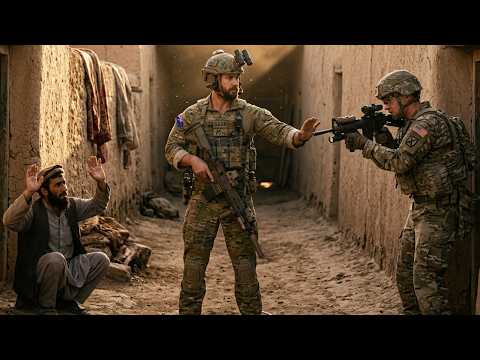
Pruitt didn’t know it then, but the man kneeling in the dust was no insurgent. Rahim had walked eleven kilometers that morning to buy diesel for an irrigation pump. The soldier beside Pruitt—a corporal in the Australian Special Air Service Regiment who had spoken barely a dozen words to him in three weeks—had made calculations Pruitt’s training never prepared him for.
All Pruitt knew was that the man with raised hands had also, half a second earlier, made a movement that every course he’d ever taken identified as a threat. His mind was already rehearsing the justifications he would need to present later. He was certain, in the adrenaline-charged logic of that instant, that he was watching a threat materialize exactly as his training had promised.
What he didn’t see was the boy beside Rahim—his twelve-year-old son—beginning to speak rapidly in Pashto, his voice rising toward panic, repeating one word that neither Pruitt nor the young soldier beside him understood. But the corporal did. The boy was saying his father’s leg had given out. That Rahim needed to hold the wall or he would fall.
Nineteen minutes later, that same corporal was pulling Rahim’s nephew from a collapsed grain storage—working with his bare hands until his knuckles cracked, because the boy had been trapped for six hours and no one else had thought to check. By the end of that day, Pruitt realized he had misread nearly everything about the man standing beside him—and that the four words that had felt like the greatest insult of his career were, in fact, the only thing that stood between him and a mistake he would have carried for the rest of his life.
But to understand how a corporal barely known to him came to make that split-second judgment—and why it would reshape everything Pruitt believed about discipline, rank, and trust—we have to go back to the beginning. To the moment Pruitt first arrived at Forward Base Ripley in the spring of 2011, carrying a resume that made him, on paper, one of the most qualified American officers in the joint task force. Twelve years in the infantry. Two combat tours in Iraq. A Ranger tab. And a reputation among his peers for a kind of methodical rigor that bordered on stubbornness.
He believed in rules of engagement the way other men believed in scripture—not because he was rigid by nature, but because he had seen, early in his career, what happened to units that treated those rules as optional. He had watched a platoon leader in Ramadi make a split-second call that turned out to be wrong, and he had watched that man carry the weight until it broke something inside him that never fully healed.
Pruitt’s answer to that memory was discipline. Follow the procedure. Trust the training. Don’t let instinct override the framework that had been built specifically because instinct under pressure is unreliable. That philosophy had kept him and every soldier under his command alive for over a decade.
And he had no reason, walking into Forward Base Ripley that spring, to believe that Oruzgan Province would be different. The Australians attached to his task force didn’t fit any category his experience had prepared him for. They were, on the surface, undisciplined in ways that offended his officer’s instinct. Rank meant almost nothing in ordinary conversation. A corporal openly disagreed with an officer’s assessment during a briefing, and no one in the room treated it as insubordination.
Equipment varied from soldier to soldier based on what each man had individually decided he needed for a given mission, rather than a standard set approved by a supply officer.
Yet the numbers told a story Pruitt couldn’t reconcile with his first impressions. In the six months before his arrival, Australian forces operating from Ripley had conducted 41 direct-action missions with a positive identification rate exceeding 80 percent and zero civilian casualties. American units running similar missions from the same base—with more aircraft, more signals intelligence, and budgets that dwarfed anything the Australians had—had 11 civilian casualties.
Pruitt requested the incident reports himself. He read all eleven. In every case, the American units involved had followed procedures exactly as written. In every case, the result was still a dead civilian. The math didn’t make sense, and Pruitt—a man who trusted numbers more than he trusted people—found himself unable to look away from the contradiction.
He learned the corporal’s name eventually: Callum Reid. Though for the first two weeks of the deployment, Pruitt knew him only by his call sign, “Whisper”—a nickname the other Australians used with a mixture of affection and something closer to reverence. Reid had been in Oruzgan for four rotations. He spoke enough Pashto to hold a real conversation—not the transactional phrases most coalition soldiers learned for checkpoints and searches, but enough to discuss a man’s family, his crops, his grievances against the government in Kabul.
He carried in a waterproof bag inside his kit a small notebook filled with names, family relationships, and compound layouts for three villages that Pruitt’s intelligence cell had never mapped at that level of detail. When Pruitt asked him early on why an operator would keep information like that personally instead of pushing it up through normal intelligence channels, Reid’s answer was so simple it was almost dismissive.
He said that by the time information moved through normal channels, it was usually too old to be useful. That the only intelligence he trusted completely was the kind he gathered himself, with his own eyes, through a conversation he remembered.
The tension between the two men—and between their two ways of war—reached its peak three days before the incident that would define Pruitt’s entire mission. A joint patrol was tasked with clearing a cluster of compounds near the village of Chenarto, based on signals intelligence indicating the presence of a mid-level Taliban facilitator responsible for coordinating roadside bomb attacks along the main supply route.
The mission brief, drafted by Pruitt’s own intelligence section, called for a standard cordon-and-search operation with standard rules of engagement for a suspected high-value target. Reid, reviewing the same brief during the planning session, asked one question that Pruitt would remember for years afterward. He asked who had confirmed that the facilitator was actually present inside the compound at the time of the planned operation, rather than merely associated with it through phone metadata.
When the intelligence officer admitted the confirmation was three days old, Reid recommended delaying the operation by 24 hours to allow his team to conduct a low-visibility reconnaissance of the compound first. Pruitt refused. The mission window, set by higher command and tied to the operational tempo across the province, didn’t allow for a 24-hour delay.
Reid didn’t argue further. He simply nodded, made a note in his own notebook, and began preparing his team for an operation he had already told Pruitt, quite plainly, he didn’t fully trust.
The compound at Chenarto turned out to be exactly what Reid had expected. A family home with no connection to the facilitator, beyond the fact that one of the sons had once repaired a motorcycle belonging to a man later identified as a Taliban courier. The operation went without incident. No shots fired, no casualties. But Pruitt noticed a change in Reid’s behavior over the following days that he wouldn’t fully understand until much later.
Reid had been right, and being right had cost him nothing tangible. No reprimand, no consequences, because the operation had ended cleanly. But Pruitt began to notice that Reid approached every subsequent mission brief with a kind of quiet, private skepticism that Pruitt initially took for arrogance. It wasn’t arrogance. It was the accumulated weight of a man who had watched, across four deployments, how the gap between confirmed intelligence and ground truth often produced outcomes that couldn’t be undone once the trigger was pulled.
Reid wasn’t questioning Pruitt’s competence. He was questioning the entire trust structure on which American operations were built—a structure that assumed information gathered days earlier by people who had never set foot in the village in question could substitute for a conversation held that same morning with a man who lived there.
The mission that would lead to the moment in the title of this story began as a direct follow-up to the Chenarto 2 reconnaissance. A joint patrol to the neighboring village of Dai Rawal to conduct what the operations order called a “local leader engagement”—a euphemism for a search operation aimed at finding a weapons cache that local informants had described in vague terms three separate times over the previous month.
Pruitt led the American element, six soldiers from his platoon supported by a squad of Afghan National Army. Reid led four Australian special forces tasked with providing overwatch and, if the cache was found, technical exploitation of any documents or electronic devices recovered.
The patrol left Forward Base Ripley at 4:30 a.m. They moved on foot for nearly two hours through terrain that ranged from open wheat fields to the narrow, mud-walled alleys that formed the residential core of the village. They reached the target compound as the sun was beginning to crest the ridge line to the east.
The compound belonging to Rahim’s family—the farmer at the center of this story—was not the primary target. It sat adjacent to the actual target, a larger walled property belonging to a man named Hajji Sardar, whose name had appeared in three separate intelligence reports as a possible facilitator for weapons. The search of Sardar’s compound proceeded without major incident, though it yielded nothing of intelligence value beyond a collection of hunting rifles that every family in the area owned for the same reasons rural families in America own them.
It was during the search of the adjacent property—conducted as a precaution because the two compounds shared a single wall with an internal gate connecting them—that the confrontation occurred.
It was during the search of the adjacent property—conducted as a precaution because the two compounds shared a single wall with an internal gate connecting them—that the confrontation occurred. Rahim was inside his own compound when the American search team entered, accompanied by his wife, his elderly mother, and his twelve-year-old son. He raised his hands immediately, as every man in the region had learned to do by that stage of the war. An automatic, universally understood gesture that had become a kind of implicit treaty between occupying forces and the civilians living under their patrols.
What happened next took roughly four seconds, and every man present would describe it slightly differently in the post-incident interviews that followed. Rahim, according to the most agreed-upon account, lowered one hand briefly—not to reach for a weapon, but to brace himself against a low mud wall as he knelt at the American soldier’s instruction. A physical necessity for a man whose knee had been badly injured years earlier in a farming accident, and who could not kneel with both hands raised without support.
To the young soldier nearest him—a private on his first deployment, who had spent the previous six months absorbing training scenarios in which exactly this kind of unexpected hand movement preceded an attack—the motion read as a reach for something. He raised his weapon. Pruitt, standing four meters away, responding to the sudden shift in the soldier’s posture rather than to anything he had himself observed about Rahim, raised his rifle and began moving his finger toward the trigger.
His mind was already rehearsing the justifications he would need to present later. He was certain, in the adrenaline-charged logic of that instant, that he was watching a threat materialize exactly as his training had promised.
Then Corporal Reid—standing near the internal gate that connected the two compounds, with a clear view of Rahim’s face rather than only his hands—covered the four meters between them in under two seconds, put his hand directly on the barrel of Pruitt’s weapon, pushed it toward the ground, and spoke the four words Pruitt would replay in his mind for years afterward: “Put that gun down.”
There was no time in that moment for explanation. Reid didn’t argue tactics or cite regulations. He simply removed the immediate physical possibility of a bullet being fired. And in the half-second of confusion that followed, Rahim’s twelve-year-old son—who had been standing beside his father throughout the confrontation—began speaking rapidly in Pashto, his voice rising toward panic, repeating one word that neither Pruitt nor the young soldier understood, but which Reid recognized instantly. The boy was saying his father’s leg had given out. That Rahim needed to hold the wall or he would fall.
The four seconds that followed the lowering of the weapon stretched in Pruitt’s memory into something that felt much longer. Rahim remained kneeling, both hands raised again, his face wearing an expression Pruitt would later describe as not quite fear, but a kind of exhausted resignation—the look of a man who had lived through enough years of war to understand exactly how close he had come to dying over a misunderstanding about his knee.
The young soldier lowered his weapon slowly, his hands visibly trembling. Reid knelt beside Rahim, spoke to him in Pashto in a low, calm voice, and helped him sit back against the wall he had been trying to reach in the first place. All while the search of the compound continued around them as if nothing had happened—because to the other soldiers present, nothing had. A weapon had been raised and lowered. No shots had been fired.
In the calculus of a war where such incidents happened and were resolved in silence dozens of times a week across the province, this one would have passed without significance, forgotten by lunch. If not for what happened nineteen minutes later.
The search of the two compounds continued for another quarter hour without notable incident, yielding nothing beyond the hunting rifles already logged at Sardar’s property. And as the patrol was preparing to depart, a woman from a third, more distant compound arrived at a run, asking for help. She explained, breathless, that a grain storage in two adjacent properties had partially collapsed that morning during routine maintenance, and that a boy was trapped inside. The boy in question was Rahim’s nephew—a child of ten who had been helping his uncle repair a support beam when the structure gave way.
Pruitt’s unit, still recovering from the tension of the near-shooting, moved toward the collapsed structure driven more by duty than by any expectation of finding the boy alive after what the woman described as six hours of entrapment. It was Reid who reached the site first, who began—without waiting for an assessment of structural stability or an official determination of whether the mission’s rules of engagement covered this kind of civilian assistance—pulling at the collapsed timber and packed earth with his bare hands, working alone for two full minutes before Pruitt and two other soldiers joined him.
The four men dug in silence while the boy’s family stood a short distance away. The mother’s hands were pressed against her mouth, saying nothing because there was nothing left to say that hadn’t already been said in the six hours of waiting that preceded this moment.
They found the boy alive, curled in a small space formed by a support beam that had fallen at an angle rather than collapsing entirely. He was conscious but severely dehydrated. One arm was broken from a fall that had occurred before the collapse, not because of it. Reid carried him out himself, refusing to hand him to anyone else until they were clear of the immediate debris field. And Pruitt didn’t notice Reid’s hands—both of them—until the boy was in his mother’s arms and the patrol’s combat medic began examining him. The knuckles were split in several places, the blood mixing with the pale dust of the collapsed grain storage, and Reid said nothing about it, didn’t stop to treat it, just kept working until the mission was done.
That evening, at Forward Base Ripley, while Reid sat on an ammunition crate outside the operations tent cleaning and bandaging his own hands with the same matter-of-fact practicality he had shown all day, Pruitt finally asked him the question that had been gnawing at him since the moment his rifle barrel had been pushed toward the ground. He asked how Reid had known, in the half-second before the young soldier raised his weapon, that Rahim was reaching for the wall and not for a weapon.
Reid’s answer wasn’t what Pruitt expected. He said he hadn’t known—not with certainty, not in the way Pruitt wanted him to know, which was to possess some special vision capable of detecting deception in a way American training couldn’t replicate. He said he had simply been watching the man’s face instead of his hands. Because a man about to attack you, in his experience across four deployments and dozens of similar encounters, rarely looked calm in the second before he moved. And Rahim’s face had shown nothing but the strained concentration of a man in physical pain trying to complete a task his body could no longer easily perform.
He said the difference between his reading of the situation and the young soldier’s reading wasn’t intuition or courage or some kind of innate Australian toughness that Pruitt’s countrymen lacked. It was simply a matter of where each of them had chosen to direct their attention in the half-second available. And that choice, Reid said, wasn’t instinct at all. It was training—but a different kind of training than the one Pruitt had spent his career perfecting. Training that prioritized reading the whole human being in front of you, rather than isolating one element of his behavior and reacting to it while ignoring everything else he was showing you.
That conversation marked the beginning of what Pruitt would later describe in the personal journals he kept throughout his deployment as a slow dismantling of every assumption he had brought with him to Oruzgan Province about what competence in combat actually meant. He had believed, throughout his career, that discipline meant adherence to procedure. That procedures existed to remove the unreliable variable of individual judgment from moments too dangerous to be left to instinct. What he saw Reid do—both in the four seconds beside the compound wall and in the two minutes of digging that preceded anyone else reaching the collapsed grain storage—was neither procedure nor pure instinct, but something Pruitt didn’t yet have a name for. A kind of trained judgment that operated faster than conscious thought, yet was nonetheless the product of years of deliberate practice. Like the way a chess master doesn’t calculate every possible move in a critical position, but simply sees the right move immediately and clearly, because pattern recognition built over thousands of previous positions has become inseparable from perception itself.
Over the following weeks, Pruitt began paying closer attention to how the Australian forces around him actually operated. And what he found challenged him on almost every level. Their selection process, which Reid described to him in fragments across several conversations, was designed not to produce men who would follow orders under pressure, but to identify and develop men who could be trusted to make the right call when there were no orders—when communications failed, when the situation on the ground diverged so completely from the plan that adherence to the plan became the greatest risk.
Their training—particularly the long, brutal selection courses conducted in the harsh terrain of Western Australia—deliberately stripped trainees of every external support structure a soldier might rely on, forcing them to depend entirely on their own judgment under conditions of extreme fatigue and uncertainty. On the theory that judgment developed under those conditions would remain reliable when the stakes shifted from a training exercise to a compound wall in Dai Rawal with a farmer’s hand raised in the balance.
The cost of that approach Pruitt began to understand over the remaining months of his deployment. It wasn’t measured only in the physical toll of the selection process itself, but in something harder to quantify. A kind of accumulated psychological weight that the fighters around him carried with a composure that had initially seemed to him like simple hardness, but which he eventually recognized as closer to suppressed grief. Reid had, across his four deployments, seen two men he had trained beside since selection killed. He had, by his own quiet decision one evening near the end of his tour, chosen not to fire in situations where a slower or more procedurally rigid reaction could have resulted in an Australian losing his life. Calculations he had made correctly every time. But decisions that required him to maintain constant awareness of how close each of those calculations had come to failure.
He didn’t speak of it with any visible bitterness. He spoke of it the way a surgeon might speak of a difficult case—with a tired clarity and a directness that belonged to a man who had made peace with the fact that his work required him to carry burdens most people would never be asked to bear, and who had decided at some point during his four deployments that carrying them correctly mattered more than appearing to carry them easily.
The final weeks of Pruitt’s deployment brought a second incident, in some ways even more revealing. An incident that never appeared in any official post-operation report, but which Pruitt recorded in detail in his personal journals—a document he would later rely on heavily when he began, years afterward, lecturing at the officer training school where he was eventually assigned as an instructor.
A joint operation was planned against a compound believed to house a bomb-making cell responsible for at least three roadside attacks on the highway connecting Tarin Kowt to Kandahar. The intelligence picture this time was far stronger than it had been for Chenarto 2. Multiple confirmed sources, recent signals intercepts, and a pattern of vehicle movement consistent with the transfer of explosive materials.
Pruitt, having learned from the previous incident, requested that Reid’s team conduct a low-visibility reconnaissance before the main assault—a request that was approved this time. Partly because the operational tempo allowed for it, and partly because Pruitt had, by this stage of the deployment, arrived at a trust in Reid’s judgment that he would not have believed possible three months earlier.
Reid’s reconnaissance—conducted over 18 hours of static observation from a position roughly 400 meters from the target compound—confirmed the presence of the suspected cell, but also identified something the American intelligence picture had completely missed. The presence of at least two women and three children living inside the same compound—family members of the suspected bomb-makers, who had not been factored into the operational planning at any level.
That discovery forced a complete redesign of the assault plan in far less time than anyone would have preferred. What had been a dynamic breach supported by suppressive fire became a slower, more deliberate approach designed to separate the family members from the suspects before any direct confrontation occurred. A plan that required the assault team to accept significantly greater personal risk in exchange for significantly reducing the likelihood of civilian casualties.
Pruitt, when he briefed his command on the modified plan, encountered resistance from officers who considered the additional risk to American and Australian personnel unjustified given the operational tempo requirements driving the broader campaign. It was Reid—who had attended the briefing at Pruitt’s request—who made the argument that ultimately settled the matter. Not by appealing to regulations or moral arguments, but through a simple, direct observation that Pruitt would remember as clearly as the four words spoken beside the compound wall weeks earlier.
Reid said that every civilian casualty in that valley over the past two years had produced, within a measurable and frustratingly consistent period of time, a documented increase in local support for the network they were trying to dismantle. And that the fastest way to ensure the bomb-making cell survived to build another device was to kill or injure the family members living inside the same walls. An outcome that would turn a tactical victory into a strategic defeat within a news cycle measured in days rather than weeks.
The operation proceeded according to the modified plan. It took four hours longer than the original assault would have required. It involved a static overwatch position that placed two Australian operators within visual range of the target for the entire duration without in-position air support. And it ultimately resulted in the successful separation of the family from the suspects—the arrest of three men later confirmed through forensic analysis to have been directly responsible for building at least two of the IEDs that had killed American soldiers earlier that year—with zero civilian casualties.
Pruitt’s own post-operation report, submitted through official channels, described the modified planning process in precise procedural language that captured almost nothing of what he had actually witnessed. The four hours of exhausting uncertainty. The moment when Reid’s team reported movement near the rear wall of the compound that nearly triggered an early engagement. The silence in the operations tent while everyone waited to learn whether the additional risks they had accepted would be justified by the outcome, or would instead produce the kind of catastrophic failure that ends careers—and, more importantly, ends lives.
By the time Pruitt left Oruzgan Province at the end of his deployment, he had arrived at a conclusion that would shape the rest of his military career in ways he could not have anticipated when he arrived. The four words Reid had spoken beside the compound wall—words that had felt, in the moment he heard them, like a profound insult to his competence and his authority—had actually been an act of a kind of courage the American military doctrine rarely trains for, and rarely rewards. The courage to act on a correct judgment that directly contradicted the direction of a superior officer within half a second, with no time for explanation and no guarantee that the judgment would be believed or forgiven if it turned out to be wrong.
Pruitt realized, by the end of his tour, that Reid hadn’t been questioning his authority in that moment. He had been exercising a form of authority that exists entirely apart from military rank. An authority earned through years of accumulated judgments under conditions that tested that judgment relentlessly, and refined it—through a combination of training, temperament, and simple survival—into something Pruitt’s own institution had never learned to trust in itself.
When Pruitt returned to the United States, he requested and eventually received an assignment as an instructor at the officer training school responsible for preparing junior officers to make exactly the kind of split-second decisions he had watched Reid make with such apparent ease. And he built, over the following years, a section of his curriculum around case studies drawn directly from his deployment—though he was careful, in every version of the material he taught, to remove any identifying details that might expose Reid or the other Australian operators he had served beside to unwanted attention. A courtesy he felt he owed to men who had never sought recognition for what they did, and who he suspected would have been genuinely uncomfortable to learn that their actions had become teaching material for a generation of American officers.
He never learned what became of Reid after that deployment. Whether he completed additional tours or was eventually rotated out of field service. Whether the accumulated weight of those years in Oruzgan Province became too heavy to carry, or whether he found, as some operators do, a way to set it down without losing the parts of himself that had made him effective in the first place.
Pruitt thought about him often—especially in the moments when a young officer under his instruction pushed back against a lesson built around trusting individual judgment over rigid procedure. Moments that reminded him, every time, of his own resistance to that very idea in the weeks before a farmer named Rahim knelt beside a mud wall with one hand lowered to brace an injured knee. And a corporal he barely knew reached across four meters of dust and consequence to push the barrel of a rifle toward the ground before either of them had to live with what would have happened if he hadn’t.
Years later, long after he had retired from active training, Pruitt received a letter forwarded through a veterans’ correspondence network—unsigned, postmarked from a town in Western Australia he had never heard of. The letter didn’t identify its author, and Pruitt never sought to confirm what he already suspected about who had written it. It described, in plain and direct language, a version of that same afternoon in Dai Rawal told from the other side of the confrontation. The perspective of a man who had spent four seconds deciding whether an American officer’s instantaneous judgment would cost an innocent farmer his life—and who had made that decision not out of contempt for the man holding the weapon, but out of a clear-eyed awareness of how narrow the margin between them was when it came to being catastrophically right or catastrophically wrong.
The letter asked for nothing. It offered no absolution and no reassurance. It simply confirmed, in a few direct sentences, something Pruitt had already come to believe but had never heard stated so plainly: that the moment beside the compound wall had unsettled Reid nearly as much as it had unsettled Pruitt himself. That the four words hadn’t come from confidence, but from a narrow window of clarity that sometimes opens in the middle of chaos. And that both of them had spent the intervening years carrying a version of the same burden—one from the perspective of the man who had nearly pulled the trigger, the other from the perspective of the man who had to decide in less than the time it takes to draw a breath whether stopping him was worth the risk of being wrong.
Pruitt kept the letter in the same drawer where he kept the folded, water-stained page from his service journal describing the collapse of the grain storage. And on the rare occasions when a former student asked him directly what had really changed his mind about the relationship between rank and judgment, he would take out both documents and read them again before answering. Not because he needed reminding of what had happened, but because some lessons he had come to believe in deserved to be learned deliberately, on purpose, again and again—rather than trusted to memory alone to preserve them with the weight they deserved.
The war in Oruzgan Province continued for years after Pruitt’s deployment ended. Through rotations and leadership changes and the slow accumulation of the same kind of statistics that had first drawn his attention to the Australians sharing his forward operating base. Pruitt never returned to that valley. He never learned with certainty what became of the boy pulled from the collapsed grain storage, or the farmer who had knelt before a mud wall on the worst afternoon of his life.
What he carried with him instead—into every classroom and every briefing room he stood in for the rest of his career—was the understanding that the four words spoken beside that wall had not been an act of defiance at all. They had been, in the truest sense available to either man in that moment, an act of trust that spanned a gap of rank and nationality and training that should have made such trust impossible. And what was honored in the years that followed by two men who never needed to speak of it again to know exactly what it had cost them—and what it had saved.
Because in the end, the distance between a catastrophic mistake and a life spared was measured not in meters or seconds, but in the willingness of one man to trust the judgment of another when everything in his training told him not to.
And perhaps the real question isn’t whether Pruitt would have pulled the trigger—but whether any of us, standing in his boots with our finger on the trigger and our certainty absolute, could have found the humility to let someone else’s judgment save us from ourselves.
Report this article
Select a reason for reporting:






