March 17, 1945. The scent of butter and maple syrup drifted through the cold morning air of Camp Harrison, Pennsylvania, curling around the barracks like a secret. Mechild Zimmerman sat up on her thin mattress, her breath misting in the chill. Around her, 43 other German women stirred, their faces etched with the exhaustion of three months in captivity. But this morning was different. Laughter—American laughter—mingled with the clatter of dishes and the sizzle of something rich and sweet. Mechild’s stomach clenched with a hunger she had long learned to ignore.
Beside her, 21-year-old Adelhide Krauss pressed her face against the frosted window. “What are they cooking?” she whispered in German, her voice tight with something between hope and fear. “It smells like… like before the war.” Through the glass, they saw American guards moving with a relaxed purpose, one carrying a covered pan that steamed with an aroma that made Mechild’s mouth water. They had been told Americans were cruel and wasteful, yet in three months, she had seen none of that. Instead, there had been small, confusing kindnesses—an extra blanket, a quiet word. But this felt different.
A sharp knock silenced their whispers. Private Alvin Hoffmier stood in the doorway, his young face serious but not unkind. “Breakfast assembly in 20 minutes,” he announced in careful, accented German. “Captain Waverly asks that everyone attend. It’s Saturday. We have special breakfast.” The door closed, leaving 44 women staring at each other in bewildered silence. None of them understood that this ordinary Saturday morning would change everything they believed about their enemies, their future, and themselves.
Three months earlier, on December 10, 1944, the transport ship had taken 11 days to cross the Atlantic. Mechild stood on the deck watching the Statue of Liberty emerge through the fog, wearing the gray uniform of a captured auxiliary soldier. She felt only numbness. Captured in France during the chaotic German retreat, she had served as a radio operator for the Wehrmacht, believing she was defending her homeland. The moment American soldiers surrounded her post, she understood that everything she had been told about winning the war was a lie.
The other women pressed against the railing—Adelhide clutching a photograph of her parents, Freda Layman staring at the horizon as if she could see all the way back to Bremen, Rosewita Schneider wrapped tightly in her wool coat. American military police processed them with efficient indifference. Mechild became prisoner 273. The reduction of her identity to three digits felt appropriate. She no longer knew who she was supposed to be.
The train journey to Pennsylvania revealed an America that contradicted every propaganda film she had ever seen. Cities showed no signs of bombing, towns had intact buildings and working street lights, farms where cattle grazed peacefully. “How is this possible?” Adelhide whispered. “We were told America was suffering, that their people were starving.” Mechild had no answer. Accepting that meant accepting that everything else they had been told might also be lies—a thought too overwhelming to face.
Camp Harrison sat in a valley surrounded by bare winter trees, floodlights illuminating high fences topped with barbed wire. Captain Helen Waverly met them at the gate—a tall woman in her mid-30s with steel-gray hair and eyes that held not cruelty or hatred, but a kind of weary compassion. Since 1933, the German government had told Mechild what to think about America: that Americans were weak, decadent, a mixed race without discipline, their soldiers cowards who would crumble. She had believed it all. Why wouldn’t she? Everyone she knew believed the same things. When you hear the same story from every possible source, doubt becomes impossible.
But even during training, small cracks had appeared—an officer who muttered about impossible orders, a letter describing casualties far higher than newspapers reported. Each doubt was quickly explained away as a temporary setback on the path to inevitable victory. The collapse came suddenly. One day she was at her radio post, confident in German strength. The next, American troops surrounded her position, their faces showing not weakness but determined competence. They offered water and checked for injuries. That contradiction had shaken something fundamental. If they were wrong about American soldiers, what else were they wrong about?
The barracks were wooden structures with thin walls and small windows. Each building housed 22 women in narrow bunks. The work was not difficult—kitchen duties, laundry, general cleaning. The food was plain but adequate. No one was starving, though no one felt satisfied. Winter settled over the camp with bitter cold. The women moved through their days like ghosts, performing tasks without thought or feeling. Mechild had expected captivity to be harsh, perhaps brutal. What she had not expected was this dull, grinding emptiness—endless days of the same meaningless routine stretching into an unknowable future.
By late February, the atmosphere had become suffocating. Private Alvin Hoffmier, a 20-year-old from a Wisconsin dairy farm, noticed Adelhide coughing violently one evening. Without thinking about regulations, he retrieved the wool scarf his mother had knitted and approached her slowly. “For the cold,” he said in his limited German. “Warm. You need warm.” Adelhide stared at the offered gift with complete confusion, then tears began streaming down her face. “Why?” she whispered. “Why are you kind to me?” Alvin shrugged. “My sister. Same age. I think if she was here, someone should be kind.” The next morning, Mechild noticed Adelhide wearing the American scarf. Whispered questions spread through the barracks. But as days passed and Alvin asked for nothing, the women began to reconsider their assumptions. Perhaps kindness could exist without ulterior motive.
March 17th arrived with unusual activity. During morning roll call, guards moved with purpose. Sergeant Thorne wore a slight smile. Even Captain Waverly seemed less stern. After roll call, the women were told to wait. “Today is Saturday,” Captain Waverly announced, Mechild translating. “In America, Saturday breakfast is special. We have decided that you should experience an American Saturday morning. We believe you have been here long enough to be treated with more hospitality than prisoners usually receive. You are still prisoners, but you are also human beings.”
The mess hall had been transformed. Tables were arranged with proper spacing, metal trays replaced with actual plates, cloth napkins folded beside each setting. But it was the smells that made several women stop in their tracks—rich, sweet, buttery aromas. Real coffee. Fresh bread. Bacon. Private Hoffmier and three other guards stood behind a serving line wearing aprons over their uniforms. Behind them sat large pans of food, steam rising in clouds. Stacks of golden-brown circles covered several platters. Bowls of fruit. Pitchers of juice. A ceramic container that could only be butter. Glass bottles filled with dark amber liquid. “Pancakes,” Captain Waverly announced. “An American Saturday tradition with maple syrup, butter, eggs, bacon, and orange juice. Please form a line.”
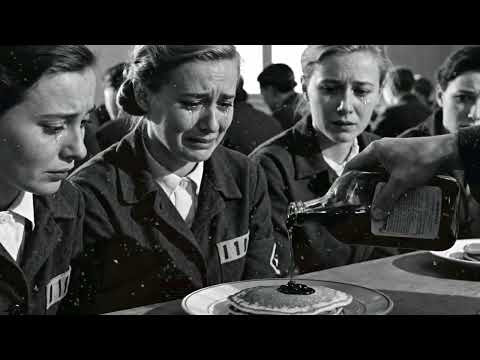
The women stood frozen. Mechild felt her throat tighten. Pancakes. She had not seen them since before the war, when her grandmother made them on special occasions. But these were not thin, sparse pancakes stretched to feed many mouths. These were thick, fluffy, abundant beyond imagining. Adelhide was first in line. Private Hoffmier smiled and placed three large pancakes on her plate. Three. Not one rationed portion, but three generous pieces. He added two eggs, four strips of bacon, and gestured toward the butter and syrup. “As much as you want,” he said in careful German. Adelhide stared at her plate, then at Hoffmier, then back at her plate. Her hands began shaking so badly she nearly dropped it.
She carried her plate to the nearest table and set it down carefully, as if the food might disappear. The three pancakes sat stacked perfectly, butter melting down their sides. She picked up the bottle of maple syrup. The dark amber liquid poured slowly, pooling on top before cascading down the sides. The sweet smell intensified. It was too much, too beautiful, too abundant, too kind. Adelhide’s vision blurred. Tears spilled down her cheeks before she could stop them. She pressed both hands over her face, her shoulders shaking with silent sobs. Around her, the same scene repeated at table after table. Grown women, soldiers who had survived war and capture, weeping over breakfast.
Mechild stood in line, watching this unprecedented display of emotion. When her turn came, Private Hoffmier met her eyes with gentle understanding. He loaded her plate with the same generosity—four pancakes instead of three, extra bacon, a larger portion of eggs, as if abundance was the point. She carried her plate to where Freda and Rosa already sat, both staring at their food with expressions of complete disbelief. Freda, who had barely shown emotion in months, had tears streaming silently down her face. Rosa held her fork but seemed unable to use it. “How is this possible?” Rosa whispered in German. “We were told America was starving, that they had nothing.” Mechild had no answer. The evidence before them contradicted years of propaganda so completely that accepting it required abandoning everything they had been taught.
She cut into her pancakes. The fork slid through easily, revealing fluffy interior texture. She brought the first bite to her mouth. The sweetness of maple syrup, the richness of butter, the soft warmth of perfectly cooked pancake. Flavors she had forgotten existed. Her throat tightened, and tears came despite her efforts. Around the mess hall, 44 German women sat crying over their breakfast—not from sadness or pain, but from the overwhelming cognitive dissonance of experiencing kindness and abundance from people they had been taught to see as cruel enemies. The propaganda had prepared them for brutality. It had prepared them for deprivation. It had not prepared them for this simple, devastating generosity.
Captain Waverly stood near the door, watching with an expression that mixed satisfaction and sadness. She understood what was happening. These women were not just eating breakfast. They were confronting the collapse of their entire worldview, one bite at a time. Sergeant Thorne moved between tables, refilling coffee cups, offering more food, speaking quietly to women who seemed overwhelmed. Mechild forced herself to eat slowly, to experience each bite fully. The pancakes were unlike anything she remembered—light, almost fluffy, with a subtle sweetness. The maple syrup itself was a revelation. Not the thin artificial substitute she had known, but rich, complex, with a depth of flavor that seemed impossible for something so simple. The bacon was crispy, salty, substantial. The eggs were cooked perfectly. Even the butter was different—creamy, fresh, abundant enough to spread thickly without worrying about rationing. But it was the fruit that truly shattered her understanding. Fresh strawberries in March. In Germany, fresh fruit had disappeared from markets years ago. Mechild had not seen strawberries since childhood summers. Yet here they were, bright red, sweet, served casually, as if they were common rather than precious.
She watched Adelhide eat with the intensity of someone trying to memorize every sensation. The younger woman had stopped crying, but her face still glistened with tears. “My mother used to make pancakes on Sundays,” Adelhide said softly in German. “Before the war. But never like this—never with real butter, never with this much syrup. We made them with water when eggs became scarce. We used beet syrup because sugar was rationed.” Freda finally spoke, her voice rough from months of silence. “I worked in food distribution for the Wehrmacht. Processed rationing reports, allocation requests, supply inventories. The numbers were classified, but I saw them. I knew how little food we had, how much we were importing from occupied territories, how the supplies were shrinking.” She paused, looking at her plate with something like anger. “We were told America was suffering worse, that they were begging for peace because their people were starving. But this—” she gestured at the abundant breakfast. “This is what they feed prisoners. Prisoners! What do they feed their own families?”
Rosa had been eating mechanically, but now she stopped. “Everything was a lie,” she said, her voice flat. “Every radio broadcast, every newspaper, every poster, every speech—all lies. They told us America was weak, desperate, failing. But look at this food. Look at this building. Look at the guards’ uniforms, their equipment, their health.” Mechild understood what Rosa was processing. If the propaganda about American poverty was false, what else was false? If they had lied about this, what else had they lied about? The questions opened doors to thoughts too dangerous to fully examine.
Private Hoffmier approached their table carrying a fresh pot of coffee. He refilled their cups with careful attention. “More pancakes?” he asked in his careful, accented German, gesturing toward the serving line where platters still held abundant food. The invitation seemed genuine, not performative, as if there was truly more available, as if shortage was not a concern. Adelhide shook her head, unable to speak. Her plate was only half empty, but she looked overwhelmed by what she had already consumed. Hoffmier nodded with understanding and moved to the next table, offering refills and seconds to women who seemed equally stunned by the abundance.
Captain Waverly stood and addressed the room. “I know this breakfast is different from what you have received. I want you to understand something important. This is how American families eat on Saturday mornings. Not wealthy families, not special occasions—ordinary working families, farmers, factory workers, teachers, shopkeepers. This is normal for us.” The words landed like physical blows. Normal. This abundance that felt almost obscene was considered ordinary in America. The implication was staggering. If prisoners received what regular Americans ate, then the disparity between what they had been told and reality was even larger than the food itself suggested. “I know you were told many things about America,” Captain Waverly continued. “That we were starving, that our economy had collapsed, that our people were suffering. I understand that you believe these things because you were given no reason to doubt them. But now you have seen the truth. Now you must decide what that truth means for everything else you were told.”
Her words hung in the air. Several women looked down at their plates, unable to meet her eyes. Others stared at the captain with expressions mixing anger and confusion. Being lied to was one thing. Having those lies exposed so definitively was another. It forced confrontation with uncomfortable questions about what else might be false. Mechild thought about the radio broadcasts she had heard during training—reports of American defeats, American casualties, American desperation. Stories of riots in American cities, of factories shutting down, of a nation on the brink of collapse. All presented as fact, supported by official sources, confirmed by authorities she had trusted. But if America was truly failing, how could they feed prisoners this well?
Two weeks after the pancake breakfast, letters began arriving from Germany. The International Red Cross had finally established reliable mail routes through the chaos of a collapsing Reich. Captain Waverly distributed the envelopes during evening roll call. Mechild was among those who received nothing. She watched as Adelhide tore open an envelope with shaking hands, her face shifting from hope to devastation as she read. That night in the barracks, those who had received mail shared what they had learned. The news was uniformly terrible. Adelhide’s letter came from a neighbor—her parents were dead, killed when Allied bombers hit Düsseldorf in October. Her younger brother was missing, last seen during the retreat from France. The neighbor wrote that their entire street was rubble, that most families they knew were scattered or dead. Freda’s letter described Bremen as a city of ghosts. Her sister wrote that their apartment building no longer existed, that food was scarce even for those with ration cards, that women and children were starving. The letter ended with a desperate plea for Freda to somehow send food, money, anything that might help.
Rosa received two letters. The first from a cousin reported that Hanover was 70% destroyed. The second from a former neighbor explained that Rosa’s mother had died of pneumonia during the brutal winter and her father had been killed on the Eastern Front months earlier. The house Rosa had grown up in was now occupied by refugees from the east—desperate families fleeing the Soviet advance. Other women shared similar stories. Cities bombed into ruins. Families dead or scattered. Homes destroyed. Food shortages approaching famine levels. Germany was not just losing the war. It was being systematically devastated, reduced to rubble and desperation. The country they had served no longer existed in any recognizable form.
Mechild listened to these accounts with growing dread. Her own family was in Nuremberg. No letter meant she knew nothing about their fate. Were they alive, dead, homeless, starving? The uncertainty was torture, but part of her feared that knowing might be worse. That night the barracks filled with sounds of weeping. Women who had maintained composure through months of captivity now broke down completely. They cried for their lost families, their destroyed homes, their ruined country. Adelhide curled in her bunk, still wearing the scarf Private Hoffmier had given her, sobbing with a grief that seemed to have no bottom. Mechild sat beside her, offering silent presence because words were useless against such loss. Captain Waverly made rounds through the barracks, her face tight with compassion. She said nothing, just moved from bunk to bunk, her hand briefly touching shoulders, her presence acknowledging their pain without trying to diminish it.
In the days following the letters, American newspapers began arriving at the camp with increasing frequency. Captain Waverly made them available in the common room, no longer restricting access to information. The newspapers carried stories that contradicted everything the women had been taught about German strength and righteousness. Reports of concentration camps being discovered as Allied forces advanced. Photographs of skeletal prisoners, mass graves, gas chambers designed for efficient murder. Detailed accounts from American soldiers describing what they found at places called Buchenwald, Dachau, Bergen-Belsen. Mechild sat in the common room, forcing herself to read these accounts even as her stomach turned. The descriptions were specific, documented, supported by photographs that could not be dismissed as propaganda. Thousands of people deliberately starved, worked to death, or systematically murdered. Not soldiers, not combatants, but civilians selected for elimination based on religion, ethnicity, political beliefs, or simple inconvenience.
Other women gathered around the newspapers, reading in horrified silence. Some rejected the reports immediately, insisting they were Allied lies designed to justify their destruction of German cities. But others, including Mechild, found the accounts too detailed, too consistent, too thoroughly documented to dismiss. “I worked in administration,” Freda said quietly, her voice hollow. “I processed transfer orders, supply requisitions, personnel assignments. I saw references to camps—special camps, labor camps—but the paperwork was always vague, classified. I never asked questions because asking questions was dangerous.” She stared at a photograph of emaciated prisoners standing behind barbed wire. “I told myself I was just doing my job, following orders, supporting the war effort. But what if my paperwork helped this happen? What if I was part of this?”
Rosa picked up another newspaper, reading about systematic deportations, about trains packed with people sent to these camps. “We saw the trains sometimes,” she said. “Boxcars filled with people. We were told they were being relocated for work assignments. I remember wondering why they needed so many guards if it was just relocation, but I did not ask. None of us asked.” Adelhide spoke through tears. “In Düsseldorf, there was a Jewish family in our building—the Goldsteins. They disappeared one night in ’42. We heard the trucks, the shouting, but we stayed in our apartments. The next morning, their door was sealed. Within a week, new tenants moved in. We never asked what happened. We told ourselves they had been relocated. We needed to believe that.”
The women sat in the common room confronting the possibility that they had served a regime not just militarily aggressive, but fundamentally evil. That their work, however minor or administrative, had supported systematic murder on an unimaginable scale. That their silence, their willingness to not ask questions, had made them complicit. The weight of that realization pressed down on them, heavier than any captivity.
April 15, 1945. Germany’s surrender was imminent. Everyone knew it. The newspapers reported Allied forces advancing from all directions, German resistance collapsing, cities falling without significant fighting. Captain Waverly called an assembly in the mess hall. “Germany will surrender within days, perhaps hours,” she announced. “When that happens, you will no longer be prisoners of war, but displaced persons awaiting repatriation. The process will take time. You will likely remain here for several more weeks before being sent home.” She paused, looking at faces that had become familiar. “I want you to understand something. You are not our enemies anymore. The war is ending. What happens now depends on choices we all make about the future.”
That evening, Mechild, Adelhide, Freda, and Rosa sat together in the barracks, discussing their uncertain futures. For the first time in months, they spoke openly about their fears, their doubts, their complete lack of clarity about what they wanted. “I have no family left,” Adelhide said quietly. “My parents are dead. My brother is missing. The house I grew up in is rubble. What am I returning to? A destroyed city where I know no one.” Freda stared at the ceiling. “My sister’s letter begs for help I cannot provide. She is starving in Bremen while I eat three meals daily here. How can I return and face her? What will I tell her about where I have been, what I have learned?” Rosa spoke with surprising firmness. “I am not the same person who was captured. That person believed in the Reich, trusted the government, accepted everything she was told. That person no longer exists. The woman I am now does not belong in Germany.”
Mechild had been thinking similar thoughts but had been afraid to voice them. “What if we did not return immediately? What if we requested to stay here, at least temporarily, until we understand better what kind of Germany we would be returning to?” The suggestion hung in the air like something dangerous and forbidden. They talked for hours, weighing impossible choices, and reached a conclusion that felt both terrifying and inevitable.
May 8, 1945. Victory in Europe Day arrived with church bells ringing across America. In Camp Harrison, the atmosphere was subdued. Captain Waverly called another assembly. Official repatriation orders had arrived from Washington. Transportation would be arranged within three weeks. The women would be processed through displaced persons camps in France before being released to make their way back to whatever remained of their homes. Mechild stood among the gathered women, her heart pounding with the decision she had spent days debating. Beside her, Adelhide, Freda, and Rosa wore similar expressions of nervous determination. When Captain Waverly finished explaining the procedures, Mechild raised her hand. “Captain Waverly,” she said in English that had improved dramatically over five months. “May I speak for some of us?” Permission granted. Mechild took a deep breath. Around her, several other women stood—a silent show of unity. Twelve women total, nearly a third of the prisoners. “We have been talking among ourselves for many weeks. Some of us do not wish to return to Germany immediately. We request permission to remain here, at least temporarily, until we better understand what kind of future awaits in our homeland.”
The silence that followed was absolute. American guards exchanged shocked glances. Captain Waverly’s eyes widened with genuine surprise. Even the German women who had not joined the request stared with disbelief. Adelhide spoke next, her voice shaking but clear. “I have no family left in Germany. My city is destroyed. I do not know anyone there anymore. Here I have found kindness when I expected cruelty. I have learned that everything I believed about America was false. I am not ready to return to Germany and pretend none of this happened.” Freda added her voice. “We understand this request is unusual. We know we are still technically prisoners, that repatriation is what the Geneva Convention requires. But we also know that the Germany we served was built on lies and committed terrible crimes. We need time to understand who we are now before we can face returning to who we were.” Rosa stepped forward. “We have been treated with dignity even though we were enemies. We have seen abundance where we were told there was starvation. We have experienced mercy where we expected punishment. These months have changed us. We cannot simply return to Germany as if we are the same people who were captured.”
Captain Waverly looked genuinely stunned. In her entire military career, she had never encountered prisoners requesting to remain in captivity rather than accept freedom. The announcement created immediate division among the prisoners. The 32 women who had not joined the request looked at those who had with expressions mixing incomprehension and something approaching betrayal. How could anyone choose to remain with their captors? How could they reject their homeland, even a devastated homeland? That evening in the barracks, tension crackled between the two groups. Women who had lived together for five months, who had shared hardship and uncertainty, now found themselves on opposite sides of an unbridgeable divide.
“You are abandoning Germany when she needs her people most,” one woman said to Mechild with quiet anger. “The country is in ruins. We should be returning to help rebuild, not running away to comfortable captivity with our enemies.” Mechild had no simple answer. The accusation stung because part of her agreed. Was her request driven by principle or cowardice? Was she truly seeking time to process her transformation, or was she simply afraid to face the consequences of Germany’s actions? But Adelhide responded with surprising firmness. “What Germany needs is people who have learned that blind loyalty leads to catastrophe. People who have seen that enemies can become friends when both sides choose humanity over hatred. We are not abandoning Germany. We are trying to become better Germans by first becoming better people.”
The debate continued through the night, voices rising and falling in German as women argued about duty, identity, and the meaning of home. Those who had chosen repatriation felt that remaining with Americans was a betrayal of everything German. Those who had requested to stay believed that returning immediately without fully processing what they had learned would be a betrayal of their own transformation.
The next day, Mrs. Lorraine Pendleton arrived at the camp. She was a local church volunteer who had been visiting weekly for two months, teaching English and bringing books. She was in her 50s with kind eyes and a gentle manner that had won over even the most suspicious prisoners. Captain Waverly had contacted her about the situation, and Mrs. Pendleton came with a proposal. Her church community was willing to sponsor some of the women who wished to remain, providing housing and support while they transitioned from prisoners to immigrants. “I cannot imagine what you are facing,” Mrs. Pendleton told the gathered women through Mechild’s translation. “To have lost everything, to have learned that much of what you believed was false, to have to choose between a destroyed past and an uncertain future. But I want you to know that some Americans see you not as enemies, but as people who deserve a second chance.”
Her words affected even those who had chosen repatriation. Several women began reconsidering their decisions. Over the following week, the composition of both groups shifted. Two women who had initially requested to stay changed their minds, deciding that duty to family outweighed personal transformation. Three women who had originally chosen repatriation joined those requesting to remain, swayed by Mrs. Pendleton’s offer and their own growing doubts about returning to devastated Germany. The final count settled at 13 women requesting to stay, 31 choosing repatriation. Both groups had valid reasons. Both faced uncertain futures, and both deserved respect for their difficult choices.
Captain Waverly worked tirelessly to secure approval for the unprecedented request. She wrote detailed reports to Washington explaining the situation, arguing that allowing these women to remain could serve American interests by demonstrating mercy and offering a model for reconciliation with former enemies. The response from Washington arrived on May 23rd. The War Department would permit the women to remain on a conditional basis. They would be reclassified from prisoners of war to displaced persons seeking immigration status. They would need sponsors, employment, and permanent housing arrangements. The military would provide temporary support for 30 days, after which the women would be responsible for their own situations.
The decision meant freedom, but also vulnerability. As prisoners, they had been guaranteed housing, food, and protection under the Geneva Convention. As displaced persons, they would have only what American charity provided. It was a more precarious existence, but it was also genuine choice rather than imposed circumstance. Mrs. Pendleton and her church community moved quickly to arrange sponsorships. Mechild would live with the Pendleton family while seeking employment as a translator. Adelhide had been offered a position continuing her nursing training at a local hospital. Freda would work with an accounting firm that needed someone with administrative experience. Rosa had found placement with a radio repair shop that valued her technical skills. The other nine women received similar arrangements, matched with families and employers who had volunteered to help. The American community’s response had been overwhelmingly positive, with more offers of support than women needing placement.
The repatriation date for those returning to Germany was set for June 12th. The women who were staying would remain at Camp Harrison until their individual arrangements were finalized, probably within two weeks. The final days before separation were emotionally complex. Women who had shared captivity now faced completely divergent futures. Those returning to Germany felt both relieved to be going home and anxious about what they would find. Those staying felt hopeful about new possibilities but guilty about not returning to help rebuild their homeland. On the evening before repatriation, both groups gathered for a final meal together.
The women who remained at Camp Harrison transitioned to civilian life gradually over the following months. Mechild moved in with the Pendleton family in late June, carrying everything she owned in a single canvas bag. The house was a modest two-story structure on a tree-lined street—nothing grand, but impossibly clean and well-maintained compared to the devastation she had seen in photographs of German cities. Mrs. Pendleton showed her to a small bedroom on the second floor. Real furniture, clean sheets, a window overlooking a garden where vegetables grew in neat rows. Mechild stood in the doorway, overwhelmed by the simple normality of it all. This was how ordinary Americans lived—not in luxury, but in comfortable sufficiency that seemed impossible after years of wartime scarcity. “This is your home now,” Mrs. Pendleton said gently. “For as long as you need it.”
Mechild found work as a translator for the State Department office in Philadelphia, helping process the thousands of displaced persons arriving from war-torn Europe. Her ability to speak German, understand European bureaucracy, and bridge cultural gaps made her invaluable. The work was emotionally difficult—facing daily reminders of the devastation her country had caused—but it felt like a form of penance. She could not undo the past, but she could help people trying to build new futures. Adelhide threw herself into nursing training with fierce dedication. She worked longer hours than required, studied late into the night, and volunteered for the most difficult cases. “You cannot save everyone,” Dr. Patterson told her one evening after she had stayed late with a dying patient. “Medicine has limits.” “I know,” Adelhide replied quietly. “But I have to try. I have to do something good to balance against what my country did.”
Freda’s transition was perhaps the most difficult. Working in accounting meant constant interaction with numbers that represented resources, supplies, and money. She could not look at inventory reports without remembering similar reports she had processed for the Wehrmacht—documents that had supported a regime now revealed as monstrous. Some days the guilt was overwhelming, but gradually she found meaning in using her skills for different purposes—helping businesses operate efficiently, ensuring workers were paid fairly, maintaining systems that served communities rather than war machines. The work was mundane, but its very ordinariness felt redemptive. Rosa discovered an unexpected talent for radio repair work. The precision required, the logical problem-solving, the satisfaction of making broken things work again—all appealed to her methodical mind. Her employer, Mr. Henderson, appreciated her careful attention to detail and gradually gave her more complex projects.
The 13 women who had stayed maintained contact with each other, meeting monthly at Mrs. Pendleton’s church. They needed these gatherings, needed to be with others who understood the complexity of their situation. They were building new lives in America, but they carried their German past with them always. They were not quite German anymore, but not quite American either. They existed in an uncomfortable middle space, belonging fully to neither identity. Letters arrived sporadically from those who had returned to Germany. The news was consistently difficult.
Twenty-five years later, on a Saturday morning in April 1970, Mechild Zimmerman Pendleton stood in her kitchen in suburban Philadelphia making pancakes for her three children. Her oldest daughter, Helen, named after Captain Waverly, was setting the table. Her twin sons, Thomas and Robert, were arguing good-naturedly about whose turn it was to pour the syrup. Mechild flipped the pancakes with practiced ease, watching their golden surfaces bubble and brown. She had made this breakfast hundreds of times over the years, but she never forgot the first time she had seen pancakes served at Camp Harrison. That morning had changed everything—had cracked open her worldview and forced her to confront truths she had been avoiding.
Her husband, Daniel Pendleton—Mrs. Pendleton’s son, who had returned from the Pacific Theater in 1946—entered the kitchen and kissed her cheek. Their marriage had raised eyebrows initially, a German former prisoner marrying an American veteran. But over the years, their relationship had become a symbol of the reconciliation both countries were working toward. “Mom,” Helen said, “you’re giving that faraway look again—the one you get when you’re thinking about the war.” Mechild smiled. Her children knew her story, knew about her time as a prisoner, her decision to stay, her gradual transformation from enemy to immigrant to citizen. She had never hidden her past from them, believing that honesty about history was essential to preventing its repetition. “I was remembering the morning everything changed,” she said. “The day American soldiers served us pancakes and taught us that enemies could become friends if both sides chose to be human first.”
She had remained in contact with the others who had stayed. Adelhide had never married, dedicating her life to nursing and eventually becoming director of nursing at a major hospital. Freda had married an American accountant and raised four children while building a successful consulting practice. Rosa had opened her own electronics repair shop and become a respected businesswoman in her community. The 13 women had all built successful lives in America, but they had also maintained their connection to Germany. They sent money to help rebuild churches and schools. They sponsored German students studying in America. They worked with German-American friendship organizations. They had not abandoned their homeland. They had simply chosen to serve it differently than the regime they had once believed in.
Mechild had returned to Germany three times over the years. The country she found was transformed—rebuilt, not just physically but morally. The new Germany had confronted its past, acknowledged its crimes, and committed itself to ensuring such atrocities could never happen again. She was proud of that transformation. Proud that Germans had found the courage to face their history honestly. But she was also grateful for America—for the country that had shown her mercy when it could have shown cruelty, abundance when it could have given scarcity, and second chances when it could have demanded punishment. The pancake breakfast had been more than just food. It had been a demonstration of values, a lesson in how former enemies could choose reconciliation over revenge.
Meckchild set the platter of pancakes on the table, the familiar scent of butter and maple syrup filling the kitchen. Her children reached for the food with the casual ease of those who had never known hunger. She watched them, remembering the morning at Camp Harrison when abundance had shattered everything she believed.
After breakfast, she walked to the window, looking out at the quiet suburban street. She thought of the 13 women who had stayed, of the 31 who had returned to a devastated homeland. They had all made their choices, carried their pasts, built their futures. The war had ended, but its lessons lived on in kitchens and classrooms, in the stories told and the silence kept.
Meckchild turned back to her family, her heart full. “The world can change,” she said softly, “one pancake at a time.”
What would you have chosen—to return to a ruined homeland or to stay with former enemies who showed you kindness? Share your thoughts below.
Report this article
Select a reason for reporting:






