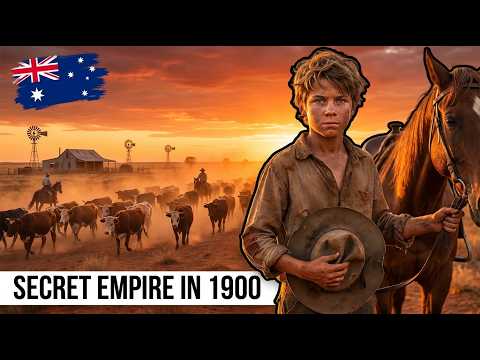
In 1870, a thirteen-year-old boy climbed onto a one-eyed horse and fled his violent home near Adelaide, South Australia. He had five shillings in his pocket—barely enough for a loaf of bread. He could hardly read or write. No map. No plan. No idea where he was going. All he knew was that he couldn’t stay. His stepfather was a violent drunk who beat the children. His older brothers had already run off to the Australian outback to escape the abuse, and now it was Sidney’s turn.
The horse was called Cyclops, a worn-out animal he’d bought with savings from working at Adelaide slaughterhouses for three shillings a week. Within days of leaving home, two men tricked him and stole the horse. He was alone, on foot, in the Australian bush, with nothing. He was thirteen years old, and from that desperate moment—no horse, no money, no family, no future—Sidney Kidman would go on to build the largest privately owned land empire in modern history. An empire of cattle stations larger than England, Scotland, and Wales combined. An empire covering over 100,000 square miles of the harshest terrain on earth.
How did a boy who couldn’t read become a master reader of the land and the richest cattleman Australia has ever known? And what was the secret that made his empire drought-proof when every other outback grazier was facing ruin? The answers lie in water—and in the extraordinary mind of a boy who realized before anyone else that whoever controls the water controls Australia.
Before we continue, don’t forget to subscribe to the channel and hit the notification bell. Every week we bring you untold stories of the people who built Australia. Thank you, and let’s continue the documentary.
Sidney Herbert Kidman was born on May 9, 1857, at Glen Stuart, near Ethelton, a few kilometers northeast of Adelaide. He was the fifth son of George Kidman, a farmer, and his wife Elizabeth Mary Nunn. His father died when Sidney was just fourteen months old, leaving the family in deep poverty. His mother remarried a man whose name was deliberately erased from most accounts of Kidman’s life, described only as a violent alcoholic who regularly beat his stepchildren in terrifying rages. Sidney received a few years of primary education at Norwood before the lure of the wild and his desire to escape became irresistible.
His older brother George had already left for the outback, working as a stockman on stations in western New South Wales. The stories that reached Adelaide of vast plains, cattle herds roaming hundreds of miles, and campfires under star-filled skies that seemed to touch the earth captured young Sidney’s heart. He began working at Adelaide slaughterhouses, earning three shillings a week, watching settlers bring their cattle in from the interior, listening to their tales of life beyond the mountain ranges. By age thirteen, he had saved enough to buy his horse Cyclops, and he set off north into the unknown, never looking back.
Kidman’s early years in the bush were a brutal education. After losing Cyclops to the swindlers, he walked to Kapunda, then to Burra, then north to the Barrier Ranges in western New South Wales, where he found his brother George working on a station. Kidman took any work available—driving bullocks, collecting cattle, breaking horses, carting supplies. He earned enough to buy a team of bullocks and worked as a carrier between remote stations and frontier towns. He slept on the ground, ate damper and salted beef. He learned to read the land—the subtle signs that told bushmen where water lay beneath the surface, where feed would grow after rain, where drought would bite hardest. He learned to read the sky—the shape of clouds, the direction of winds, the behavior of birds—because weather in the outback wasn’t a luxury; it was life or death.
He learned from the Aboriginal people he met, who possessed an understanding of the land tens of thousands of years old. They guided him to water springs no European had found. They taught him to read the flight patterns of parrots, which always headed toward water at dusk. They showed him how to find moisture in the roots of certain trees when there was no surface water for a hundred miles. Kidman absorbed this knowledge with the same passion that men of his era absorbed books and lectures. He couldn’t read a university textbook, but he could read the Australian continent like a map—and his map was more accurate than any drawn by surveyors.
This knowledge, accumulated over years of constant travel through the most arid regions of Australia, became the foundation of his fortune. In 1878, Kidman heard about the copper rush at Cobar in central New South Wales. He traveled to Cobar and opened a butcher shop and general store, supplying miners with meat and provisions. The business was profitable, but Kidman was watching something else. He noticed that the miners who made fortunes weren’t the ones digging the deepest shafts—they were the ones who owned shares in the mining companies. When he had the chance to trade ten bullocks for a quarter share in a fledgling mine called BHP, Broken Hill Proprietary, Kidman took it. It was one of the smartest deals in Australian business history. BHP would become Australia’s largest company and one of the world’s largest mining corporations. Kidman’s small share would rise beyond his wildest dreams. He held it for years before eventually selling—a patience that marked everything he did.
Most men of his era would have rushed to cash in. But Kidman understood that time is the most important factor in multiplying value. He applied the same principle to land—buying stations when they were cheap, holding them through droughts, and watching their value rise when the rains returned. He never sold in panic, never bought in frenzy. He moved at the pace of the land itself—slowly, steadily, with a deep understanding of the seasonal cycles that modern scientists would take decades to quantify.
But mining was never his passion—cattle was. On June 30, 1885, Sidney Kidman married Isabel Brown Wright, a schoolteacher from the frontier town of Kapunda. Isabel was a remarkable woman in her own right—educated, patient, and prepared to share her husband with the Australian wild for the rest of her life. Kidman built her a home and called it Eringa, an Aboriginal word meaning “place of water”—a fitting name for a man whose entire fortune would be built on the control of water. It was the first roof he had slept under since running away from home fifteen years earlier. The couple had four children—three daughters and a son named Norman, who died in childhood.
Kidman adored his family, but he was rarely home. Isabel understood this from the beginning. She had married a man whose office was the saddle and whose boardroom was the horizon. She managed the household, raised the children, and maintained the family’s social connections in Adelaide while her husband was absent for months at a time, traversing stations that stretched across vast distances. In later years, Isabel accompanied Kidman on his inspection trips, sitting beside him in the buggy as they crossed rugged tracks through the farthest reaches of the Australian outback. She was, in many ways, the Elizabeth Macarthur of the outback—the woman who held the family together while the man who bore the name built his public empire.
But even with a home, Kidman was rarely there. He spent up to six months at a time in the saddle, crisscrossing the outback, inspecting properties and looking for stations for sale. His strategy was unique in the Australian pastoral industry. Most graziers bought a single station and hoped for rain. Kidman bought chains of stations—contiguous properties that stretched along the great inland river systems from north to south. The logic was simple and devastatingly effective. In the tropical north, the wet season brought floods that produced lush green feed. In the arid center and south, drought could last for years. By owning stations along the entire corridor—from the monsoon lands of the Northern Territory to the markets of Adelaide—Kidman could move his cattle south as the seasons changed, always keeping them on green feed, always avoiding drought. While other graziers watched their cattle die of thirst, Kidman’s cattle walked to water. He called it his “supply chain.” Modern logistics experts call it “vertical integration.” Kidman invented it on horseback, with no university degree, no textbook, and no one to tell him it was possible.
The mechanism worked like this: a calf is born on a breeding station in the monsoon region of the Northern Territory or far north Queensland, where regular summer rains provide abundant feed. As the calf grows, it is moved south to a fattening station in central Queensland or western New South Wales, where feed is still good but distances to market are shorter. When the animal is ready for sale, it is walked—or later trucked—to railheads and markets in South Australia, where it is slaughtered and sold. At every stage of this chain, the cattle grazed on land owned by Kidman, drank his water, and fed on his grass. There were no middlemen, no freight charges to outside carriers, no dependence on anyone else’s property or reputation. The system was self-contained, sustainable, and almost immune to the droughts that destroyed his competitors.
During the Great Drought of 1895 to 1903—the worst in Australia’s recorded history, which killed half the nation’s sheep and a third of its cattle—Kidman didn’t just survive; he expanded. While other station owners sold their properties at rock-bottom prices, Kidman bought. He acquired estates that their drought-stricken owners could no longer afford, adding them to his portfolio at a fraction of their true value. When the rains finally returned, Kidman’s empire was larger, stronger, and more strategically positioned than ever. He had turned catastrophe into opportunity—not through cruelty or exploitation, but through a system that made drought work for him instead of against him.
By 1900, Kidman’s empire was immense. He owned or had financial interests in cattle stations across South Australia, Queensland, Western Australia, and the Northern Territory. His holdings stretched over nearly 100,000 square miles—an area larger than England, Scotland, and Wales combined. He ran over 450,000 head of cattle on his stations. Because his horses traveled vast distances over rugged terrain, he bred a distinctive strain—strong, sure-footed animals known as Kidman horses, capable of surviving where other stock perished. He employed an army of stockmen, drovers, and station managers who were fiercely loyal to him—almost to the point of devotion. Working for Kidman was a badge of honor in the Australian outback. He paid well, treated his men fairly, and never asked them to do anything he wouldn’t do himself. He was a master at mustering, driving, branding, and breaking horses—just like any other man who worked for him. His memory was legendary among bushmen, who prided themselves on their knowledge of the land—he could recall the name, location, and water source of every station he had ever visited.
The Aboriginal people on his stations called him “Kidman the Big One, King of Adelaide.” When drought struck, they offered to bring rain in exchange for wagons, blankets, tobacco, and jam. Kidman always obliged. He was knighted in 1921 for his contributions to Australia’s service during World War I. He donated thousands of horses to the Australian Light Horse regiments. The cavalry charge at Beersheba in 1917 became one of the most famous battles in military history. Many of those horses were of Kidman stock—bred on his stations and trained to survive in harsh, dry conditions like the Middle Eastern desert. The charge of the Australian Light Horse at Beersheba—800 horsemen galloping across open ground under Turkish machine-gun fire—was one of the last great cavalry charges in history. Many of the horses that carried those men to victory were born on Kidman’s stations, broken by Kidman’s stockmen, and raised on Kidman’s grass. Kidman also donated vast quantities of beef to support the war effort, feeding Australian troops from his stations.
His generosity wasn’t limited to wartime. Throughout his career, Kidman was known for his philanthropy. He donated to hospitals, schools, and drought relief funds. When bushfires or floods struck communities near his stations, he sent money, cattle, and supplies without being asked. He was a man who remembered the meaning of deep poverty and never forgot that the fortune he built was on land taken from the Aboriginal people who had nurtured it for thousands of years. He was no saint—he was a businessman. But he was a businessman who believed that wealth carried obligations. His knighthood made him Sir Sidney Kidman, but to the people of the outback, he was always known as “Sid.”
He didn’t live on his stations; he lived in Adelaide at his home in Unley Park with Isabel, but he made constant inspection trips—first on horseback, then by horse-drawn buggy with Isabel, and in his later years by car. He drove across his empire on roads that barely existed, through country that could kill any unprepared traveler within days. He checked water sources, confirmed cattle numbers, and spoke with his managers about feed conditions. He considered these trips essential, especially during droughts. His men waited for him, and he never let them down.
Sidney Kidman died on September 2, 1935, at his home in Millswood, Adelaide, at the age of 78. His funeral procession stretched for more than two kilometers through the city streets. Hundreds of mourners from all walks of life came to bid farewell to the cattle king. Stockmen who had worked for him stood beside politicians who had sought his favor. Aboriginal people who had worked on his stations stood beside the bankers who had financed his deals. He was buried in Mitcham Cemetery in Adelaide, next to his wife who had waited for him through decades of absence. His gravestone was modest, as Kidman would have wanted. He was never a showy man. He wore the same worn hat for years. He carried his own luggage. He ate stockmen’s food. He drank his tea black and his whiskey neat. He was, in every sense of the word, a man of the bush—a man shaped by the land, who in turn helped shape it.
The empire he left behind would be run by his descendants for generations. His daughter Gertrude married Sidney Reid, and the Reid-Kidman partnership continued to manage the stations according to the same principles Kidman had established. S. Kidman & Co. continued as one of Australia’s largest pastoral companies, its stations stretching across the continent on the same chain system he had invented. The company survived two world wars, the Great Depression, countless droughts, and Australia’s transformation from a pastoral economy into a modern industrial nation. It survived because the system Kidman built didn’t depend on any one person, any one station, or any one season. It depended on the land—and the land, as Kidman knew better than anyone, always comes back.
In 2016, Gina Rinehart, the mining billionaire and daughter of one of Australia’s most prominent wealth builders, purchased S. Kidman & Co. in partnership with a Chinese company—bringing together two of the most powerful names in Australian pastoral and mining history. The deal was worth $365 million. The land included stations covering more than 1% of Australia’s total area—a figure larger than the entire country of Ireland. Kidman would have understood Rinehart. She believed, as he did, that Australia’s wealth lies in its land—not its cities, banks, or stock exchanges, but its soil, its water, and the grass that grows between the horizons.
Sidney Kidman’s story is one of the greatest inspirational success stories ever—not just in Australia, but in the world. A boy who fled a violent home at thirteen, lost his only horse to a swindler, could barely read or write, yet taught himself the geography of an entire continent by riding across it, and built a vast empire beyond imagination. His secret wasn’t money, education, or connections. His secret was water.
He realized, before anyone else—before the scientists, the surveyors, the government—that the Australian interior wasn’t barren. It was a system. A system of rivers, creeks, wells, and underground springs that flowed in patterns that could be learned, predicted, and harnessed. He mapped those patterns in his mind with such precision that he could recall the depth of a waterhole he’d visited twenty years earlier, and used that knowledge to build an empire that wasn’t just resistant to drought—it was fortified against it. While other graziers prayed for rain, Kidman moved his herds to where the rain had already fallen. It was a plan brilliant in its simplicity.
He was incredibly ambitious, and the idea came to a boy on a one-eyed horse who had nothing to lose and everything to gain. Sidney Kidman didn’t just conquer the Australian outback—he understood it deeply. And by understanding it, he became its king. But there’s something deeper in Kidman’s story that expresses the essence of the Australian character. It’s a country built by people who started from nothing. Convicts, immigrants, runaways, refugees—they made something extraordinary from the dust. Kidman embodies this spirit more completely than any other figure in Australian history.
He had no advantages, no inheritance, no education, no powerful friends. He had only the vast, harsh, indifferent outback—and enough intelligence to see what others didn’t: that the outback wasn’t empty. It was full. Full of water, full of grass, full of possibilities, if you knew where to look. And Kidman knew where to look because he spent his entire life looking. From the moment he climbed onto Cyclops at thirteen, his eyes were opened to everything. He watched the rivers, watched the rain, watched the birds, and watched the land change colors from brown to green and back to brown. Through that observation, he built an empire that lasted a century and still bears his name today.
The “Kidman” brand, now owned by Hancock Prospecting under Gina Rinehart, still produces some of Australia’s finest beef. The stations still stretch across the continent, the springs still flow, and somewhere in the dust of the South Australian outback, there’s a track carved into the earth by the hooves of a one-eyed horse ridden by a boy who had nothing but five shillings, a broken heart, and the audacity to believe the land itself would provide what he needed. And it did—and Sidney Kidman never forgot to be grateful.
So here’s the question for you: If a thirteen-year-old boy with five shillings and no education could read the land better than the experts of his time, what is the “water” in your own life—the hidden resource everyone else overlooks? Tell us in the comments below.
Report this article
Select a reason for reporting:






