At 05:30 on December 16, 1944, the Ardennes forest erupted. Roughly 1,900 German guns and rocket launchers opened fire along an 80-mile front, tearing apart pine trees, collapsing log bunkers, and scattering frozen earth across the snow. Searchlights bounced their beams off the low cloud ceiling, painting the battlefield in a pale, unnatural glow that soldiers on both sides called artificial moonlight. 200,000 soldiers of the Third Reich began moving west. Hitler had gambled everything on one last surprise. He believed that within days his panzers would be drinking captured fuel in Antwerp, and that the Western Allies would be split, broken, and forced to negotiate.
He did not know that within nine days his men would meet a weapon that did not yet exist in any other army on earth. He did not know that an American shell would learn to listen for them. He did not know that something invisible would whisper to those shells from 20 to 50 feet above their heads and tell them, “Now.”
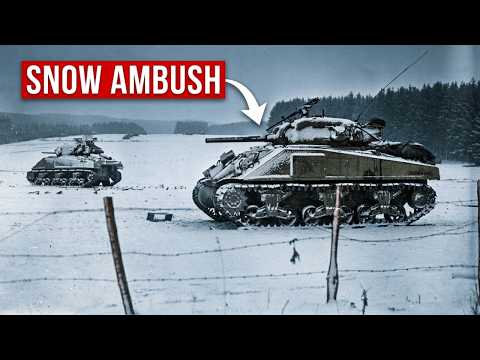
This is the story of the VT proximity fuse—the secret radio that lived inside an artillery shell—and what the Germans learned when those shells started bursting above the snow.
To understand what arrived in the Ardennes that December, you must first understand what an artillery shell had been for the previous 500 years. A shell was a steel container filled with explosive. To kill men in the open, gunners used either a contact fuse that exploded when the shell struck the ground or a mechanical time fuse that burned for a calculated number of seconds and then detonated. Contact fuses wasted most of their fragments by burying them in the dirt. Time fuses, in theory, could create an air burst that sprayed shrapnel downward, but only if the gunner could see exactly where the round was bursting and adjust the timing by hand. In fog, in heavy snow, in darkness, that adjustment was almost impossible. Soldiers in foxholes were safe from most ground bursts. A man in a hole was almost untouchable.
The VT fuse changed all of that. Inside its small steel housing, no larger than a pint glass, lived a complete miniature radio station. Five vacuum tubes the size of pencil erasers, a continuous wave transmitter, a receiver, a wet cell battery sealed inside a glass ampule, a safety system that arms the fuse only after it had traveled a safe distance from the muzzle, and a thyratron switch waiting to fire the detonator at the right instant.
When the gun fired, the shell experienced an acceleration of roughly 20,000 times the force of gravity. The shell began spinning at 25,000 revolutions per minute. The glass ampule shattered, releasing acid into the battery. The transmitter awoke and began broadcasting a continuous radio signal into the air around the shell. As the shell approached the ground, that signal reflected off the earth below and returned to the fuse. The reflected wave mixed with the outgoing wave to produce a low-frequency beat. When the strength of that beat crossed a precise threshold, the thyratron fired and the shell detonated in midair somewhere between 20 and 50 feet above the heads of whoever stood beneath it. A man in a foxhole no longer had a roof.
The idea was British. In 1939 and 1940, scientists at the Telecommunications Research Establishment, the Ministry of Supply, and the Pye Laboratory sketched the first concepts. A radio engineer named W. A. S. Butement drew up the schematic for a radar proximity fuse. A physicist named Samuel Curran refined the design. A man named John Cockcroft, who would later share a Nobel Prize, started research at Pye in September 1939 into making fragile vacuum tubes survive the violence of a gun barrel.
In the autumn of 1940, with the Battle of Britain still being fought in the skies above southern England, the United Kingdom shared this idea, along with many of its other secrets, with the United States. The mission was led by the British scientist Henry Tizard, and history has remembered it as the Tizard mission. Among the technologies the British carried across the Atlantic was the cavity magnetron that powered radar. Almost as important, though far less famous, was the proximity fuse concept.
In August 1940, Captain Gilbert Hoover of the United States Navy Bureau of Ordnance asked the National Defense Research Committee to take the British idea and turn it into something that could survive being fired from a gun. The job went to a section of the new committee given the cover name Section T, after its director, the physicist Merle Tuve. Tuve was a no-nonsense man from South Dakota, who had worked on the structure of the atomic nucleus at the Carnegie Institution of Washington. He set up shop first in the Carnegie Institution’s Department of Terrestrial Magnetism. His section quickly outgrew that building. In early 1942, the project moved into a leased three-story used car building on Georgia Avenue in Silver Spring, Maryland—the former Wolfe Motor Company, which had sold Chevrolets before the war. The new effort was renamed the Applied Physics Laboratory of Johns Hopkins University. It is there, in that converted car dealership, that the VT fuse was born.
Tuve hung two rules on the wall of his laboratory, and they have echoed through American military research ever since. The first rule said, “I do not want any damn fool in this laboratory to save money. I only want him to save time.” The second rule said, “Shoot at an 80% job. We cannot afford perfection. Do not try for an A. In a war, D is necessary and enough, but an F is fatal.”
His scientists obeyed. Among them was a young physicist named James Van Allen, who would later become famous for discovering the radiation belts that bear his name. Van Allen spent his war designing miniature vacuum tubes tough enough to survive the concussion of a 5-inch naval gun. Another physicist on the program, Ralph Baldwin, later described the central engineering problem of the fuse in a single sentence. “Imagine,” he wrote, “a good-sized girl standing with all her weight on one stiletto heel bearing on a tiny glass tube.” The tube had to live through the equivalent of that pressure and then keep working perfectly while spinning hundreds of times per second.
The cover name VT came from a Navy captain named S. R. Shoemaker. He chose the letters because they sounded like they could mean variable time, the existing class of mechanical time fuses that everybody already knew about. If a German engineer captured a document mentioning the VT fuse, Shoemaker hoped he would simply assume it was a new ordinary time fuse and move on. The Army adopted its own cover name for the same device, calling it the posit fuse. Both names were lies on purpose. The actual nature of the device—a tiny radio inside a shell—was a secret guarded as fiercely as anything else in the war.
The American industrial response was staggering. More than 87 companies in over 110 factories built parts for the fuse. Sylvania Electric, the great producer of radio tubes, devoted 10,000 workers, mostly women, to the manufacture of those eraser-sized vacuum tubes. By the end of the war, Sylvania alone was producing about a million tubes every two and a half days. That single output exceeded two-thirds of the entire pre-war American radio industry. General Electric reopened a plant in Cleveland that had once made Christmas tree bulbs and turned it into a tube factory. The Crosley Corporation in Cincinnati, more famous for radios and small cars, became one of the five primary fuse assemblers. The Wurlitzer company, which built theater pipe organs and jukeboxes, contributed precision assembly. Even Eastman Kodak helped.
By the end of the war, more than 22 million fuses had been produced. The unit cost dropped from $732 in 1942 to about $18 by 1945. The total program cost reached approximately $1 billion in the currency of the time—the equivalent of more than $14 billion today. Apart from the Manhattan Project that built the atomic bomb, no single American weapons program of the Second World War cost more.
The first combat success came on January 5, 1943, in the South Pacific. The light cruiser USS Helena fired a 5-inch gun loaded with the new shells at a Japanese dive bomber, and the aircraft fell out of the sky. The fuse worked. Aboard the Helena that day was a Navy captain named William Parsons, known to everyone as Deak. He would later, on a different mission, climb into a B-29 bomber called the Enola Gay and arm the atomic bomb that fell on Hiroshima.
But for the rest of 1943 and for most of 1944, the VT fuse was not allowed to be fired over land. The reason was simple. Every shell fired had a chance of being a dud. Every dud that landed on enemy-held ground was a chance for the Germans to find it, take it apart, understand the radio inside, and either copy it or—even worse—build jammers that would protect their bombers and missiles from Allied air bursts. So the fuse went only to ships. It defended American carriers in the Pacific. It guarded the invasion fleets at Salerno and Anzio. It killed the kamikaze pilots off Okinawa. But over Europe, it stayed silent.
Then came the V-1. In June 1944, the Germans began launching their flying bombs against southern England. Each was a small, pilotless aircraft carrying nearly a ton of high explosive, traveling at speeds approaching 400 mph. The British called them buzz bombs after the sound of their pulse jet engines. They flew low and fast, and the existing anti-aircraft guns could barely hit them. On June 12, 1944, the VT fuse was authorized for use against the V-1s along the Channel coast. Any duds would fall harmlessly into the sea.
In the first week, gun batteries shot down about 17% of the V-1s aimed at London. By August, that figure had risen above 74%. On the last great day of V-1 attacks, of 104 detected on radar, only four reached London. Winston Churchill himself praised the fuse, calling it potent against the unmanned aircraft assailing his country. When the German army began launching V-1s at the recently captured port of Antwerp, the same defense was rushed to Belgium. Special Royal Air Force Lancaster bombers, authorized by Churchill personally, carried the latest fuses from Cincinnati to Antwerp by way of England. One American anti-aircraft battalion shot down 48 of the first 75 V-1s aimed at the Antwerp. The port stayed open. The men ashore had no idea what was protecting them.
By October 25, 1944, the Combined Chiefs of Staff agreed that the VT fuse could be used in the anti-aircraft role over land, but the original date for its release as a field artillery shell fired at men on the ground was set for Christmas Day, 1944. That date had been chosen because the planners assumed the war would have moved deep into Germany by then, and any duds would fall on enemy soil where they could not be recovered before the Allies arrived to overrun the area. The German attack of December 16, 1944 made all of those plans obsolete in a single morning.
The three German armies of Field Marshal Walter Model came out of the Eiffel Hills before dawn. To the north, the Sixth Panzer Army of Sepp Dietrich drove for the Meuse with the 1st SS Panzer Division leading the way. In the center, the Fifth Panzer Army of Hasso von Manteuffel attacked through the dense Schnee Eifel Forest toward St. Vith and Bastogne. In the south, the Seventh Army of Erich Brandenberger pushed forward to protect the flank. Behind them came 19 divisions, 1,400 armored vehicles, and 2,600 guns. The weather had been chosen with care. Heavy fog, thick low cloud, and falling snow grounded the Allied air forces that had ruled the skies since June.
The Americans they hit were not ready. The Ardennes had been considered a quiet sector—a place for tired veteran divisions to recover and green divisions to learn the trade of war. Among them was the 106th Infantry Division, only weeks in country, holding the Schnee Eifel Ridge with two regiments. Within 48 hours, those two regiments would be encircled and surrendered—the largest American mass surrender of the entire war in Europe. To their north stood the 99th Infantry Division, nicknamed the Battle Babies, also brand new, and the veteran 2nd Infantry Division. To their south, the 28th Infantry Division was holding a front several times longer than doctrine permitted. They were spread thin across roughly 85 miles of fog and forest.
For the first three days, the bulge in the American line grew rapidly. Units were overrun, surrounded, captured, or thrown back. Communications failed. Supply roads jammed. Refugees fled west. And at the headquarters of the Allied Supreme Command in Versailles, General Dwight Eisenhower made his decision. On December 19, 1944, he formally requested clearance to release the VT fuse for use as a field artillery shell against German troops in the open. Two days later, on December 21, all remaining restrictions came off. From that moment, every American howitzer and gun crew in the European theater could load shells whose fuses carried tiny radios and fire them at German infantry.
Roughly 200,000 fused rounds were already in theater, most designated for anti-aircraft use, but now available for any target. The Americans had been hoarding their secret. The hoard was open.
The first place where the new shells made an unmistakable difference was the northern shoulder of the bulge, at a long low ridge above the Belgian villages of Elsenborn, Butgenbach, and Krinkelt. Here, the German Sixth Panzer Army needed to break through to reach the Meuse. Here, the green Battle Babies of the 99th, the veterans of the 2nd, and elements of the 1st Infantry Division—the famous Big Red One—dug in along a pine-covered ridge that overlooked open farmland. The ground was so frozen that engineers had to use small explosive charges to blast foxholes out of the earth.
A brigadier general named Cliff Andrus, who had just stepped up from commanding the 1st Infantry Division’s artillery to leading the division itself, took control of the artillery for several divisions and welded them into a single fire direction net. More than 300 guns, plus a battalion of 4.2-inch chemical mortars, were available to him. He could call on them all at once.
When the Germans of the 12th SS Panzer Division—the Hitler Youth—and three Volksgrenadier divisions came up the open slopes, they came into the most concentrated American artillery fire of the war in Europe. Around December 21 and 22, 1944, the divisional artillery of the Big Red One and supporting corps battalions fired roughly 10,000 rounds in a single day in support of the 26th Infantry Regiment at the village of Dom Butgenbach. German tanks broke into the American line in places, but as one American historian recorded, “Not a single Panzergrenadier managed to make his way close to the American defensive foxholes. The infantry that should have followed the tanks was no longer there. It was scattered across the snow behind them, killed or wounded by an overhead rain of steel that no foxhole and no shell crater could stop.”
On December 26, 1944, the 246th Volksgrenadier Division attempted its last attack on the ridge. According to the surviving American battle records, it was, in the words of an official summary, “mowed down by artillery fire virtually at the moment of its start.” The artillery concentration of an entire American Army Corps had made the Elsenborn position virtually unassailable.
The young soldiers who died on those slopes were not the elite of the German army. The Volksgrenadier divisions were a creation of the late war, formed from displaced sailors of a vanished surface fleet, leftover Luftwaffe ground crews whose airfields had been overrun, recovered wounded, factory workers swept up in the last great combing, men in their 40s, and boys as young as 17. Manteuffel himself had complained before the offensive began that his Volksgrenadier divisions were filled with men who had seen little real combat and had not been properly trained.
They came up the open fields toward Elsenborn Ridge expecting the artillery to be the kind they knew—the kind that exploded when it hit the ground. They put their faces in the snow and waited for the rounds to crash and pass them by. The rounds did not crash and pass them by. The rounds opened above their heads. “There was,” said one captured German prisoner, “simply no defense.”
To the south, around the road hub town of Bastogne, a different story unfolded along the same theme. The 101st Airborne Division, hurried in by truck from a rest area in France, took up an all-around perimeter through deep snow, surrounded on every side by elements of five German divisions. Their acting commander was a brigadier general named Anthony McAuliffe, who, by background and habit of mind, was a divisional artilleryman. He fought instinctively with guns.
When a German officer approached his perimeter under a white flag on December 22, 1944, demanding surrender, McAuliffe gave a one-word reply that has lived on in American memory. The word was “Nuts.” What McAuliffe really meant was that he would defend Bastogne with the field artillery battalions inside his perimeter. He had the parachute artillery battalions of his own division—the 377th, the 463rd, the 321st, and the 907th. He had the 420th Armored Field Artillery Battalion attached from the 10th Armored Division. He had the 969th Field Artillery Battalion, a segregated African-American unit equipped with 155-mm howitzers. And he had the 705th Tank Destroyer Battalion with its long-barreled M18 Hellcats. He did not have enough infantry, but he had guns. And from December 21st onward, his guns had the new shells.
For days, the weather had grounded the Allied air forces. Then, on December 23rd, the cloud lifted. The sky over Bastogne went a hard, brilliant blue. 241 C-47 transports of the 9th Troop Carrier Command flew over the town and dropped more than 140 tons of supplies by parachute. The bundles came down in red and yellow and blue silk, scattered across the snow inside the perimeter. Among the rounds the bundles delivered were artillery shells. The Bastogne defenders, who had been reduced to firing only at confirmed targets and counting their rounds, could fire again. By the time the weather closed in once more, the cargo had crossed the gun lines and reached the howitzers.
On Christmas Day, 1944, around 3:00 in the morning, 18 German Mark IV tanks of Kampfgruppe von der Marcke from the 15th Panzergrenadier Division, supported by the 77th Regiment of the 26th Volksgrenadier Division, attacked the western perimeter near the villages of Champs and Hemroulle. They came close—within 100 yards of the howitzers of the 463rd Parachute Field Artillery Battalion—before being broken up by direct fire from the howitzers themselves, by the Hellcats of the 705th, and by bazooka teams from the Airborne Infantry. But behind that close-in fight, German infantry forming up for follow-on attacks were destroyed in the open by airbursts they did not know were coming. The 969th Field Artillery Battalion would later receive the Distinguished Unit Citation—today the Presidential Unit Citation—for its work at Bastogne, among the early such honors awarded to an African-American ground combat unit in the Second World War.
Two days later, on December 27th, 1944, in temperatures of about 10°F, the 951st Field Artillery Battalion, under Lieutenant Colonel Karl Eisenberg, fired its first official mission with the new posit ammunition. The men on the gun line that day were not certain what would happen. They had been told that this fuse would change the war. They watched the rounds rise, vanish into the gray sky, and then explode somewhere they could not see, far over the German lines. The unit history records the result tersely. “10 enemy tanks burning. The forward observer reported the new fuse as very effective.”
The most famous use of the fuse in the Bulge came along the Sauer River, on the southern flank of the battle, where General George Patton’s Third Army was driving north to relieve Bastogne. Patton himself had attended a demonstration of the new shell on the very morning of December 16, 1944—the day the German offensive began. He had watched rounds of various calibers explode about 20 feet above irregular ground, and he had been deeply impressed. He had ordered the demonstration kept secret until the right moment.
The right moment came on the night of December 25 and into the morning of December 26, 1944. A German battalion of the 212th Volksgrenadier Division attempted to cross the Sauer River near the Luxembourg town of Echternach, into the path of the American 5th Infantry Division—the Red Diamond Division. They came down the far bank in the darkness in small rubber boats, on a wooden footbridge, and through the freezing water itself. American observers watched them step out from cover and called the fire mission. The shells came in from the south, climbed over the river, and detonated 30 feet above the German formations.
In a letter Patton wrote afterward to Major General Levin Campbell, the Chief of Army Ordnance, he described what happened in the dry voice of a professional. “The new shell with the funny fuse,” he wrote, “is devastating.” “We caught a German battalion which was trying to get across the Sauer River with a battalion concentration and killed by actual count 702. I think that when all armies get this shell, we will have to devise some new method of warfare. I am glad that you all thought of it first.” In his post-war memoir, he simplified the figure to 700. He wrote in his diary that the German soldiers attempting to swim back across the Sauer to escape the fire were engaged in a pastime that was hardly healthy.
The 10th Infantry Regiment at the river that night recorded in its own action report a single line that captured the shape of the next year of European warfare. “Prisoners of war,” the report said, “also reported terrific effect of new artillery fuse on them.” The American infantry began calling the new round a Christmas present for the Germans.
Near the Hürtgen Forest, where American divisions had bled for months trying to root out dug-in defenders, the 8th Infantry Division caught a German patrol in a single fire mission using the new fuse. Roughly 90 dead were found in the open afterward. The Hürtgen had previously been a place where the Germans, dug in beneath stout log overhead cover, could absorb almost anything the American artillery threw at them. The new fuse did not need to find the trees. It found the gaps between the trees. It found the roads. It found the supply paths.
Across the front, German prisoners of war began to report something they did not understand. American intelligence summaries collected the descriptions. “The shells,” the prisoners said, “exploded high above their heads with a sound unlike any shell they had ever heard.” They detonated in places where there were no trees to set off a tree burst. They detonated at night, in fog, in snow, in rain. They detonated when the men were standing in old craters that should have offered protection. They detonated in the middle of marching columns. They detonated in defensive trench lines. There was, said one prisoner whose words were preserved in the Bureau of Ordnance war narrative, “no defense. Quick, powerful bursts against which there was simply no defense.”
A captured order found later recorded that German commanders had begun offering rewards to any soldier who could find an intact American shell with the strange new fuse and bring it back. Almost none ever did. The fuse had a self-destruct mechanism that destroyed dud rounds before they reached the ground. The few that survived intact came down in places where the Germans never recovered them.
There was one moment when the secret almost broke. In the chaos of the early days of the Bulge, retreating American units were forced to abandon a forward ammunition dump. When German forces overran it, they discovered nearly 20,000 artillery shells fitted with the new fuse. It was the worst case the planners had feared—20,000 chances to take the device apart, study it, and design a counter. But the Germans, when they looked at the shells, did not understand what they had. Their own engineers had concluded years earlier that it was impossible to put a working radio inside an artillery shell because no vacuum tube could survive the shock and spin of being fired from a gun. They had abandoned the idea. When they captured the dump, they apparently cataloged the rounds as ordinary timed ammunition and moved on. The proximity fuse was so far outside what they thought possible that they could not see it even when it was in their hands.
In Allied intelligence, however, no one was willing to bet on continued German blindness. As soon as word of the captured dump reached London, 200 special jamming devices designed by an American engineer named Winfield Salisbury were fitted to American bombers operating over Germany. If the Germans suddenly fielded a copy, the bombers would have a chance. The copy never came.
This is the part of the story where it is important to be careful. There is a famous quotation, often repeated, in which General Patton supposedly said that the funny fuse won the Battle of the Bulge for us. He did say something close to it, and in the spirit of the man, he meant it. But the official history of the United States Army, written after the war by the historian Hugh Cole, makes clear that this is a soldier’s hyperbole, not a statistical truth. Most American artillery battalions in the Ardennes did not have access to the new fuse in any quantity until late December and early January. Most of the killing along the Elsenborn Ridge was done by mechanical time fuses, fired by skilled gun crews. The proximity fuse added decisive weight at decisive moments. It did not, by itself, win a battle that was won by hundreds of thousands of cold and frightened men in foxholes and in tank turrets.
What it did do was make certain things possible that were not possible before. It made the night a place where artillery could kill the way it killed in daylight. It made the fog a place where artillery could kill the way it killed in clear weather. It made open snow a place where infantry in the open could be slaughtered without an observer correcting the rounds by hand. It collapsed the long-evolved soldier’s reflex of jumping into a foxhole when the shells came in. The reflex saved his life against ground bursts. Against the new fuse, the reflex meant only that he was face up under what was about to kill him.
There is one other story from those weeks that must be told, because it lives next to the story of the new shells, and because it changes the meaning of them. Among the field artillery battalions caught in the German breakthrough on December 17, 1944 was the 333rd Field Artillery Battalion, a segregated African-American unit equipped with 155-mm howitzers. They had landed in Normandy the previous July. They were supporting the 106th Infantry Division when the German offensive hit them. Their Service Battery and C Battery were ordered to stay in place to cover the withdrawal. They were overrun.
Eleven men of the 333rd escaped on foot through the snow to the tiny Belgian hamlet of Wereth. They were given shelter by a Belgian family. They were betrayed to the SS. Soldiers from the 1st SS Panzer Division, often identified with the unit of Sturmbannführer Gustav Knittel, captured them, marched them into a frozen field, and murdered them. Their names are recorded. Curtis Adams, Mager Bradley, George Davis Jr., Thomas Forte, Robert Green, James Leatherwood, Nathaniel Moss, George Moton, William Pritchard, James Stewart, Due Turner. They are remembered today as the Wereth 11.
The remnants of the 333rd made their way west. Some of them folded into the 969th Field Artillery Battalion at Bastogne. They served the guns that, with the new fuses, broke up the German attacks on Christmas Day. They are part of the same story. The arm of service that delivered the new airbursts also took, at the same moment, one of the worst racial atrocities of the war in Europe. From the very same German divisions whose Volksgrenadier comrades were being shredded by those airbursts, the men of the 333rd who survived to fight at Bastogne were not avenging their dead, exactly. They were doing their job. But it would be wrong to tell the story of the new shells without also telling theirs.
By late January 1945, the Battle of the Bulge was over. The Germans had been pushed back to roughly their starting line. They had lost between 80,000 and 100,000 men in killed, wounded, captured, and missing. They had lost almost all of their armored reserves. They had used up the trained core of the late-war Wehrmacht. They had no replacement for any of it. In the official German records, ammunition consumption for the Sixth and Fifth Panzer Armies, despite the failure of the offensive, exceeded 1,200 tons of artillery shells per day during the heaviest fighting. The American consumption in the same period was higher and never broke down. Hugh Cole, the official American historian, summed it up cleanly. “The American troops,” he wrote, “never suffered any notable failure of ammunition at the guns.”
For the rest of the war in Europe, the VT fuse was used at scale. Between the Bulge and the Allied crossing of the Rhine that spring, American anti-aircraft batteries using VT shells brought down more than 1,000 German aircraft. Field artillery battalions used the fuse routinely against troops in the open, against assembly areas, against bridges, against road columns, against river crossings.
By the time the German army surrendered on May 8, 1945, the proximity fuse was no longer a secret. The Germans knew it. Details of its design had also reached Moscow, in part through espionage. The British had been using it for nearly a year. Vannevar Bush, the head of the United States Office of Scientific Research and Development, who had supervised every major American wartime research program from radar to the atomic bomb, wrote in his 1949 book that the proximity fuse had three principal effects in the war. It defeated the Japanese kamikaze attacks against the American fleet. It defeated the V-1s over England and Antwerp. And it decimated German divisions in the open during the Battle of the Bulge, in conditions where the bad weather should have protected those divisions from any conventional time-fused shell.
Admiral Lewis Strauss, after the war, wrote a sentence that has been quoted in every history of the program since. “One of the most original and effective military developments in the Second World War,” he wrote, “was the proximity, or VT, fuse. It found use in both the Army and the Navy. It was employed in the defense of London. While no one invention won the war, the proximity fuse must be listed among the very small group of developments, such as radar, upon which victory very largely depended.”
The war ended. The fuse did not. In the years that followed, the same basic device, much improved, became the standard way to detonate anti-aircraft missiles, surface-to-air missiles, and naval gun rounds against air targets. Modern artillery shells still use proximity fuses, whose technical descendants can be traced directly back to the converted used car building on Georgia Avenue, where Merle Tuve had hung his rule about not saving money, but saving time.
The Applied Physics Laboratory of Johns Hopkins University, which began in that borrowed showroom in early 1942, today employs more than 8,000 engineers and scientists. It built the New Horizons spacecraft, which flew past Pluto in 2015 and is still operating in the Kuiper Belt beyond. James Van Allen, who had spent his war making vacuum tubes that could survive the inside of a shell, used those same skills after the war to make instruments rugged enough to fly on rockets. He discovered the radiation belts that surround the Earth. He died in 2006. Merle Tuve, his wartime boss, died in 1982. Ralph Baldwin, the physicist who had described the fuse tube as a girl on a stiletto heel, lived long enough to write a declassified history of the program in 1980, called The Deadly Fuse, the single best primary source for the story.
The Germans who survived the air bursts also lived their long lives. Some were captured. Some made it home. Some, like the boys of the Volksgrenadier divisions, were buried in unmarked snow above villages whose names most readers will never see. Several large German military cemeteries dot the Ardennes today, maintained by the Volksbund Deutsche Kriegsgräberfürsorge. Many of the headstones bear no name, only a date—December 1944 or January 1945.
The American casualties of the Battle of the Bulge were heavier than those of any other single battle the United States Army fought in the Second World War. Between 75,000 and 108,000 men, depending on which official count is used, were killed, wounded, captured, or recorded as missing. About 19,000 of them were killed outright. 3,000 civilians also died, caught between the armies in their own villages.
Today, the memory of the battle is preserved at the museum at Bastogne, at the Mardasson Memorial outside the same town, at the museum at Diekirch in Luxembourg, at the small chapel built at Wereth by a Belgian farmer for the 11 men of the 333rd, and in the National World War II Museum in New Orleans, which holds the largest American collection of Bulge artifacts and oral histories.
The proximity fuse itself is in the Smithsonian. A cutaway model donated by James Van Allen sits in the National Air and Space Museum. You can see the five glass tubes. You can see the wet cell battery. You can see the housing, smaller than your hand. There is no dramatic plaque. There is only a description. It explains, in plain words, what the device did, and refers visitors who want to know more to a small set of books.
The deeper meaning of the story, though, is not technical. It is human. For most of military history, a soldier who dug a hole could survive almost anything that fell from the sky. He could not always survive the bullet or the bayonet or the panzer track, but he could nearly always survive the artillery shell if he was quick enough and the hole was deep enough. The earth was his friend. The hole was his roof. For one cold winter in a forest in Belgium and Luxembourg, that friendship broke.
The Germans coming up those slopes in the snow had been raised on the lessons of their fathers from the trenches of 1915. Get into the hole. Stay low. Wait. The shells will pass over you. They had been told this in training. They had been told it by their veteran sergeants. They had been told it by every memory in their culture that knew anything about war. What they learned that December was that the lesson had ended. A new kind of shell had decided that the hole no longer counted. There was no place to hide on the open slope and no place to hide in the forest gap and no place to hide on the river crossing and no place to hide in the assembly area in the rear. Wherever men gathered, the small radios in the small steel housings would find them, and the shells would open above their heads at a height of 30 feet, and the steel fragments would fall straight down.
It was not magic. It was 20,000 g of acceleration translated into a continuous radio signal broadcast in the very high frequency band around 200 MHz, reflected off the ground, mixed in a triode, amplified through two more tubes, and switched by a thyratron at a precise threshold. It was a physics solution to a tactical problem. It was a girl’s stiletto heel pressing on a glass tube and not breaking it. It was 10,000 women at Sylvania assembling tubes for eight-hour shifts at a rate of one tube every two seconds. It was $18 per fuse in 1945 instead of $732 in 1942. It was an answer that began as a British schematic in 1940 and arrived as a finished American shell in a snowy field above Echternach on Christmas night, 1944.
The Germans coming up those slopes did not know any of that. They knew only that their oldest shelter—the hole in the earth—had stopped working. And once the shelter stopped working, the offensive that Hitler had bet his last reserves on lost the kind of momentum that no field marshal could restore.
History remembers many weapons of the Second World War. It remembers the Sherman tank and the Tiger tank, the B-17 and the Lancaster, the Mustang and the Messerschmitt. It remembers radar, sometimes, and it remembers the atomic bomb, always. The proximity fuse it remembers less well, partly because the fuse was small, partly because its workings remained classified for decades after the war, and partly because the men who used it described its effects in the dry language of after-action reports. But on the slopes above Elsenborn, on the perimeter at Bastogne, in the patrol caught in the Hürtgen, on the bridge across the Sauer, the effect was not a footnote. It was the difference between the conduct of war as it had been and the conduct of war as it was about to become. It was the moment when an inert metal shell, fired from a steel tube by a man with a lanyard, learned to hear, learned to listen, and learned to decide on its own when to detonate.
That is what the Germans learned in the last winter of the war, when the American shells started bursting above the snow. They learned that for the first time in the long history of artillery, an ordinary infantry foxhole had no roof against a round fired from miles away. They learned that the long contract between the soldier and the earth—the contract their grandfathers had signed in the mud of the Somme and Verdun—had been quietly torn up by physicists they had never heard of, working in a building they had never seen, in a country they had been told they could outlast.
The men who built the fuse never met the men it killed. The men it killed never saw the laboratory in Silver Spring, never read Tuve’s posted rules, and never heard the name Van Allen. Most of them never even saw the shell that killed them. They saw, at most, a small flash of light high in the cold air, and then the darkness took them before the sound arrived. In the winter of 1944, the foxhole quietly lost the protection it had given soldiers for centuries. The world has been working out what to do with that fact ever since.
So here is the question that remains, buried in the snow of the Ardennes and the quiet files of the Applied Physics Laboratory: when a machine learns to decide for itself—to listen, to measure, and to choose the instant of death—where does the responsibility for that death finally rest? With the gunner who pulled the lanyard, the physicist who solved the equation, the nation that built the factory, or the cold steel shell that made the choice alone? What do you think—does a weapon that thinks for itself make war more humane, or simply more inevitable?
Report this article
Select a reason for reporting:






