On a bluff overlooking Narragansett Bay, a young Jacqueline Bouvier stood in a receiving line, shaking hands for nearly two hours as 1,200 guests filed across her stepfather’s lawn. The cameras captured the bride, the senator, the kiss—but behind them stood a house with a clay-tiled roof that called itself a farm. It had a driveway to the stables, barns at the end of the formal garden, and a tenant farmer’s cottage older than the country itself. The woman who sewed the wedding dress twice—after a burst pipe ruined the first—was turned away at the front door and sent to the service entrance. Within 24 years, the family would sell the house, and paying visitors would be offered the bride’s old bedroom. Who really ran this private world, and why couldn’t the family hold onto it? Everyone has seen the wedding photos from that lawn. I want to show you the farm behind them, and the people the cameras never caught.
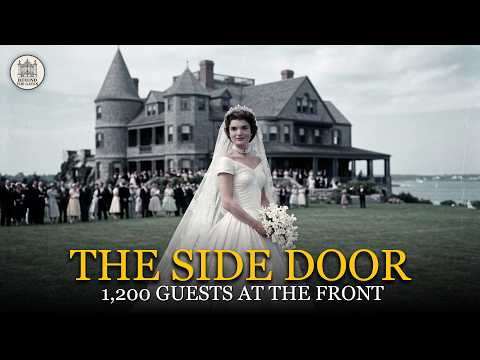
Long before any Newport mansion, a banished man named William Brenton walked to the southern tip of Aquidneck Island and counted his sheep. He didn’t come by choice. In 1637, he was expelled from the Massachusetts Bay Colony as a follower of Anne Hutchinson. Two years later, he settled on 2,000 acres south of the new town of Newport, divided it into two farms, and gave it the name of his English home: Hammersmith. The land was fertile—ocean winds kept the pastures green, and the bay teemed with fish. Brenton raised 11,000 sheep, along with horses and cattle, and died a wealthy man, once governor of the colony. His mansion vanished, but one building from the old farm still stands: a modest, one-and-a-half-story tenant farmer’s cottage built before 1720. Over the next century, it grew with wings and ells, a room here, a kitchen there. The landowner lived elsewhere; the man who knew the land lived here. Children who grew up around it called it “the Castle.”
For more than two centuries, the fields and walls and sheep and cattle remained. Newport rose, fell, and rose again. By the mid-19th century, it had become the summer escape for America’s richest families. One of them was the Auchinclosses, New York dry-goods merchants who first arrived in 1851. In 1887, John Winthrop Auchincloss began building a house on the old Brenton land, high above the bay. He chose architect Robert Henderson Robertson, who built a large, rambling wooden house—28 rooms, three stories, a tall conical tower, deep porches cut into the south side, and a wide carriage entrance. No one knows what it cost. By 1889, it was standing, and it kept its old name: Hammersmith Farm. The name was a deliberate choice. Newport’s rich called their palaces “cottages”—a joke. Hammersmith was the reverse: a grand summer house that called itself a farm. And the difference, as the next century would show, was that Hammersmith wasn’t pretending. It was a working farm, and it stayed one as long as the family owned it.
The first Auchincloss to live there didn’t stay long. In 1897, John sold Hammersmith to his younger brother Hugh, who had retired young from the family firm and married Emma Brewster Jennings, daughter of an original Standard Oil shareholder. When Hugh and Emma moved in, the 28-room house was backed by Gilded Age oil money. In August of that year, a son was born in the house—Hugh Dudley Auchincloss, known as “Hoody.” He grew up summers on the bay, winters in New York. A house like this is not just a house; it’s a set of demands. Fires to light, kitchens to provision, roofs to mend, grass to cut. And because it called itself a farm, it needed more: animals to feed and milk, fields to plow, a stable to maintain, and someone living in the old tenant cottage to do the farming. Emma Auchincloss had ideas about what the land should become. She didn’t want a field; she wanted a garden, the kind the great landscape firms designed for the richest families in the country.
In the fall of 1909, a surveyor walked the fields of Hammersmith with a chain and a notebook, measuring a farm for a garden. His survey survives in the archives of the Olmsted Brothers firm. Between 1909 and 1910, two designers turned part of the old farm into a formal garden. The plans show something strange when read closely: lines drawn from two points on the ground, and at the end of those lines, a note to draw a barn. The era’s finest landscape architects made the farm part of the view. They designed the ground so that a guest standing at those points could see the barns by looking across the land. Another plan shows the road between the house and the stable; another, the steps down to the garden. Together, they paint a picture of two lives side by side: above, the house and its porches; below, the stable and barns and the roads used to take out horses and bring in hay. What they built was a sunken garden below the lawn, with a lily pond, a rock garden, and a long pergola. We know its shape because a woman came in 1917 to photograph it: Frances Benjamin Johnston, whose hand-tinted glass slides are preserved in the Library of Congress. The pergola overlooks the sunken garden; the lily pond is still; the rock garden climbs a slope. In the soft colors of the slides, the garden seems to float above the farm like a dream a rich family paid for.
The house kept its own record, too. In 1930, another set of lantern slides was made of the Hammersmith garden, tinted by artist Edward Van Altena; the archive notes that Mrs. Hugh D. Auchincloss ordered them. Emma had lost her husband by then—Hugh Auchincloss Sr. died in New York in April 1913, at 54—and she seems to have wanted to memorialize her garden. She continued to run the house, the farm, and the garden for nearly 30 more years. She raised three children, and one of them, Esther, later wrote down her memories. Born in 1895, she was the eldest, and shortly before her death in the 1980s, she published “I Remember” in the Newport History journal. The editors noted that the farm is seen through the eyes of a child of about ten, likely around 1905, and that Hammersmith comes alive through those eyes in a way no other record can. Life went on summer after summer through World War I and the Depression. The house pulsed with life each summer as the family came from New York, then closed again when they left. In between, it needed the same services performed by people rarely named in the family papers.
Hoody grew up and left. Groton, Yale, Navy service in World War I, Cambridge, Columbia Law. He joined the government, worked in aviation in the Commerce and State Departments, and in 1931 founded his own brokerage firm in Washington and bought a seat on the New York Stock Exchange for $235,000. He bought an estate in Virginia above the Potomac called Merrywood. He married and divorced, then married and divorced again. Yet he came back every summer to the house where he was born. In the summer of 1942, he returned with a new wife. In September of that year, Emma Brewster Jennings Auchincloss died at her home in Fairfield, Connecticut, at 80. She left an estate of $5 million, divided among her three children. The garden she had paid Olmsted to design and photograph, and commissioned slides of, would pass by 1946, according to one account, to her son born in the house. And with him came a house full of children who were, for the most part, not Auchinclosses at all. One of them was a girl of twelve, about to turn thirteen, who arrived at Hammersmith in June of that year with her mother and younger sister. She loved horses, and in this new family, she sometimes felt like an outsider. Her name was Jacqueline Bouvier. The farm was about to become home, and she was about to make it famous.
Janet Lee Bouvier arrived with two daughters, the elder a month shy of thirteen. She had married Hugh Auchincloss on June 21, 1942, at his Virginia estate. It was her second marriage and his third. Her first husband, John Vernou Bouvier III—known to everyone as Black Jack—had ended in divorce. Hugh’s first wife had been a Russian noblewoman, his second the daughter of a senator. So the family that gathered at Hammersmith that summer was made of three broken families.
The Kennedy Library puts it simply: alongside her younger sister Lee, Jackie had two half-brothers, Yusha and Tommy, and a half-sister, Nina. Yusha, Hugh’s son from his first marriage, was fourteen. Nina and Tommy were small children. In 1945, Hugh and Janet had a daughter they named Janet, and in 1947 a son they named James, known to all as Jamie. That made seven children, and the photo captions in the Newport Historical Society from those years read: Mr. and Mrs. Hugh D. Auchincloss and their seven children summering in Newport at Hammersmith Farm.
Raymond Sinibaldi, the Newport historian who wrote about Jackie’s life in the city, sums it up in one generous sentence: they never considered themselves stepchildren or halves, just brothers and sisters. That was the picture. The feeling inside was more complicated, at least for the girl who had just arrived. The Auchinclosses were old, rich, Protestant, and established; Jackie was Catholic and the daughter of a divorcee, and biographers note she sometimes felt like an outsider in their world.
There was money, too—or rather, the lack of it. Her father was still paying the girls’ expenses, and by one account could barely afford their school fees and a monthly allowance of $50, a paltry sum compared to what the Auchincloss children received. The same account puts it plainly: Jackie was a poor relation. Imagine it from her point of view—a twelve-year-old girl whose parents had separated, brought to a house that was not hers, filled with children who were not hers, on a farm whose name she had to learn.
The house had rooms enough for all of them. By Sinibaldi’s account, her room was on the third floor, with a large window. From there, under the house’s clay-tiled roof, the quiet girl could watch the whole farm at work below. And in 1942, the farm’s work was war. America was at war, and Newport was a Navy town. Hoody himself was promoted to lieutenant in the Naval Reserve in May 1942, a month before his wedding, and spent the war years in naval intelligence and the War Department. As Sinibaldi tells it, the farm went to war with him.
Sinibaldi writes that World War II was raging, and that Jackie threw herself into it as much as a girl of thirteen could. She says her stepfather reopened Hammersmith as a working farm by buying two Guernsey cows. Then comes a detail that seems too perfect to be true, though it is reported as fact. He named them Jacqueline and Caroline. Caroline was the real name of Jackie’s younger sister, Caroline Lee Bouvier, always known as Lee. And so the two new cows in the Hammersmith barn carried the names of the two new girls in the Hammersmith house.
Nor was the farm limited to two cows, by the same account. Ninety acres of green fields returned to producing food supplies, Sinibaldi writes, this time for the U.S. Navy. And Jackie had a role in it. According to his narrative, her task was caring for more than 2,000 Rhode Island Red chickens. Compare these numbers side by side as the sources give them, and a picture of the wartime farm emerges. Two Guernsey cows bearing the names of two sisters. More than 2,000 chickens, by Sinibaldi’s count, on a girl’s list of chores. Ninety acres of fields, as he tells it, planted for the Navy in the harbor below. Seven children in the house above. And a distant father sending $50 a month, by one account, to support his daughters in a world that cost far more.
There is a question in the word “reopened.” A guide to the Hammersmith Farm papers at the Newport Historical Society, covering 1903 to 1960, indicates the farm remained working throughout the Auchincloss ownership. Sinibaldi says it was reopened during the war. Perhaps the two describe the same thing from different angles: a farm that never stopped working, and that returned to full production when the country needed food.
Down the hill, the oldest building on the property was still in use. The tenant farmer’s cottage, built by the Brentons before 1720, became part of the family’s life. According to a magazine photograph of the family’s Newport estate, it was at one time the home of Hoody’s former nurse and her husband. Hoody and his siblings had given the place its grand name, “the Castle,” when they were children. The woman who had raised the master of the house had taken the old farmer’s cottage as her own.
And the war gave the teenage Jackie her own “Newport,” too, and she wrote about it. A 14-page letter written in blue ink on Hammersmith Farm stationery appeared at auction in 2025. She wrote it to her closest friend, a girl named Woodley, who had sailed across the ocean, and she wrote it when she had returned to school and was missing the summer. “I’ve been longing to answer your letter, because it will bring back summer memories, and I miss it terribly,” she wrote. The auction house said she was eighteen when she wrote it. The letter itself suggests she was younger. It mentions her half-brother Yusha still at Groton, which he left to join the Navy in 1945, and her friend in what Jackie calls “wartime England.” Whenever it was written, the summer it describes is a wartime summer.
She wrote once: “We three went sailing, and it was wonderful. There was a picnic where people played the piano and sang old songs and roasted marshmallows on matchsticks. It was really innocent, nice fun for Newport,” she wrote, as if innocent, nice fun were not what Newport usually offered. Then the war entered. She wrote of one party: “There were a great many Navy men, and Mrs. Corbin rushed in,” Jackie recalled, “and said, ‘Jackie, you shouldn’t be here with all these drunks.'” There, in a schoolgirl’s handwriting, lies the strange double life of the place. Above, a girl in a third-floor room writing to her friend about sailing and singing. Below, a farm feeding a fleet and a harbor full of young men far from home.
Hammersmith was a private world, but it was never isolated. The war came through its gate. The girl who fed the chickens was learning something that summer about the house and about herself. She loved it. As Time magazine later reported, she did not want to spend her life there.
She loved it, but she wanted more than Newport. The horses found her first, and by eleven she was winning national championships. In 1940, the New York Times described Jacqueline Bouvier, an eleven-year-old equestrienne from East Hampton, with a double win. The horses were the only part of her old life that came with her intact. At Hammersmith, she rode bareback across the fields with her stepsister.
In 1944, she was at Miss Porter’s, and she told friends, “I know perfectly well that no one is going to marry me, and I’ll end up as housemother at Farmington.” But the house was changing again. In 1945, Hoody called Olmsted back to Hammersmith, thirty-five years after his mother first brought them there. Five thousand cubic yards of earth were moved to reshape the formal garden. The pasture fence remained beside it. Even at its peak, Hammersmith’s garden was bordered by cows.
In the summer of 1947, Jackie was presented to society. A tea dance for 300 at Hammersmith, then a ball at the Clambake Club. The newspapers crowned her Debutante of the Year. It was everything the house had been built for, and she wasn’t sure she wanted any of it.
In the fall, she went to Vassar, then a year in Paris that changed her life. “I loved it more than any year of my life,” she wrote. She returned, as she said, with a love for Europe she feared she would never lose. Looking back, she said, “I didn’t know what I wanted. I was still groping.” Time magazine, telling her story in 1961, put that groping beside one thing she seemed to know: she did not want her life to be in Newport. But she never stopped loving the place.
She wrote to Yusha, her stepbrother and close friend, that she would never know which she loved more—Hammersmith with its green fields and summer winds, or Merrywood, snow-covered, with its river and high hills. Merrywood was the other half of her life, her winter home on the Potomac in McLean, Virginia. A Georgian house with gardens by Beatrix Farrand and a library paneled in black walnut, described by Time in 1961 as rich in taste and culture, with attentive servants and dinners often conducted in French. Between the two estates, she lived a divided year: summers by the sea among chickens and horses, winters in Virginia among books.
She finished her degree at George Washington University in 1951 and that fall took a job at the Washington Times-Herald as a reporter. It was a simple job, but it was her choice. Then came a dinner party at Merrywood in 1951 or 1952, which, by Yusha’s own account, was his idea. The guest was a young congressman from Massachusetts, John F. Kennedy, twelve years older, about to become a senator. By the summer of 1953, they were engaged. The girl who didn’t know what she wanted was going to marry Kennedy, and Hammersmith, that quiet farm overlooking the bay, was about to be asked to host the entire country.
Report this article
Select a reason for reporting:






